Education at The Rep announces Fall Classes

It is August.  The month the Rep is supposed to announce plans for its future.

While no white smoke has emerged from the chimney yet, the Rep’s Education branch did kick off the week with a big announcement.

We will move forward with Fall Classes at The Rep for students ages kindergarten through adult! Be on the lookout for the full schedule, announced very soon.

Thank you for your energy and support. We are thrilled for the opportunity to continue our mission of sharing theatre with Arkansas students of all ages.

This portends a continuation of the Rep and should be harbinger for a positive announcement for future plans.

Stay tuned….

Repertorium Praeter Theatrum

Birth of William E. Ashley in 1823 – first LR Mayor to have been born in LR

On August 6, 1823, future Little Rock Mayor William Eliot Ashley was born in Little Rock.  He would go on to become the first Little Rock Mayor to be born in Little Rock.  Ashley was the son of Mary and Chester Ashley; his father would later serve as a U. S. Senator from Arkansas.  He was the second of the couple’s seven children.

Though he was raised in Little Rock, he did receive some schooling out of state. The State History Commission has correspondence between eleven year old William, studying in New York, and his father. Part of the letter is a request for money.

On October 26, 1846, he married Frances Eliza Grafton at Christ Episcopal Church.  They were the first Little Rock residents to be married in that church.  The couple had five children, including triplets.  Only one of the children, Frances (who was one of the triplets) survived to adulthood.

Ashley was first elected Mayor of Little Rock in 1857. After completing a two year term, he was succeeded by Gordon N. Peay (another scion of a prominent Little Rock family).  In 1861, Ashley returned to the office of Mayor.  He was reelected to a third term in 1863.  In September 1863, following the defeat of Confederate troops by the Union forces at the Battle of Little Rock, the City of Little Rock ceased operations.  On September 21, 1863, Little Rock municipal government closed its doors, stopped collection of taxes and disbanded.  Thus Ashley’s third term ended.

In addition to his interest in local government, Ashley was a member of St. John’s College Board and a director of the newly-formed Little Rock Gas Company.

William Eliot Ashley died on August 16, 1868, at the age of 45.  He was buried in Mount Holly Cemetery (which sat partially on land that had once belonged to his family). His parents, wife and children are all buried in Mt. Holly as well.

Interestingly, for someone who grew up in a prominent family, there does not appear to be a surviving likeness of Mayor Ashley – either in painting or photograph.  Several exist of his parents, but none of him.

1906 verdict scuttles plans for new LR City Hall with Auditorium

The 1906 plans for City Hall with the Municipal Auditorium on the left portion.

Little Rock Mayor Warren E. Lenon had been advocating for a new City Hall a municipal auditorium since shortly after taking office in April 1903. After plans were approved in July 1906, a group of citizens, led by Arkansas Gazette publisher J. N. Heiskell, filed suit to stop the City.

The closing arguments in the trial against plans for a new City Hall and auditorium complex had been heard on Monday, July 30.  The case was heard by Chancery Judge J. C. Hart.  Serving as an advisor to Chancellor Hart throughout the trial (though with no official legal standing) was Pulaski County Circuit Court Judge Robert J. Lea.  To accommodate the expected large attendance, the trial had been moved into his courtroom which was larger than Chancellor Hart’s.

On Friday, August 3, Pulaski County Chancery Judge J. C. Hart issued an injunction to keep the City from signing a contract for the construction of a city hall, jail and auditorium.  Chancellor Hart concurred with the plaintiffs that Arkansas’ constitution and laws dictated all taxation must be for public purposes.  He found there was nothing in Arkansas case law which defined an auditorium to be used for conventions as a public purpose.

As had been the case throughout the trial, the tone of the coverage of the decision differed greatly in the city’s two daily papers.  The subheading in the Democrat noted that the plaintiffs would be liable for any losses to the municipal government’s coffers due to a delay in commencing the construction if Little Rock eventually prevailed.  That fact is not mentioned by the Gazette.  Both papers did make note that Judge Lea agreed with the Chancellor’s decision.

For now, it looked as if the City of Little Rock would be stuck in the 1867 City Hall on Markham between Main and Louisiana.  Mr. Heiskell and his compatriots waited to see if the City would appeal the decision.

While August would be a quiet month publicly, work would go on behind the scenes.  More on that, in the future.

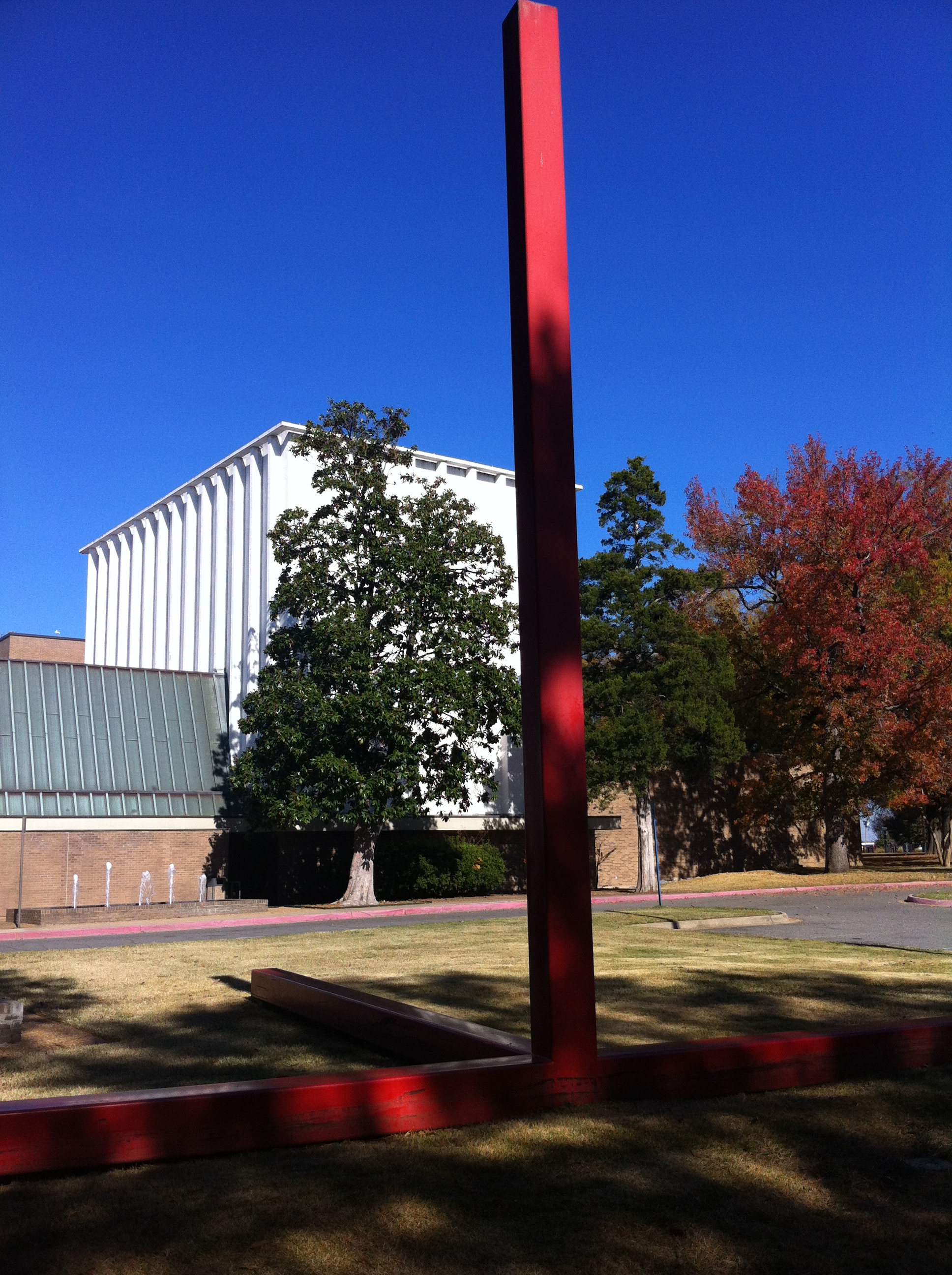
Birth of sculptor Tal Streeter who has a piece in MacArthur Park as part of Arkansas Arts Center collection

On August 1, 1934, Tal Streeter was born in Oklahoma City.  After graduating from the University of Kansas, he worked as a sculptor and artist.  He died in 2014.

In 1970, Streeter and the Arkansas Arts Center Board of Trustees donated Streeter’s sculpture Standing Red in honor of Jeannette Edris Rockefeller.  Mrs. Rockefeller had been a champion of the Arkansas Arts Center and had served as longtime chair of the Board.  She had also been instrumental in the recruitment and hiring of Townsend Wolfe who would be the longtime director of the Arkansas Arts Center.

Streeter’s sculpture stands 27 feet tall and is 54 feet from one end to another.  It consists of a T-shaped base and a perpendicular pedestal.  It is in the Minimalist style of art.  In creating it, Streeter focused on the placement of a thin red line into a setting.  It was placed near the then-entrance of the Arkansas Arts Center (which still serves as the entrance for the Museum School and Children’s Theatre).

This was one of the earliest pieces of abstract art in Little Rock.  A silkscreen by Streeter is also in the Arkansas Arts Center collection.