
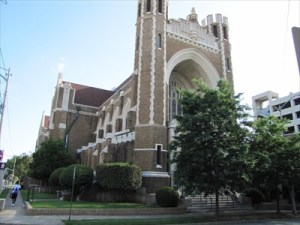
Little Rock Look Back: 190 Years of 1st Presbyterian Church

This weekend, Little Rock’s First Presbyterian Church will celebrate 190 years.

The Sunday service will feature a Scottish Bagpiper, special music, and historical readings to recognize the church’s history. The message will be delivered by Reverend Stewart Smith, General Presbyter of the Presbytery of Arkansas.

The church was organized in July 1828. It is the oldest continuously serving Presbyterian church west of the Mississippi River.  Not only that, it appears to be the oldest, continuously serving church of any denomination in Little Rock.  It predated the establishment of Catholic (1830), Methodist (1833) and Episcopal (1839) churches in the city.

Little Rock’s first Presbyterian congregation was organized in July 1828. Reverend James Wilson Moore had been commissioned by the Northumberland Presbytery of Pennsylvania as a Presbyterian Missionary to the Territory of Arkansas.

Prior to the formal establishment  of the church, Rev. Moore preached his first sermon in Little Rock on  January 28, 1828. It took place in Jesse Brown’s schoolhouse (Little Rock’s first school) which was at the foot of Rock Street.

When the church was established, it had seven members: two men and five women.  From 1828 until 1833, it met in a variety of temporary locations.

The congregation’s first permanent structure was at the southeast corner of Second and Main (where the Main Street Parking Deck is sited). In 1853, it moved to land on Markham between Cumberland and Rock.  Following an 1866 fire which destroyed the church and several other buildings, the church made plans to move.  In 1869, the congregation moved to three lots at the northwest corner of Capitol Avenue and Scott Streets. This brick sanctuary with a steeple was the first church built in Little Rock after the Civil War.

By 1909, the church was outgrowing the building. There was discussion as to whether the building should be expanded or a new building built elsewhere. Due to the increase in the property value in the existing site, the decision was made to move.  In 1913, property at the southwest corner of 8th and Scott Streets was purchased.  Construction began first on an education building (with a temporary auditorium). That building opened in 1914.

In May 1920, ground was broken for a new sanctuary building; the cornerstone was laid on November 7, 1920.  The first worship service in the sanctuary took place on October 2, 1921.

A disastrous four-alarm fire gutted the sanctuary in May 1958, causing thousands of dollars damage of the chancel and the organ. The sanctuary was restored for worship services within nine months.

A Sesquicentennial Anniversary celebration marking the 150 years of First Presbyterian Church history was held in the summer of 1978. Governor David Pryor (Governor of Arkansas and shortly U. S. Senator-elect) was principal speaker at worship services.

The building was listed on the National Register of Historic Places in 1986.

31 Days of Arkansas Rep: PETER PAN in 1994

Peter Pan flew into the window of the Darling’s nursery in December 1994 on the Arkansas Rep stage.  With a cast of thirty-six, Peter Pan was one of the Rep’s larger productions.
Directed by Brad Mooy, the production featured Steve Wilkerson in the title role. It gained some national press attention, because the role is usually played by women, so Wilkerson’s casting was a bit of a novelty.

Others in the cast were Ed Romanoff, Angie Ohren, Dustin Alford, Matthew Block, Peggy Billo, Tanya Duggar, Gary Taggart, Angie Foresman, and Linda Sue Sanders. The Lost Boys were played by Adam Napper, Bernie Baskin, James Knight, Brian Jones, Kale Ludwig, and Kyle Ludwig.

The pirates were played by Mark Hansen, Joel Gordon, Derek Reid, Shannon E. Farmer, Tony D. Owens Jr., DeJon Mayes, Kenneth Elins, Matt Patton, Eric Harrison and Tom Kagy. Taking on the roles of the indians were Suzan Hart, Rusty Miller, Mikel Brown, Ryan Martine, Patrick McNally, Christina Boatwright, Leslie Goodwin, Tori Petrus and Dennis Glasscock.

Glasscock was the production’s choreographer. Flying for Pan and others was created by Foy, the same firm which was responsible for Mary Martin’s flying in the role on Broadway in 1954. Hans Stiritz was the musical director, Mike Nichols was set designer, and Don Bolinger provided costume design.

The production was so successful, it was nearly sold out before it opened.  Two years later, the Rep reprised it.  There were some different design elements as well as a largely different cast. Wilkerson returned as did Ohren, Dugger, Gordon, Knight, Napper, Alford,  Petrus, and Kagy.

Little Rock Look Back: Installation of Chapel’s THE CENTER

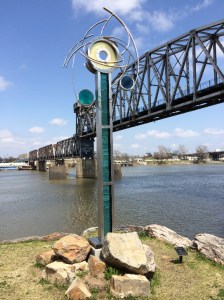
On October 19, 2012, the first winner of the Sculpture at the River Market public monument sculpture competition was dedicated.

Selected at the 2011 Sculpture at the River Market Show and Sale, Chapel’s THE CENTER is located to the west of the Junction Bridge in Riverfront Park.  It stands fifteen feet and is composed of glass, stainless steel and bronze.

According to Chapel:

The theme of The Center is a coalescence around a strong core.  Historically the Arkansas River was one of the mainstays of Little Rock’s economy.  Recently, the River has taken on a new life as a cultural and arts center through the various sculpture parks and amphitheater along its banks.


All of the disparate themes of life here are represented by the complex structure of gathering arcs.  These highly finished arcs reflect all the colors of the surrounding environment while the transparent central glass column refracts the changing light.  The shape itself will cast a fascinating shadow providing a constantly changing and adapting sculpture.

31 Days of Arkansas Rep: Charles Portis’ DELRAY’S NEW MOON in 1996

When you’ve written one of the great American novels of the second half of the 20th Century and seen it turned into an Oscar winning movie, what do you do next?  You continue writing.
And if you are Charles Portis, you decide in the 1990s to try your hand at a play.  So in 1996, the Arkansas Rep offered a staged reading of Portis’ play Delray’s New Moon. 

Directed by Rep Artistic Director Cliff Baker, it was set in a honky tonk hotel halfway between Little Rock and Texarkana. Most of the people there are senior citizens awaiting their next location whether it be a nursing home or a relative’s house.

The cast featured Scott Edmonds played a father being shuffled each month between his daughters played by Judy Trice and Natalie Canerday.  Others in the cast included Danielle Rosenthal, Jean Lind, John Stiritz, Michael Davis, Graham Gordy, Stacy Breeding, Angel Bailey, Rhonda Atwood and Tom Kagy.

The production ran from April 18 to 28.  The normally reclusive Portis participated in talkback sessions following performances.

30 Years of the City of Little Rock Flag

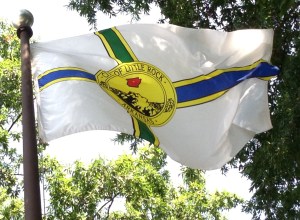
On October 18, 1988, the City of Little Rock Board of Directors adopted the first official flag for the City of Little Rock.

The adoption of Ordinance No. 15,566 was the culmination of a design competition which had been spearheaded by Little Rock City Director Sharon Priest (later Little Rock Mayor, Arkansas Secretary of State and Executive Director of the Downtown Little Rock Partnership).

Prior to the Official Board of Directors meeting that day, a press conference was held in the Little Rock City Board Chambers for presentation of the City’s flag.  The City Beautiful Commission, a commission of the Department of  Parks and Recreation, sponsored a the contest which received a total of fifteen flag designs.

The flags were judged October 12, 1988, by City Directors and City Beautiful Commission Members. Director Sharon Priest presented the winning flag and introduced David Wilson, a law clerk at the Mitchell Law Firm, who designed the flag chosen for the $1,000 first prize. The second-place winner was Craig Rains, who received $500; and the third-place recipient was David Tullis, who received $250.

The flag was adopted by the City Board that night by a 6-0 vote; former mayor and current director Charles Bussey was absent.  Those voting to adopt the flag were Mayor Lottie Shackelford and directors Sharon Priest, Tom Prince, Buddy Villines, Buddy Benafield and Tom Milton.  Priest would be a future mayor while Prince, Villines and Benafield had all served as mayor.

The official description of the flag is as follows:

As the official flag of the City of Little Rock, its symbolism is described as follows: A clean white background of the banner represents the optimism and open potential that the city has to offer. The royal blue horizontal broad stripe symbolizes the Arkansas River which borders Little Rock, and has served as an economical and historical emblem since the city’s beginning. The forest green stripe runs vertical to the royal blue stripe, creating a cross which symbolizes the location and statute of Little Rock—a city serving not only as the crossroads of Arkansas, but a crossroad of the mid-southern United States as well.

The strong forest green color depicts the fields, parks and forests which contribute to the natural beauty of the city. The seal of the flag is a modernized adaptation of the current Little Rock seal. The razorback red silhouette of the great State of Arkansas shows her capitol, the City of Little Rock, represented by the centered star. The star rises directly above “The Little Rock”—the protruding cliff along the Arkansas River, which was discovered in 1722 by French explorer La Harpe, when the city was given the name. The Arkansas River behind the rock and the symmetrical oak leaves in the border of the seal are a stylized illustration of what the flag’s stripes represent—the natural beauty of the city. Finally, the gold color of the seal and bordering stripes symbolize the superior economic history, and the future economic potential that is available in the City of Little Rock, Arkansas.

Little Rock Look Back: Little Rock named Capital of Arkansas

On October 18, 1820, Territorial Governor James Miller signed legislation designating Little Rock as the new capital for Arkansas.  This was a mere 10 months after the first permanent settlement was established in Little Rock.

While Little Rock became the Capital, technically it was not the Capital City, since it would not be incorporated as a City until 1835. It wasn’t even incorporated as a town until 1831.

The Act provided that after June 1, 1821, the sessions of the Legislature and the Superior Court would be held at Little Rock.  This caused Arkansas Post, the first territorial capital, to fade from prominence.

The move was made based on the lobbying of Amos Wheeler, Chester Ashley and William Russell.  These men all owned land in the Little Rock area and would benefit from the move of the Capital to Little Rock. The official reason given was Little Rock’s geographical center to the Arkansas Territory and that it was elevated land less prone to flooding.

But just as important, Messrs. Wheeler, Ashley and Russell promised to donate land for a capitol building and a guarantee of $20,000 for construction of a suitable building. (That would be the equivalent of $432,000 today.)

Around the time the legislation was approved, several members of the Territorial legislature purchased land around Little Rock.  When a subsequent effort to relocate the Capital upstream was launched, it failed due to the financial ties of these legislators to land in Little Rock.

31 Days of Arkansas Rep: ANGELS IN AMERICA (1996 and 1997)

In 1996, the Arkansas Rep presented Tony Kushner’s Angels in America: Millennium Approaches.  It was one of seven professional theatres granted the rights to do the show that season.  The production ran from February 29 to March 17 of that year.

Directed by Brad Mooy, the production came about due to lobbying of the Broadway producers by Rep Artistic Director Cliff Baker.  There was skepticism in New York as to how Little Rock audiences would respond. And, to be honest, there was skepticism in Little Rock, too.  But the rights were granted, and Little Rock embraced the play.

The next season, the Rep brought Part I back to be joined by Part II for the opportunity experience a theatrical marathon.  The Rep’s production was unprecedented in Little Rock. It was not just a rarity for the Rep, such an undertaking had never been done by any theatre in town.

Directed by Brad Mooy, the 1997 dual production required five weeks of rehearsals (more than the usual amount).  Six of the eight actors from the 1996 production returned for the second go around.

As it had been in 1996, the cast was led by Rep favorite Steve Wilkerson. Others in the cast were Caitlin Hart, Jo Anne Robinson, Jonathan Lamer, Jonna McElrath and Ray Ford. The two new additions were Christopher Swan and Ken Kramer.  They played the roles which Barry Stewart Mann and Fred Baker had played the prior year.

The design team included Mike Nichols (sets), Don Bolinger (costumes), David Neville (lighting), Melissa Wakefield (properties), Rob Milburn (sound), and ZFX Inc. (flying).