
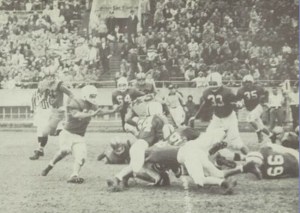
Little Rock Look Back: In first day without 101st Airborne, LR Central plays final Thanksgiving game against NLR

Central dominating NLR in 1957

Central dominating NLR in 1957

The November 28, 1957, football game between Little Rock Central and North Little Rock had been poised to be memorable for a few years.

With the 1957 opening of Little Rock Hall High, the Tigers would switch their rivalry on Thanksgiving Day from a cross-river one to a cross-town one starting in 1958.  So the 1957 edition of Tigers vs. Wildcats was set to be historic as the end of a 24 year tradition.

(In its first year, Hall played smaller schools because its team was largely younger.  It would move up to top classification schools in the 1958 season.)

The events at Little Rock Central in September 1957 added a new layer of history to everything that school year.  The 101st Airborne was sent in by President Eisenhower in the evening of September 24 to ensure the Little Rock Nine were able to attend classes.  But President Eisenhower did not intend the Army to be there indefinitely.  On Wednesday, November 27, the soldiers left Little Rock. The National Guard was now charged with keeping the peace at Central.

The first day without the US Army was also Thanksgiving Day, and the final Bengals vs. Cats game.  The sports coverage of this game however belied all the drama off the field. News reports focused on Turkey Day as the final game between the longtime rivals and on the fact that it had a morning start time instead of the traditional afternoon start time.

In the end, the Tigers had the same result as they did in the first Turkey Day meeting: a win.  The Bengals scored 40 while the Cats only managed 7.

After 24 meetings on Thanksgiving Day, Little Rock had 19 wins, 4 losses, and one tie.  Seven times they shut out the Wildcats, and one time the northern team blanked them.  The fewest total points scored were 2 in the 1934 game, while the 1950 game produced a cumulative total of 71 points (LR 64, NLR 7).  The Tigers scored a total of 517 points over 24 games and gave up only 203.

Little Rock Look Back: 60 years ago today – the inaugural Central vs. Hall Thanksgiving Football Game

A Central vs. Hall Thanksgiving Day game (though not from 1958)

On November 27, 1958, the Central High Tigers and Hall High Warriors faced off for the first time in a Thanksgiving Day football game.

Playing on Thanksgiving had been a Central High tradition since 1914. But for Hall High, in only its second year, this was a new occurrence.  The Tiger-Warrior faceoff on Thanksgiving would be a 25 year tradition.

The games were always played at Quigley Stadium, which was at the time the home stadium for all of the Little Rock School District’s high schools (the third high school Parkview opened in 1968).  Each year Central and Hall would alternate which was the “Home” team.

The week leading to the game would feature skits and pep rallies at both high schools.  Pranks, rumors of pranks, and threats of retribution would abound between the schools.  Cars wrapped in orange and white would circle the Central campus one day, while black and gold cars would encircle Hall’s campus another day.

On game day there would be special performances at the stadium by the drill teams, cheerleaders and bands of both schools.  The Tiger and Warrior mascots would taunt each other.  Friendships between students at the rival schools were put on hold.  It was all about the tradition and THE GAME.  Church services, family dinners and any other activities were scheduled around the festivities at Quigley.

Hall High opened its doors and started playing football in 1957. As a new school with a largely younger student body, it only played smaller schools that initial season.  The first Hall vs. Central game was set for Thanksgiving 1958.

During the 1958-1959 school year, Little Rock’s high schools were closed for the ill-conceived, ill-advised reason to keep them from being integrated schools.  Though classes were not in session, football teams practiced and played.  The Arkansas Gazette noted that most of those games that season drew only 1,000 spectators, which was down from the usual 5,000 to 8,000 a game.

With the future of Little Rock’s high schools in doubt, there was some hand wringing about whether the 1958 game would be not only the first meeting between Hall and Central, but perhaps also the last.  In only its second year of playing, Hall was undefeated and poised to win the state championship heading into the Thanksgiving game.

Central surprised the Warriors by winning 7-0 before a crowd of 5,000, which cost Hall the undefeated season and the championship (El Dorado became state champs).  This game set the tone for the high stakes of the rest of the series.

The next year classes were back in session at Hall and Central. The future of the series was not in doubt.

Little Rock Look Back: Mayoral Race of 1930

KNOWLTON

In the early 20th century, Little Rock mayors were traditionally granted a second two-year term, if they wanted them. So, 30 year old Mayor Pat Robinson may have been surprised when City Clerk Horace A. Knowlton Jr., announced his challenge for the Democratic primary in 1930.

Robinson had been the rising star of the Democratic Party in Little Rock. At the age of 25, he was nominated for the position of City Attorney and elected at 26 to the position. Two years later, he was re-elected. Then, a few months into his second term, he ran for the position of mayor. In the primary, he defeated the incumbent, an alderman and a school board member.  Taking office a few days after turning 29, Robinson was one of Little Rock’s youngest mayors ever.

However, shortly after taking office, Robinson butted heads with the majority of the City Council over a special election. And his term was marked with continual political strife.

In 1929 and 1930, Little Rock was recovering from the 1927 flood and the 1929 stock market crash. Yet Robinson appeared to be trying to spend the city out of the doldrums and driving up the city’s debt.

Knowlton was elected City Clerk in 1921 and had been re-elected in 1923, 1925, 1927, and 1929. He was viewed as an efficient politico and a stalwart member of the party.

The City’s financial state was the main thrust of Knowlton’s campaign against Robinson.  The phrase “orgy of spending” appeared in an ad. The incumbent countered with the progress of the City.

A third candidate, Bob Brown, was not a factor in the race.

November 10, 1930, dawned. It was the local Democratic primary day. Since the GOP was virtually non-existent, the winner of the nomination would be the ultimate winner in April 1931.

Anyone thinking the nasty election would be over soon was in for a surprise.

When the results came in, the tallies were: Horace A. Knowlton, 4,537; Pat L. Robinson, 4,554; Bob Brown. 61. It appeared that Robinson had eked out a 17 vote victory.  On November 12, the Pulaski County Democratic Committee certified the results.

Three days later, Knowlton filed suit in circuit court claiming that a variety of illegal votes had been cast for Robinson.  A few days later, Robinson alleged that illegal votes had been cast for Knowlton.

The case was extensive. The transcript of the trial runs over 1,800 pages.  The judge reviewed the more than 9,000 ballots cast and compared them to voter rolls and poll tax lists.  Ultimately, he found that Knowlton had received ten more votes than Robinson and declared that Knowlton was the nominee.

Knowlton’s name was placed on the ballot in April and he was elected, taking office later that month.

However, Robinson had appealed the circuit court ruling to the Arkansas Supreme Court.  In June 1921, the Court upheld the lower court ruling and affirmed that Knowlton was indeed the duly elected mayor of Little Rock.

Thanksgiving Football 1969 in Little Rock: Hogs, Tigers, Warriors, Bearcats and Rockets

The Hogs stop Texas Tech at War Memorial Stadium

On Thanksgiving 1969 (November 27), four Little Rock high schools AND the University of Arkansas all played football games in Central Arkansas.  It was a day for football in the Rock!

It appears this was the only time this feat has happened.

It was a cool and misty day which seems to have made balls slippery and grass fields sloppy. But the precipitation seemed to be more an annoyance than a barrier for the players and fans.

The Arkansas Razorbacks, ranked Number 2 in the nation, played host to the Texas Tech Red Raiders at War Memorial Stadium.  The two teams played before a crowd of 35,287.  This was the smallest crowd in LR that season, likely due to it being Thanksgiving and the presence of the Central/Hall football game the same day.  It would have been hard to fit in two football games, Thanksgiving meals, and a possible church service all within one day.

The Hogs were 16 point favorites for the game with a 1:50 kickoff.  It was broadcast on ABC, and fans were encouraged to wear red to show up well on the color telecast.

The Hogs beat the Red Raiders by a score of 33 to 0 in their penultimate regular season game.  Turnovers were the key with the Hogs recovering a fumble and intercepting five passes.

This game set the stage for the final Hogs regular season game, which was the December 6, 1969, shootout against the Number 1 Texas Longhorns in Fayetteville.

Earlier in the day, Little Rock Catholic took on NLRHS north of the river with a 10am kick off. The Rockets, under head coach George Loss, were 9-2 heading into the game. The Wildcats (coached by Ken Stephens) were 5-4 and had won four in a row. At the end of the game, NLR was triumphant by a score of 21 to 12.

Later that day, Jones High hosted Horace Mann at the same stadium. This game, with a 2pm kickoff, would be the final game between Jones and Mann. Jones was being closed at the end of the year.

The teams had met earlier in the season with Mann triumphing 13 to 8. Mann had a record of 2-8, playing in the larger AAAA classification. Jones, with a record of 4-6, played in the AA classification. For years these all African American schools were not allowed to play in the Arkansas Activities Association. But by the late 1960s, they were now playing in AAA conferences.

Jones scored an upset victory over the Bearcats by a score of 19-8.

Quigley Stadium was less than three miles from War Memorial Stadium. With a 10am kickoff before a sold out crowd, people who had wanted to go to both the Hogs game and Hall/Central game also had the option of listening to the high school gridiron competition on KARK radio (now KARN).

Prior to the game, Hall had captured the AAAA State Championship by virtue of its record. (The top classification did not participate in playoffs until 1983.) C. W. Keopple was the Warriors’ coach, while Gene Hall was the Tigers’ mentor.  The damp field and high stakes of the game turned it into a defensive slugfest.  Hall had 2 fumbles while Central fumbled four times.

At the end of the fourth quarter the scoreboard showed a 0 to 0 tie. And that one went into the record books.  Hall’s season record was 9-0-1, while Central’s was 6-2-2.  It was the best season record Hall had amassed in its 13 years of football.

Four football games within a few miles of each other were a peek into Little Rock life:

  • The Hogs were riding the crest of their 1960s football superiority in the Southwest Conference.
  • The final Thanksgiving football game in Arkansas between two segregated public schools.
  • Continued alternating dominance by Hall and Central in the state’s largest school sports classification.  Soon, Parkview would be added to the mix. Throughout the 1970s, all three Little Rock public high schools would rotate winning state championships.

Happy Birthday to Hall High and Arkansas Arts Center alum, award winning actor Daniel Davis

On November 26, 1945, future actor Daniel Davis was born in Gurdon.  As a child, his family moved to Little Rock where his parents ran a movie theatre.  As a child, he appeared on “Betty’s Little Rascals” local TV show with Betty Fowler.
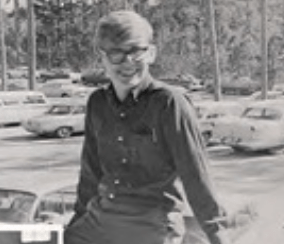
While a student at Hall High, Davis had the lead as Horace Vandergelder in The Matchmaker (which would soon be musicalized on Broadway in Hello, Dolly!), appeared in Judgment at Nuremburg, sang in the Hallmarks (concert choir), and was a Harlequin Player (drama club). He was also on the staff of the Warrior (yearbook), War Whoop (newspaper), and Inkwell (literary magazine). His fellow members of the class of 1963 voted him the Wittiest boy in the class.

Davis at Hall in 1963

After graduating from Hall, Davis remained in Little Rock and enrolled in the new Arkansas Arts Center school of Art and Drama, a degree granting program.  While there, he appeared in numerous plays.  One of them was The Persecution and Assassination of Jean-Paul Marat as Performed by the Inmates of the Asylum of Charenton under the Direction of the Marquis de Sade.  National theatre critic Henry Hewes of the Saturday Review came to Little Rock to review the production, which was presented a year after the play had won a Tony for Best Play.  Hewes actually liked the Little Rock production better.

After completing studies at the Arts Center, Davis worked with the Oregon Shakespeare Festival, American National Theatre Academy, Stratford Festival, and American Conservatory Theatre. He also started appearing in television, including a stint in the soap “Texas” and guest starring in many TV series. In 1993, he started a six year, 145 episode run as Niles the butler in “The Nanny.”  His British accent on the show caused many in the public to think he was from England instead of Arkansas.

Davis has continued to act frequently on stage.  In 1969, he made his Broadway debut as the Dauphin in Henry V followed by an appearance in Othello.  He was a replacement as Salieri in the original production of Amadeus.   In 2003, he received an Obie Award for his appearance in Alan Bennett’s Talking Heads.  Three years earlier he was nominated for a Tony for his appearance in Wrong Mountain.  Other recent Broadway appearances include The Invention of Love, The Frogs, La Cage aux Folles and Noises Off.

Little Rock Look Back: Final Thanksgiving Day High School football game in Arkansas

Since the early 1960s, the Arkansas Activities Association had been discouraging the playing of games on Thanksgiving Day.  With the advent of state playoffs, these Thanksgiving games were an interruption. By 1982, only one such rivalry still existed. The Little Rock Central vs. Little Rock Hall game.  Both schools were in the largest classification (5A) which did not have playoffs.

With the changes of state athletic conference classification, the 1982 game was announced as the final Thanksgiving Day game between Hall and Central. The top two classifications were being combined which would necessitate conferences and playoffs to determine the state champion. This would mean that Hall and Central would need to meet before Thanksgiving.  Going into the game Hall led the series with 13 wins to Central’s 8 wins.

The 1982 edition lived up to the hype.  Played on November 25, 1982, this was the 25th edition of the Hall and Central rivalry. While there was no doubt that Hall would end up with the most wins, Central wanted to make sure that they ended it in the way they started it in 1958 – with a win.

Central boasted a 4-1 record. Pine Bluff and LR Parkview were both 4-1-1. Hall was 3-0-2. As long as Central or Hall won outright, the winner would be state champ. A tie (and there had been three previous ones) would result in a four-way tie for first place.  Hall’s coach C. W. Keopple had led the team since 1964 and amassed a 10-6-1 record against Central.  The Tigers were mentored by Bernie Cox who was 4-3 against the Warriors since taking over in 1975.

Nearly 9,000 fans packed Quigley Stadium for a cold but dry day. As the buzzer sounded after four quarters, the Hall High Warriors were jubilant. They had won the game 14-3 after putting together a nearly flawless offensive effort. The win moved them into first place with a 4-0-2 record. Central, which had sat atop the conference most of the season, ended up in fourth place with a 4-2 record.  The defeat also ended the Tiger’s hopes for a third consecutive championship.  This game, like so many before it, provided high drama and excitement as it confounded some pundits yet also lived up to billing.

And with that, the series concluded.  In the end, Hall had fourteen wins while Central had eight.  There were also three hard-fought ties.  Central achieved four shutouts of Hall, while the Warriors blanked the Tigers three times.  In the twenty-five games, Central scored 228 points, and Hall scored 297 points.

From 1983 until 2005, Hall and Central continued to play each other in football. This time, they played for the ceremonial bell in what became known as “The Battle for the Bell.”  Today, the bell is proudly displayed at Quigley Stadium.  After 2005, Hall moved into a lower classification than Central. This put them on separate trajectories facing different sets of teams.

Little Rock Look Back: C. P. Bertrand

On November 23, 1808, future Mayor Charles P. Bertrand was born in New York.  He was the son of Pierre and Eliza Wilson Bertrand; his father died in 1809 in an uprising in Haiti and his mother eventually remarried.  With her new husband, Dr. Matthew Cunningham, she and the family moved to Little Rock in 1820.

After apprenticing with family friend William Woodruff at the Arkansas Gazette, Bertrand opened the Arkansas Advocate newspaper.  He later studied law under Robert Crittenden and entered the legal profession.

In 1835-1836, he served as State Treasurer for the Arkansas Territory, and in 1836 as secretary for the first constitutional convention. He was a member of the Arkansas House of Representatives from 1840-1841 and 1844-1849.

Bertrand followed in his stepfather’s footsteps and became Mayor of Little Rock.  (Dr. Cunningham had been the first Little Rock Mayor in 1831.)  He was in office from January 1855 through January 1857, serving two one-year terms.  He later served on the City Council and filled in as acting mayor. (Another influence on his upbringing was studying under future Mayor Jesse Brown who taught at the first school in Little Rock.)

Bertrand, as acting mayor, was involved in the negotiations of the surrender of Little Rock to federal troops in 1863.  He also later corresponded with President Lincoln on behalf of Little Rock citizens

.

Though a staunch Confederate, his good will toward the Union soldiers and federal officials is credited with helping to save Little Rock from the destruction which befell many other Southern cities.  He is also credited with delaying the start of the Civil War.

Prior to the attack on Fort Sumner, members of the Arkansas Militia were planning to attack the Federal Arsenal at Little Rock during the absence of Governor Rector.  This would have been viewed as an act of war.  Bertrand was able to dissuade them from the attack.  Had he been unsuccessful, the Civil War would have likely started in Arkansas instead of South Carolina.

He had put his considerable fortune into Confederate money during the war. At the Civil War’s conclusion, the family was financially ruined. Though they had vast land holdings, those would be sold off in parcels to pay for taxes.

Bertrand died August 27, 1865, shortly after the conclusion of the Civil War.  He, like his mother, step-father, and several other relatives, is buried in Mt. Holly Cemetery.