
Birthday of Hall High and Ark Arts Center alum Daniel Davis

On November 26, 1945, future actor Daniel Davis was born in Gurdon.  As a child, his family moved to Little Rock where his parents ran a movie theatre.  As a child, he appeared on “Betty’s Little Rascals” local TV show with Betty Fowler.

While a student at Hall High, Davis had the lead as Horace Vandergelder in The Matchmaker (which would soon be musicalized on Broadway in Hello, Dolly!), appeared in Judgment at Nuremburg, sang in the Hallmarks (concert choir), and was a Harlequin Player (drama club). He was also on the staff of the Warrior (yearbook), War Whoop (newspaper), and Inkwell (literary magazine). His fellow members of the class of 1963 voted him the Wittiest boy in the class.
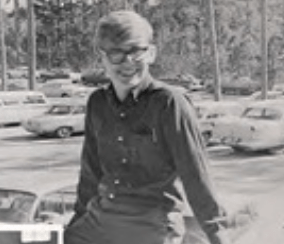
Davis at Hall in 1963

After graduating from Hall, Davis remained in Little Rock and enrolled in the new Arkansas Arts Center school of Art and Drama, a degree granting program.  While there, he appeared in numerous plays.

One of them was The Persecution and Assassination of Jean-Paul Marat as Performed by the Inmates of the Asylum of Charenton under the Direction of the Marquis de Sade.  National theatre critic Henry Hewes of the Saturday Review came to Little Rock to review the production, which was presented a year after the play had won a Tony for Best Play.  Hewes actually liked the Little Rock production better.

After completing studies at the Arts Center, Davis worked with the Oregon Shakespeare Festival, American National Theatre Academy, Stratford Festival, and American Conservatory Theatre. He also started appearing in television, including a stint in the soap “Texas” and guest starring in many TV series. In 1993, he started a six year, 145 episode run as Niles the butler in “The Nanny.”  His British accent on the show caused many in the public to think he was from England instead of Arkansas.

Davis has continued to act frequently on stage.  In 1969, he made his Broadway debut as the Dauphin in Henry V followed by an appearance in Othello.  He was a replacement as Salieri in the original production of Amadeus.   In 2003, he received an Obie Award for his appearance in Alan Bennett’s Talking Heads.  Three years earlier he was nominated for a Tony for his appearance in Wrong Mountain.  Other recent Broadway appearances include The Invention of Love, The Frogs, La Cage aux Folles and Noises Off.

Paint with the Animals of the Museum of Discovery today from 2pm to 4pm

Some of the animals living at Museum of Discovery have recently taken up painting as an enrichment activity.  Soon, their paintings will be available for purchase in our Explore Store.  But because watching the animals painting is just as fun as owning one of their masterpieces, they are hosting a painting party for our guests!

During the party you will watch a variety of our animals paint (using a non-toxic tempera paint) and be able to collaborate with them by painting yourself by using objects such as feathers, snake skins and more! You will also be able to take a collaborative art piece home!

All children must be accompanied with an adult.  Tickets to this event must be purchased in advance.  Tickets are $5 for adult and children Museum of Discovery members and $15 for adult non-members and $13 for children non-members (this includes the cost of museum admission.)  Museum members must show proof of membership at the door.

Birth of Little Rock’s 46th Mayor – Horace Knowlton – on Nov. 25, 1872

On November 25, 1872, future Little Rock Mayor Horace A. Knowlton Jr. was born.

In April 1920, he was elected City Clerk of Little Rock.  He served in that position until April 1931.  That year, he was chosen as the Democratic nominee for Mayor, denying incumbent Mayor Pat L. Robinson a second term.

The primary race against Mayor Robinson was close.  When the results were first announced, it looked as if Mayor Robinson had prevailed.  But after challenging ballots, Mr. Knowlton was declared the winner.  Since Little Rock was primarily a Democratic Party city, unsurprisingly Mr. Knowlton was elected Mayor in April 1931 and served two terms as Mayor.

He oversaw the start of some of President Roosevelt’s New Deal programs in Arkansas during his tenure.  In 1934, he negotiated the purchase of Gillam Park for the City which established the first public park in Little Rock for African Americans.  While a segregated park would today be wrong, in the 1930s he was viewed as very progressive for providing a public park for African Americans.  One of his final acts as Mayor was to participate in the groundbreaking for the Museum of Fine Arts building in City Park (now a portion of the Arkansas Arts Center building in MacArthur Park).

Following his departure from public office, Mayor Knowlton and his wife (who had been an elementary school teacher) eventually moved to Florida and resided in the Tampa Bay area.  His son and grandson (Horace III and Horace IV) have both been lawyers in the Tampa Bay area.  Mayor Knowlton died on February 14, 1965.  He is buried in the Oak Grove cemetery in Conway.

Thanksgiving Look Back: Central and Hall face off in final Thanksgiving Day Football Game in Arkansas

Since the early 1960s, the Arkansas Activities Association had been discouraging the playing of games on Thanksgiving Day.  With the advent of state playoffs, these Thanksgiving games were an interruption.

By 1982, only one such rivalry still existed. The Little Rock Central vs. Little Rock Hall game.  Both schools were in the largest classification (5A) which did not have playoffs.

With the changes of state athletic conference classification, the 1982 game was announced as the final Thanksgiving Day game between Hall and Central. The top two classifications were being combined which would necessitate conferences and playoffs to determine the state champion. This would mean that Hall and Central would need to meet before Thanksgiving.  Going into the game Hall led the series with 13 wins to Central’s 8 wins.

The 1982 edition lived up to the hype.  Played on November 25, 1982, this was the 25th edition of the Hall and Central rivalry. While there was no doubt that Hall would end up with the most wins, Central wanted to make sure that they ended it in the way they started it in 1958 – with a win.

Central boasted a 4-1 record. Pine Bluff and LR Parkview were both 4-1-1. Hall was 3-0-2. As long as Central or Hall won outright, the winner would be state champ. A tie (and there had been three previous ones) would result in a four-way tie for first place.  Hall’s coach C. W. Keopple had led the team since 1964 and amassed a 10-6-1 record against Central.  The Tigers were mentored by Bernie Cox who was 4-3 against the Warriors since taking over in 1975.

Nearly 9,000 fans packed Quigley Stadium for a cold but dry day. As the buzzer sounded after four quarters, the Hall High Warriors were jubilant. They had won the game 14-3 after putting together a nearly flawless offensive effort. The win moved them into first place with a 4-0-2 record. Central, which had sat atop the conference most of the season, ended up in fourth place with a 4-2 record.  The defeat also ended the Tiger’s hopes for a third consecutive championship.  This game, like so many before it, provided high drama and excitement as it confounded some pundits yet also lived up to billing.

And with that, the series concluded.  In the end, Hall had fourteen wins while Central had eight.  There were also three hard-fought ties.  Central achieved four shutouts of Hall, while the Warriors blanked the Tigers three times.  In the twenty-five games, Central scored 228 points, and Hall scored 297 points.

From 1983 until 2005, Hall and Central continued to play each other in football. This time, they played for the ceremonial bell in what became known as “The Battle for the Bell.”  Today, the bell is proudly displayed at Quigley Stadium.  After 2005, Hall moved into a lower classification than Central. This put them on separate trajectories facing different sets of teams.

This year the two teams played a football scrimmage. In 2020 they will face each other in a regular season football game again.

Relive the 1990s in new exhibit at Clinton Presidential Center!

The Clinton Presidential Library is bringing back the decade that brought us blockbuster movies, must-see television shows, genre-changing music, iconic fashion, collectible toys, and the rise of PCs and the World Wide Web.

This exhibit will feature an exciting and diverse display – from props and scripts to fashion and tech – that, together, will tell the story of popular culture in the United States at the end of the 20th century.

You won’t want to miss Rose’s dress and Jack’s drawing portfolio from Titanic, scripts from The West Wing, one of Garth Brooks’ Stetson Cowboys hats, and, of course, a collection of Beanie Babies that were sent to the Clinton family during the White House years. you’ll definitely want to bring all your “Friends” for a special “perk”-y photo op!

Throughout the exhibit, you’ll have the opportunity to play a variety of interactive games that focus on the era, including ’90s trivia, Pogs, a giant crossword puzzle with ’90s clues, and a ’90s-style video game!

Birth of Little Rock’s 21st Mayor – Charles P. Bertrand

On November 23, 1808, future Mayor Charles P. Bertrand was born in New York.  He was the son of Pierre and Eliza Wilson Bertrand; his father died in 1809 in an uprising in Haiti and his mother eventually remarried.  With her new husband, Dr. Matthew Cunningham, she and the family moved to Little Rock in 1820.

After apprenticing with family friend William Woodruff at the Arkansas Gazette, Bertrand opened the Arkansas Advocate newspaper.  He later studied law under Robert Crittenden and entered the legal profession.

In 1835-1836, he served as State Treasurer for the Arkansas Territory, and in 1836 as secretary for the first constitutional convention. He was a member of the Arkansas House of Representatives from 1840-1841 and 1844-1849.

Bertrand followed in his stepfather’s footsteps and became Mayor of Little Rock.  (Dr. Cunningham had been the first Little Rock Mayor in 1831.)  He was in office from January 1855 through January 1857, serving two one-year terms.  He later served on the City Council and filled in as acting mayor. (Another influence on his upbringing was studying under future Mayor Jesse Brown who taught at the first school in Little Rock.)

Bertrand, as acting mayor, was involved in the negotiations of the surrender of Little Rock to federal troops in 1863.  He also later corresponded with President Lincoln on behalf of Little Rock citizens.

Though a staunch Confederate, his good will toward the Union soldiers and federal officials is credited with helping to save Little Rock from the destruction which befell many other Southern cities.

Bertrand is also credited with delaying the start of the Civil War.  Prior to the attack on Fort Sumner, members of the Arkansas Militia were planning to attack the Federal Arsenal at Little Rock during the absence of Governor Rector.  This would have been viewed as an act of war.  Bertrand was able to dissuade them from the attack.  Had he been unsuccessful, the Civil War would have likely started in Arkansas instead of South Carolina.

He had put his considerable fortune into Confederate money during the war. At the Civil War’s conclusion, the family was financially ruined. Though they had vast land holdings, those would be sold off in parcels to pay for taxes.

Bertrand died August 27, 1865, shortly after the conclusion of the Civil War.  He, like his mother, step-father, and several other relatives, is buried in Mt. Holly Cemetery.