Hillcrest Historic District to be site of 52nd Quapaw Quarter Spring Tour

qqa tourThe Quapaw Quarter Association (QQA) will host its 52nd Spring Tour on Mother’s Day Weekend, May 7-8 in the Hillcrest Historic District.
The Spring Tour of Homes has been held since 1963 with the purpose of fostering appreciation of historic buildings and neighborhoods and the need for their preservation.  The Tour was last year’s recipient of the Grand Old Classic Special Event Award at the Arkansas Department of Parks and Tourism’s Henry Awards.  The 52nd Spring Tour will feature interior access to five historic homes, four of which have never before been on tour.
“The Spring Tour is our best tool to build pride in historic neighborhoods and encourage continued investment in our city’s architectural heritage” said QQA President Jarrod Johnson.  “The Tour is a great way to celebrate Mother’s Day and experience one of Little Rock’s unique neighborhoods.”
The 52nd Spring Tour will feature the homes at 516 Ridgeway, 478 Ridgeway, the Canby House at 420 Midland, the Ashcroft House at 444 Fairfax Avenue, and the Foster-Cochran House at 3724 Hill Road.  Pulaski Heights Elementary and Middle Schools will also be open with student-led tours.  The Candlelight Tour on Saturday evening will include the special additions of the house at 319 Midland, a champagne stop at the Storthz House at 450 Midland, and the chapel at Pulaski Heights Presbyterian Church, followed by a party in the church’s fellowship hall.
In a new addition to the tour this year, the students in the Gifted and Talented Programs at Pulaski Heights Elementary and Middle Schools are doing research on the history of about 100 structures in Hillcrest, many of them the student’s own home.  Signs will be mounted in the yards or windows of these buildings that explain the history of the structure.  The signs will be temporarily posted, creating a walking tour throughout the neighborhood during the weekend of the Spring Tour.  In the process, the students will learn about the history of the community that they live in or utilize every day and how to use primary and historic resources when doing research.  The QQA hopes that residents of Hillcrest and Spring Tour-goers will take advantage of the walking tour to learn more about and appreciate the history of this historic community.
The tour will be open Saturday and Sunday afternoons; tickets may be purchased in advance for $20, or on site for $30.  Kids 10 and under are free.  The Candlelight Tour and Party tickets start at $125 per person and include afternoon tours.  Other activities will be a Sunday Brunch at Curran Hall and specials at neighborhood businesses.
Find more information and tickets at www.quapaw.com or at the Little Rock Visitor Information Center at Historic Curran Hall at 615 E. Capitol Avenue. You may also call 501-371-0075. Proceeds benefit the historic preservation programs of the QQA.
For social media, the QQA encourages attendees to use #QQASpringTour as the official event hashtag.
Sandwich in History at Waldo E. Tiller House today at noon

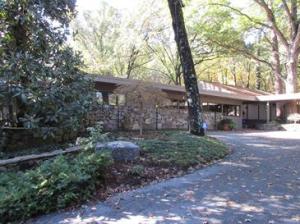
ahpp WaldoTillerHouseThe Arkansas Historic Preservation Program’s next “Sandwiching in History” tour will visit the Waldo E. Tiller House at 35 Sherrill Road in Little Rock beginning at noon today, (March 4).

Completed in 1954, the Tiller House was designed by Little Rock architect Dietrich Neyland, who worked for the firm of Ginocchio, Cromwell & Associates. The home’s modern design was inspired by the work of Neyland’s mentor, internationally-known architect Richard Neutra. Waldo Tiller was president of the Tiller Tie & Lumber Company. He also served as president and later, executive secretary, of the Arkansas Forestry Association. The Tiller House was remodeled in 2007 to provide necessary updates while preserving the home’s unique, Mid-Century Modern character.

The “Sandwiching in History” tour series targets Pulaski County structures and sites. The noontime series includes a brief lecture and tour of the subject property. Participants are encouraged to bring their lunches with them. The American Institute of Architects offers one HSW continuing education learning unit credit for members who attend a “Sandwiching in History” tour.

The tour is free and open to the public. For information, call the AHPP at (501) 324-9880, write the agency at 323 Center St., Suite 1500, Little Rock, AR 72201, send an e-mail message to info@arkansaspreservation.org, or visitwww.arkansaspreservation.org.

The AHPP is the Department of Arkansas Heritage agency responsible for identifying, evaluating, registering and preserving the state’s cultural resources. Other agencies are the Arkansas Arts Council, the Delta Cultural Center in Helena, the Old State House Museum, the Mosaic Templars Cultural Center, the Arkansas Natural Heritage Commission and the Historic Arkansas Museum.

Black History Month Spotlight – Pike-Fletcher-Terry Mansion

IMG_5151The new Arkansas Civil Rights History Audio Tour was launched in November 2015. Produced by the City of Little Rock and the University of Arkansas at Little Rock allows the many places and stories of the City’s Civil Rights history to come to life an interactive tour.  This month, during Black History Month, the Culture Vulture looks at some of the stops on this tour which focus on African American history.

In 1958, in this stately antebellum home, seventy-six-year-old Adolphine Fletcher Terry helped to organize the Women’s Emergency Committee to Open Our Schools (WEC). Always involved in civic activities, she was dismayed that the four high schools in Little Rock remained closed rather than become integrated. Mrs. Terry told Arkansas Gazette editor Harry Ashmore that “It’s clear to me that the men are not going to take the lead in turning this thing around and so the women are going to have to.” She organized the Women’s Emergency Committee (WEC).

When segregationist school board members tried to fire forty-four teachers and administrators who supported integration in the public schools, the WEC worked with a group of businessmen who had organized a Stop This Outrageous Purge (STOP) campaign to elect new school board members who favored integration. High schools were reopened with token integration in August 1959. The WEC operated in secret because of concerns about harassment or worse. In 1998, on the fortieth anniversary of its founding, the names of WEC members were released for the first time. Those names are now etched in the window panes of the house.

Originally built in approximately 1840 by Albert Pike, it was purchased by Lou Krause from the Pike family in 1886. In 1889, she sold it to her brother-in-law, former Little Rock Mayor John Gould Fletcher. He was the father of Adolphine Fletcher Terry, who grew up in the house.  Since the 1970s, it has been property of the City of Little Rock for use by the Arkansas Arts Center.  This was stipulated in the wills of Mrs. Terry and her sister Mary Fletcher Drennan.

The app, funded by a generous grant from the Arkansas Humanities Council, was a collaboration among UALR’s Institute on Race and Ethnicity, the City of Little Rock, the Mayor’s Tourism Commission, and KUAR, UALR’s public radio station, with assistance from the Little Rock Convention and Visitors Bureau.


THE WITTENBERG HERITAGE focus of Architecture & Design Network discussion this evening at 6pm at Arkansas Arts Center

wittenberg-heritageIn 1919, young architects George Wittenberg and Lawson Delony co-founded the firm that would become, under the visionary leadership of George’s son Gordon, one of the largest, longest-lasting and most influential architectural firms in the state. During his thirty-year tenure (1952-1982) as head of Wittenberg Delony & Davidson Architects, the company had a significant role in the design of many city landmarks, winning more than thirty awards for its work. The Arkansas Chapter of the American Institute of Architects awarded its most prestigious prize, the Gold Medal, to Gordon Wittenberg in recognition of his many contributions to the profession. In view of his outstanding contributions to the field, he was elected a Fellow of the American Institute of Architects, an honor accorded a select few.

This evening (February 23) the Architecture and Design Network will feature Gordon Wittenberg in a program entitled THE WITTENBERG HERITAGE.  It begins at 6pm at the Arkansas Arts Center with a reception at 5:30pm preceding it.

Wittenberg will be joined by his colleagues in reflection on the firm’s nearly one hundred year history, a heritage that shaped spaces and places throughout the state and beyond. THE WITTENBERG HERITAGE a group presentation, chaired by Gordon Ducksworth, AIA, Senior Associate/Project Architect, Wittenberg, Delony & Davidson Inc. Architects, Little Rock, AR. Like other Architecture and Design Network (ADN) lectures, THE WITTENBERG HERITAGE is free and open to the public. The Architecture and Design Network (ADN), a non-profit organization, is supported in part by the Arkansas Arts Center, the Central Arkansas Section of the Arkansas Chapter of the American Institute of Architects, the University of Arkansas Fay Jones School of Architecture and friends in the community.

Little Rock Look Back: Robinson Auditorium opens in 1940

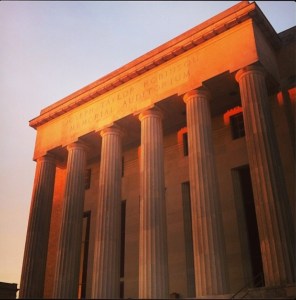
auditoriumduskOn February 16, 1940, after three years of planning and construction including several delays due to lack of funding, the Joseph Taylor Robinson Memorial Auditorium officially opened. It was a cold, rainy night, but those in attendance did not care.

Searchlights painting arcs in the sky greeted attendees. They were borrowed from the Arkansas National Guard. Newspaper accounts noted that only a few of the men who attended were in tuxedos, most were simply in suits. The work to get the building opened had been so harried, that it was discovered there was not an Arkansas Flag to fly in front of the building. Mayor Satterfield found one at the last minute courtesy of the Arkansas Department of the Spanish War Veterans.

The weather delayed arrivals, so the program started fifteen minutes late. Following a performance of Sibelius’ Finlandia by the fledgling Arkansas State Symphony Orchestra, Mayor J. V. Satterfield, Mrs. Joseph T. Robinson, Mrs. Grady Miller (the Senator’s sister-in-law and a member of the Auditorium Commission) and D. Hodson Lewis of the Chamber of Commerce participated in a brief ribbon cutting ceremony. Mrs Robinson cut the ribbon on her second attempt (once again proving that nothing connected with getting the building open was easy).

The ceremony was originally set to be outside of the building but was moved indoors due to the inclement weather. The ribbon cutting took place on the stage with the ribbon stretched out in front of the curtain. The opening remarks were broadcast on radio station KGHI.

Mr. Lewis, Mrs. Miller and Mayor Satterfield look on as Mrs. Robinson cuts the ribbon

Mr. Lewis, Mrs. Miller and Mayor Satterfield look on as Mrs. Robinson cuts the ribbon

Though he had previously discussed how he had voted against the auditorium in 1937 before entering public life, the mayor’s remarks that evening were appropriately gracious, statesmanlike and a testament to the effort he had invested to get it open upon becoming mayor. “We hope you have a very pleasant evening and hope further that it will be the first in a long series which you will enjoy in this, your auditorium.”

Tickets for the event, advertised as being tax exempt, were at four different pricing levels: $2.50, $2.00, $1.50 and $1.00.

The estimated attendance was 1700. Following the ribbon cutting, the main performance took place. The headliner for the grand opening was the San Francisco Opera Ballet accompanied by the new Arkansas State Symphony Orchestra (not related to the current Arkansas Symphony Orchestra). The featured soloist with the ballet was Zoe Dell Lantis who was billed as “The Most Photographed Miss at the San Francisco World’s Fair.”

At the same time that the gala was going on upstairs in the music hall, a high school basketball double-header was taking place in the downstairs convention hall. North Little Rock lost to Beebe in the first game, while the Little Rock High School Tigers upset Pine Bluff in the marquee game.

Sandwich in History today at the First Presbyterian Church

The monthly architectural history program “Sandwiching in History” visits the Albert Pike Memorial Temple, located at 712 Scott Street. The program begins at noon today (February 5).  A historian with the Arkansas Historic Preservation Program delivers a brief lecture about the church before leading guests on a tour.

Organized in July 1828, Little Rock’s First Presbyterian Church occupied three locations before it moved to the southwest corner of 8th and Scott streets. Built in 1920-1921, the current Gothic Revival-style sanctuary was designed by Little Rock architect John Parks Almand to complement an earlier three-story education building on the site. The sanctuary’s main entrance was crowned by a deeply recessed arch and a parapet with battlements. Beautiful stained-glass windows, made by Payne Studios of Patterson, New Jersey, were dedicated in 1928.

Sandwiching in History is a program of the Arkansas Historic Preservation Program, an agency of the Department of Arkansas Heritage.  The AHPP is responsible for identifying, evaluating, registering and preserving the state’s cultural resources. Other DAH agencies are the Arkansas Arts Council, the Delta Cultural Center in Helena, the Old State House Museum, the Mosaic Templars Cultural Center, the Arkansas Natural Heritage Commission and the Historic Arkansas Museum.

“Disagree to Agree” is topic of February Architecture and Design Network

According to architect  Neil Denari, it’s not unusual for parties to disagree when it comes to making decisions about  matters architectural. Stands taken in response to deeply seated concerns about money or commitment to “a specific direction and outcome” sometimes lead to stalemates. In his lecture, Denari will talk about ways in which NMDA deploys  “potentially disagreeable ideas into a welcoming context of agreement”. Equal amounts of “logic and enthusiasm” are key to resolving  differences between architect and client.
Tonight (February 2) Denari will discuss this at the Arkansas Arts Center at 6pm as part of the Architecture and Design Network series.  A reception at 5:30 will precede the address.
 
A native of Fort Worth, Texas, Denari, who earned a BArch at the University of Houston and a MArch from Harvard, founded the firm that bears his name in 1988, the same year he began a five year teaching stint at Southern California Institute of Architecture (SCI-Arc). Currently, he serves as Professor of Architecture and Vice Chair of Architecture and Urban Development (AUD) at UCLA. Living in New York City during the 1980s,  he worked for James Stewart Polshek Partners as a senior designer. Denari has held visiting professorships at UC Berkeley, Columbia, Princeton, University of Pennsylvania and the University of Texas at Arlington. Author, artist and filmmaker as well as architect, Denari has won a number of prestigious awards, including two from the National Academy of Design. 
 
Architecture and Design Network lectures are free and open to the public. Denari’s participation in ADN’s Little Rock lecture series is made possible by the UA Fay Jones School of Architecture and Design. For additional information contact ardenetwork@icloud.com.
 
Supporters of Architecture and Design Network include the Arkansas Arts Center, the Central Section of the Arkansas Chapter of the American Institute of Architecture, the UA Fay Jones School of Architecture and Design and friends in the community.