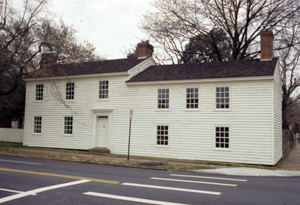
Heritage Month – Joseph T. Robinson House

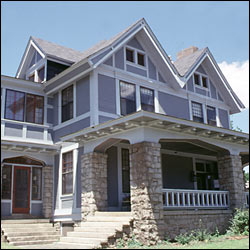
JT Robinson HouseThe Robinson House or the Foster-Robinson House is located at 2122 Broadway.

It was designed by Frank W. Gibb and built in 1904 for lumber man H. H. Foster.  Senator Robinson purchased the home from Foster’s widow and the house remained in the Robinson family until 1972 (following the Senator’s death in 1937 and his widow’s death in 1958). While visiting the state, President Roosevelt stayed at this house.

The Robinson house is a 2-1/2 story wood frame structure resting on a foundation of granite and brick. The exterior is sheathed in clapboards, and the roof is steeply pitched with a complex and irregular plan. There are four chimneys, two of brick and two of granite and brick. The main facade consists of a full-width porch supported by three square granite posts, above which are two pairs of sash windows, topped by a pair of gable ends, each with two small square windows. The gable ends are finished in stucco with decorative half-timbering. The porch is decorated with flattened Tudor-style arches and ornamental brackets, and shelters the main entrance, which is under the right gable, and paired windows under the left gable.

The interior has a wealth of high-quality woodwork, made using some of the choicest and most unusual cuts available at the time.

In addition to the house, the property includes a carriage house built using the same methods as the house. The yard is enclosed by an iron fence on the south and east sides, and a rock wall on the north and west sides.

It was listed in the National Register of Historic Places on March 28, 1975.  On October 12, 1994, it was designated a National Historic Landmark.
Heritage Month – Hotze House

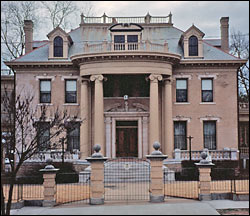
Hotze hosueThe Hotze House, located at 1619 Louisiana in Little Rock’s historic Quapaw Quarter district, was built by one of Arkansas’ most successful and prominent businessmen.  Designed by Charles L. Thompson, Little Rock’s most prominent architect and constructed in 1900, the house reflects the Beaux Arts tradition combined with Georgian influence.  The interior was reputed to have been designed by Tiffany Studios of New York.  The house has been remarkably well preserved and remains practically unaltered.

Peter Hotze was born in Innsbruck, Austria, on October 12, 1836.  He was young at the time of his father’s death, but Mrs. Hotze’s inheritance made it possible for her three sons to attend the University of Innsbruck.  In 1857 Peter Hotze moved to Little Rock and went into the general merchandise business.

Returning to Little Rock after service and imprisonment in the Civil War, Hotze went into a business as a merchant in partnership with Capt. John G. Fletcher, who had been his company commander.  Each man put $2,500 into the business.  After a while, they limited their business exclusively to the cotton trade.  In 1873 it was decided that Hotze should move to New York to handle that end of the firm’s business.  He lived there for 27 years, in a fashionable neighborhood near Central Park.

In 1900, Hotze retired and returned to Little Rock.  Upon his return in 1900 he built the large house in which he lived with his daughter Clara and son Frederick until his death on April 12, 1901.  He chose to build his home directly behind the small frame house he had built about l869 and lived in during his previous residence in Little Rock.

The Hotze House is one of the finer homes remaining in the state which expresses the opulence of the period in which it was constructed, particularly in the interiors, which are extraordinarily rich in quality. Resting on three and one-half lots, the Hotze House is remarkably well preserved and appears practically the same as when it was first constructed.

It was added to the National Register of Historic Places on August 11, 1975.


Heritage Month – Fordyce House

FordyceThe Fordyce House was built in 1904 for Mr. and Mrs John R. Fordyce.  The house was designed architect Charles L. Thompson in an Egyptian Revival style.  The Egyptian Revival style is rarely seen in houses in the United States,  major features of the style include the porch columns resembling bundles of stalks tied together and flared at the top and the “battered” walls that slant inward as they rise.

The Fordyce ‘s lived in the house until 1920 when it was sold to James Shipton who lived in the house until 1950.  The house has remained a single family home through the years.

It was added to the National Register of Historic Places on August 9, 1975.

Heritage Month – Fones House

FonesThe Fones House, located at 902 West Second, has two areas of significance.  Architecturally, the house is a leading example of the Victorian Italianate style, which is rare in Little Rock.  Secondly, the builder, Daniel G. Fones, was a leading Little Rock businessman.

The two and one-half storey Fones House is constructed of red brick.  The exterior features a bracketed frieze topped by a steep gabled roof with wrought iron cresting, decorative window heads in several different styles and ornately railed balconies.

Daniel Gilbert Fones was born in Decatur, Georgia, on August 19, 1837, the eldest son of Alvan T. and Adelia A. Cone Fones.  Though raised in relatively luxurious surroundings, after his father’s death he was apprenticed as a tinsmith at the age of 15.  In 1855, he came to Pine Bluff, and in 1859, moved to Little Rock.  That year, he formed the Fones Brothers’ partnership which would eventually became known as Fones Brothers’ Hardware and existed until 1987.

At the outbreak of the Civil War, Fones enlisted in the Confederate Army; after the war he returned to Little Rock.  He remained a civic leader throughout the rest of his life.  The Fones House was constructed in 1878 for Fones and his wife.

Fones was president of the Fones Brothers’ Hardware Company, President of the Arkansas Building and Loan Association, Vice President of the Equitable Building and Loan Association, President of the German National Bank and was associated with many other financial enterprises.  He served as an alderman in Little Rock and in 1916 was elected to the Little Rock School Board.

Fones married Texanna Dustan Reaves on May 30, 1867, who died in 1893.  In 1899 he was married to Mrs. James Hennegan Tucker.  Fones, who had no descendants, died May 28, 1916.

The Fones House was added to the National Register of Historic Places on August 19, 1975.

Heritage Month – Curran Hall

Curran HallCurran Hall, sometimes known as the Walters-Curran-Bell House, stands at 615 East Capitol Avenue and is one of the few remaining antebellum properties in Little Rock.  It was built in 1842 and was listed on the National Register of Historic Places on January 1, 1976.

Curran Hall was constructed in the Greek Revival style. The original one-story structure of the house was made with walls three bricks thick, cypress interior and exterior, and solid wood trimming and was settled on a raised foundation. The original interior floor plan was a four-room, central-hall type, although it was later added to by various owners. Each of the four rooms contains its original fireplace and classically designed mantel. The original interior of the house remains relatively undisturbed; however, the two rear additions have been fully transformed. In 1848, a children’s playhouse was constructed at the back of the house. The existing playhouse was reconstructed in the 1960s with materials from various historic houses in Little Rock.

Over the years, Curran Hall has been owned by several important Arkansas families. It changed hands fairly frequently from 1842 until the 1881.  At that point in time, Mary Eliza Bell, the daughter of Gazette founder William E. Woodruff moved in.  Her descendants stayed in the house until 1993.  In 1996, the structure was sold to the City of Little Rock.  The City’s Advertising & Promotion Commission and a private foundation raised money to restore the building.  After six years and $1.4 million, the house was formally opened to the public as the Little Rock Visitor Information Center on May 18, 2002.

In March 2007, the Quapaw Quarter Association took over the management of Curran Hall as the City’s official visitor information center.  The building is open daily for visitors to tour as well as learn about activities throughout the City.

Today, (Sunday, May 10), Curran Hall is one of the featured properties on the 51st Annual Quapaw Quarter Association Spring Tour of Homes.

Today from 1 to 5, the 51st Quapaw Quarter Association Spring Tour of Homes

qqa tourThe Quapaw Quarter Association will hold its 51st Spring Tour of Homes next month in historic downtown Little Rock. The event has existed since 1963 and this year we continue to celebrate decades of remarkable preservation that has made downtown Little Rock the South’s most impressive urban renewal success story!

Tickets for this award winning tour of downtown are $25 today. The tour runs from 1pm to 5pm.

The Sunday tour will feature three trolleys throughout the route.
Trolley Stops: 
  • 509 Scott Street (Christ Episcopal Church)
  • 615 E Capitol Avenue (Historic Curran Hall)
  • 1201 Commerce Street (Firehouse Hostel and Museum)
  • Daisy Bates and Main Street(Bernice Gardens)
  • Daisy Bates and Broadway
  • 13th and Spring Street
QQATicket Booths: 
  • 615 E Capitol Avenue (Historic Curran Hall)
  • 1201 Commerce Street (Firehouse Hostel and Museum)
  • Daisy Bates and Broadway
Restrooms: 
  • 615 E Capitol Avenue (Historic Curran Hall)
  • 1201 Commerce Street (Firehouse Hostel and Museum)


Here are the properties to be featured!

Historic CURRAN HALL, ca. 1842

615 E. Capitol Avenue

Construction of Curran Hall began in 1842. The home was a wedding gift from Colonel Ebenezer Walter, to his wife Mary Starbuck. She unfortunately passed before the home was completed. The home would then be sold the home to James M. Curran in 1849. The home remained with the Currans until 1881, and Mary Curtis Bell, daughter of William E. Woodruff, in 1884. The home stayed in the Bell family until 1997, when local preservationists and the City of Little Rock joined forces to save it. The home was restored through this partnership to its original glory as a Greek Revival, and today serves as Little Rock’s Visitor Information Center.

1411 Broadway, ca. 1896

The history of construction for this home is unknown, beyond that it was likely constructed before 1896. The primary owner after its construction, throughout the 1890s and early 1900s was Frank Carl, a businessman. The structure then had various owners from 1912- 1922 and was divided up as a rental property from 1922-1935. The home was officially the Broadway Apartments from 1935 to 1975 and became commercial property after that until the Miller family purchased the home for rehabilitation. The home is now a single family home once again and has been restored with historically appropriate details.

HAILE COTTAGE, ca. 1880s

417 W. 13th Street

The Haile family, Andrew J. and his mother Annie, likely constructed the cottage in the late 1880s. This home appears to have been built as a rental property. The Haile Cottage did not remain under the ownership of the Haile family for long. It changed hands many times throughout the late nineteenth and early twentieth centuries. Throughout the early 1900s, there were several additions on the east and west sides of the home. There was also a second story added. It was not until 1989 that the home would be purchased to be restored to its original beauty.Carl Miller, Jr. purchased the home for restoration. When the home was purchased, it had seen years of deterioration and overall neglect. Miller’s rehabilitation restored the Haile Cottage to its original Folk Victorian charm.

CHRIST EPISCOPAL CHURCH, 1941

509 Scott Street

In 1839, Leonidas Polk helped organize Christ Episcopal church in Senator Chester Ashley’s home. It was named after Christ Church in Alexandria, Virginia, of which several of the group had been members. Bishop Polk arranged to buy property at the church’s present location, 5th & Scott Streets, in 1840. In 1846 the first church building was opened. By 1873, that building had been destroyed by fire. By 1887 the funds had been raised and a new building was opened. In 1938, before an unveiling of a new interior, this building burned as well. Plans were again drawn for a new church, this time in a neo-gothic style, with the exterior of Arkansas stone rather than the red brick of the former church. In September of 1941 the current building was opened. Guided tours of Christ Episcopal Church will begin at the front door and take place at 2, 3, and 4 p.m.

FIREHOUSE HOSTEL AND MUSEUM, ca. 1917

1201 Commerce Street

Little Rock Fire Station no. 2 is one of the most visible and well known landmarks in the MacArthur Park Historic District. The firehouse was opened in 1917 after moving from its Main Street location to the western end of City Park, now known as 1201 S. Commerce. The fire station, as seen today, is definitively Craftsman. Originally it featured a large porch and had some Spanish Revival elements as well. In 1959 the station was closed when a new station opened on 9th street. The building has served as a meeting location for clubs and organizations in the community, and has been managed by the City of Little Rock since the late 1990s. In 2006 Hosteling Arkansas, Inc. began plans to turn the firehouse into a hostel and museum. It is set to open later this year.

HERRON HORTON OFFICE/STUDIO/RESIDENCE, 2008

1219 South Spring Street

Architects Jennifer Herron and Jeff Horton designed and built their 2008 office and art studio as a separate structure beside the home they designed and built at the same time for their family of four. The two energy efficient structures are joined through a passageway and transition space that connects home to work and work back to home. As infill in an historic neighborhood at a point where residential begins to transition to commercial, the Herron Horton office/studio and residence offers a thoughtful and elegant counterpoint to the older homes and commercial businesses surrounding them.

Heritage Month – Hinderliter House

HinderliterThe Hinderliter House is the oldest building still in existence in Little Rock.  It is now part of the Historic Arkansas Museum.

The Hinderliter Grog Shop began as a log structure in 1826-27 by Jesse Hinderliter, a man of German descent. It was his home and business, where he lived with his wife and two slaves until his death in 1834. Popular folklore associates the building with the last meeting of the territorial legislature of 1835. Red oak logs and cypress flooring were used in the grog shop’s construction. The clapboard siding and porch were later additions. Inside, the hand-carved federal mantel in the formal dining room shows that style was important, even in a log house on the frontier.

Many modifications were made to the building over the years.  Work to restore it in the late 1930s and again in the late 1960s removed many of these alterations.

The Hinterliter House and other structures on the Historic Arkansas Museum can be toured daily. They are being showcased today (May 9) as part of HAM’s 42nd Annual Territorial Fair.

The Hinderliter House was added to the National Register of Historic Places on March 5, 1970.