Heritage Month – Augustus Garland House

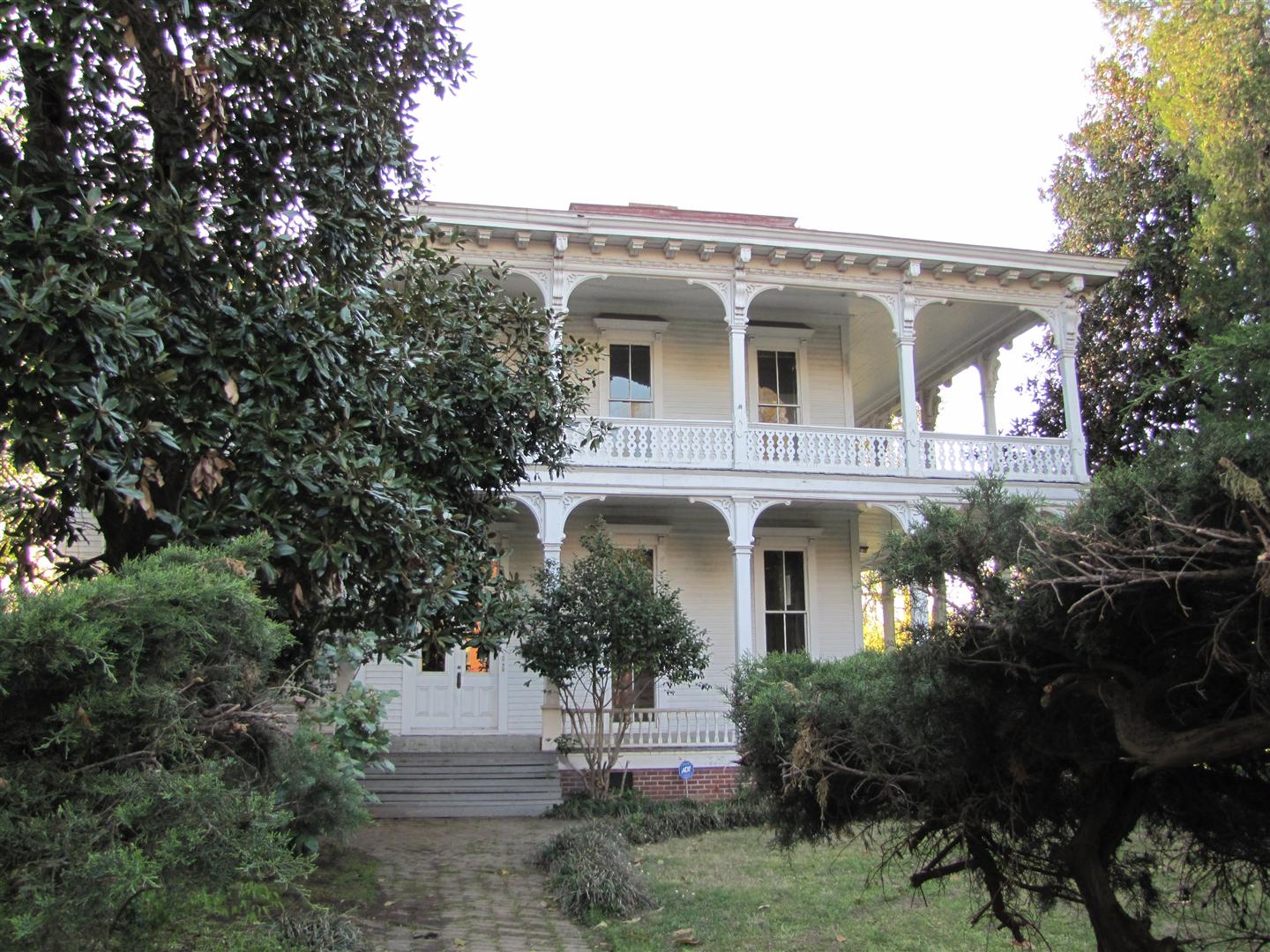
Augustus Garland HouseThe Augustus Garland House, also known as the Garland-Mitchell House, is located at 1404 Scott Street.

Built in 1873, the house has undergone few alterations during the last century. It appears much the same today as when Governor Augustus H. Garland and his family lived there in the 1870’s.  The dominant feature of the house is the two story ell-shaped gallery.

Even though the Garland-Mitchell House has been divided into three separate apartments, the interior still retains its architectural integrity. The wide central hallway which once bisected the entire first floor of the house now terminates at a wall under the stairs which was added in the 1940’s.

Because of the prominent two story porches which are reminiscent of nineteenth century riverboats, the Garland-Mitchell House is locally referred to as “steamboat Gothic” architecture; however, it also has elements of the Italianate Victorian style.

Not only is the building architecturally significant, but as the residence of Augustus Garland, it has other significance.  Augustus Hill Garland was an Arkansas lawyer and politician. He was a senator in both the United States and the Confederate States, served as 11th Governor of Arkansas and as Attorney General under President Cleveland. He was the first Arkansan to serve in the President’s cabinet (and would remain the only one until the Clinton administration). Later, the house served as the residence of Charles Brough while he served as Governor of Arkansas.

It was added to the National Register of Historic Places on June 10, 1975.


Heritage Month – Leiper-Scott House

Leiper ScottMay is Heritage Month in Arkansas.  This month, the Culture Vulture will feature properties on the National Register of Historic Places which are located in Little Rock.  First is the Leiper-Scott House.

The Leiper-Scott House is a one-story structure located at 312 South Pulaski, two blocks east of the State Capitol.

It was built on a lot which slopes abruptly to the rear. Therefore its basement on the rear or west elevation is exposed. The building has a cottage-style plan, combining hip and gable roof form, an asymmetrical front facade, and one floor of usable living space. It is an adaptation of a plan that was popular between 1880 and World War I for modest, low-cost housing.

The Leiper-Scott House is transitional in style, with both Queen Anne and Colonial Revival characteristics. The massing of the building, the steep pitches of the roof and the use of slate infilll in the south elevation pediment are characteristics of the Queen Anne style. Colonial Revival elements include tracery windows, round Roman arches, hipped dormer, Tuscan columns and gable returns.

It was added to the National Register of Historic Places 35 years ago today on May 1, 1980.


New Quapaw Quarter Historic Building Marker Program focus of program tonight at Butler Center

qqa markerLearn about the Quapaw Quarter Association’s Historic Building Marker Program and How to Participate

Historic homes are cherished parts of the community, and building markers help tell their stories. The Butler Center for Arkansas Studies will host an informational session about the Quapaw Quarter Association’s (QQA) building marker program on Tuesday, April 21, at 5:30 p.m. in room 204 of the Arkansas Studies Institute building, 401 President Clinton Ave.

Attendees will learn how to research historic properties to determine National Register eligibility and how to apply for a building marker. The session will focus specifically on how to use the QQA’s records and other resources available at the research room of the Arkansas Studies Institute building. More information on the QQA’s building marker program is available at http://quapaw.presencehost.net/what_we_do/qqa-historic-building-marker-program/. To attend the session, property owners may RSVP toqqa@quapaw.com with a property address.

The Quapaw Quarter Association began the new Historic Building Marker Program earlier this year.  This program replaces the discontinued Quapaw Quarter Historic Structure Plaque and the QQA Historic House Marker Programs.   The markers will be aluminum and approximately 14 inches wide by 12 inches high.  They will display the building name and date of construction.  They may be pole-mounted, or attached directly to the building.

The goals of this program are to recognize historically and architecturally significant buildings located anywhere in the City of Little Rock that have been well-maintained or have undergone exemplary rehabilitation; to bring to the attention of the general public buildings that are unique assets to the City of Little Rock; and to promote the Quapaw Quarter Association as Little Rock’s leading historic preservation organization.

The Butler Center for Arkansas Studies is a department of the Central Arkansas Library System (CALS) promoting the study and appreciation of Arkansas history and culture. For more information, visit www.butlercenter.org or call 501-918-3033.

Little Rock Look Back: 107 years of City Hall at Markham & Broadway

CityHa78107 years ago today, Little Rock City Hall officially opened at the corner of Markham and Broadway.

On April 15, 1908, the Italian Renaissance Revival style building, which had been designed by local architect Charles Thompson, played host to an open house. Staff had started moving into the building in March of that year.   This was, as often is the case, behind schedule.  The date in the cornice toward the top of the building is 1907, but the building was not completed until 1908.

In 1903, W. E. Lenon became Mayor of Little Rock. Back then, the terms were two-year terms.  By the start of his second term in 1905, he realized that the City was outgrowing City Hall, which was, at the time, on the northeast corner of Markham and Louisiana – where part of the Statehouse Convention Center sits today.

In February 1906, Mayor Lenon appointed a committee of five aldermen to over see the planning for the building of a new City Hall. In July 1906, the City Council approved plans, which called for a City Hall with an municipal auditorium wing. There was some hue and cry about wasteful spending and a resulting lawsuit, so, in September 1906, those plans were scrapped and a simpler City Hall was approved for the cost of $175,000.

The last resolution in the old City Hall called for the banning of smoking in the new Council Chambers – while the Council was in session. This may well have been the first smoking ban in a public government building in the history of Arkansas.

When the building opened, the third floor was not finished out. The space was not needed. When the Museum of Natural History and Antiquities (now the Museum of Discovery) moved into City Hall in 1929, they had to finish out their space.

In 1913, the new Central Fire Station, designed in the Beaux Arts style, was constructed adjacent to City Hall. During the 1930s, as the City grew, more space was needed. A garage, designed in the “austere, utilitarian” style was built in 1936 and a City Jail Annex, built by the WPA in the modified Art Deco style was built in 1938.
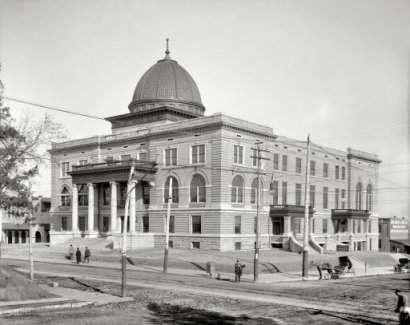
City Hall prior to 1912

By 1955, the copper-clad dome which sat on top of City Hall needed severe repairs. The wooden supports and the copper cladding were both in dire shape. Mayor Pratt Remmel set aside money for the dome to be repaired. After defeating Remmel in his bid for a third term, Mayor Woodrow Mann scrapped plans for the repair and, indeed, scrapped the dome.

Following the lead of County Judge Arch Campbell who had removed the tower at the County Courthouse, Mann proposed removal of the dome. He had an informal survey which had three options: repair the dome, replace the dome with an aluminum one, or remove it. This was open to anyone to respond – voting eligibility or Little Rock residency did not matter. By a slim margin, remove the dome won – so the dome was removed.

In 1960, as air conditioning was installed, windows were bricked in to promote energy efficiency. At the time, the feeling was that a new City Hall would be constructed in the 1970s somewhere more central to the growing city. Relocation talk persisted throughout the 1970s and early 1980s. By that time, City Hall had been modified a great deal – with no thought about historic preservation. When the Police and Fire Department had moved out into their new facilities, their old spaces had become storage.

By 1984, the decision was made to stay at Markham and Broadway. An extensive renovation and restoration effort was undertaken. In 1988, the building reopened, and the interior had been restored to its 1908 appearance.

“Where We Learn Matters” is topic of tonight’s Architecture & Design Network talk given by former LR resident Anisa Baldwin Metzger

anisaLittle Rock native Anisa Baldwin Metzger will headline an Architecture and Design Network discussion tonight entitled “Where We Learn Matters.”  The program starts at 6pm in the lecture hall at the Arkansas Arts Center. A reception will precede it starting at 5:30.

As School District Sustainability Manager for Green Schools at the U.S. Green Building Council (USGBC), headquartered in Washington, D.C., Anisa Baldwin Metzger, oversees a  national effort that  provides guidance and support for the Council’s state subsidiaries and their sustainability efforts. Here in Arkansas, the state USGBC hosts the Arkansas Green Challenge (AGC), a program that pairs mentors – architects and engineers among them – with students and staff to find ways of greening their schools. Now in its fourth year, the Arkansas AGC has reached  eighty schools and more than forty thousand students, helping them understand the influence of school facilities design on matters relating to learning, health and the environment. 

Ms. Baldwin Metzger, who grew up in Little Rock, received a B.S degree in architecture from Washington University, St Louis and earned an M.Arch from the University of Washington, Seattle. Following the devastation of Hurricanes Katrina and Rita, she worked in New Orleans, helping schools rebuild in ways that reflected their commitment to USGBC’s  principles of greening.   Drawing on her own experience, she asserts that “the pursuit of environmental sustainability requires that we utilize design thinking to deal with many complex problems our world faces.” In her talk, she will share strategies for working with schools and school districts throughout the country to develop ways of insuring sustainability.
Growing up in Little Rock, Anisa rode to kindergarten on the back of her dad’s bike. She was raised by parents (Jim Metzger and Deborah Baldwin) who made it second nature to try to waste less, and so she understands the importance of raising sustainability natives—children and adults who act to benefit the earth without needing to be asked.
 
The Arkansas chapter of the USGBC is the co-sponsor of Ms. Baldwin Metzger’s talk.  Supporters of Architecture and Design Network (ADN) include the Arkansas Arts Center, the UA Fay Jones School of Architecture, the Central Arkansas Section of the Arkansas Chapter of the American Institute of Architecture and friends in the community. 
 
All ADN lectures are free and open to the public

Pulaski County Historical Society tours the Holtzman-Vinsonhaler House this afternoon

VinsonhalerWhile often the Pulaski County Historical Society hears presentations at its meetings, today the meeting focuses on a tour of a historic Little Rock residence. Refreshments start at 2pm with the tour commencing at 2:30pm.

The Holtzman-Vinsonhaler House stands on the northeast comer of Ninth and Commerce Streets, in Little Rock. This large brick home was constructed about 1898 by William D. Holtzman, a contractor.  Holtzman also built the house two doors to the east, the Holtzman-Vinsonhaler-Vogler House, designed in the Queen Anne Revival style and constructed in the early 1890s (note the stained glass window on its porch) and the W. D. Holtzman house three doors to the east, constructed about 1905 and designed in the Colonial Revival style.  The extended Holtzman family built and/or occupied almost the entire 500 block of East Ninth Street at various times from the 1850s through the 1930s.

Join the PCHS for this wonderful tour to learn the full rich history of one of Little Rock’s most prominent residences.

The Pulaski County Historical Society is dedicated to the following:


  • Documenting the history of Pulaski County from the earliest known period to the present.
  • Promoting interest in locating, collecting and preserving historical information on the county’s history.
  • Identifying the contributions of individuals and institutions to the broader community.
  • Popularizing stories of the county’s citizens, its business life and its institutions.
  • Recognizing the relationship of Pulaski County history with that of Arkansas and the South
  • Stimulating research and its presentation.
  • Publishing information about the county’s history.
  • Marking historic places.

Little Rock Look Back: Special Election to finish funding Robinson Auditorium construction

jtrma-c.jpgThough Joseph Taylor Robinson Memorial Auditorium opened in February 1940, there was still money that needed to be raised to finish the construction and the building’s furnishing.  Ten days after the auditorium opening, the City Council approved an ordinance to call a special election on April 2, 1940, for the purposes of approving bonds for three separate projects.  One of these was for $30,000 for the completion of the auditorium; the bonds would not require any additional tax levy.

At the same meeting, a letter was read from the Young Men’s Business Association expressing support for the auditorium in the election, which was to be held in conjunction with the annual municipal general election. The Auditorium Commission had previously asked the City Council to consider issuing the bonds to pay for additional equipment for the building.  In their request to the aldermen, the members stressed that due to the current bond structure, these new bonds would not necessitate any tax increase.

The campaign for the new bonds used a similar structure and message as the 1937 election to build the auditorium.  There were newspaper ads by the steering committee (this time simply called the Citizen’s Committee and led by Omar Throgmorton) and support from civic organizations.  One thing very different from the 1937 campaign was the presence of an actual building.  On Sunday, March 31, just two days before the election, there was an open house for the public to explore the edifice.  From 1:00 p.m. to 9:00 p.m., members of various Little Rock Boy Scout troops led 4,000 visitors on tours of the auditorium.  Visitors were shown all over the building; one scout calculated that the walking tour equated to two miles.  Though most people were from Little Rock, the guest registry indicated visitors from California and Pennsylvania.

On April 2, 1940, Little Rock voters approved the new bonds 1,413 to 423.  Every precinct in every ward of the city voted in favor of the new bonds.  Shortly after the election, the bonds were issued.  The auditorium construction which had first been broached in 1904 was now completed in 1940.