Back to School Cinema: HOOSIERS

HoosiersNot just one of the best sports movies ever made, but one of the best movies of any genre, Hoosiers is also a back to school movie.  This 1986 opus embraces the cliches of the underdog sports team, Gene Hackman as a washed up lost soul, and Dennis Hopper as a drunk.  Through all of the reasons this movie could be a failure, it is the exact opposite.

There is an elegant honesty and humility that runs throughout the movie.  Hackman, Hopper and Barbara Hershey trust the script and the situation. This keeps what could be a hackneyed and melodramatic story from losing its honesty.

The actors playing the basketball players were hired more for their basketball ability. With similar haircuts, they sometimes become interchangeable. But instead of being a detriment, instead this becomes one of the assets of the film.  The movie is about a team. While each player has his own story, the more important story is that of the team.

The sepia-tinged cinematography and languid pace of the movie also add to the period feeling. While it doesn’t look like a movie filmed in the 1950s (that would have been in Technicolor or black & white), it seems like it should be a movie filmed in the 1950s.

This movie never fails to induce goosebumps and misty eyes each time I watch it.  I KNOW how it is going to end, and I still get caught up in it.  When Gene Hackman measures the distance between the net and the floor to demystify the enormity of the championship arena, I am reminded of the importance of keeping things in perspective.

Back to School Cinema: CLUELESS

cluelessJane Austen meets 1990s Beverly Hills in Clueless – Amy Heckerling’s take on the classic tale of matchmaking gone awry before a happy ending.

This 1995 movie starred Alicia Silverstone and Stacey Dash as the benevolent rulers of a Beverly Hills high school.  With snappy, smart dialogue it is reminiscent of screwball comedies of the 1930s.  Unlike some films of the same genre (and many of its imitators), it relies heavily on scenes at school and involves the students interacting with teachers.

Brittany Murphy plays the newcomer whose arrival sets many plans in motion while Elisa Donovan, Donald Faison, Jeremy Sisto, Breckin Meyer, and Justin Walker play fellow students. Paul Rudd’s performance as the older ex-step-brother of Silverstone helps anchor the film.  (He also keeps the ick factor from creeping in at the ending of the movie based on the character who becomes the object of his affection).  Julie Brown, Wallace Shawn and Twink Caplan bring hilarity and heart to their roles as teachers.

As with Beverly Hills itself, this movie has a distinctive look.  The costumes by Mona May are exaggerated without becoming parodies.  Interesting, this movie is heavily dominated by females behind the camera.  It was written and directed by Heckerling.  Casting and editing were both led by women as well as two of the assistant directors and one of the film’s producers.

Appreciation or even familiarity with Austen is not necessary to enjoy this film.  It is literate, witty, smart, and fun.

Back to School Cinema: TO SIR, WITH LOVE

tosirwithlove1967’s To Sir, With Love is a bit formulaic.  Following in the footsteps of Goodbye, Mr. Chips; The Corn Is Green; and Blackboard Jungle, it tells the tale of a teacher who seeks to educate “problem” students and show them a brighter future.

There are several reasons this movie succeeds.  One is Sidney Poitier. He is polished and understated exuding a genuine humanity without being beatifically noble.  The obvious wrinkle this movie presents to the formula is that the teacher is black, while the students are not mainly white.  While that is an added layer to the challenges “Sir” faces in teaching the students, neither the screenplay nor Poitier’s performance seek to make this a message movie.

The students also keep this movie from slipping into cliche.  They are a motley crew.  Filmed in the East End of London in 1966, these actors embody the time and era. These are not pristine, scrubbed faces – they are ruddy, with stringy hair. While they may be a bit older than their characters, it works in this movie.  These characters face hard lives and have had to grow up too quickly.  But, as Poitier’s character uncovers – they really are like schoolchildren who just want someone to care about them.

Several veteran mid-level British actors fill out the other adult roles.  Patricia Routledge makes her movie debut as one of Poitier’s colleagues.  For those who have only seen her as Hyacinth Bucket, her performance is a revelation here.

The cinematography, direction and music also aid the movie.  It has a dark, grimy look, more akin to a documentary. Director James Clavell working with cinematographer Paul Beeson and editor Peter Thornton, makes use of the realistic look while throwing in occasional quick cuts and varied angles. The iconic trip to the British Museum is accomplished by using only still photos over the score.  This was borne out of necessity because the museum would only allow still photos not filming.  But it is more powerful, and the photos are stunning.

The film was largely overlooked at awards time.  It was released the same year as Poitier’s In the Heat of the Night and Guess Who’s Coming to Dinner.  He received no nomination that year at the Oscars — his three films probably all cancelled each other out.

The title song, which was sung by Lulu in the movie, was nominated for a Grammy.  Written by Mark London and Don Black, it has been covered by everyone from Al Green to Soul Asylum to 10,000 Maniacs with Michael Stipe.  Lulu’s version spent five weeks at Number 1 on the Billboard chart.

Happy Birthday Maureen O’Hara – In 1940 she set off a stampede of fans at Robinson Center

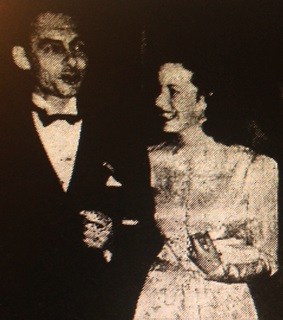
Mayor J V Satterfield escorting actress Maureen O'Hara at the Movie Ball (photo from Arkansas Democrat)

Mayor J V Satterfield escorting actress Maureen O’Hara at the Movie Ball (photo from Arkansas Democrat)

Oscar winner Maureen O’Hara turns 95 today.  With her elegance and beauty, she still turns heads. Seventy-five years ago, in February 1940, a nineteen year old Miss O’Hara turned many heads and set off a frenzy of autograph seekers when she came to Little Rock to attend a series of events.

In conjunction with a meeting of film executives and movie theatre owners sponsored by Robb and Rowley Theaters (which later became the United Artists theatre chain), several Hollywood actors were in Little Rock and headlined a Movie Ball. While in Little Rock, Maureen O’Hara, Phyllis Brooks, Arleen Whelan, Tim Holt and Gene Autry had also made a variety of public appearances.

On the evening of February 1, 1940, Robb and Rowley hosted the Movie Ball in the lower level of Robinson Auditorium. So many of the attendees crowded around for autographs that the evening’s grand march could not take place (a newspaper headline in the Democrat innocently used the word “orgy” to describe the crowd). After two attempts, Little Rock Mayor J. V. Satterfield (who was escorting Miss O’Hara) and the other members of the Little Rock host delegation led the Hollywood stars to their reserved table. For quite a while that evening, the table was besieged by autograph seekers.

Though it is unknown as to whether he sought an autograph, photos from the evening showed a very satisfied Mayor Satterfield with Miss O’Hara on his arm. Satterfield family lore joked that Mrs. Satterfield (who had stayed home that night to tend to a sick son) was not a fan of Miss O’Hara’s films after that evening.

The Movie Ball showed Little Rock citizens the value of Robinson Auditorium even before it had been officially dedicated. The film industry meetings had taken place at the Albert Pike Hotel which did not feature a ballroom large enough to host the ball. Without the auditorium’s availability for the gala, organizers might not have chosen Little Rock for the meeting.

Back to School Cinema: GREASE

greaseGrease is the word! This 1978 film rode the wave of 1950s nostalgia and became a cultural phenomenon.  Based on the long-running Broadway musical, the film version capitalized on the success of John Travolta and Olivia Newton-John by pairing them and making film history.

The film was directed by Randal Kleiser based on the original play by Jim Jacobs and Warren Casey.  The cast included 23 year old Travolta, 28 year old Newton-John, 26 year old Jeff Conaway, 33 year old Stockard Channing and cast members ranging from 20 to 31 including Barry Pearl, Michael Tucci, Kelly Ward, Didi Conn, Jamie Donnelly, Eddie Deezen and Annette Charles.  Only Lorenzo Lamas and Dinah Manoff were teenagers, at 19, from the principal cast.

A dash of old Hollywood – or at least TV from the 1950s rounded out the adult cast with Eve Arden, Sid Caesar, Dodie Goodman, Alice Ghostley and Joan Blondell. Frankie Avalon had a cameo as the very contemporary looking Teen Angel.

Because of the success of Saturday Night Fever, a BeeGees written title song was added.  Other songs were written for Newton-John by John Farrar, her main songwriter.  One of those, “Hopelessly Devoted to You,” nabbed the film’s only Oscar nomination.  Sha-Na-Na was added to perform 1950s standards and Grease songs at the school dance in the film.

Though the film has its flaws, it was wildly successful and stands up today as still a very fun film.  Just hearing the opening strains of “Summer Nights” is likely to send people into singing “Tell me more, tell me more….”  In the 1970s, Grease was evocative of a simpler time.  Now, 37 years after its initial release, the film stands as a reminder of a simpler time – the summer it came out.

Back to School Cinema: DEAD POET’S SOCIETY

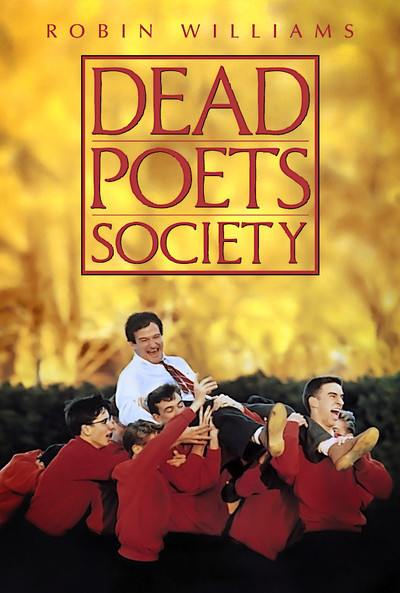
Dead_poets_societyWith students returning to school, this week the Culture Vulture will feature seven favorite films about the high school experience.  Up first is 1989’s Dead Poets Society.

While it can be a bit melodramatic, Peter Weir’s movie (from Tom Schulman’s script) captures not only the generational split between students and their teachers & parents, but also the seismic shifts that were happening in the US in the late 1950s. The movie takes place just prior to the JFK-Nixon election time.  It sets the stage for the dichotomy of feelings those candidates represented.

When it first came out, it had a tremendous influence on me.  I appreciated the references to history and literature, the Ralph Lauren designed clothing, the tremendous use of plaid in set decoration and the breathtaking scenery.  The actors playing the students were my age, though playing slightly younger (I was in college, they were playing prep school seniors).  Though I confess, I was not much of a Walt Whitman fan, and still am not.

Robin Williams is stellar as a combination Mr. Chips and Pied Piper who bucks the system at Welton Academy. Though the part was not written for him, he made it his own. It showcased not only his comic talents but also his ability to show pathos.  Even when he is hamming it up for his students, Williams shows a bit of restraint – he keeps his character grounded in 1959.

The actors playing the students had great chemistry – they functioned as a complete unit. They have gone on to varied levels of success.  Robert Sean Leonard has won a Tony and alternated between stage and TV with a few films.  Ethan Hawke was, for a while, a leading actor of his generation and has received Oscar nominations for acting and writing. Josh Charles has worked fairly steadily, especially on TV in shows like “SportsNight” and “The Good Wife.”  James Waterston has also kept busy in various acting roles.  Gale Hansen, who was so magnetic in this film, has disappeared from acting.  Allelon Ruggiero and Dylan Kussman, too, have had only a few credits.

The movie also proved to be a breakout for Kurtwood Smith. He followed up this hellish dad with a kinder version in “That 70’s Show.”  Norman Lloyd, who played the headmaster, celebrated his 100th birthday in November 2014.  He still takes a few acting roles and attends events.  (When I first watched it, I would never have predicted that 25 years later Williams would be dead and Lloyd would be turning 100.)  Several other character actors pop up as faculty members and parents.  (One of my favorites, John Cunningham, plays Ethan Hawke’s father.)

This being a movie that came out in the summer, I was was pleased when it received four Oscar nominations: Best Picture, Actor (Williams), Director (Weir) and Original Screenplay (Schulman).  On Oscar night, Schulman walked home with the trophy.

The ending of the film gives me goosebumps each time – even though I know it is coming.  There are so many other moments I enjoy – the kicking of the ball while reciting inspirational quotes accompanied by Beethoven is certainly another.  And I can still recite Puck’s final speech in A Midsummer Night’s Dream because I learned it from this movie.

I was fortunate to have teachers to inspire me at all levels of schooling.  Though none asked me to stand on desks, I was challenged, cajoled and even on a few times chastised.  And I am the better for it.

 

Go GOOD WILL HUNTING at 10pm tonight at the CALS Ron Robinson Theater

RRT Good WillThe 1997 Oscar winning GOOD WILL HUNTING will be shown at 10pm tonight at the Ron Robinson Theater.  Robin Williams (Best Supporting Actor), Matt Damon & Ben Affleck (Original Screenplay) took home the golden statuettes for their work on this film.

The movie also stars Minnie Driver, Stellan Skarsgård, Casey Affleck, and Cole Hauser. Directed by Gus Van Sant, it tells the story of a janitor at MIT who is a math savant.  As he tries to embrace his genius, he must also grapple with the impact this has on his own self-value and his relationships.

Filmed for an estimated $10 million, it grossed over $138 million in its initial release.

Admission is $5, with refreshments available for purchase.