
Little Rock Look Back: Farewell to the Hotel Marion and the Grady Manning Hotel

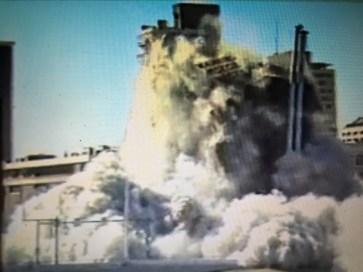
Manning Implosion.JPGOn February 17, 1980, a cold and clear Sunday morning, over seven decades of Arkansas history came tumbling down as the Hotel Marion and Grady Manning Hotel were imploded.  Thousands of people watched from places in downtown Little Rock and along the Arkansas River.  Many more were able to watch from live coverage carried on KATV, KARK and KTHV.  Those that missed it were able to see the replays multiple times on the news.

It was the first large-scale implosion in Little Rock’s history.  (It was likely the first implosion, but there could have been a small one that is not known.)  The two hotels were torn down to make way for the construction of the Excelsior Hotel and the Statehouse Convention Center.

The Hotel Marion, named after the builder Herman Kahn for his wife, opened in 1907. For four years it was Arkansas’ tallest structure.  It was the largest and grandest hotel in the City. For decades it would be the host to many dignitaries, conventions, and gala celebrations.

The Grady Manning Hotel was originally known as the Hotel Ben McGhee when it opened in 1930.   Manning was the head of the company which owned both the Marion and Ben McGhee properties.  Upon his untimely death by drowning in September 1939, the property was subsequently renamed in his memory.

The Manning Hotel, though taller, was never as grand a hotel as the Marion.  It was more of a mid-range property in pricing.

By the 1970s, both hotels were suffering from neglect and disinterest.  Changes in the lodging industry combined with a decline in downtown Little Rock had left both facilities with little business.

When Little Rock civic and government leaders decided to construct a larger convention center downtown with an adjacent hotel, it was decided that neither of these facilities could be properly renovated to be part of the project.  Instead, the land on which they stood (and the space in between) would be prime for the new hotel and center.

So, on the cold Sunday morning, the explosives were detonated, and the buildings came down.   Sunday morning was chosen because it would have the least impact on traffic flows since it would cause numerous streets to be closed for safety reasons.  The blast was delayed due to a rumor that someone might be in one of the buildings.  After checking both sites and finding them empty, the charges were set off.

And the Marion and Grady Manning became as much a memory as the long gone people who had once populated them.

The University of Arkansas’ Pryor Center for Oral and Visual History has a video of the implosion.

Little Rock Look Back: Opening of Robinson Auditorium

robinson-auditorium-by-scott-carterOn February 16, 1940, after three years of planning and construction including several delays due to lack of funding, the Joseph Taylor Robinson Memorial Auditorium officially opened. It was a cold, rainy night, but those in attendance did not care.  (The concept of a municipal auditorium for Little Rock had first been raised in 1904, so this evening was truly a long time in the works.)
Searchlights painting arcs in the sky greeted attendees. They were borrowed from the Arkansas National Guard. Newspaper accounts noted that only a few of the men who attended were in tuxedos, most were simply in suits. The work to get the building opened had been so harried, that it was discovered there was not an Arkansas flag to fly in front of the building. Mayor Satterfield found one at the last minute courtesy of the Arkansas Department of the Spanish War Veterans.

The weather delayed arrivals, so the program started fifteen minutes late. Following a performance of Sibelius’ Finlandia by the fledgling Arkansas State Symphony Orchestra, Mayor J. V. Satterfield, Ewilda Robinson (the Senator’s widow), Emily Miller (the Senator’s sister-in-law and a member of the Auditorium Commission) and D. Hodson Lewis of the Chamber of Commerce participated in a brief ribbon cutting ceremony. Mrs Robinson cut the ribbon on her second attempt (once again proving that nothing connected with getting the building open was easy).

The ceremony was originally set to be outside of the building but was moved indoors due to the inclement weather. The ribbon cutting took place on the stage with the ribbon stretched out in front of the curtain. The opening remarks were broadcast on radio station KGHI.

Mr. Lewis, Mrs. Miller and Mayor Satterfield look on as Mrs. Robinson cuts the ribbon

Mr. Lewis, Mrs. Miller and Mayor Satterfield look on as Mrs. Robinson cuts the ribbon


Though he had previously discussed how he had voted against the auditorium in 1937 before entering public life, the mayor’s remarks that evening were appropriately gracious, statesmanlike and a testament to the effort he had invested to get it open upon becoming mayor. “We hope you have a very pleasant evening and hope further that it will be the first in a long series which you will enjoy in this, your auditorium.”

Tickets for the event, advertised as being tax exempt, were at four different pricing levels: $2.50, $2.00, $1.50 and $1.00.

The estimated attendance was 1700. Following the ribbon cutting, the main performance took place. The headliner for the grand opening was the San Francisco Opera Ballet accompanied by the new Arkansas State Symphony Orchestra (not related to the current Arkansas Symphony Orchestra). The featured soloist with the ballet was Zoe Dell Lantis who was billed as “The Most Photographed Miss at the San Francisco World’s Fair.”

Auditorium Commission chairman E. E. Beaumont, a local banker, noted that while event planners knew the evening of ballet and classical music would not appeal to everyone, it was intended to show the wide range of offerings that would be suitable in the new space.  Earlier in the week, children’s theatre performances had been offered to school groups through the auspices of the Junior League of Little Rock.

At the same time that the gala was going on upstairs in the music hall, a high school basketball double-header was taking place in the downstairs convention hall. North Little Rock lost to Beebe in the first game, while the Little Rock High School Tigers upset Pine Bluff in the marquee game.

Little Rock Look Back: Court orders integration of LR public facilities

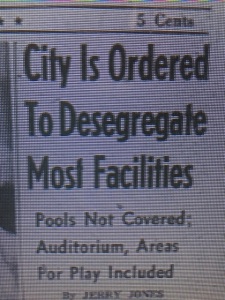
Following the March 1962 lawsuit by twenty-two (22) African Americans seeking the integration of public facilities in Little Rock, Federal Judge J. Smith Henley issued a order on February 15, 1963.  Judge Henley ordered the end to segregation in City parks, playgrounds, golf courses, tennis facilities, community centers, and Robinson Auditorium.
Regarding the auditorium, the order allowed for single event, short-term leasing of wholly private meetings for membership and immediate friends of members.  But it did stress that there could be no racial discrimination in the selection of or terms of leases.

The judge’s order did not cover “other facilities not identified in the record.”  Which meant, the order did not apply to swimming pools.  At the time, War Memorial pool was operated for whites and Gillam Park pool was operated for African Americans.   The judge wrote that he saw no reason to extend it to facilities not mentioned, but did not rule out the ability for future lawsuits.  In asking for a summary judgement in January 1963, the defendants had listed many types of facilities but not swimming pools.

Judge Henley’s decision did not mean that a municipality was required to integrate.  It just could not enforce segregation.  As with many other court decisions at the time, it was narrow in scope.

The end result was that Little Rock facilities were now integrated.  Except for the swimming pools.  Those would have their own story.  It would take the 1964 Civil Rights act and more legal actions for that to happen.

A Lincoln Viaduct Portrait

Photo courtesy of the Arkansas Historic Preservation Program

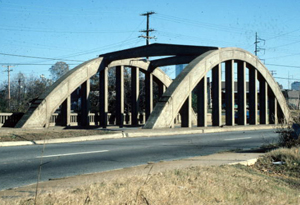
Since today is Abraham Lincoln’s birthday, it is a good day to pay tribute to the Lincoln Avenue Viaduct.  This arched bridge is traversed by thousands of cars each day, with most having no idea the name of the structure.  The Lincoln Avenue Viaduct is the arched bridge connecting LaHarpe with Cantrell Road which (literally) bridges downtown with the west along Highway 10.

The Lincoln Avenue Viaduct is a reinforced concrete rainbow arch bridge. It was opened at 2:05 p.m. on Friday, December 28, 1928, and, despite later alterations, it remains particularly well-preserved. The Missouri Pacific Railroad Company, considered the most important railroad company in the state, constructed the bridge amid a series of improvements in Little Rock made necessary by the damage wrought by the infamous spring floods of 1927.

Though the bride was constructed by the railroad, the City had to give authorization to do so, this was accomplished by the passing of Ordinance 4,335, at the May 28, 1928, City Council meeting.

Lincoln Avenue was one of several names for stretches of Highway 10 in Little Rock. By the 1960s, the areas west of the Lincoln Avenue viaduct were all renamed Cantrell in honor of the man who had developed much of the area west of the Heights. The longest stretch of the road already carried that name. There had been an effort to rename Highway 10 (including sections named Lincoln, Q, and Cantrell) in Little Rock for Senator Joseph Taylor Robinson in 1930. He declined the offer because he did not want to diminish the contributions of Mr. Cantrell.  Over time the entire stretch bore the name Cantrell.

The stretches east of the viaduct which involved a couple of names were renamed La Harpe Boulevard in honor of the French explorer who first saw the Little Rock. (La Harpe was originally an extension of Riverfront Drive. But with changes to development along the Arkansas River and the coming of I-30, the streets were reconfigured significantly in the 1950s and early 1960s.)

Though the street has been renamed, the bridge still carries the name of the 16th President of the United States.

Rock the Oscars: Nine from Little Rock

On April 5, 1965, the Academy Award for Best Documentary, Short Subject went to the film “Nine from Little Rock.”

Narrated by Jefferson Thomas, Charles Guggenheim’s documentary looks at the nine African-American students who enrolled in Little Rock Central High School in 1957. Thomas, one of the students reflects on the state of race relations in the seven years that had elapsed (up to 1964).  The film also focuses on Ernest Green, Elizabeth Eckford and Thelma Mothershed.

Guggenheim both directed and co-wrote the film. The latter credit was shared with Shelby Storck, who also produced the film.   The film had been commissioned by George Stevens, Jr., for the United State Information Agency.

The Oscar that night was Guggenheim’s first of four.  His others would be for: 1968’s “Robert Kennedy Remembered” (Live Action Short), 1989’s “The Johnstown Flood” (Documentary Short) and 1994’s “A Time for Justice” (Documentary Short).  His son Davis Guggenheim won the Oscar for Documentary, Feature for An Inconvenient Truth.

The film was digitally restored by the Motion Picture Preservation Lab for the 50th anniversary of its win for Best Short Documentary at the 1965 Academy Awards.  It is available for purchase on DVD and can also be viewed in its entirety on YouTube

Little Rock Look Back: Bombing of the Carlotta Walls Home

On February 9, 1960, a bomb was detonated at the home of Carlotta Walls. One of the Little Rock Nine as a sophomore, she was now in her senior year at Little Rock Central High.  This followed the September 1959 Labor Day bombings in Little Rock.

The bomb went off at approximately 11:00pm.  The blast could be heard for two miles from the house (located at 1500 S Valentine St.). Carlotta’s mother, Juanita, and sisters were at home with her, though her father, Cartelyou, was at his father’s house at 3910 West 18th Street.  Thankfully all members of the family were not physically harmed.  Two sticks of dynamite were used for the bomb.  The blast removed brick and broke three windows in the Walls house.

According to media accounts, this bombing was the first in the United States directed at a student since the 1954 US Supreme Court decision in Brown v. Board of Education.  As such, it made national headlines.  Carlotta was not deterred.  She had no thought of dropping out of school.

Reaction in the community including the Women’s Emergency Committee deploring the action and the NAACP being outraged.  The Little Rock School District only stated that it was a matter for the police.  The Chamber of Commerce was concerned about the impact it would have on attracting industry.

The FBI came in to investigate in addition to the Little Rock Police Department.  Two African Americans, Herbert Monts and Maceo Binns, Jr., were convicted for causing the bombing. Binns’ conviction was thrown out because it was proven he was coerced into a confession.  Monts served twenty (20) months of a five year sentence.  The supposed motive was to build sympathy for the African American community.  Carlotta Walls LaNier has stated that she did not believe the men bombed her house.

Monts has petitioned the Arkansas Parole Board for a pardon. It is scheduled to be reviewed in September 2018.


2018 Grants announced by National Endowment for the Arts; includes 4 Little Rock groups

Four Little Rock organizations were announced today as recipients of grants from the National Endowment for the Arts.  They are: Arkansas Repertory Theatre, Arkansas Symphony Orchestra, Chamber Music Society of Little Rock, and the Oxford American magazine.

Each year, more than 4,500 communities large and small throughout the United States benefit from National Endowment for the Arts (NEA) grants to nonprofits. For the NEA’s first of two major grant announcements of fiscal year 2018, more than $25 million in grants across all artistic disciplines will be awarded to nonprofit organizations in all 50 states, the District of Columbia, and Puerto Rico. These grants are for specific projects and range from performances and exhibitions, to healing arts and arts education programs, to festivals and artist residencies.

“It is energizing to see the impact that the arts are making throughout the United States. These NEA-supported projects are good examples of how the arts build stronger and more vibrant communities, improve well-being, prepare our children to succeed, and increase the quality of our lives,” said NEA Chairman Jane Chu. “At the National Endowment for the Arts, we believe that all people should have access to the joy, opportunities, and connections the arts bring.”


Arkansas Repertory Theatre Company
$10,000 Little Rock, AR
Art Works — Theater
To support a production of “The Call” by Tanya Barfield.


Arkansas Symphony Orchestra Society, Inc.
$12,500 Little Rock, AR
Art Works — Music
To support the Canvas Festival, which will combine visual arts and the performance of live symphonic music.


Chamber Music Society of Little Rock
$10,000 Little Rock, AR
Challenge America
To support a series of chamber music performances and related educational programming.


Oxford American Literary Project

$25,000 Little Rock, AR
Art Works — Literature
To support the publication and promotion of “The Oxford American” magazine.