
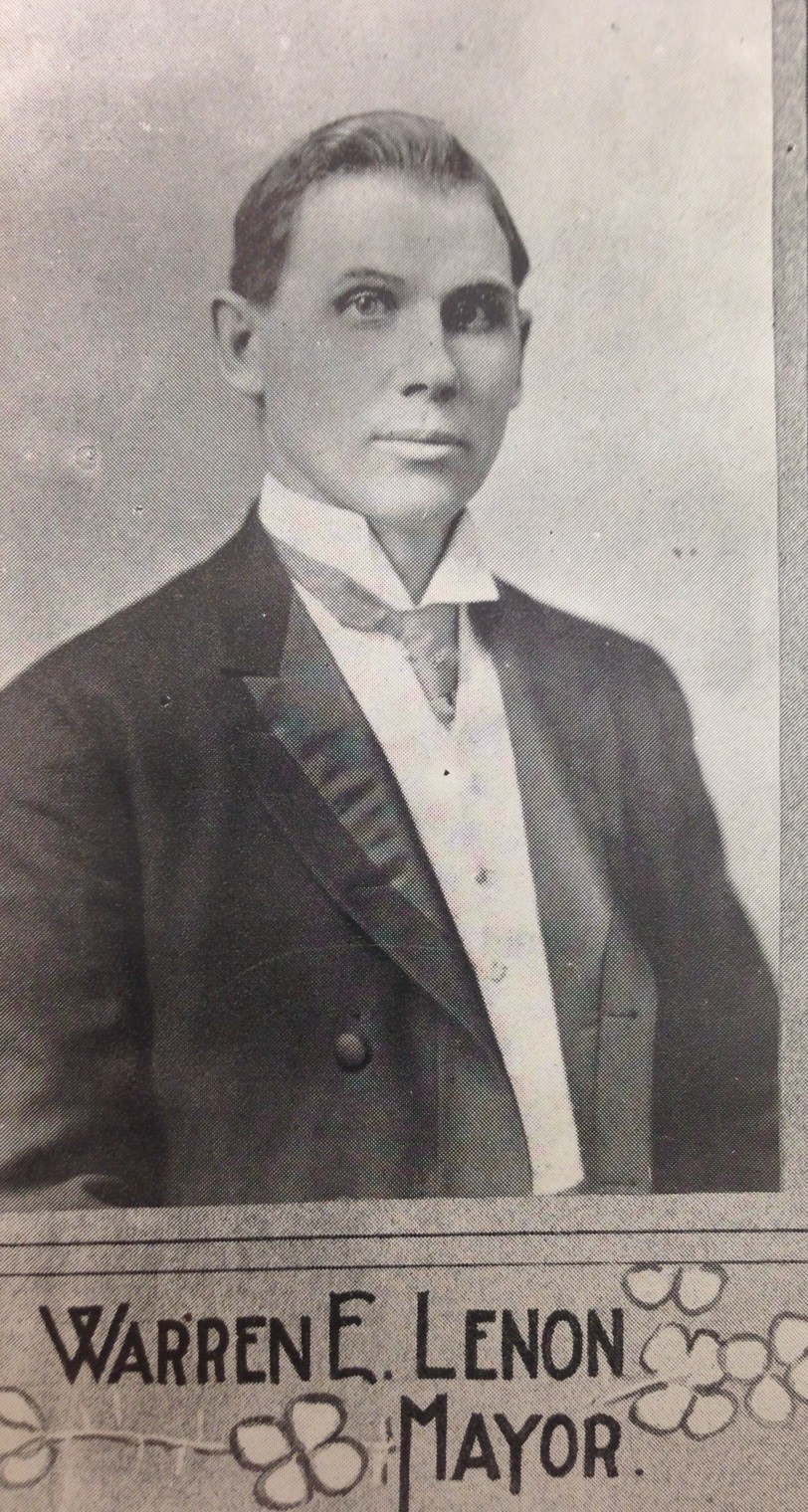
Little Rock Look Back: Warren E. Lenon

OMayor Lenonn October 8, 1867 in Panora, Iowa, future Little Rock Mayor Warren E. Lenon was born.  He was one of eleven children of John D. and Margaret M. Long Lenon.

Lenon came to Little Rock in 1888 after finishing his schooling in Iowa.  He helped set up an abstract company shortly after his arrival.  In 1902 he organized the Peoples Savings Bank.  Among his other business interests were the City Realty Company, the Factory Land Company, the Mountain Park Land Company, and the Pulaski Heights Land Company.

From 1895 to 1903, he was a Little Rock alderman, and in 1903, he was elected Mayor of the city. A progressive Mayor, he championed the construction of a new City Hall which opened in 1908.  At the first meeting of the City Council in that building, Mayor Lenon tendered his resignation.  His duties in his various business interests were taking up too much of his time.

Mayor Lenon had been a champion for the establishment of a municipal auditorium. He had wanted to include one in the new City Hall complex. But a court deemed it not permissible under Arkansas finance laws at the time.  He also worked to help establish the first Carnegie Library in Little Rock which opened in 1912.

Mayor Lenon continued to serve in a variety of public capacities after leaving office.  In the 1920s, he briefly chaired a public facilities board for an auditorium district. It appeared he would see his dream fulfilled of a municipal auditorium.  Unfortunately the Arkansas Supreme Court declared the enabling legislation invalid.

In 1889, he married Clara M. Mercer.  The couple had three children, two of whom survived him.  A son W. E. Lenon Jr., and a daughter Vivian Mercer Lenon Brewer.  Together with Adolphine Fletcher Terry (also a daughter of a LR Mayor), Mrs. Brewer was a leader of the Women’s Emergency Committee.

Mayor Lenon died June 25, 1946 and is buried at Roselawn Cemetery.  Lenon Drive just off University Avenue is named after Mayor Lenon.

Central to Creativity – Dr. Sybil Jordan Hampton

Dr. Sybil Jordan Hampton made history as the first African American student to attend each high school year at and graduate from Little Rock Central High School.  But her impact on history exceeds that and extends into classrooms throughout Arkansas.
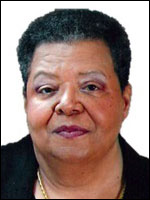
After a career which took her from elementary classrooms to corporate boardrooms, Dr. Hampton returned to Little Rock in 1996 to become the Executive Director of the Winthrop Rockefeller Foundation.  In that capacity, she oversaw many opportunities to broaden the ways the arts and humanities were used in classrooms and outside of classrooms.  Dr. Hampton led the WRF until her retirement in 2006.  Through her vision and leadership, many tens of thousands of dollars of support went to cultural institutions and organizations during her decade at the helm.

Following the untimely death of the Arkansas Symphony Orchestra’s executive director, Dr. Hampton served as acting executive director of the ASO while a national search could be conducted.  She had long been a supporter of the ASO and other cultural institutions as a patron.

During the Central High Integration 60th Anniversary, Dr. Hampton served as emcee of the Commemoration Ceremony.  She continues to be involved with Little Rock’s cultural life through her involvement in the Mount Holly Cemetery Association. She is a tireless advocate for this living museum of Little Rock’s past.

Little Rock Look Back: Elizabeth Eckford

After 60 years, the most dramatic images of the 1957 crisis at Little Rock Central High School remain those of 15-year-old Elizabeth Eckford, being taunted as she walked through a hate-filled mob, on her way to school.  Today, Ms. Eckford recalls how difficult it was for her parents, Oscar and Birdie, to allow her to continue the struggle to integrate the Little Rock schools.

Born on October 4, 1941, she grew up in Little Rock.  Because all of the city’s high schools closed her senior year, Ms. Eckford moved to St Louis, where she obtained her GED. She attended Knox College in Illinois, and received her BA in History from Central State University in Wilberforce, Ohio.  While in college, Ms. Eckford became one of the first African Americans to work in a local St. Louis bank, in a non-janitorial position, and later she worked as a substitute teacher, in Little Rock public schools.

Ms. Eckford, a veteran of the U.S. Army, has also worked as a substitute teacher in Little Rock public schools, test administrator, unemployment interviewer, waitress, welfare worker, and military reporter.  Along with her fellow Little Rock Nine members, she is a recipient of the NAACP’s Spingarn Medal and the prestigious Congressional Gold Medal.  Together with one of her former tormenters, Ms. Eckford also received a Humanitarian award, presented by the National Conference for Community and Justice (NCCJ), following their meeting 34 years after an apology.  The award recognizes forgiveness and atonement.  They talked to students for two years, and, together, attended a 12-week racial healing course.

Ms. Eckford has started to walk through the painful past in sharing some of her story.  She has said that true reconciliation can occur if we honestly look back on our shared history. She believes that the lessons learned from Little Rock Central High School must continue to be shared with new generations, reminding audiences that “the dead can be buried, but not the past.”  Ms. Eckford continues her interest in education by sharing her story with school groups, and challenges students to be active participants in confronting justice, rather than being passive observers.

Ms. Eckford lives in Little Rock, and is a probation officer for the First Division Circuit Court of Pulaski County.

JFK in LR and other parts of ARK

JFK LROn October 3, 1963, President John F. Kennedy delivered remarks at the Arkansas State Fairgrounds.  Only a few weeks later, he would be felled by an assassins bullet in Texas.
In the speech, the President praised Arkansas’ congressional delegation including Senators John McClellan and J. William Fulbright and Congressmen Took Gathings, Bill Trimble, Wilbur Mills and Oren Harris.  Each of these men held senior leadership positions in key committees.  The main focus of the speech was to discuss President Kennedy’s vision for a new economy in the South.

The President was actually in the state to speak at the dedication of the Greers Ferry Dam. He agreed to make that appearance as a part of a negotiation with Congressman Mills as they were deadlocked over changes to the tax code.  He had previously visited Little Rock in 1957 when he came to the state to address the Arkansas Bar Association meeting in Hot Springs.

President Kennedy continued the string of 20th Century Presidents to visit Little Rock.  Presidents Theodore Roosevelt, William Howard Taft, Franklin Roosevelt and Harry Truman had all visited while in office.  Woodrow Wilson, Herbert Hoover and Dwight Eisenhower all visited prior to attaining the presidency.

Little Rock Look Back: US Supreme Court announces Cooper v. Aaron decision

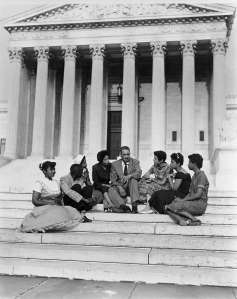
Thurgood Marshall, of the NAACP, sits on the steps of the Supreme Court Building after he filed an appeal in the integration case of Little Rock’s Central High School. The students are, from left: Melba Pattillo, Jefferson Thomas, Gloria Ray, escort Daisy Bates, Marshall, Carlotta Walls, Minnijean Brown, and Elizabeth Eckford. (AP Photo, file)

On September 29, 1958, the U.S. Supreme Court issued its decision in Cooper v. Aaron. That decision held that Little Rock public officials were required to implement a desegregation plan in compliance with the Brown v. Board decision.

The Court found that “the federal judiciary is supreme in the exposition of the law of the Constitution” and all state officials must adhere to the Court’s decisions and follow the rules laid down in those decisions in similar future cases.

The genesis for the Cooper v. Aaron court case was the Little Rock School Board seeking a delay in further implementation of the plan to integrate schools.

After the events of 1957-1958, the School Board was reluctant to have another year of integration, even if it were severely limited. The school board caved to this political pressure, filing a request for a two-and-a-half-year delay in implementing desegregation. The district court granted the request, but the court of appeals reversed. Chief Justice Earl Warren called a Special Term of the Supreme Court into session to consider the case. The stage was set for Cooper v. Aaron.

In their decision, the Warren Court made it clear that resistance to Brown would not be tolerated. The Court went on to state that “the federal judiciary is supreme in the exposition of the Constitution” and “the interpretation of the Fourteenth Amendment enunciated by this Court in the Brown case is the supreme law of the land.”

Little Rock Look Back: Pulaski Heights City Council first meeting

On September 28, 1905, the first meeting of the Pulaski Heights City Council took place.  The newly elected Mayor was J. H. Joslyn, the Recorder was F. D. Leaming, and new Alderman present were E. E. Moss, Maxwell Coffin and C. C. Thompson.  Pulaski Heights had been incorporated on August 1, 1905.  At that time its population was estimated at between 300 and 400.

The first ordinance, which was offered by E. E. Moss, was to set a tax rate and give the City the ability to levy taxes.  Next was a motion to establish a committee to establish rules and procedures for the council. The final business before the Council was to allow the Recorder to order stationary, a seal and a record book (that record book is now in the vault at Little Rock City Hall).

The next meeting would be October 28.  At that meeting, two other Aldermen are mentioned in the minutes (Fauble and Paul) but were absent from that meeting as well.  Mr. C. M. Fauble was present at the third meeting.  Mr. R. O. Paul did not appear until the fifth meeting (December 13, 1905).

Interestingly the Recorder had a vote in the Council meetings (which was not a practice in the City of Little Rock at the time).

The Council did not have a permanent meeting place until the third meeting.  At that point in time, they used space in the offices of Dr. Hockersmith.  They later met in a building which is now part of the Pulaski Heights Baptist Church campus.

Pulaski Heights was a separate City until January 1916.  On January 4, 1916, Little Rock voters approved the annexation of Pulaski Heights by a ten-to-one margin, and the suburb became the city’s ninth ward. This established a couple of precedents for the City of Little Rock which are in effect to this day.  The first is that Little Rock would not be a central city surrounded by a variety of small incorporated towns (in the manner that St. Louis and other cities are).  It was this thought process which has led the City to continue to annex properties.

In addition, this move to annex Pulaski Heights was the first time that the City grew toward the west.  Previous growth had been to the south.  By emphasizing western expansion, this has allowed Little Rock to continue to grow.

Little Rock Look Back: LR Voters ratify closing of high schools

fedgovark

Signs placed outside of Little Rock’s high schools erroneously cited the federal government as the source of school closures.

On September 27, 1958, voters in Little Rock approved the continuation of the closure of the city’s high schools.

Using legislation passed by the General Assembly in a hastily called special session in summer of 1958, Governor Orval Faubus had ordered the closure of Little Rock’s four public high schools in order to keep them from being desegregated.  But that state law only allowed the closure of Central, Hall, Horace Mann and Technical high schools on a temporary basis. In order for them to be closed permanently, the city’s voters must approve it by a vote.

The election date was to be set by Governor Faubus.  Originally scheduled for Tuesday, October 7, the date was moved to September 27.  Speculation for the new date selection centered on:

  • Faubus wanted it to be prior to the October 1 poll tax deadline so that only people who had paid their poll tax for the prior year were eligible
  • The election was on a Saturday.  Though Tuesday was the most common day of the week for elections, in the late 1950s Saturdays were used on elections as well.  The school board elections, for instance, were on Saturdays in some years.
  • On September 27, 1958, the Arkansas Razorbacks had a home football game in Fayetteville.

These were all designed to stifle voter turnout. In addition, the state law required a majority of eligible voters to approve reopening the schools.  The law also spelled out the confusing wording of the ballot question.  As historian Sondra Gordy points out in her book FINDING THE LOST YEAR, the ballot question was about only being for or against integration of the schools – it did not say anything about closure or opening of schools.

While the newly formed Women’s Emergency Committee did try to educate voters about the issue and encourage a vote to reopen the schools, this nascent group was less than a fortnight old by the Saturday election day.  In addition, the Governor campaigned for the remaining closure of the schools including in television appearances.

On that Saturday, Little Rock voters voted 19,470 to keep schools segregated to 7,561 to integrate them.

It would be a long road ahead to reopen the schools.  It would take two more elections before the City’s four public high schools would reopen.