
Little Rock Look Back: Roswell Beebe receives Little Rock land title

Map showing boundaries of original City of Little Rock

Map showing boundaries of original City of Little Rock

On September 25, 1839, businessman Roswell Beebe received title to all of the land in Little Rock.

Starting in the 1810s, there had been much dissension as to who had title to land in what would become Little Rock.  As the settlement developed into a town and city, these disagreements became greater. Often land speculators would sell land to settlers without having the right to do so.

Coming to Little Rock in 1835, Beebe was a witness to the continued uncertainty over land ownership.  In early 1839, he acquired 240 acres which had the only incontestable title in town. This acreage comprised most of Little Rock. He went to Washington DC in 1839 and, on September 25, received the original patent for the town of Little Rock, signed by President Martin Van Buren. It is recorded in the Pulaski county recorder’s office Book L, page 312.

Upon his return, Beebe gave all the people who had bought lots from a certain real estate developer, whom he considered to be fair and honest, title to their land for a dollar. In December 1839, he drew up a plan for Little Rock, laying off blocks and streets. He deeded the streets and alleys to the city for a dollar. He gave the state the title for the land on Markham Street, where the new capitol building (now the Old State House Museum) was located.  He also donated part of the land for Mount Holly Cemetery, the other portion came from his brother-in-law Chester Ashley.
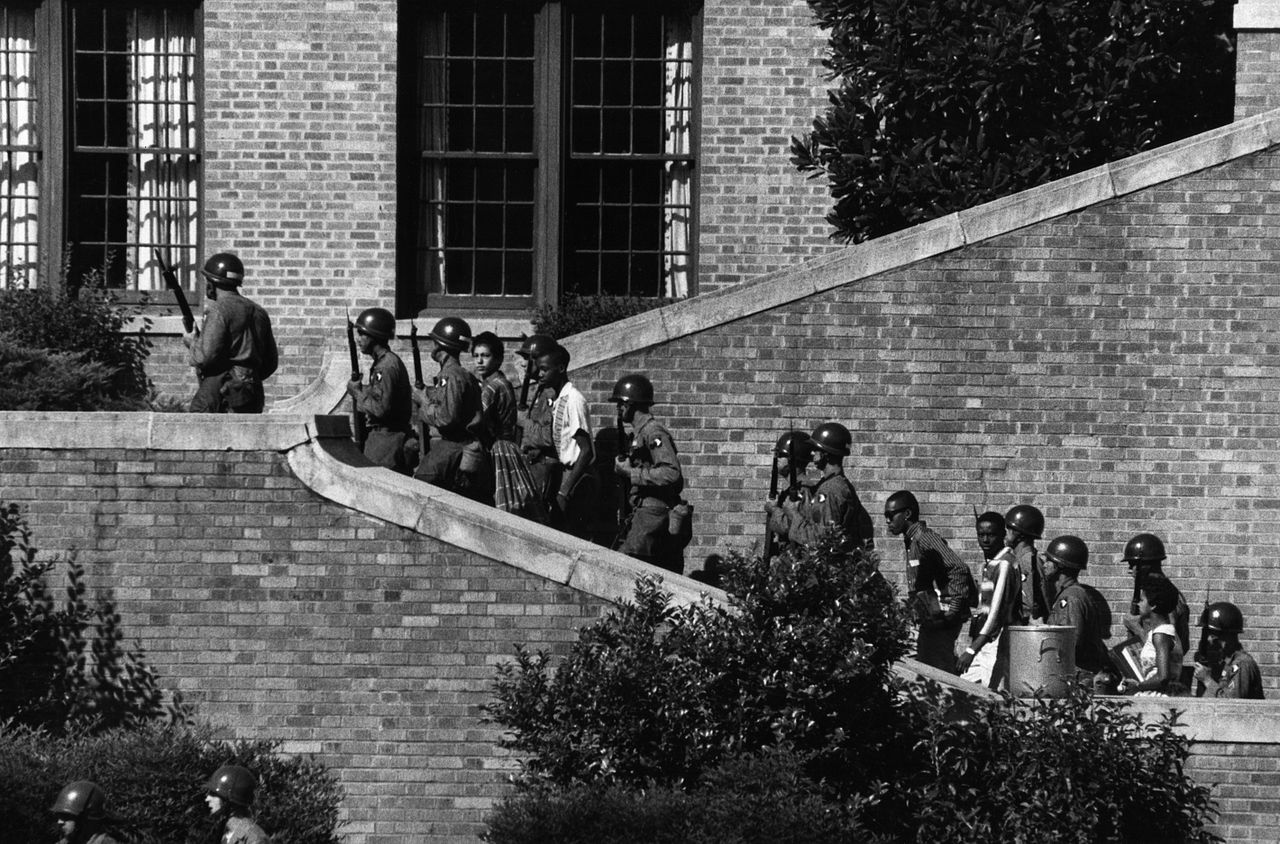
Little Rock Look Back: The Little Rock Nine finally enter Central High

101st_Airborne_at_Little_Rock_Central_HighIt was 58 years ago today that the Little Rock Nine entered Central High School and stayed. On one hand, this brought to the end a nearly month long standoff between segregationists and those who wanted to obey the U.S. Supreme Court’s Brown v. Board decision.

In the bigger picture, the struggle did not end that day.  Throughout the remainder of the school year, the Little Rock Nine were subjected to threats, isolation and hostility.  Outside of the school, while the crowds may had dispersed after September 25, the raw feelings did not subside.

This was evidenced by the fact that the following year the high schools were closed to avoid having them integrated.

But September 25, 1957, was an historic day in the United States. Under guard of members of the 101st Airborne Division of the Army, the Little Rock Nine were escorted into Central High School. This action by President Dwight Eisenhower was the result of the intrusive efforts of Governor Orval Faubus who had used the Arkansas National Guard to keep the nine students out.

The City of Little Rock was largely a bystander in this issue. The form of government was changing from Mayor-Council to City Manager in November 1957. Therefore Mayor Woodrow Mann and the entire City Council were lame ducks. Mann, whose son was a senior at Central, tried to focus on keeping the peace in Little Rock. Most (if not all) of his Council members sided with the Governor.

Congressman Brooks Hays, a Little Rock resident, had tried to broker an agreement between the President and the Governor but was unsuccessful.  Following that, Mayor Mann was in discussions with the White House about the ability of the Little Rock Police Department to maintain order.  Finally, in the interest of public safety, the President federalized the National Guard and removed them. This paved the way for the Army to come in.

Though the school year was not easy, the nine youths who became known worldwide as the Little Rock Nine were finally in school.  They were Minnijean Brown, Elizabeth Eckford, Ernest Green, Thelma Mothershed, Melba Patillo, Gloria Ray, Terrence Roberts, Jefferson Thomas and Carlotta Walls.

In 1997, President Bill Clinton, Governor Mike Huckabee and Mayor Jim Dailey, famously held open the doors of Central High for the Little Rock Nine on the 40th anniversary.  Ten years later, Clinton, Huckabee and Dailey returned joined by current Governor Mike Beebe and Mayor Mark Stodola to host the 50th anniversary events.

Today the school is a National Historic Site, while still functioning as a high school.

Little Rock Look Back: LR City Hall Ceases Operation in 1863

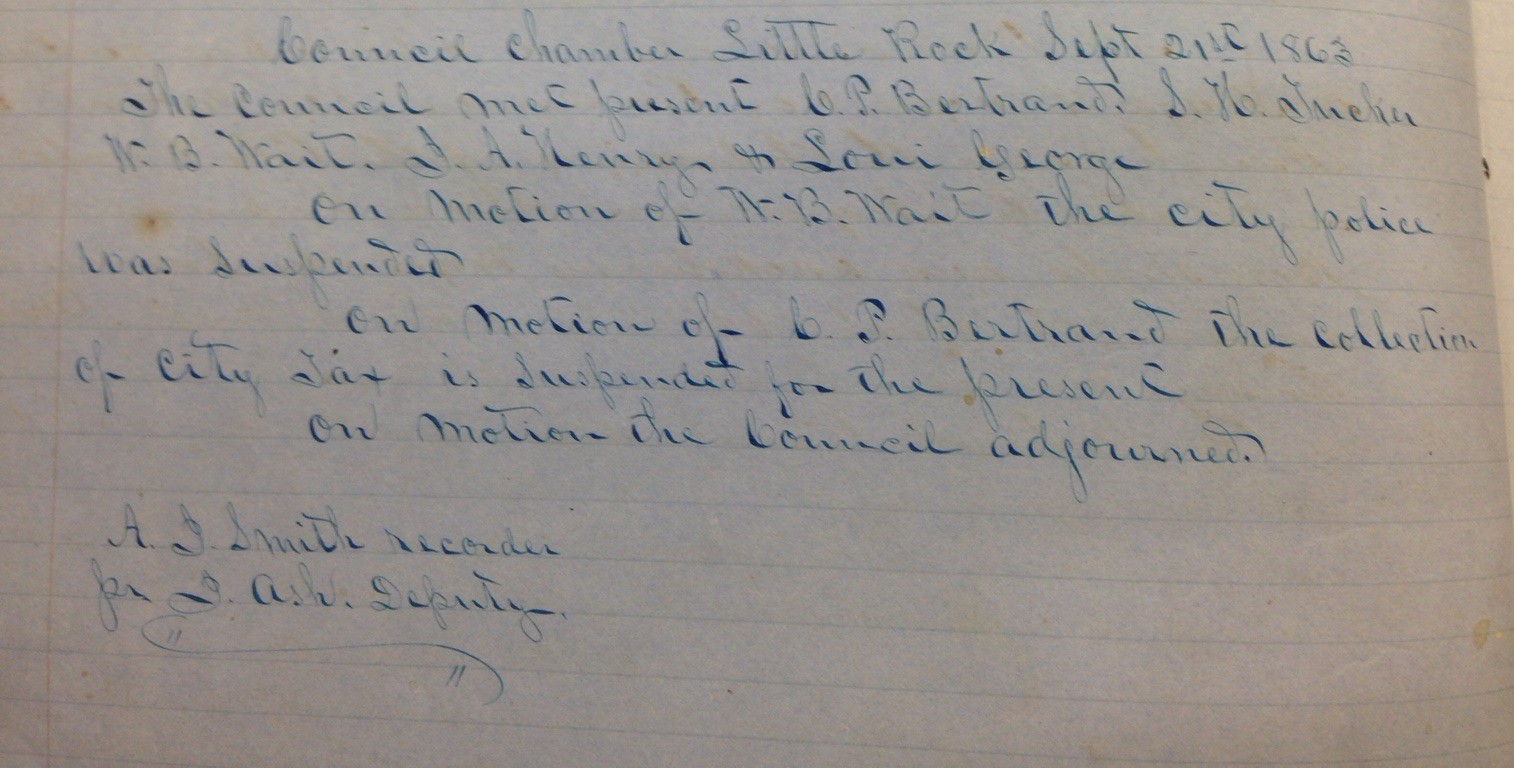
LR1863 minutes of closureFollowing the Battle of Little Rock, the City of Little Rock ceased operations on September 21, 1863.

Planning for this had started in August, which would suggest that civic leaders were none too confident in the ability of Confederate forces to hold on to the city.  At the August 24, 1863, City Council meeting it was reported that the City’s funds (presumably Confederate) had been “placed in the hands of a reliable party who is well known to the Council.”  The identity of this “reliable party” has never been disclosed.

On September 21, the Council met and took three votes.  The first was to suspend the operation of City police (which at the time was not an official police force, it was a constable and some volunteers). The second was to suspend the collection of City taxes.  The final vote was to adjourn.

There is no record of Mayor William Ashley being present at this meeting.  Recorder A. J. Smith (the equivalent of City Clerk today) was not present.  The minutes were signed by “J. Ash, Deputy.” Records do not indicate if that gentleman was officially Deputy Recorder or if he had simply been deputized to take minutes at the meeting.  The five City Council members present were C. P. Bertrand (a former mayor and step-son of Little Rock’s first Mayor, Matthew Cunningham), S. H. Tucker, W. B. Walt, I. A. Henry (would would also serve on the first City Council after the war in 1866), and Lou George.

Little Rock Look Back: Mayor John E. Knight

Jno E Knight sigOn September 20, 1816, future Little Rock Mayor John Elliott Knight was born in Newburyport, Massachusetts. In 1843 he married Hannah Donnell in New York, and came to Little Rock that same year.

Knight was editor of the Arkansas Democrat from 1846 to 1850. He was also associated with the Arkansas Gazette and published the short-lived Chronicle. In 1851, Knight served as Mayor of Little Rock. In 1855, he served as a member of the City Council.

In 1858 a song was published entitled “I Am Near to Thee” which featured music by Arkansan Benjamin Scull and lyrics by Knight.  The song was dedicated to Mary Woodruff.

During the Civil War, he served as a Colonel.  During the 1850, 1860 and 1880 census, he was listed as an attorney.

He had one daughter, Elizabeth Knight, who married James S. Pollock, a banker in Little Rock. Knight died in Little Rock, Arkansas, on October 28, 1901, and was buried in Mount Holly Cemetery. Elizabeth Knight Pollock died in 1910.

As an attorney and newspaper editor, John E. Knight collected documents about the settlement of Little Rock. Those papers are now part of a collection at the Arkansas History Commission.  The majority of these papers are from William Russell to Chester Ashley, pertaining to pre-emption claims in and around Little Rock. Other material concerns the 1819-1822 dispute related to the the New Madrid Certificate and pre-emption claims of James Bryant, Stephen F. Austin, and William M. O’Hara.

4th Annual Tinkerfest today at Museum of Discovery

tinkerfestThe Museum of Discovery presents its fourth annual Tinkerfest from 9 a.m. to 3 p.m. Saturday, Sept. 19, offering the public a chance to discover how everyday objects such as cars and computers work, and opportunities to explore the engineering and science behind building objects.

More than 40 stations will be set up both inside and outside the museum. Among the activities Tinkerfest visitors can engage in:  

  • Toy take-apart
  • Car take-apart
  • Water exploration activities
  • Marshmallow shooters
  • Tiny drawings
  • Light painting
  • “How to make” workshops
  • Squishy circuits
  • Cardboard maze
  • Construction for kids

There also will be food trucks at Tinkerfest selling a variety of food.

“Tinkerfest is one of the great days of the year at the Museum of Discovery,” said Kelley Bass, museum CEO. “It’s invigorating to see hundreds of families engaged in hands-on activities that are as instructional as they are enjoyable. Tinkerfest is directly aligned with the museum’s mission, and we’re happy the public has embraced it so enthusiastically.”

Cross Gunter Witherspoon and Galchus is Tinkerfest’s presenting sponsor. The event is also made possible through financial support from Welspun Tubular; Arkansas Discovery Network; East-Harding Construction; AT&T; Entergy Arkansas; Central Arkansas Water; Nabholz Construction; Arkansas School for Math, Science and Arts; Acxiom; Ace Glass; Caterpillar; VCC; and Spectra Entergy.

Tinkerfest activities are included in the museum’s regular daily admission: $10 for adults, $8 for children 1-12 and free for infants younger than 1. Seniors, teachers, Little Rock city employees and active and retired military are admitted for $8.

To learn more about Tinkerfest, visit https://www.museumofdiscovery.org/events/tinkerfest 

Museum of Discovery’s mission is to ignite a passion for science, technology and math in a dynamic, interactive environment.

1,000th Clinton School Speaker tonight with Chelsea Clinton

chelseaIn “It’s Your World: Get Informed, Get Inspired & Get Going!,” Chelsea Clinton tackles the biggest challenges facing us today. She combines facts, charts, photographs and stories to give readers a deep understanding of the world around them and how anyone can make a difference. With stories about children and teens who have made real changes big and small, this book inspires readers of all ages to do their part to make our world a better place.

One of Clinton’s favorite childhood books was “50 Simple Things Kids Can Do to Save the Earth;” as an elementary school student in Little Rock, AR, she helped start a paper-recycling program at her school; as a teenager in Washington, D.C., she led her school’s service club; and as a student at Stanford University, she volunteered as a reading and writing tutor and at the Children’s Hospital.

Today, she is Vice Chair of the Bill, Hillary and Chelsea Clinton Foundation where she helps lead the work of the Foundation across its various initiatives, with a particular focus on work related to health, girls and women, creating service opportunities, and empowering the next generation of leaders. Chelsea holds a BA from Stanford University, an MPH from Columbia University, and an MPhil and doctorate degree in international relations from Oxford University.

The lecture featuring Chelsea Clinton will be the 1,000th public program for the Clinton School of Public Service. On September 18, 2004, the Clinton School welcomed their first public program speaker, Senator Bob Dole.

This event will be at the Wally Allen Ballroom at the Statehouse Convention Center at 6pm.

Final week for 57th Delta Exhibition at Arkansas Arts Center

arkartsThe 57th Annual Delta Exhibition provides a unique snapshot of the Delta region by showcasing innovative and provocative contemporary works in all media.

Guest juror George Dombek, an internationally acclaimed watercolorist and previous Delta award winner, selected the artworks to be exhibited among 882 pieces submitted by 380 artists. He won the 1975 Delta Purchase Award with his work White Whites.

The exhibition is open to all artists who live in or were born in one of the following states: Arkansas, Louisiana, Mississippi, Missouri, Oklahoma, Tennessee and Texas.

72 works were selected for the exhibition from 68 individual artists, with 48 of those artists from Arkansas. In all, eight states were represented in this year’s Delta.

Artists awarded in the 57th Annual Delta Exhibition include:

Grand Award

Mark Lewis of Tulsa, Okla., for his work titled, Under the Oak (Woodward Park)

Delta Awards

Lisa Krannichfeld of Little Rock, Ark., for her work titled, Shirt (in gold), dressed series

Neal Harrington of Russellville, Ark., for his work titled, Feather Signal

Honorable Mentions:

Michael Preble of Hot Springs, Ark., for his work titled, Unintended Consequences

Robyn Horn of Little Rock, Ark., for her work titled, Sideways

Aaron Calvert of Arkadelphia, Ark., for his work titled, Giving Figure

John Salvest of Jonesboro, Ark., for his work titled, Cage A

Laura Terry of West Fork, Ark., for her work titled, Ozarks Landscape, Late Summer

David Underwood of Jefferson City, Tenn., for his work titled, Abandonded Schoolhouse

Contemporaries Delta Award:

Mark Lewis of Tulsa, Okla., for his work titled, Under the Oak (Woodward Park)

Contemporaries Honorable Mentions:

Neal Harrington of Russellville, Ark., for his work titled, Feather Signal

The exhibition, which runs through September 20, is sponsored by Mrs. Lisenne Rockefeller, Bourbon & Boots, The Brown Foundation, Inc. of Houston, Dianne and Bobby Tucker, Janet and Sam Alley and the Capital Hotel. The Grand Award is supported by The John William Linn Endowment Fund. The exhibition is supported by the Andre Simon Memorial Trust in memory of everyone who has died of acquired immune deficiency syndrome (AIDS).