Little Rock Look Back: JFK in the ARK

JFK LROn October 3, 1963, President John F. Kennedy delivered remarks at the Arkansas State Fairgrounds.  Only a few weeks later, he would be felled by an assassins bullet in Texas.  In the speech, the President praised Arkansas’ congressional delegation including Senators John McClellan and J. William Fulbright and Congressmen Took Gathings, Bill Trimble, Wilbur Mills and Oren Harris.  Each of these men held senior leadership positions in key committees.

The main focus of the speech was to discuss President Kennedy’s vision for a new economy in the South.  He tied that to improvements in the state’s universities and colleges as well as public works projects.

The President was actually in the state to speak at the dedication of the Greers Ferry Dam. He agreed to make that appearance as a part of a negotiation with Congressman Mills as they were deadlocked over changes to the tax code.  He had previously visited Little Rock in 1957 when he came to the state to address the Arkansas Bar Association meeting in Hot Springs.

He arrived at the Little Rock Air Force Base, then only a few years old, and proceeded to Heber Springs via helicopter. Students and civic leaders from nearby Batesville were present to help welcome the President and his entourage.  Following the ceremony at Greers Ferry, he and his party ventured to Little Rock.

It was an exceptionally hot October day (temperatures were in the lower 90s), but all else seemed perfect according to media reports.  The Little Rock School District dismissed classes on that day (which was a Thursday) so students could attend the President’s remarks at the Fairgrounds.

Sandwich in History today at the White-Baucum House

ahpp White-Baucum HouseThe monthly architectural history program “Sandwiching in History” visits the White-Baucum House, located at 201 South Izard Street. The program begins at noon today.  A historian with the Arkansas Historic Preservation Program delivers a brief lecture about the church before leading guests on a tour.

This Italianate-style house was built in 1869-1870 for Robert J. T. White, then-Arkansas secretary of state, and was enlarged in the mid-1870s by its second owner, businessman George F. Baucum. The White-Baucum House was recently rehabilitated using federal and state tax incentives to serve as office space.

Sandwiching in History is a program of the Arkansas Historic Preservation Program, an agency of the Department of Arkansas Heritage.  The AHPP is responsible for identifying, evaluating, registering and preserving the state’s cultural resources. Other DAH agencies are the Arkansas Arts Council, the Delta Cultural Center in Helena, the Old State House Museum, the Mosaic Templars Cultural Center, the Arkansas Natural Heritage Commission and the Historic Arkansas Museum.

Vintage Military Vehicles at MacArthur Park this afternoon

macmusMore than 60 vintage military vehicles on a cross-country convoy will be stopping in Little Rock on Wednesday, Sept. 30.

The Military Vehicle Preservation Association is retracing the route of the 1920 Transcontinental Motor Convoy, which also stopped in Little Rock during its 3,300-mile journey from Washington, D.C., to San Diego.

While the convoy is in Little Rock, vintage vehicles will be on display at the south end of MacArthur Park, along with vehicles from the Arkansas Military Vehicle Preservation Association.

The convoy is expected to arrive around noon.

THE COLOR PURPLE shown and explored tonight as part of Banned Books Week

cals bbweek purpleThe Arkansas Literary Festival will celebrate Banned Books Week with an interview reenactment, a film, and a writing contest. A program based on Alice Walker’s Pulitzer Prize and the National Book Award-winning novel, The Color Purple, will be presented on Wednesday, September 30, at 6:30 p.m. at the Ron Robinson Theater, 100 River Market Ave. After the presentation, the 1985 film will be shown. The event is free and open to the public.

Actresses Verda Davenport Booher and Vivian Norman will reenact part of an interview with Alice Walker. The interview touches on Walker’s inspiration for the book and on the success it has had, as well as the film and the musical.

Written as a series of letters, the 1982 novel been challenged repeatedly because of language, sexuality, and violence. The film was directed by Steven Spielberg and nominated for eleven Academy Awards. A successful musical based upon the book opened on Broadway in 2005, and was nominated for ten Tony awards. Oprah Winfrey, nominated for an Oscar as best supporting actress in the film, was one of the producers of the musical. A pared-down revival of the musical is slated to open on Broadway in December, 2015.

Banned Books Week (September 27−October 3, 2015) is an annual event sponsored by the American Library Association celebrating the freedom to read. It highlights the value of free and open access to information and the freedom to seek and to express ideas, even those some consider unorthodox or unpopular. By focusing on efforts across the country to remove or restrict access to books, Banned Books Week draws national attention to the harms of censorship and books that have been targeted with removal or restrictions in libraries and schools. While books have been and continue to be banned, part of the Banned Books Week celebration is the fact that, in a majority of cases, the books have remained available. This happens only thanks to the efforts of librarians, teachers, students, and community members who stand up and speak out for the freedom to read.

The Festival’s celebration of Banned Books Week is sponsored by the Fred K. Darragh Foundation. This is the Festival’s fifth annual Banned Books Week presentation. Other titles that have been featured include The Catcher in the Rye, Lord of the Flies, The Great Gatsby, A Clockwork Orange, A Doll’s House, and The Perks of Being a Wallflower.

The Arkansas Literary Festival is a program of the Central Arkansas Library System (CALS). For more information about the 2016 Arkansas Literary Festival, visit ArkansasLiteraryFestival.org, or contact Brad Mooy at 918-3098. For information on volunteering at the Festival, contact Angela Delaney at 918-3095.

Upcoming US Supreme Court session topic of Clinton School & UALR Bowen Law talk at noon today

us supreme courtIn partnership with UALR William H. Bowen School of Law, the Clinton School Speaker Series presents “Landmark Decisions: What’s on the Docket Next” today at noon.

Every year on the first Monday in October the United States Supreme Court begins its new term. Last term’s same sex marriage and Obamacare decisions are the latest examples of how the Court’s decisions change the way we live. Associate Dean Theresa Beiner and Dean Emeritus John DiPippa at the University of Arkansas at Little Rock Bowen School of Law will discuss last year’s United States Supreme Court term and its blockbuster cases. They will also highlight the important cases on the Court’s docket and their significance.

It will take place at Sturgis Hall.

*Reserve your seats by emailing publicprograms@clintonschool.uasys.edu or calling (501) 683-5239.

Happy 50th Birthday to the National Endowment for the Arts & National Endowment for the Humanities

NEANEH50On September 29, 1965, President Lyndon Baines Johnson signed into law the National Foundation on the Arts and the Humanities Act of 1965 at a White House Rose Garden ceremony, attended by scholars, artists, educators, political leaders, and other luminaries.

The law created the National Endowment for the Humanities as an independent federal agency, the first grand public investment in American culture. It identified the need for a national cultural agency that would preserve America’s rich history and cultural heritage, and encourage and support scholarship and innovation in history, archeology, philosophy, literature, and other humanities disciplines.

On this occasion, President Johnson said: “Art is a nation’s most precious heritage. For it is in our works of art that we reveal ourselves, and to others, the inner vision which guides us as a nation. And where there is no vision, the people perish.”

This new law was the fruit of two presidents, several senators and representatives, and four previous pieces of legislation. Separate bills had been introduced, in previous years, into the House by Representative Frank Thompson (D-NJ), and into the Senate by Senators Hubert Humphrey (D-MN) and Jacob Javits (R-NY). Senator Claiborne Pell (D-RI) had overseen hearings on some of this preliminary legislation, beginning in October 1963, before the death of President John F. Kennedy.

Over the years, the NEA and NEH have awarded millions of dollars to Little Rock based institutions, organizations and individuals through direct appropriations.  They have also impacted Little Rock cultural life through funding of the Mid-America Arts Alliance, Arkansas Arts Council, Department of Arkansas Heritage, Arkansas Department of Parks & Tourism, and U.S. Conference of Mayors among others. These groups have either re-granted the dollars to Little Rock entities or undertaken projects which have directly impacted and improved life in Little Rock.


Little Rock Look Back: First Pulaski Heights Council Meeting

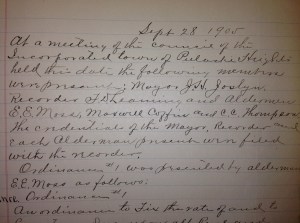
Pul Heights CC minutesOn September 28, 1905, the first meeting of the Pulaski Heights City Council took place.  The newly elected Mayor was J. H. Joslyn, the Recorder was F. D. Leaming, and new Alderman present were E. E. Moss, Maxwell Coffin and C. C. Thompson.  Pulaski Heights had been incorporated on August 1, 1905.  At that time its population was estimated at between 300 and 400.

The first ordinance, which was offered by E. E. Moss, was to set a tax rate and give the City the ability to levy taxes.  Next was a motion to establish a committee to establish rules and procedures for the council. The final business before the Council was to allow the Recorder to order stationary, a seal and a record book (that record book is now in the vault at Little Rock City Hall).

The next meeting would be October 28.  At that meeting, two other Aldermen are mentioned in the minutes (Fauble and Paul) but were absent from that meeting as well.  Mr. C. M. Fauble was present at the third meeting.  Mr. R. O. Paul did not appear until the fifth meeting (December 13, 1905).

Interestingly the Recorder had a vote in the Council meetings (which was not a practice in the City of Little Rock at the time).

The Council did not have a permanent meeting place until the third meeting.  At that point in time, they used space in the offices of Dr. Hockersmith.  They later met in a building which is now part of the Pulaski Heights Baptist Church campus.

Pulaski Heights was a separate City until January 1916.  On January 4, 1916, Little Rock voters approved the annexation of Pulaski Heights by a ten-to-one margin, and the suburb became the city’s ninth ward. This established a couple of precedents for the City of Little Rock which are in effect to this day.  The first is that Little Rock would not be a central city surrounded by a variety of small incorporated towns (in the manner that St. Louis and other cities are).  It was this thought process which has led the City to continue to annex properties.

In addition, this move to annex Pulaski Heights was the first time that the City grew toward the west.  Previous growth had been to the south.  By emphasizing western expansion, this has allowed Little Rock to continue to grow.