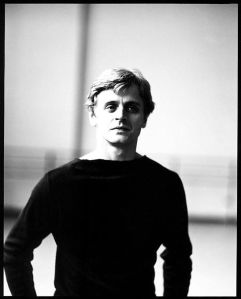
Rock the Oscars: Mikhail Baryshnikov

On July 24, 1983, Mikhail Baryshnikov danced on the stage of Robinson Center under the auspices of Ballet Arkansas.   Nearing the end of his dancing career with American Ballet Theatre, he was leading a summer tour of the Southeast and Midwest US.

In the early spring of 1983, Ballet Arkansas was contacted to see if they would be interested in having him perform in Little Rock.  (The $60,000 sponsorship was paid completely by the ARKANSAS DEMOCRAT.) The performance was announced in April with tickets going on sale shortly thereafter.

Following Baryshnikov’s performance, he and his fellow dancers attended a reception at the Old State House Museum which was hosted by Governor and Mrs. Bill Clinton.

After dancing with the Mariinsky Ballet for several years, he defected to Canada while the ballet was performing there in 1974. He later came to the US to dance with American Ballet Theatre and later New York City Ballet. He returned to ABT in 1980 to take on the role of Artistic Director and continue dancing.  It was in this capacity that he visited Little Rock.

He received a 1977 Oscar nomination for Best Supporting Actor for his role in the ballet-themed film The Turning Point.

Baryshnikov would later be welcomed by the Clintons to the White House when he received a 2000 Kennedy Center Honors.

Rock the Oscars: Gregory Peck

In August 1977, Oscar winner Gregory Peck appeared in Little Rock for the premiere of the film MacARTHUR.  He played the general who had been born in Little Rock but who spent most of his life downplaying (or even denying) that fact.

MacArthur was brought to the screen by Universal Pictures.  It was their attempt to capitalize on the success of the movie Patton, including sharing some of the same members of the production team.

Told entirely in flashback, it starred Peck as the fabled World War II general who was born in Little Rock. It focuses primarily on events in 1942 during the war, his dismissal by Truman in 1952, and his famous address to West Point in 1962.

Peck initially did not care for the subject or the script, but eventually stated that he grew to admire the challenges MacArthur faced.  Peck later called it one of his favorites roles, if not one of his favorite movies.

Producer Frank McCarthy, who worked on both Patton and MacArthur once said of Patton and MacArthur: “Both were complex men but General MacArthur was complex on a much broader scale. Patton had no ambition except to be a soldier and to command a field army. He was strictly command.”

Most of the film was shot on the backlot at the movie studio, which impacted the quality of the film.  The production budget simply would not allow for overseas location filming.

The premiere was a fundraiser for the Museum of Science and History (now the Museum of Discovery).  At the time it was located in the Arsenal Building, in which MacArthur had been born.  Since 1999, that has been home to the MacArthur Museum of Arkansas Military History.  Since MacArthur only spent a few hours in Little Rock as an adult, it is possible that Peck spent more time in the building than the General did.

The evening of August 5, 1977, started with an exclusive reception for 100 people with Gregory and Veronique Peck.  The movie itself was shown at the Cinema 150, where its general run would start on Saturday, August 6.  Following the film, a reception and silent auction brought people back to the museum.  Tickets ran $250 a person for all events, $100 a person for the film and post-show reception, and $25 for the movie.  It sold out.

Governor and Mrs. David Pryor escorted the Pecks into the theatre.  Former Governor (and World War II hero) Sid McMath introduced Mr. Peck to the crowd.  He extolled the virtues of Peck and MacArthur.  (It is interesting that he should admire MacArthur so much, since the General and President Truman had a well-publicized tiff, and McMath and Truman had enjoyed a warm relationship.)  Little Rock City Director Jim Dailey presented Peck with a Key to the City.

MacArthur did not lead to an Oscar nomination for Peck (though he did earn a Golden Globe nomination for the role).  But the actor had enjoyed four nominations prior to his win for To Kill a Mockingbird.  He also received the Jean Hersholt Humanitarian Award from the Academy.  He served as president of the Academy for several years.

 

Little Rock Look Back: Birth of a General

On January 26, 1880, Douglas MacArthur was born in the Arsenal Building while his father was stationed at the Little Rock Barracks.  Though he left Arkansas a few weeks later when his father was transferred, he returned to his birthplace on March 23, 1952. On that day he was greeted by crowds welcoming one of the USA’s most famous military figures.

Though Gen. MacArthur spent only a few weeks in Little Rock, he was baptized at Christ Episcopal Church.  The location of the baptism remains a mystery today because the church was meeting in temporary locations due to the first structure having been lost to a fire.

When the General returned to Little Rock in 1952, he did pay a brief visit to Christ Church.  He also spoke at the Foster Bandshell in the park which bore his name.  He was one of three presidential candidates to speak at the Foster Bandshell in 1952, the others were the eventual Democratic and Republican nominees Adlai Stevenson and Dwight Eisenhower.

When General MacArthur died, he was granted a state funeral.  He was one of the few non-Presidents to have been given this honor.

Today, the MacArthur Museum of Arkansas Military History is located in the Arsenal building.  It was created to interpret our state’s military heritage from its territorial period to the present.

Located in the historic Tower Building of the Little Rock Arsenal–the birthplace of General Douglas MacArthur–the museum preserves the contributions of Arkansas men and women who served in the armed forces.

Exhibits feature artifacts, photographs, weapons, documents, uniforms and other military items that vividly portray Arkansas’s military history at home and abroad.

Little Rock Look Back: LR Votes FOR a Municipal Auditorium

On January 26, 1937, Little Rock voters went to the polls to vote on three different municipal bond issues.  One of them was the construction of a municipal auditorium.

The bonds for the auditorium would be $468,000 in general obligation bonds which would be paid off between 1940 and 1971. This was toward a total cost of $760,000 for the entire project.

The official campaign for the auditorium was sponsored by the Little Rock Forward Committee which was led by W. H. Williams. In campaign advertisements it showed the value of conventions in New York City which was estimated at $100 per convention attendee. Little Rock organizers were estimating a $10 a day expenditure by visitors, which the committee stressed was very conservative. The campaign committee emphasized the importance of acting at that time due to the federal government money involved.

Various committees and organizations endorsed the auditorium project including the Little Rock Chamber of Commerce, Little Rock Federation of Women’s Clubs, and the Young Business Men’s Association.

The thrust of the campaign focused on the economic benefit to Little Rock as well as the fact that the auditorium would be for all citizens. This message was picked up in editorials by both the Democrat and Gazette. In editorials on January 23 and 25, the Democratopined that the benefits of the auditorium would be distributed among all classes of the citizenry. The next day, both papers ran editorials which touted the economic boon an auditorium would bring through conventions and meetings.

The Democrat’s approach broke down the current value of conventions to Little Rock with, what it termed, the city’s “existing inadequate” facilities. The paper emphasized a conservative estimate of what the added value to Little Rock’s economy would be with the new auditorium.

In expressing support for the auditorium the Gazette stressed the values for local, statewide and national groups. “An auditorium would provide a more convenient and better adapted community center for all kinds of local gathering,” and continued that it would make Little Rock “the logical meeting place for state conventions of every sort.” In discussing the value of state, regional and national meetings the paper stressed that the outside money spent by convention attendees has an impact beyond stores, hotels and restaurants.

Both papers also echoed the importance of the federal government financing to make this possible. The Democrat noted that the Public Works Administration grant and federal low cost loan made this an ideal time.

On January 26, 1937, Little Rock voters approved the auditorium bond by a vote of 1,518 to 519. It passed in each of the city’s 23 precincts. Little Rock Mayor R. E. Overman expressed his pleasure at the outcome of the vote and extended his thanks to the voters.

After the election, a Gazette editorial commented on the low turnout for the special election by commenting that the weather had been nice and there were no other barriers to voting. The editorial writer opined that those not voting in the election must not have been opposed to the endeavor.

Little Rock Look Back: LR FINALLY takes possession of Robinson Auditorium

Robinson Auditorium

On January 25, 1940, the City of Little Rock officially took complete possession of the Joseph Taylor Robinson Memorial Auditorium. By assuming custody of the structure from the contractor and the PWA, the City accepted responsibility for any of the remaining work to be completed.  This event happened one day shy of the third anniversary of the election which approved plans to issue bonds for an auditorium.  The act took place only about five months behind schedule.

E. E. Beaumont, the Auditorium Commission chairman, stated that an opening date could not be set until more work was completed. A major unfinished task was the laying of the front sidewalk which had been delayed due to cold weather.

The night before Little Rock took possession, Robinson Auditorium had been a topic of discussion at the Little Rock Chamber of Commerce annual meeting. The new Chamber president Reeves E. Ritchie (who as an Arkansas Power & Light executive had been engaged in the lengthy discussions about the installation of the steam line and transformers of the building) pledged that the Chamber would work to bring more and larger conventions to Little Rock at the Joseph Taylor Robinson Memorial Auditorium.

Rock the Oscars: Leo Robin and Jule Styne

Lyricist Leo Robin with composer Jule Styne working together on the score of Gentlemen Prefer Blondes at the time of the original production in 1949.

Perhaps the most famous song about Little Rock is “(I’m Just a) Little Girl from Little Rock.”  Written by Leo Robin and Jule Styne, it first appeared on Broadway in Gentlemen Prefer Blondes where it was sung by Carol Channing.  When the title was made into a movie, it was sung by Marilyn Monroe and Jane Russell.

Because it was not written for the screen, the song was not eligible for an Oscar.  However, the duo who wrote it had their fair share of Oscar nominations and wins.

Robin, earned ten nominations between 1934 and 1953.  As a lyricist, he collaborated with seven different composers in earning these nominations. His one Oscar came for “Thanks for the Memory” from The Big Broadcast of 1938.  In the film it was sung by Bob Hope and Shirley Ross.  It would be associated with Hope the rest of his life.

Styne also earned ten nominations; his were between 1940 and 1968.  Seven of the nominations were for collaborations with Sammy Cahn.  (There were three other partners with whom he shared nominations, too.)  His win came for “Three Coins in the Fountain” from the film of the same name.  In the movie it was sung by an uncredited Frank Sinatra during the opening title sequence. During the closing credits, an unnamed chorus repeated the song.

Gentlemen Prefer Blondes received no Oscar nominations, though Charles Lederer did receive a Writers Guild of America nomination for screenplay of an American Musical.  Though Jane Russell introduced an Oscar winning Best Song in Paleface (“Buttons and Bows”) and Oscar nominated Best Song in Son of Paleface (“Am I in Love”) she never received an Oscar nomination.  Monroe never received one either.  Only co-star Charles Coburn had any luck with Oscar.  He received three nominations, winning once.

Rock the Oscars: Broncho Billy Anderson

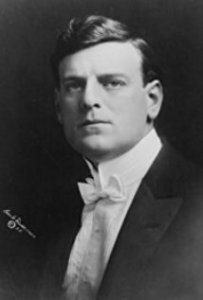
At the 1958 Oscars, GilbertM. “Broncho Billy” Anderson received an Honorary Oscar as a motion picture pioneer.  The citation praised  his contributions to the development of motion pictures as entertainment.

Born in Little Rock in March 1880, he was the son of Esther and Henry Aronson. Both were originally from New York.  Her parents were German-Jewish immigrants and his parents were Russian-Jewish immigrants.

After working as a photographer’s assistant and model, Anderson eventually found his way to vaudeville as a performer and writer.  In 1903, he appeared in the early seminal film The Great Train Robbery in several roles.  He created the western persona of Broncho Billy in front of the cameras.  Behind the scenes, he was a studio owner and director.  Over his career, he directed over 400 films.  By the early 1920s, he retired as an actor and director and devoted himself to owning a Broadway theatre and producing stage shows.

He made occasional film appearances beginning in the 1940s.  In 1958, he appeared in a documentary about Westerns for the TV show “Wide, Wide World.”  Also featured in that special were Little Rock actors Ben Piazza and Gail Davis.  His final screen appearance was in 1965’s The Bounty Killer.  He died in 1971 at the age of 90. He had been married to his wife for sixty years at the time of his death.