
Central to Creativity – Dr. Sybil Jordan Hampton

Dr. Sybil Jordan Hampton made history as the first African American student to attend each high school year at and graduate from Little Rock Central High School.  But her impact on history exceeds that and extends into classrooms throughout Arkansas.

After a career which took her from elementary classrooms to corporate boardrooms, Dr. Hampton returned to Little Rock in 1996 to become the Executive Director of the Winthrop Rockefeller Foundation.  In that capacity, she oversaw many opportunities to broaden the ways the arts and humanities were used in classrooms and outside of classrooms.  Dr. Hampton led the WRF until her retirement in 2006.  Through her vision and leadership, many tens of thousands of dollars of support went to cultural institutions and organizations during her decade at the helm.

Following the untimely death of the Arkansas Symphony Orchestra’s executive director, Dr. Hampton served as acting executive director of the ASO while a national search could be conducted.  She had long been a supporter of the ASO and other cultural institutions as a patron.

During the Central High Integration 60th Anniversary, Dr. Hampton served as emcee of the Commemoration Ceremony.  She continues to be involved with Little Rock’s cultural life through her involvement in the Mount Holly Cemetery Association. She is a tireless advocate for this living museum of Little Rock’s past.
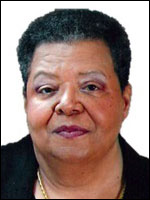
Little Rock Look Back: Elizabeth Eckford

After 60 years, the most dramatic images of the 1957 crisis at Little Rock Central High School remain those of 15-year-old Elizabeth Eckford, being taunted as she walked through a hate-filled mob, on her way to school.  Today, Ms. Eckford recalls how difficult it was for her parents, Oscar and Birdie, to allow her to continue the struggle to integrate the Little Rock schools.
Born on October 4, 1941, she grew up in Little Rock.  Because all of the city’s high schools closed her senior year, Ms. Eckford moved to St Louis, where she obtained her GED. She attended Knox College in Illinois, and received her BA in History from Central State University in Wilberforce, Ohio.  While in college, Ms. Eckford became one of the first African Americans to work in a local St. Louis bank, in a non-janitorial position, and later she worked as a substitute teacher, in Little Rock public schools.

Ms. Eckford, a veteran of the U.S. Army, has also worked as a substitute teacher in Little Rock public schools, test administrator, unemployment interviewer, waitress, welfare worker, and military reporter.  Along with her fellow Little Rock Nine members, she is a recipient of the NAACP’s Spingarn Medal and the prestigious Congressional Gold Medal.  Together with one of her former tormenters, Ms. Eckford also received a Humanitarian award, presented by the National Conference for Community and Justice (NCCJ), following their meeting 34 years after an apology.  The award recognizes forgiveness and atonement.  They talked to students for two years, and, together, attended a 12-week racial healing course.

Ms. Eckford has started to walk through the painful past in sharing some of her story.  She has said that true reconciliation can occur if we honestly look back on our shared history. She believes that the lessons learned from Little Rock Central High School must continue to be shared with new generations, reminding audiences that “the dead can be buried, but not the past.”  Ms. Eckford continues her interest in education by sharing her story with school groups, and challenges students to be active participants in confronting justice, rather than being passive observers.

Ms. Eckford lives in Little Rock, and is a probation officer for the First Division Circuit Court of Pulaski County.

Central to Creativity – Will Trice

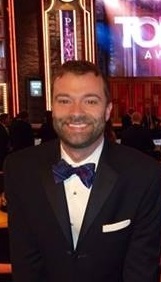
Trice at Tonys

Trice at the 2014 Tony Awards

Tony winning producer Will Trice used his theatrical performing and producing skills while a student at Little Rock Central High School.

In less than a decade on Broadway, Trice has taken home three Tony Awards and earned eight Tony nominations.

He has earned Tony nominations for producing the plays All The Way* and Wolf Hall; play revivals The Best Man, The Glass Menagerie, Who’s Afraid of Virginia Woolf*, and You Can’t Take It With You; and the musical revivals Porgy and Bess* and Fiddler on the Roof.  (An * indicates a Tony win.)

He has worked with playwrights Gore Vidal and Edward Albee in their final Broadway ventures; actors Al Pacino, James Earl Jones, Angela Lansbury, Audra McDonald, Matthew Broderick, Elisabeth Moss, Bryan Cranston, Tracy Letts, Carrie Coon, Elizabeth Ashley, Rose Byrne, Jason Biggs, Marisa Tomei, Bobby Cannavale, Richard Schiff, John C. McGinley, Toni Collette, Michael C. Hall, Cherry Jones and Patti LuPone.

As a producer at Jeffrey Richards Associates, he has also produced national tours and productions in London.

Central to Creativity – Gail Davis

gail_davisGail Davis is best known as TV’s Annie Oakley.  She was born Betty Jeanne Grayson on October 5, 1925. Her mother was a homemaker and her father, W. B. Grayson, was a physician in McGehee (Desha County), which did not have a hospital, so her birth took place in Little Rock (Pulaski County).

When her father became the state health officer, the family moved from McGehee to Little Rock, where Grayson attended Little Rock High School. Grayson rode horses and was a tomboy growing up. Grayson also held various beauty titles in high school and college, and she sang and danced in local shows from the time she was eight.

While studying dramatics at the University of Texas in Austin, she married Robert Davis in 1945, with whom she had a daughter, Terrie (the couple divorced in 1952). After World War II, they moved to Hollywood, where she worked as a hatcheck girl until being discovered by an agent who obtained an MGM screen test for her. She was signed to a contract, with her first appearance in 1947’s The Romance of Rosy Ridge, starring Van Johnson.

She worked steadily in movies, including fourteen films with Gene Autry in the late 1940s and early 1950s. He was impressed with her, changed her name to Gail Davis, and cast her as the star of the Annie Oakley TV show, which he produced. The show ran for eighty-one episodes from 1954 through 1956.

After her TV series ended, she appeared as Annie Oakley in the 1959 film Alias Jesse James starring Bob Hope. In that film, she appears in an uncredited role along with such other stars, also uncredited, as Gary Cooper, Bing Crosby, Roy Rogers, James Garner (as Bret Maverick), and Fess Parker (as Davy Crockett).

Her television appearances include guest roles on The Lone Ranger, The Gene Autry Show, The Cisco Kid, and Death Valley Days, as well as a 1961 episode of the Andy Griffith Show (Episode 37, “The Perfect Female”), her final appearance as a performer and in which she demonstrated her trademark sharpshooting.

Gail toured with Gene Autry’s Wild West show and made appearances as herself on TV programs such as Wide, Wide World: “The Western” (1958) with fellow Arkansan Ben Piazza. For her work in television, she was awarded a star on the Hollywood Walk of Fame, located at 6385 Hollywood Boulevard, and in 2004, she was inducted posthumously into the National Cowgirl Hall of Fame.

Gail Davis died of cancer in Los Angeles on March 15, 1997, and is buried in Hollywood’s Forest Lawn cemetery.  In 2007, she was posthumously inducted into the Arkansas Entertainer’s Hall of Fame.  In 2016, a room was named in her memory at the newly renovated Robinson Center.

JFK in LR and other parts of ARK

JFK LROn October 3, 1963, President John F. Kennedy delivered remarks at the Arkansas State Fairgrounds.  Only a few weeks later, he would be felled by an assassins bullet in Texas.
In the speech, the President praised Arkansas’ congressional delegation including Senators John McClellan and J. William Fulbright and Congressmen Took Gathings, Bill Trimble, Wilbur Mills and Oren Harris.  Each of these men held senior leadership positions in key committees.  The main focus of the speech was to discuss President Kennedy’s vision for a new economy in the South.

The President was actually in the state to speak at the dedication of the Greers Ferry Dam. He agreed to make that appearance as a part of a negotiation with Congressman Mills as they were deadlocked over changes to the tax code.  He had previously visited Little Rock in 1957 when he came to the state to address the Arkansas Bar Association meeting in Hot Springs.

President Kennedy continued the string of 20th Century Presidents to visit Little Rock.  Presidents Theodore Roosevelt, William Howard Taft, Franklin Roosevelt and Harry Truman had all visited while in office.  Woodrow Wilson, Herbert Hoover and Dwight Eisenhower all visited prior to attaining the presidency.

Central to Creativity – Dee Brown

Dee BrownDorris Alexander (Dee) Brown was born in 1908 in Louisiana.  After spending time in Stephens, Arkansas, his family relocated to Little Rock.

He lived more than half his life in Arkansas and, beginning as a teenager, wrote continuously for publication.  An admiration for a Native American baseball player in Arkansas helped influence Brown’s attitude toward Native Americans.  After graduating from high school in 1927, Brown got a job as a printer for the Harrison Daily Times in Boone County.

In 1928, Brown went to Arkansas State Teachers College (ASTC), now the University of Central Arkansas, graduating in 1931 with a Bachelor of Arts and Education degree with a major in history. Brown met his future wife, Sally Stroud of when they were both students there.

In the 1930s, Brown worked in Washington DC for the U.S. Department of Agriculture library. While there, he earned a Bachelor of Library Science degree in 1935 from George Washington University. During World War II, he served in the Army.

His first book was 1942’s Wave High the Banner, which was based on stories Brown had heard his grandmother tell.  In the 1950s, Brown received his Master of Library Science degree at the University of Illinois in Urbana-Champaign.  He worked there as a librarian until 1972 and wrote several books during that time.


In the late 1960s, Brown began writing his groundbreaking book, Bury My Heart at Wounded Knee.  After his return to Little Rock, Brown spent 27 years as a writer.  Brown died on December 12, 2002, at the age of ninety-four at his home in Little Rock. A branch library in

Central to Creativity – Charlotte Moorman

tvbra2For 2017’s Arts and Humanities Month, the blog will focus on cultural personalities who are connected with Little Rock Central High School.

Up first – the Topless Cellist, a 1951 graduate.  Charlotte Moorman

Born in Little Rock, at the age of ten she began to study cello.  After graduating from Little Rock high school in 1951, she attended Centenary College.  She undertook subsequent studies at the University of Texas and Julliard.

After spending time with the American Symphony Orchestra, she participated in the experimental art scene including with her friend Yoko Ono.

In 1963 Moorman founded the Annual Avant Garde Festival of New York, which presented the experimental music of the Fluxus group and Happenings alongside performance, kinetic art, and video art. Despite the event’s title the festival was not held annually. There were fifteen festivals from 1963 to 1980.

On February 9, 1967 Moorman achieved widespread notoriety for her performance of Paik’s Opera Sextronique at the Film-Makers Cinematheque in New York City. For this performance, Moorman was to perform movements on the cello in various states of nudity. For the second movement, she played International Lullaby by Max Matthews while wearing a black skirt, but while being topless, and was arrested mid-performance by three plainclothes police officers For her court trial, Moorman and Paik restaged and filmed the first two movements of Opera Sextronique with the filmmaker Jud Yalkut.

In the late 1970s she was diagnosed with breast cancer. She underwent a mastectomy and further treatment, to continue performing through the 1980s in spite of pain and deteriorating health. She died of cancer in New York City on November 8, 1991, aged 57.