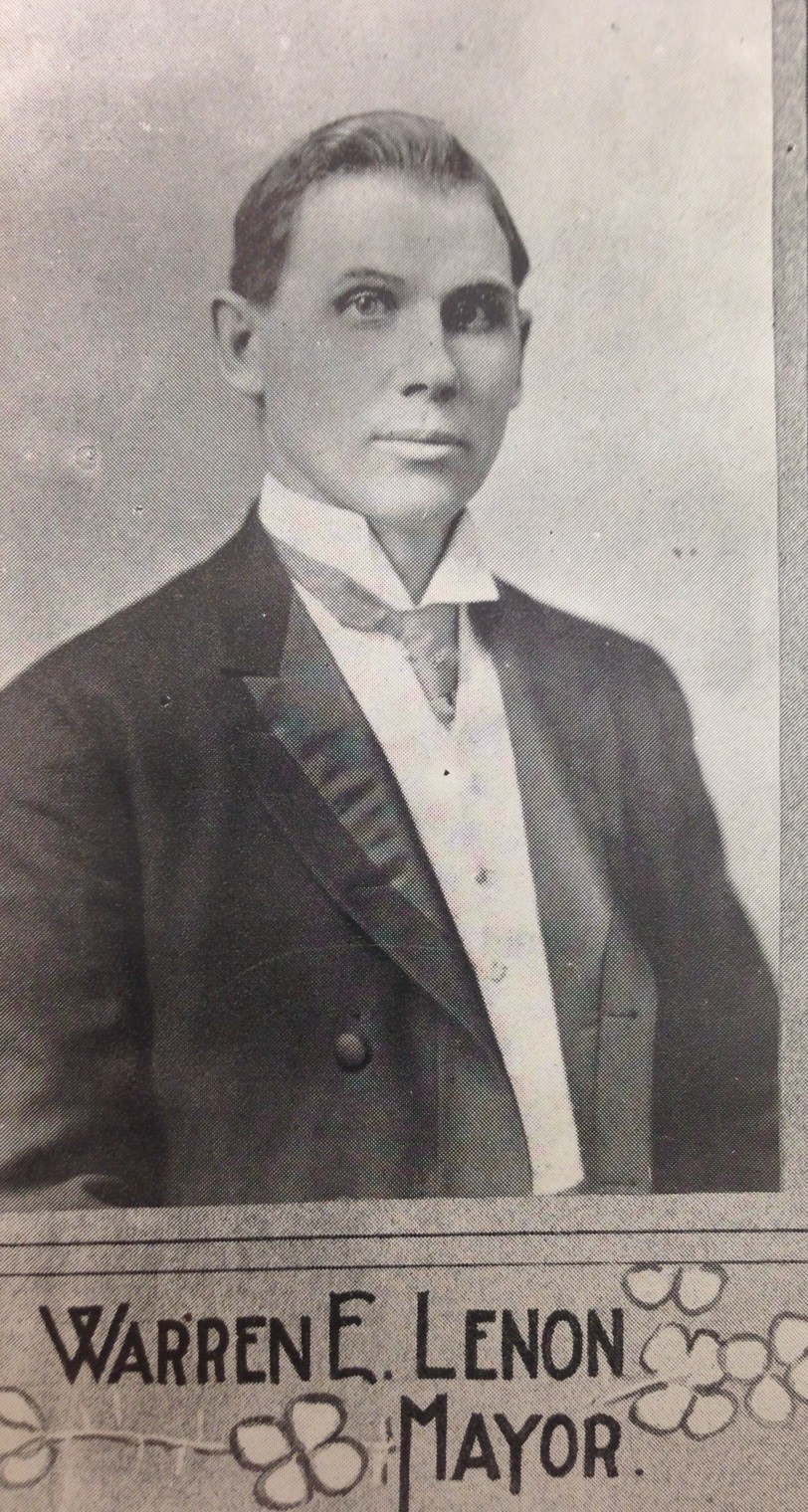
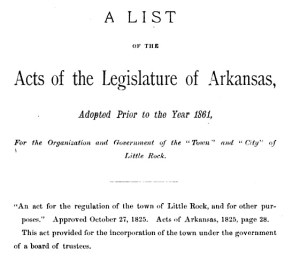
 The first permanent settlement of Little Rock started in 1820. But by 1825, it was little more than a loosely defined group of structures. One hundred and ninety-two years ago today, on October 27, 1825,Territorial Governor George Izard signed legislation which started establishing a framework for Little Rock to function as a city.
It established that Little Rock citizens could elect a board of trustees to decide matters. Those trustees would choose one of their own to be a presiding officer. Though Little Rock would not be officially incorporated until 1831, this was the first step towards incorporation. The first trustees, elected for 1826, were Robert Crittenden, Joseph Henderson, Nicholas Peay, Bernard Smith and Isaac Watkins. Smith was chosen to be the presiding officer.
Crittenden had been largely responsible for the relocation of the capitol to Little Rock, where he owned a lot of land. He was a major political force in Arkansas politics during the territorial days. Watkins was a nephew of a signer of the Declaration of Independence. He had established the first tavern in Little Rock in 1821 and later he first mill in 1826. He was murdered in 1827 and the perpetrator was never captured.
Peay bought the tavern from Watkins in 1826 and continued in the tavern and hotel business the rest of his life. He later served on the Little Rock City Council and was acting mayor. His son Gordon Neill Peay served as Mayor of Little Rock. The Peay family also co-founded Worthen Bank and Christ Episcopal Church. Members of several branches of Mr. Peay’s descendants including the Worthen and Hurst families remain active in Little Rock affairs.
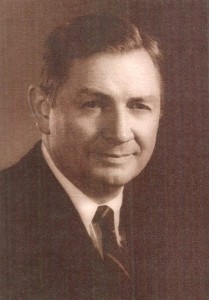 One hundred and two years ago today, on October 26, 1915, future Little Rock Mayor Pratt Cates Remmel was born. He was one of five children of Augustus Caleb and Ellen Lucy Remmel. His father died when he was five, leaving his mother to raise six children (Gertie, Harmon – also known as Buck, Pratt, Gus, Rollie, and Carrie) by herself. After graduating from high school in 1933, he received a bachelor’s degree in economics from the University of Virginia in 1937. During World War II, he held the rank of Lieutenant in the US Navy.
 Actor-director-playwright-author Ben Piazza was born on July 30, 1933, in Little Rock, and graduated from Little Rock High School in 1951 as valedictorian. He also had starred in the senior play that year (The Man Who Came to Dinner) and edited the literary magazine.
 Phyllis D. Brandon played a unique role in shaping and supporting Little Rock’s cultural life. As the first and longtime editor of the Arkansas Democrat-Gazette‘s High Profile section, she promoted cultural institutions, supporters and practitioners.
 Rex DeLoney’s colorful, vibrant artwork conveys the messages of hope, faith, and the everyday joys and struggles of life. His work is reflective of his life, past and present, a life that has been enriched with the love and desire to create art that tells a story and evokes memories for anyone that views his work.