Little Rock Look Back: John Tyler

640px-WHOportTylerOn March 29, 1790, future US President John Tyler was born.

Upon the death of President William Henry Harrison, as Vice President he assumed the office of President.  The language in the U.S. Constitution was open to interpretation as to whether he was President or merely acting as President.  He insisted he was President which established the precedent (until a subsequent amendment formalized the procedure he had put into place).  His detractors, including many in his own Whig Party, referred to him as “His Accidency.”

Tyler was a strong proponent of Manifest Destiny and westward expansion.  He actively sought to bring the Republic of Texas into the U.S.  Because of his interest in this, the Tyler Administration was a benefit to Arkansas. As the western border of the US (and a neighbor to Texas), Arkansas was an important stop for commercial and political leaders on the road to and from Texas.

He is memorialized in Little Rock with Tyler Street.  An easy way to remember which street is Tyler and which is Taylor (a couple of blocks away): Tyler Street has Saint John’s Seminary as a terminus. So the street named after John Tyler, ends at the Saint John’s campus.

As of this writing, two of his grandsons are still alive.  Born in 1924 and 1928, they make Tyler the earliest U.S. President with living grandchildren.  Many of his successors do not have living grandchildren.

Robinson Redux March

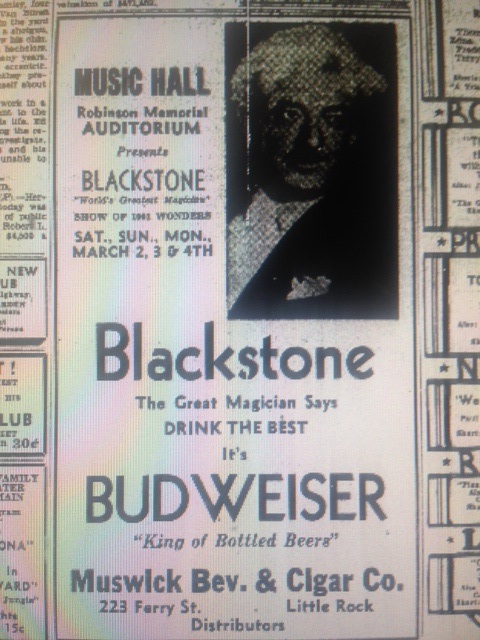
Blackstone adWhile Robinson Center Music Hall is closed for renovations, the Culture Vulture blog is taking a look back at previous bookings in the facility each month.

March 1940 was the first full month that Robinson Auditorium was open.  The month started with Blackstone the magician in performances from March 2 through 4. In addition to his appearance touted by the auditorium, Muswick Beverage & Cigar Company promoted his appearance, and the fact that he endorsed Budweiser beer.  Later that month, appearances included the Shrine Circus, the AAU girls basketball championship, and the Saint Louis Symphony.

March 1950 was a particularly busy month. It featured singer Vaughn Monroe on the 6th and the Arkansas State Symphony playing Beethoven’s Ninth Symphony on the 7th.  On the lower level, a circus took up residency from the 7th through 10th.  Back upstairs in the music hall, Ballet Theatre visited performing Balanchine’s “Theme and Variations” featuring ballerina Nora Kaye and conductor Max Goberman.  The month concluded on the 27th with James Dunn starring in the Pulitzer Prize winning Harvey.

In 1955, Jose Greco and His Spanish Dancers entertained audiences on March 7. Five years later, the Chicago Ballet was featured on March 26, 1960. Earlier that month (the 16th), Max Rudolf conducted the Cincinnati Symphony Orchestra. March 1965 feautured the Chicago Opera Ballet (on the 2nd) and an evening of country music stars including Buck Owens and Kitty Wells (on the 10th).

In March 1970, the national tour of the Broadway musical Mame starring Sheila Smith launched the month on the 6th and 7th. Later that month The Florida Boys were in concert. March 1975 saw much activity at Robinson Center. Guy Lombardo and his orchestra appeared on the 2nd and Richard Fredricks, baritone, gave a recital on the 4th, under the auspices of the Community Concert Series. On March 5 & 6, a statewide touring production of South Pacific played at Robinson. Produced by Vince Insalaco, it starred Judy Pryor (now Judy Trice) as Little Rock native Nellie Forbush. The month closed out with the national tour of Fiddler on the Roof.

March 1980 saw Dawn Wells starring in Neil Simon’s Chapter Two on the 8th. The Arkansas Symphony Orchestra performed on the 15th and 16th with pianist Lorin Hollander as guest artist. Five years later, Marilyn Horne appeared with the ASO on March 2, 1985. At the same time that evening, the Shriners Ball was taking place on the lower level. Later that month a national tour of Sophisticated Ladies stopped by Robinson on the 12th. The ASO returned on March 20 & 21 with pianist Garrick Ohlsson.

The Sharks and the Jets lept on the stage on March 20, 1990, as a tour of West Side Story came to Robinson Center. The month concluded with pianist Jose Carlos Cocarelli in concert with the ASO.

Marilyn Horne returned to Little Rock, ten years and one day after her previous appearance, and performed with the ASO again on March 3, 1995. The month also included The Will Rogers Follies on March 10-12, Jazz Explosion II (with George Duke, Dianne Reeves, Phil Perry, Howard Hewett, and George Howard) on March 15, and the ASO in concert with cellist Jeffrey Solow on March 18 & 19. On March 22, the musical Raisin was performed. The cast included Peabo Bryson, Jeffrey Osborne and Lynette Hawkins.

As the 2000s rolled around, Robinson Center continued to feature an eclectic mix. In March 2000, Ann Hampton Callaway performed with the ASO on March 4 & 5. Later that month the original cast of Red, White & Tuna played at Robinson from March 14 through 19. In 2005, the national tour of Mamma Mia! played at Robinson from March 1-6. Later that month the ASO performed Broadway a la Carte with an eveningn of songs from the Great White Way (on March 18 & 19).

In 2010, the ASO performed a concert version of Porgy & Bess on March 12 & 13. It was the first time that title had ever been performed in its entirity in Arkansas. Irish dance took the stage the next night as Lord of the Dance took up residence at Robinson Center.

Women’s History Month Throw Back Thursday: Mount Holly Cemetery Association

Mt Holly ProfileThe Mount Holly Cemetery is a treasure trove of history, architecture and horticulture on the edge of downtown Little Rock.

It was established in 1843 when Chester Ashley and Roswell Beebe donated the land to the city of Little Rock. Feeling the town fathers were not giving the cemetery the attention it deserved, a group of Little Rock businessmen formed a cemetery commission on March 20, 1877. Charter members of the commission were J. H. Haney, Fay Hempstead, James Austin Henry, Philo O. Hooper, and Frederick Kramer. However the private group of men did no better in maintaining the cemetery.

In 1914, a contingent of the town’s women became critical of the cemetery’s unkempt appearance and took over the reins from the men. Following adoption of City Ordinance No. 2199 in June 1915, the ladies’ Mount Holly Cemetery Association was incorporated on July 20, 1915. (It should be noted this action by the women came at a time when women did not have the right to vote.)

The Mount Holly Cemetery Association grew out of a meeting which took place on June 9, 1914 at the home of Mrs. A. H. Scott. Thirty-six women gathered for the purpose of improving the cemetery.

An executive committee was formed, and the women started working on improvements to the cemetery. Though first viewed by some men as an auxiliary to the Cemetery Commission, it quickly became apparent that the women were in no mood to take a back seat in matters pertaining to Mount Holly.

The first executive board (from June 1914 to July 1915) included Mrs. A. H. Scott, Mrs. B. S. Johnson, Mrs. George Thornburgh, Mrs. Moorhead Wright, Mrs. H. M. Bennett, Mrs. George Worthen, Mrs. W. E. Green, Mrs. George Stratman, Miss Louise Gibson and Miss Clara Hotze.

The July 1915 incorporators were Mrs. Scott as well as Julia E. Bennett, Eva C. Shields, Rosa M. Miller, Ruby P. Ratcliffe and Marguerite R. English. Mrs. Bennett, known affectionately as “Scrap” would serve as the first president, and Miss Miller was the first secretary.

Over the years the Association has undertaken countless projects large (construction of a mausoleum) and small (signs on the lanes) to improve Mount Holly Cemetery for its residents and for visitors.

In 1993, the Association published a history of the first 150 years of the cemetery.  More recently, they launched the annual RIP (Rest in Perpetuity) picnic held the last Sunday in April on the grounds.  They have also published a cookbook–Recipes in Perpetuity.

Today, the Mount Holly Cemetery Association is still going strong!

Little Rock Look Back: President Clinton performs with Arkansas Symphony

Former U.S. President Bill Clinton addresses the audience after reciting Martin Luther King's famous speech, 'I Have A Dream', to the music of Alexander L. Miller at Robinson Auditorium March 25, 2003 in Little Rock, Arkansas. Clinton was the honored guest for a performance by the Arkansas Symphony Orchestra to benefit the William Jefferson Clinton Presidential Foundation. (Photo by Karen E. Segrave/Getty Images)

Former U.S. President Bill Clinton addresses the audience after reciting Martin Luther King’s famous speech, ‘I Have A Dream’, to the music of Alexander L. Miller at Robinson Auditorium March 25, 2003 in Little Rock, Arkansas. Clinton was the honored guest for a performance by the Arkansas Symphony Orchestra to benefit the William Jefferson Clinton Presidential Foundation. (Photo by Karen E. Segrave/Getty Images)

On March 25, 2003, former President Bill Clinton took the stage of Robinson Center Music Hall to perform with the Arkansas Symphony Orchestra. Entitled “Let Freedom Ring – A Patriotic Celebration,” the evening was a joint fundraiser for the Symphony and the Clinton Foundation.

Before a packed house of over 1700, Clinton narrated Aaron Copland’s A Lincoln Portrait which weaves excerpts from Lincoln speeches with Copland’s own unique classical take on American heartland music.  Clinton also narrated Let Freedom Ring, a symphonic setting by Alexander Miller of Martin Luther King’s “I Have A Dream” speech.

The evening also consisted of Broadway veteran and Little Rock favorite Lawrence Hamilton singing “Wheels of a Dream” from the musical Ragtime.  On Broadway and on national tour, Hamilton had previously sung the song.  The Arkansas Symphony Orchestra also performed An American in Paris by George Gershwin and “Jupiter” from The Planets by Gustav Holst.  This final selection was a tribute to the seven astronauts who had died in the crash of the space shuttle Columbia on February 1, 2003.

David Itkin, who was then the musical director of the ASO, conducted the concert.


Little Rock Look Back: MacArthur Returns….to Little Rock

General MacArthur and Mayor Remmel

General MacArthur and Mayor Remmel

On Sunday, March 23, 1952, General Douglas MacArthur made his only post-infancy visit to Little Rock. He had previously been scheduled to visit Mississippi, and Little Rock Mayor Pratt Remmel had persuaded him to add a visit to Little Rock to the agenda. The fact that Little Rock now had a Republican mayor had apparently piqued the General’s interest.

General MacArthur, accompanied by his wife and son as well as several journalists and members of his military retinue, arrived at Little Rock Airport at 10:40 am. He was met by a delegation of civic leaders including Mayor Remmel. Alderman James Griffey made welcoming remarks on behalf of the city. Then the General and Mayor boarded an open car and led a motorcade from the airport to downtown.

The motorcade’s destination was Christ Episcopal Church at Capitol and Scott streets. It was at this church that MacArthur had been baptized as an infant. The delegation was greeted by the Episcopal Bishop R. Bland Mitchell, Rector J. Hodge Alves, and Rector Emeritus W. P. Witsell. (While he had been Rector, Dr. Witsell had garnered national attention by issuing an Easter blessing to Gen. MacArthur as he had been evacuating the Philippines at the height of World War II.) In order to gain admittance to the church that morning, church members and guests had to have tickets.

Following the worship service, the General and his party went to three events in the park named in his honor. The first was a tour of the Museum of Natural History (now the Museum of Discovery and located in the River Market; the current tenant of the building is the MacArthur Museum of Arkansas Military History), which was located in the building in which the General had been born. After the tour, he spoke at a dedication of a small rose garden adjacent to the museum. It was sponsored by the Little Rock City Beautiful Commission and the Garden Clubs of Greater Little Rock.

Though every stop of the General’s visit had featured crowds, the largest was at the third location in MacArthur Park. A crowd of several thousand greeted the General as he spoke from the Foster Bandshell in the park’s southwest corner. Chamber of Commerce president Richard C. Butler (brother-in-law of Mayor Remmel) was the master of ceremonies. Following an invocation by Methodist Bishop Paul Martin, the only other speaker was the General. In his remarks he spoke of his Southern heritage and of his appreciation for the support of the citizens of Little Rock over the years.

Several gifts were bestowed upon the MacArthurs at the ceremony. The City of Little Rock presented Mrs. MacArthur with an engraved silver serving tray.

Following the events in MacArthur Park, the family retired for a brief respite to the Hotel Marion. They then attended a luncheon buffet in their honor at the home of Howard and Elsie Stebbins on Edgehill Road. The General and Mrs. MacArthur circulated through the house greeting guests and then eschewed a special table in favor of balancing their plates on their laps and sitting in wingback chairs. Meanwhile Arthur MacArthur stayed upstairs and discussed stamp collecting and other hobbies with the Stebbins’ two teenage sons.

Following the luncheon, the MacArthur party went back to the airport and by 4:00pm, the plane was in the air.

Though this visit was coming at the end of a whirlwind of activities, by all accounts, the General and Mrs. MacArthur were very gracious and accommodating. The General was being mentioned as a potential GOP candidate for President, but purposefully steered clear of any political comments in his remarks. He and Mrs. MacArthur dutifully posed for photos not only for the media but also for amateur photographers. At lunch, the General even asked a Gazettephotographer to take a photo of him with his Little Rock Police motorcycle escorts so that they could have a souvenir of the visit.

Little Rock Look Back: Robert Catterson–Doctor, Soldier, LR Mayor

R_F_Catterson_BGen_ACWOn this date in 1835, future Little Rock Mayor Robert Francis Catterson was born in Indiana, the son of Irish immigrants.  He studied medicine in Ohio and established a medical practice in Indiana upon completion of his studies.

With the outbreak of the Civil War, he enlisted as a private in the Union Army.  Throughout the war, he was promoted and was eventually mustered out as a brigadier general in 1866.  During his service, he participated in the siege of Vicksburg, the Battle of Chattanooga, the Atlanta Campaign and Sherman’s March to the Sea.

Following his departure from the military, Catterson decided not to return to medical practice.  He moved to Arkansas and worked for a brief time in the cotton commodities field.  He later returned to military service commanding a militia fighting the Ku Klux Klan.  Catterson was appointed US Marshal and would also command the Brooks troops during the Brooks-Baxter War in Little Rock.

In November 1871, he was elected Mayor of Little Rock. His election ended a tumultuous two-year period where the Little Rock City Council tried unsuccessfully to remove Mayor A. K. Hartman.  Mayor Catterson served a relatively quiet two year term in office until November 1873.

Following the completion of his term, Mayor Catterson moved to Minnesota. He later moved to Texas where he died on March 30, 1914 at the age of 79.  He is buried in the San Antonio National Cemetery.

Vietnam Documentary Premieres at CALS Ron Robinson Theater

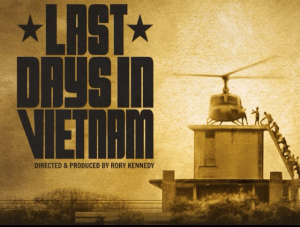
The emergency evacuation of U.S. forces in the final days of the Vietnam War is examined in Last Days in Vietnam, a PBS American Experience film which has been nominated for numerous awards including an Academy Award for Best Documentary.

The film’s theatrical premiere in Arkansas is at the Central Arkansas Library System’s (CALS) Ron Robinson Theater, 100 River Market Ave., on Saturday, March 21, at 2 p.m. Admission is free and open to the public. Seating is first come, first served, and the doors will open at 1:30 p.m.

The film’s television broadcast premiere is Tuesday, April 28, at 8 p.m. on AETN.

Last Days in Vietnam documents the chaotic final days of the Vietnam War, when the North Vietnamese Army closed in on Saigon as South Vietnamese resistance crumbled. The United States had only a skeleton crew of diplomats and military operatives still in the country.

As Communist victory became inevitable and the U.S. readied to withdraw, some Americans began to consider the certain imprisonment and possible death of their South Vietnamese allies, co-workers, and friends. Meanwhile, the prospect of an official evacuation of South Vietnam became terminally delayed by Congressional gridlock and the inexplicably optimistic U.S. Ambassador.

With the clock ticking and the city under fire, a number of heroic Americans took matters into their own hands, engaging in unsanctioned and often makeshift operations in a desperate effort to save as many South Vietnamese lives as possible.

Last Days in Vietnam was produced and directed by Rory Kennedy, an Emmy Award-winning independent documentary filmmaker and co-founder and president of Moxie Firecracker Films. Her work has been shown on PBS, HBO, A&E, MTV, and Lifetime.

The screening is presented by the Butler Center for Arkansas Studies, a department of CALS. For more information, call 501-918-3033.