
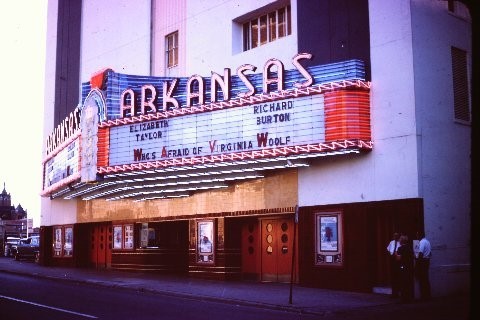
Final movie theatre in downtown Little Rock

On October 4, 1977, the Arkansas Theatre screened its final films at 516 South Louisiana.  When it closed, it also ended the run of commercial movie theatres in downtown.

The last two films to show there were J. D.’s Revenge (which starred Louis Gossett Jr.) at 5:40pm and 9:00pm, and Coffy (which starred Pam Grier) at 7:20 pm.

The decision to close the theatre was made by United Artists which operated the facility, and had once had its local offices in the building.  Since the 1930s, UA (and its predecessors) had been booking films into the building.  But as the movie going public started preferring to watch their films in the suburbs, downtown movie houses became a thing of the past.

The building opened on September 20, 1910, as the Kempner Opera House. It was designed by New York architect Henry Beaumont Herts of the architectural firm Herts & Tallant. Originally the facade was in a Sullivanesque style, but this was later altered into an Art Deco style, with stucco and ceramic tile highlights.

Seating over 1300, it was home to plays, operas, musicals, lectures, vaudeville, and community meetings. By the late 1920s, with motion pictures a booming business, it was transformed into a movie house.  It reopened as the Arkansas Theatre on September 27, 1929.

The last few years it was open, the Arkansas had featured mainly Blaxploitation films.  But by 1977, Hollywood was moving away from those. The area manager for the UA chain told the Arkansas Gazette that the lack of movies in that genre also contributed to the reason to shut it.

United Artists had a lease with the Kempner family that would run through 1997, unless they could find someone else to take the building over.  They tried to interest the Arkansas Opera Theatre, but it was not a feasible option for AOT.  Eventually, the building was deeded to the University of Arkansas Foundation.

In late 1995, the structure was razed. After 18 years of sitting vacant, the structure had deteriorated beyond repair.  Because of alterations to the interior and exterior over the years, it was not eligible for historic preservation designations or funds.

Today it is a parking lot across the street from the Lafayette Building and due south of the Hall-Davidson Building.
State Fair Preview is theme of October’s Old State House Night at the Museum!

Image may contain: outdoor, text that says 'NIGHT AT THE MUSEUM Old State House Museum'

Come get a taste of the Arkansas State Fair at Nights at the Museum on Thursday, Oct. 3!

Food trucks will be at the Old State House Museum selling your fair favorites, like corn dogs and funnel cakes. You can also play carnival games for FREE and win prizes! Nights at the Museum is for adults 21 and older, so you get the fun of the fair … without having to keep track of the kids.  As always, adult beverages will be available to purchase.

Nights at the Museum takes place on the museum’s iconic front lawn on the first Thursday of each month seasonally, March-October. (In case of inclement weather, the event will be indoors at the museum.)

Arkansas State House Society – Friends of the Old State House Museum, a nonprofit organization dedicated to supporting OSHM and its programs, hosts the Nights at the Museum. The society invites young professionals to come early for a networking opportunity from 5 p.m. to 6 p.m.

General admission starts at 6 p.m. and costs $5; food and beverages will be available for purchase. Tickets may be purchased in advance at https://squareup.com/store/ArkansasStateHouseSociety/ or at the gate.

The museum can validate parking at the DoubleTree hotel; metered parking near the hotel is free after 6 p.m.

Bill Clinton announces for Presidency on October 3, 1991

The Clintons following his remarks.

On October 3, 1991, Governor Bill Clinton strode out the front doors of the Old State House Museum and announced his intentions to seek the 1992 Democratic Party’s nomination for President of the United States.

(While Clinton was a major fan of JFK, it is doubtful he realized that his announcement took place on the 28th anniversary of JFK speaking in Little Rock.)

Clinton was the fifth major Democrat to announce for the office. That there were that many by early October was somewhat surprising considering that the first half of 1991 saw many national Democrats announce they were NOT seeking the office.

Jerry Brown, Bob Kerrey, Paul Tsongas, and Tom Harkin were also in the race.  Clinton was seen as a centrist, along with Senator Kerrey while the others were viewed as being from the far-left wing of the Democratic Party.

In its coverage of the announcement, The New York Times noted the significance of Gov. Clinton’s remarks on race.  In the speech he referenced his desire to strengthen relations and remove barriers between the races.  As the Times pointed out, it was at the Old State House that Arkansas held two conventions on the issue of secession prior to the state’s entry into the Civil War.

At the time of the announcement, Gov. Clinton was far from a front-runner. His national profile was probably the lowest of any of the announced candidates. Most of the knowledge of him outside of Little Rock came from his lengthy speech about Michael Dukakis at the 1988 Democratic Convention and the subsequent appearance on “The Tonight Show” where both he and Johnny Carson poked fun as his loquaciousness.

Regardless of their views on his chances, the Governor’s family, friends, and fans packed the front lawn of the Old State House to cheer him.  The national media treated him as a serious, albeit largely unknown, candidate.  After having had Wilbur Mills, Dale Bumpers and others flirt with running and then backing out, the local media were probably thrilled to finally have someone from Arkansas actually running for the presidency.

One local media outlet would not see much of the campaign. Just fifteen days later, the Arkansas Gazette would close. As a paper which had covered nearly two decades of his career, the Gazette was often Clinton’s champion, though the paper was not afraid to point out times the two differed.  However, there would be no Gazette headline about Clinton in New Hampshire, at the Democratic Convention, or a general election victory.

On Election Day in 1992 and again in 1996, Bill Clinton would repeat the stride out the front doors of the Old State House accompanied by his wife and daughter.  Those two times the crowds would spill down the streets in all directions. Instead of a handful of media outlets there would be scores of them.

But it all started on a sunny autumn day in Little Rock in early October 1991.

JFK in LR

On October 3, 1963, President John F. Kennedy delivered remarks at the Arkansas State Fairgrounds.  Only a few weeks later, he would be felled by an assassins bullet in Texas.

In the speech, the President praised Arkansas’ congressional delegation including Senators John McClellan and J. William Fulbright and Congressmen Took Gathings, Bill Trimble, Wilbur Mills and Oren Harris.  Each of these men held senior leadership positions in key committees.  The main focus of the speech was to discuss President Kennedy’s vision for a new economy in the South.

The President was actually in the state to speak at the dedication of the Greers Ferry Dam. He agreed to make that appearance as a part of a negotiation with Congressman Mills as they were deadlocked over changes to the tax code.  He had previously visited Little Rock in 1957 when he came to the state to address the Arkansas Bar Association meeting in Hot Springs.

President Kennedy continued the string of 20th Century Presidents to visit Little Rock.  Presidents Theodore Roosevelt, William Howard Taft, Franklin Roosevelt and Harry Truman had all visited while in office.  Woodrow Wilson, Herbert Hoover and Dwight Eisenhower all visited prior to attaining the presidency.

This evening at the Clinton School – Theo Witsell discusses his Bicentenary interpretation of Thomas Nuttall’s exploration of the Arkansas Territory

Image result for theo witsellThe year 2019 marks the 200th anniversary of the great botanist and naturalist Thomas Nuttall’s year-long journey of discovery through the Arkansas Territory, present day Arkansas and Oklahoma.

Tonight at 6pm, as part of the Clinton School Speaker Series, Theo Witsell will discuss Nuttall’s trek and the implications it has for today.

Nuttall would be the first trained naturalist to record observations and collect specimens in most of the territory. His first-hand account of this trip, later published as “A Journal of Travels into the Arkansas Territory in the Year 1819,” provides some of the earliest reliable information on the natural history of the region. These observations and his surviving botanical specimens are central to our understanding of what the region was like before it was forever altered by the ravages of human progress.

To commemorate the bicentennial of Nuttall’s trip, Theo Witsell, Ecologist and Chief of Research for the Arkansas Natural Heritage Commission and the Curator of the ANHC Herbarium, worked for the past several years on a “200 years later” reinterpretation of all the natural history observations he made in Arkansas Territory.

This included retracing his route using both historical and modern geospatial datasets, updating the nomenclature and taxonomy of all the plants and animals he mentions, and weaving his own observations gained over the past 24 years conducting field work for the Arkansas Natural Heritage Commission. The aim is to provide a fairly detailed interpretation of Nuttall’s natural history observations, and discuss changes in the landscape since his trip, specifically as they relate to ecological and biological diversity.

All Clinton School Speaker Series events are free and open to the public. Reserve your seats by emailing publicprograms@clintonschool.uasys.edu or by calling (501) 683-5239.