
 The Arkansas Repertory Theatre production of Matthew Lopez’s The Whipping Man is a riveting production which features three men grappling with issues of faith, family, and fidelity over three days at the close of the Civil War. Set in the remains of a once-grand townhouse in Richmond (masterfully designed by Mike Nichols), it tells the story of Caleb, the scion of the edifice’s owner, and two of the now-former house slaves, Simon and John.
As Simon, the moral compass of the trio, Michael A. Sheppherd portrays a complex man wrestling with the changing times while holding on to a vision of a bright future. His approach to the role is to emphasize Simon’s pragmatism. He can easily shift from stern (when making hard decisions) to tender (when discussing his wife and daughter). Sheppherd projects an inner strength which never allows the character to slip into the “noble, long-suffering slave” stereotype. As do the other two actors, he finds the quiet, honest humor in the script while not disrupting the story.
Damian Thompson likewise avoids having John wear the “shiftless, devious” label. He joyfully struts like a peacock in his increasingly finer clothing (a deft creation of costume designer Yslan Hicks) and brags of his latest acquisitions (which progressively litter the stage courtesy of props designer Lynda J. Kwallek). But like the other two characters, he is seeking to better himself in these uncertain times. Thompson’s eyes and smile flash the brilliance of the character, who obviously has intelligence since he taught himself to read.
Ryan Barry’s Caleb spends much of the time onstage sitting in one place due to an injury. Through his sometimes pained voice, shifts in posture and gestures, he never seems static. His descriptions of the horrors of war are gripping. When paired with his soft tone of voice and romantic longing for the girl he left behind at home, he serves as a reminder that not all went into war with gusto.
Throughout the play, it becomes apparent that all is not what it seems with any of the three. What the secrets are, and who knows what about whom, is just part of the evening. While the mysteries are plot points, they are not the whole point of the story. The faith and shared experiences bind these three together far more than they would care to admit. Sheppherd, Thompson and Barry share a great chemistry which serves the production well.
Director Gilbert McCauley obviously trusts his actors and the script. He lets the action unfold at a languid, but not sluggish pace. In his hands, the silences and stillness of the actors can sometimes be more powerful than words and movement. There are moments in the script which could easily shift into melodrama, but McCauley does not allow that.
This same approach is shared with the strong and subtle lighting design of Dan Kimble. He achieves a rare balance of having the stage dim and well-lit at the same time. The mood of the play is also ably served by Allan Branson’s sound design.
The Whipping Man offers no easy answers or pat endings. While none of the characters are without flaws (who is?), they each have redeeming qualities. At the end of the play, one is left wondering what will happen to them. Realizing that the Reconstruction era in the South was hardly pleasant for anyone regardless of race, the audience knows that the future will probably not be too satisfying for any of the three.
Toward the end of the play, the trio share a Seder. In addition to the obvious connections (Abraham Lincoln and Abraham from the Bible, the end of slavery in both eras), it is also about sharing faith and sharing experiences. It is, for a brief respite, a moment of pure peace.
The Arkansas Rep production of Lopez’s play serves as a helpful reminder that in the midst of chaos, harmony can be achieved, if only for a moment.
First Old State House Brown Bag Lunch Lecture today focuses on Capt. Robert Sanders Burke
 Today at noon at the Old State House Museum, Richard Hartness discusses “Local Hero: Captain Robert Sanders Burke, Home Guard Commander”
The new year’s first Brown Bag Lunch Lecture is presented by Richard Hartness and is the story of a south-central Arkansas farmer/surveyor, turned citizen-soldier, elected by his neighbors to lead them in their defensive quest to save their homes and farms from the ravages of enemy invasion. During the Civil War, Robert Sanders Burke was elected Captain of a group of Montgomery County mounted volunteers, initially called “Burke’s Company,” and by war’s end was mustered into Confederate service as Company “B.” Newton’s group, like many others, was composed primarily of boys too young for conscription and older men, who may have served on other units before joining local “home guard” militias.
Richard Hartness is the president of the Cross County Historical Society and is currently enrolled in the Ph.D. program in Heritage Studies at Arkansas State University, where he is researching information on the first tenured Black professors in Arkansas’s colleges and universities. In February 2013, Hartness was honored by the Cross County Chamber of Commerce as their “Distinguished Citizen of the Year, 2012.”
Little Rock Look Back: Elijah A. More, LR 3rd Mayor
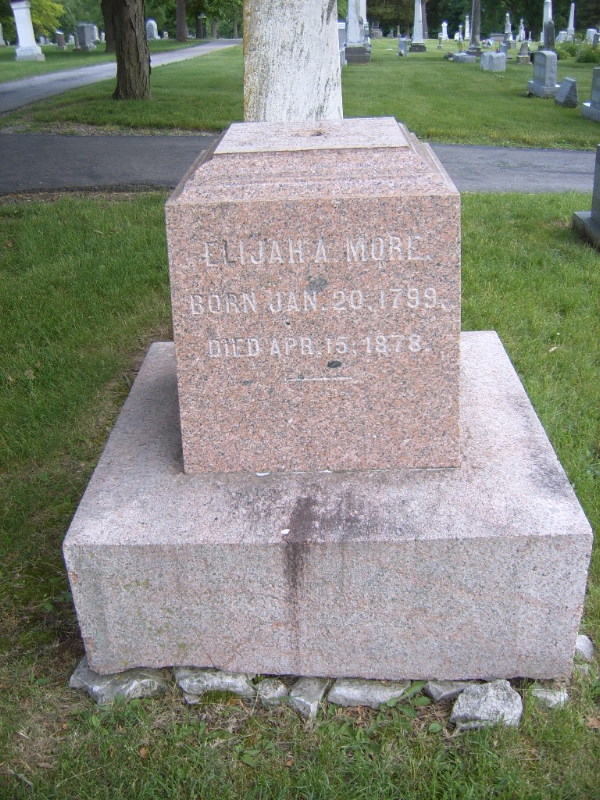 On January 20, 1799, Elijah A. More was born in Kentucky. By the early 1830s, he was residing in Hempstead County and practicing law. Because of the court system being based in Little Rock, he spent a great deal of time in Pulaski County.
By January 1834, he had obviously established a permanent residence in Little Rock, because he was chosen as the third mayor. He served from January 1834 until January 1835. According to records, he apparently continued to alternate between residing near what is now Hope and living in Little Rock. In 1839, his wife Caroline Owens More died and was buried in Little Rock. Though not originally buried at Mount Holly (it did not open until 1843), she is now buried there.
In 1840, More was the subject of a court case before the Arkansas Supreme Court resulting from actions he had taken as an executor of an estate and subsequently as Pulaski County Probate Judge.
By 1864, More resided in Missouri. There is a record of him swearing a loyalty oath to the Governor of Missouri in that year (presumably in response to actions associated with the Civil War).
He died on April 15, 1878 and is buried in Columbia Cemetery in Columbia, Missouri.
Honoring Dr. King’s Legacy, the Mosaic Templars Cultural Center hosts a day of service
 In honor of Dr. Martin Luther King Jr., the Mosaic Templars Cultural Center is hosting its annual MLK Challenge today.
The MLK Challenge is a service program designed to engage youth ages 12-18 in volunteerism with a full day of service projects that challenge them mentally and socially. Participants will travel to various community sites including Little Rock Summer of Solutions, Millennium Adult Day Care, Oakland Fraternal, Helping Hand of GLR, and Dunbar Community Gardens to complete a range of service projects. Participants must register prior to the event.
For more information, call Elvon Reed at 501-683-3592.
LR Look Back: HAIR flows at Robinson Auditorium

Ad for the original production of HAIR in Little Rock. Note the ticket prices. And that they could be purchased at Moses Music Shops.
Forty-three years ago today, on January 18, 1972, the musical Hair settled in for a week-long run at Robinson Auditorium. The saga to bring the national tour to Little Rock had actually begun eleven months earlier.
In February 1971, a young Little Rock attorney named Phil Kaplan petitioned the Little Rock Board of Censors to see if it would allow a production of Hair to play in the city. He was asking on behalf of a client who was interested in bringing a national tour to Arkansas’ capital city. The show, which had opened on Broadway to great acclaim in April 1968 after an Off Broadway run in 1967, was known for containing a nude scene as well for a script which was fairly liberally sprinkled with four-letter words. The Censors stated they could not offer an opinion without having seen a production.
By July 1971, Kaplan and his client (who by then had been identified as local promoter Jim Porter and his company Southwest Productions) were seeking permission for a January 1972 booking of Hair from the City’s Auditorium Commission which was charged with overseeing operations at Robinson Auditorium. At its July meeting, the Commissioners voted against allowing Hair because of its “brief nude scene” and “bawdy language.”
Kaplan decried the decision. He stated that the body couldn’t “sit in censorship of legitimate theatrical productions.” He noted courts had held that Hair could be produced and that the Auditorium Commission, as an agent for the State, “clearly can’t exercise prior censorship.” He proffered that if the production was obscene it would be a matter for law enforcement not the Auditorium Commission.
The Commission countered that they had an opinion from City Attorney Joseph Kemp stating they had the authority. One of the Commissioners, Mrs. Grady Miller (sister-in-law of the building’s namesake the late Senator Robinson, she had served on the Commission since 1940), expressed her concern that allowing Hair would open the door to other productions such as Oh! Calcutta!
On July 26, 1971, Southwest Productions filed suit against the Auditorium Commission. Four days later there was a hearing before federal Judge G. Thomas Eisele. At that hearing, Auditorium Commission member Lee Rogers read aloud excerpts from the script he found objectionable. Under questioning from Kaplan, a recent touring production of Neil Simon’s Plaza Suite was discussed. That play has adultery as a central theme of one of its acts. Rogers admitted he found the play funny, and that since the adultery did not take place on stage, he did not object to it. Among those testifying in favor of it was Robert Reddington, who was director of performing arts at the Arkansas Arts Center.
Judge Eisele offered a ruling on August 11 which compelled the Auditorium Commission to allow Hair to be performed. Prior to the ruling, some of the Auditorium Commissioners had publicly stated that if they had to allow Hair, they would close it after the first performance on the grounds of obscenity. To combat this, Judge Eisele stated that the Commission had to allow Hair to perform the entire six day engagement it sought.
Upon hearing of the Judge’s ruling, Commissioner Miller offered a succinct, two word response. “Oh, Dear!”
In the end, the production of Hair at Robinson would not be the first performance in the state. The tour came through Fayetteville for two performances in October 1971 at Barnhill Arena.
On January 18, 1972, Hair played the first of its 8 performances over 6 days at Robinson Auditorium. In his review the next day, the Arkansas Gazette’s Bill Lewis noted that Hair “threw out all it had to offer” and that Little Rock had survived.
The ads promoting the production carried the tagline “Arkansas will never be the same.” Tickets (from $2 all the way up to $8.50) could be purchased at Moses Melody Shops both downtown and in “The Mall” (meaning Park Plaza). That business is gone from downtown, but the scion of that family, Jimmy Moses, is actively involved in building downtown through countless projects. His sons are carrying on the family tradition too.
Little Rock was by no means unique in trying to stop productions of Hair. St. Louis, Birmingham, Los Angeles, Tallahassee, Boston, Atlanta, Charlotte NC, West Palm Beach, Oklahoma City, Mobile and Chattanooga all tried unsuccessfully to stop performances in their public auditoriums. Despite Judge Eisele’s ruling against the City of Little Rock, members of the Fort Smith City Council also tried to stop a production later in 1972 in that city. This was despite warnings from City staff that there was not legal standing.
Within a few years, the Board of Censors of the City of Little Rock would be dissolved (as similar bodies also were disappearing across the US). Likewise, the Auditorium Commission was discontinued before Hair even opened with its duties being taken over by the Advertising and Promotion Commission and the Convention & Visitors Bureau staff. This was not connected to the Hair decision; it was, instead, related to expanding convention facilities in Robinson and the new adjacent hotel. Regardless of the reasons for their demise, both bygone bodies were vestiges of earlier, simpler and differently focused days in Little Rock.
LR Look Back: Webb Hubbell, Little Rock 64th Mayor
 On January 18, 1948, future Little Rock Mayor Webster “Webb” Hubbell was born. After playing football in high school, he played for the University of Arkansas Razorbacks. He also received his law degree from the U of A.
At the age of 30, already a successful attorney, Hubbell was appointed to the Little Rock City Board of Directors to fill a vacancy in September 1978. In 1980, he was elected to a four year term on the City Board.
In June 1979, there was a vacancy in the office of Mayor of Little Rock. Hubbell was selected by his fellow City Directors to serve as Mayor until December 1980. In January 1981, he was selected to serve another term as Mayor. In June 1981, he stepped down as Mayor but continued to serve on the City Board of Directors.
In 1984, Hubbell was appointed to serve as Chief Justice of the Arkansas Supreme Court to finish out the term of Richard B. Adkisson. Following his service on the court, he returned to the practice of law at the Rose Law Firm. He later served as the Associate Attorney General in the Justice Department during the Clinton administration.
Hubbell resigned from the Justice Department due to an investigation related to Whitewater. Following conviction and serving time in prison, he has been an author and management consultant. His novel, When Men Betray, was published by Beaufort Books in May 2014. This coming May, his next novel Ginger Snaps will be released.
Little Rock Look Back: Martin Borchert, LR 57th Mayor
 On January 16, 1916, future Little Rock Mayor Martin Borchert was born in Stuttgart. After graduating high school he moved to Little Rock. He started work at ACME Brick and spent 21 years there before engaging in other business interests. Among these businesses were Martin Borchert Co., ASCO Hardware, Dtection Systems Inc. and Component Systems Inc. In 2005 he was inducted into the Arkansas Construction Hall of Fame.
Mayor Borchert was elected to the Little Rock City Board of Directors in 1964 and served from January 1965 through December 1968. He chose not to seek a second term. In 1967 and 1968 he served as Mayor of Little Rock. During this time, he laid out the vision for what has become Riverfront Park along the Arkansas River.
Other civic achievements included being a member of the Board of the Little Rock Chamber of Commerce, being on the Governor’s Citizens Advisory Committee, a member of the Pulaski County Quorum Court, vice chairman of the Arkansas Planning Commission, and being on the Little Rock Air Force Base Community Council. In 1967 he served on the President’s National Advisory Council to the Small Business Administration. Mayor Borchert served on the Little Rock Water Commission, including a tenure as chairman. In 1985, he was chairman of the Metropolitan Transit Policy Board and as chairman oversaw the transfer of the Central Arkansas Transit system to the Central Arkansas Transit Authority. One of the achievements of which he was very proud of was that he was one of the very first in Arkansas to receive an Adopt the Highway road.
Mayor Borchert was married for 57 years to Rosemary “Biddy” Branch Borchert. They had two children, a son, John “Topper” Borchert and a daughter, Leslie Borchert Wilson. He died on May 11, 2007.
 Little Rock Culture Vulture