Little Rock Look Back: Little Rock Council Meets for First Time in 1832

TowncouncilplaqueOn January 16, 1832, Mayor Matthew Cunningham MD presided over Little Rock’s first council meeting. Since Little Rock did not yet have a government hall, the Mayor and his wife hosted the meeting at their house. The Cunninghams owned the entire block which was bordered by what is now Main Street, 3rd Street, Louisiana Street and 4th Street.

A plaque at 3rd and Main Street commemorates this meeting and was placed there in the 1930s. The Cunningham’s house was likely closer to the southwest corner of the block. The plaque is on the Fulk building which once housed Bennett’s Military Supply. Currently the plaque is covered as the building undergoes renovation in preparation of it housing CJRW.

The block also includes the Mann on Main project, which is comprised of the buildings originally constructed for the Gus Blass Department store.  Bruno’s and the new Samantha’s are also on the block.

Little Rock was chartered as a town in 1831 and elections were subsequently held. Dr. Cunningham outpolled Rev. W. W. Stevenson to become the first Mayor.

Joining Mayor Cunningham at the first meeting were the original four Town Council members – Charles Caldwell, Benjamin Clemens, David Holt and John McLain.

In 1931 a plaque, as part of Little Rock’s Centennial, a plaque was erected to note the first meeting. The plaque erroneously implies that the first meeting was in 1831. This mistake is understandable since the legislation incorporating Little Rock was approved in November 1831. The plaque also refers to the body as the City Council. It was, in fact, the Town Council. There would not be a City Council until 1835 when Little Rock was elevated to City status.

Robinson Center Redux- January

WAVW LR Jan65Since Robinson Center Music Hall is closed for renovations and restoration, this year the Culture Vulture will take a monthly look back at some of the featured attractions which have played there.  This month looks at January of years ending in “0” and “5.”

As noted earlier on the blog, even before the February 1940 opening of the music hall, the lover level exhibition hall was playing host to events including basketball games.

By 1945, things were well underway on both levels. Buddy Johnson & his Orchestra were playing a dance for African Americans in the lower level on January 10. Upstairs events ranged from a lecture on Christian Science (January 7), a play Good Night Ladies (January 17), a lecture by Dr. Emil Ludwig on Germany after World War II, and Paul Draper & Larry Adler in concert (January 23).

In 1950, Tallulah Bankhead starred in a revival of Private Lives (January 13), a Passion Play booked it for over a week (January 21 – 28) and a double-header of Shakespeare plays held court on January 30. Margaret Webster’s Shakespeare Company played The Taming of the Shrew in the afternoon and Julius Caesar in the evening. Also that month the Arkansas State Symphony (a forerunner to today’s Arkansas Symphony Orchestra) gave a concert on the 17th.

A highlight of 1955 was a women’s wrestling match on January 4 in the lower level.

In 1960, two theatrical productions were presented. On January 8 & 9, Odd Man In was presented “pre-Broadway” (it didn’t make it). Much more successful was the national tour of My Fair Lady from January 18 through 23.

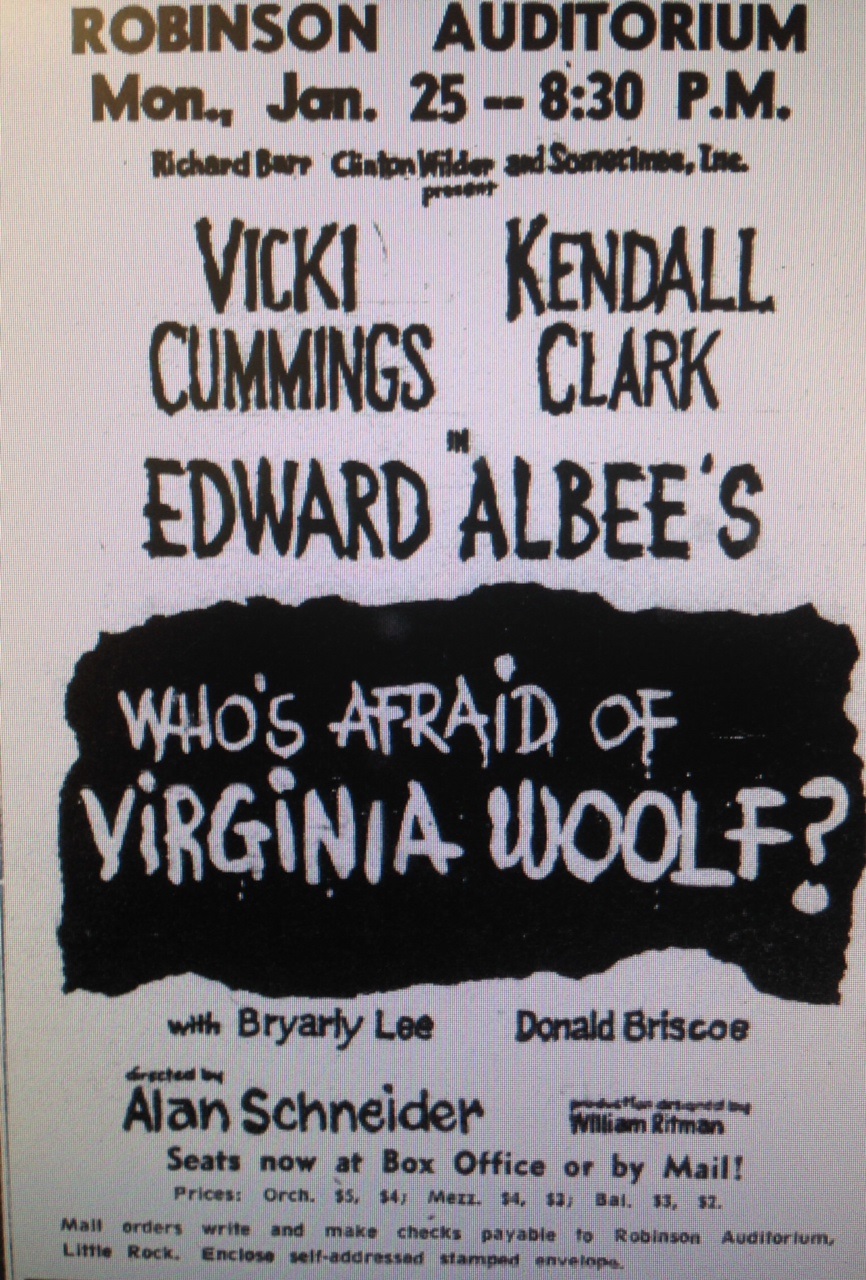
Though Little Rock native Ben Piazza had helped develop the play, he wasn’t in the cast when the national tour of Who’s Afraid of Virginia Woolf? played Robinson on Januayr 25, 1965.

By the late 1960s and early 1970s, Robinson was at a crossroads.  Many performers wanted to play at larger spaces (such as Barton Coliseum) or smaller venues (such as churches or the UALR recital hall).  In 1970, the Happy Goodman Family gave a concert on January 21.  Five years later they returned on January 10, 1975 in a concert with Vestel Goodman. The next night, Johnny Paycheck was in concert.  On January 21, 1975, Robert Alda headlined a tour of The Sunshine Boys.

Orchestra concerts dominated most January offerings from 1980 onward.  On January 27, 1980, the Pittsburgh Symphony Orchestra gave a concert at Robinson. In 1985, the Arkansas Symphony Orchestra presented concerts (January 19 & 20) with Misha Dichter, pianist.  January 1990 saw the ASO with Stephen Burns, trumpet on January 20 & 21.

In 1995, the ASO performed Rimsky-Korskaov’s Scheherazade on January 13 & 14.  Composer, pianist and conductor Marvin Hamlisch highlighted a concert with the ASO on January 22 in 2000. Earlier in the month the ASO performed Der Freischatz on the 15 & 16th.  The day before Hamlisch, the Martins were in concert.

2005 highlights included the ASO with Elmer Oliveira, violinist (Jan 15 & 16), the ASO Side by Side concert (where Arkansas Symphony Youth Orchestra musicians and ASO musicians perform together) on January 29 and the ASO Family Series: Secrets of the Orchestra on January 30.  The Irish dance spectacular Riverdance played Robinson from January 17 through 19.

Five years ago, Ron “Tater Salad” White performed his stand-up at Robinson on January 8, 2010. Later that month the ASO offered Edvard Grieg’s Piano Concerto on January 16 & 17. The 2010 ASO Side by Side concert was on January 30.  On January 20 the Shen Yun Chinese cultural performance took place in Robinson.

Historic Preservationists Honored by HPAA

hpaa awardsLast Friday, the Historic Preservation Alliance of Arkansas presented the 2014 Arkansas Preservation Awards.

Ruth Hawkins, Ph.D. of Jonesboro received the Parker Westbrook Award for Lifetime Achievement.  Named in honor of the Alliance’s Founding President, the Parker Westbrook Award recognizes significant individual achievement in historic preservation. It is the Alliance’s only award for achievement in preservation over a period of years. The award may be presented to an individual, organization, business or public agency whose activity may be of local, statewide or regional importance.

As director of the Arkansas Heritage Sites program at ASU, Dr. Hawkins has the  responsibility for development of the Hemingway-Pfeiffer Museum and Educational Center at Piggott, the Southern Tenant Farmers Museum at Tyronza, the Lakeport Plantation near Lake Village and the Historic Dyess Colony: Boyhood Home of Johnny Cash.   She also is executive director of Arkansas Delta Byways, Inc., a tourism promotion association serving 15 counties in Eastern Arkansas. The association manages and promotes two National Scenic Byways in the region:  the Crowley’s Ridge Parkway and the Arkansas segment of The Great River Road.

Other awards were:

Excellence in Preservation through Rehabilitation 

  • William F. Laman Public Library, North Little Rock
  • Dempsey Bakery, Little Rock


Excellence in Preservation through Restoration

  • Beth El Heritage Hall, Helena

Ned Shank Award for Outstanding Preservation Publication

  • Architects of Little Rock: 1833-1950 by Gordon Wittenberg and Charles Witsell. Published by University of Arkansas Press


Outstanding Achievement in Preservation Advocacy

  • Scott Darwin, Jonesboro. For the V.C. Kays House.


Outstanding Achievement in Preservation Education

  • Hot Springs Historic Baseball Trail


Outstanding Service in Neighborhood Preservation

  • Jennifer Carman and Donna Thomas, Little Rock. Rehabilitation projects in the Central High School Neighborhood Historic District.


Outstanding Work by a Craftsperson

  • Clancy McMahon. A. R. Carrol Drugstore, Canehill


Outstanding Preservation Reporting in the Media

  • Rex Nelson, Little Rock. Coverage of the historic Majestic Hotel and downtown Hot Springs


The Historic Preservation Alliance of Arkansas works to build stronger communities by reconnecting Arkansans to our heritage and empowering Arkansans to save and rehabilitate historic places.
As Arkansas’s only statewide nonprofit organization focused on preserving Arkansas’ architectural and cultural resources, the Alliance has been educating,
advocating and assisting preservation efforts across Arkansas since 1981. From educating lawmakers to assisting individual property owners, the Alliance
is committed to protecting the many valuable heritage resources that make our state unique. The Alliance’s numerous educational programs include the
quarterly Arkansas Preservation Digest, the annual Arkansas Preservation Conference and the Ramble tours of historic sites. The Alliance has effectively
advocated for public sources of preservation funding and incentives, such as the Real Estate Transfer Tax and the Arkansas Historic Rehabilitation Tax Credit.

The Alliance assists local governments and historic downtown communities through administration of the federal Preserve America program in Arkansas
and participation in the Arkansas Historic Preservation Program’s Main Street Arkansas program—programs which promote historic preservation and heritage
tourism as economic development tools. We hope that you will support the Alliance in these efforts by becoming a member and staying informed of our
many programs and events which enhance the sustainability and quality of life in Arkansas.

“Then and Now – The Central High Neighborhood” focus of architecture lecture tonight

centralentranceThe Architecture and Design Network is hosting a panel presentation on the historic Central High neighborhood this evening at 6pm at the Arkansas Arts Center.

Panelists are:

  • Rachel Silva, Arkansas Historic Preservation Program
  • Kwendeche, an architect
  • Nancy Rousseau, principal of Central High School
  • Vanessa McKuin, president of the Central High School Neighborhood Assocation

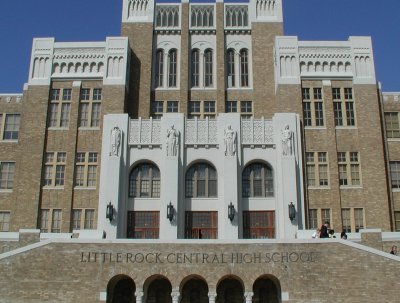
The westward expansion of Little Rock in the mid-1890’s gave rise to the West End, a section of the city which, in time, became known as the Central High School neighborhood. At the time the high school was completed in 1927 it was designated by the American Institute of Architects as “the most beautiful high school in America.”  For its time it was the largest and most expensive high school building in the United States.  Thirty years later its reputation would be changed as it became the site of international media coverage of efforts to fight the integration.

In addition to discussing the history and development of the area, the panel will talk about the future of historic properties in the neighborhood. A trio of neighborhood groups is actively involved in the effort. The three are: Wright Avenue Neighborhood Association, Capitol Hill Neighborhood Association and Central High Neighborhood Association.

The Architecture and Design Network is a non-profit organization. It is supported, in part, by the Arkansas Arts Center, Central Arkansas section of the Arkansas Chapter of the American Institute of Architects, the Fay Jones School of Architecture and friends in the community.

A reception will begin at 5:30 prior to the lecture.

Arkansas Political History at Old State House

OSH logoThe Arkansas General Assembly convenes today, while tomorrow is the inauguration day for the Governor and other Constitutional officers.

To learn more about Arkansas’ political past, visit the Old State House Museum.  Two of their permanent exhibits are especially of note this week.

First Families of Arkansas

The “First Families” of Arkansas varied in their background and experience. James Miller, the First Territorial Governor, spent little time in Arkansas, and his wife Ruth remained in Massachusetts. James Conway, the first governor of the state of Arkansas, came to Arkansas as a surveyor in 1820 and served in the Territorial Legislature. Conway was a founding member of an Arkansas dynasty known as “the Family,” a political alliance that dominated Arkansas until the Civil War. Conway’s wife, the former Mary Jane Bradley, came from a prominent Arkansas frontier family and was actively involved in furthering her husband’s political career.

Beginning in the 20th century, Anna Roark Brough served as her husband’s campaign manager. First Lady Brough, an active suffragette, posed on the steps of the capitol during a 1919 rally advocating voting rights for women.


On The Stump: Arkansas Politics, 1819 – 1919

In 1819 when the Arkansas Territory was created, the elimination of property requirements for voting combined with the raucous spirit of the frontier produced a new style of mass participation in American politics. The results were crude and often vulgar, but thoroughly democratic. This manifested itself in Arkansas politics less centered on political parties of Arkansas and the ideology of citizens than on the personalities of those involved. So personal were the politics of the times that political campaigns often culminated in duels. Carl Moneyhon, Professor of History at the University of Arkansas at Little Rock, served as author and guest curator for On the Stump. Additional materials were provided by the museum’s staff.


In addition, the Old State House Museum website has features on the men who have served as Governor of Arkansas.

Little Rock Look Back: Basketball at Robinson Auditorium

Former entrance to Robinson off Garland Street. Used to attend basketball games.

Former entrance to Robinson off Garland Street. Used to attend basketball games.

While Joseph Taylor Robinson Memorial Auditorium is known today as a performance and meeting venue, in its early days it was also the home to sports. Seventy-five years ago tonight the first basketball game was played at Robinson.

One of the first regular activities which took place in the lower level exhibition hall was a series of boxing and wrestling matches.  Building on the success of this, basketball came to the convention hall in January 1940.

A series of games featuring Little Rock High School and North Little Rock High School were announced by Coach Earl Quigley to take place from January 11 through February 16, the official opening day for the facility.

At that time, neither high school had a gymnasium; therefore both schools played their basketball games on their school auditorium stages with fans seated in the audience. The convention hall offered a regulation size floor (made of pecan block parquet) with seating for over 1,300 people along the sidelines and in the balcony.  The first men’s basketball game in Robinson Auditorium took place between the Little Rock High School Tigers and the North Little Rock High School Wildcats on January 11, 1940.

The Tigers lost the game before a crowd estimated to be 1,300.  Earlier in the evening there had been an exhibition between two women’s basketball teams.  The cost for admission to the games was 35 cents for the reserved seating and 25 cents for general admission.

Sandwich in History today at noon at old Fire Station No. 2 in MacArthur Park

Little Rock Fire Station No 2_tour_tnThe monthly architectural history program “Sandwiching in History” visits the old Little Rock Fire Station No. 2 located at 1201 S. Commerce Street (on the southwestern corner of MacArthur Park).

Located in the MacArthur Park Historic District, Little Rock Fire Station No. 2 was built in 1917 and served as a fire station until the late 1950s. The Craftsman-style building was constructed with a mixture of materials. It features exposed rafter tails, false half-timbering, and triangular knee braces under the eaves.

From the early 1960s through the 1980s, it had a variety of uses by the City’s Parks Department and other entities. In the 1980s through the mid-1990s, it served as storage and preservation space for the nearby Museum of Science and History (then-located in the Arsenal Tower building on the northern edge of the park.)

It sat largely vacant for a couple of years and sustained damage during January 1999 tornado which ripped through downtown.  For the past several years, a group has been working to convert it into a 30-bed hostel and museum.

Sandwiching in History is a program of the Arkansas Historic Preservation Program, an agency of the Department of Arkansas Heritage.