Little Rock Look Back: First Pulaski Heights City Council Meeting

Pul Heights CC minutesOn September 28, 1905, the first meeting of the Pulaski Heights City Council took place.  The newly elected Mayor was J. H. Joslyn, the Recorder was F. D. Leaming, and new Alderman present were E. E. Moss, Maxwell Coffir and C. C. Thompson.  Pulaski Heights had been incorporated on August 1, 1905.  At that time its population was estimated at between 300 and 400.

The first ordinance, which was offered by E. E. Moss, was to set a tax rate and give the City the ability to levy taxes.  Next was a motion to establish a committee to establish rules and procedures for the council. The final business before the Council was to allow the Recorder to order stationary, a seal and a record book (that record book is now in the vault at Little Rock City Hall).

The next meeting would be October 28.  At that meeting, two other Aldermen are mentioned in the minutes (Fauble and Paul) but were absent from that meeting as well.  Mr. C. M. Fauble was present at the third meeting.  Mr. R. O. Paul did not appear until the fifth meeting (December 13, 1905).

Interestingly the Recorder had a vote in the Council meetings (which was not a practice in the City of Little Rock at the time).

The Council did not have a permanent meeting place until the third meeting.  At that point in time, they used space in the offices of Dr. Hockersmith.

Pulaski Heights was a separate City until January 1916.  On January 4, 1916, Little Rock voters approved the annexation of Pulaski Heights by a ten-to-one margin, and the suburb became the city’s ninth ward. This established a couple of precedents for the City of Little Rock which are in effect to this day.  The first is that Little Rock would not be a central city surrounded by a variety of small incorporated towns (in the manner that St. Louis and other cities are).  It was this thought process which has led the City to continue to annex properties.

In addition, this move to annex Pulaski Heights was the first time that the City grew toward the west.  Previous growth had been to the south.  By emphasizing western expansion, this has allowed Little Rock to continue to grow.
LRFF’s Reel Civil Rights Film Festival concludes with – Beyond Galilee – Central Park Five – George Wallace: Settin’ the Woods on Fire

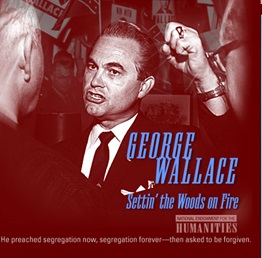
GeoWallaceThe Little Rock Film Festival’s Reel Civil Rights Film Festival concludes today with three different films. The concluding one is George Wallace: Settin’ the Woods on Fire at Historic Arkansas Museum at 6pm.

George Wallace was one of the most controversial and conflicting figures of the second half of the 20th Century in America.  Four times governor of Alabama, four times a candidate for president, he was feared as a racist demagogue and admired as a politician who spoke his mind. A lightning rod for controversy, Wallace both reflected and provoked tensions in American society over more than four decades. This film traces the rise of the firebrand politician from his roots in rural Alabama to the assassination attempt that suddenly transformed him.

Winner of the Sundance 2000 Film Festival Special Jury Prize, “George Wallace: Settin’ the Woods on Fire” is produced by Paul Stekler and Dan McCabe and written by Steve Fayer (“Eyes on the Prize,” “Vote for Me,” “Rock & Roll,” “Nixon”). According to PBS, this film places the public and private George Wallace within the turbulent history of the 1960s and 1970s, tracing a powerful story relevant to today’s presidential politics.

The first film of the day is Beyond Galilee at 12 noon.  It is the story of the Civil Rights movement in Shreveport.  Following the film, director and producer Tim DeWayne will lead a talkback.

At 3pm, the documentary Central Park Five will be shown.  It explores the 1989 case of five black and Latino teenagers who were wrongfully convicted of raping a white woman in Central Park.  Social justice activist Iris Roley will lead a discussion following the film.

LR Film Fest Reel Civil Rights Film Fest continues with MEDGAR EVERS: AN UNSUNG HERO

medgar-eversFifty years ago this past June, Civil Rights activist Medgar Evers was assassinated in front of his house in Mississippi.  Earlier this week, his widow (Myrlie Evers-Williams) and daughter (Reena Denise Evers-Everette) were honored in Little Rock for their work on behalf of the Civil Rights movement.

The Little Rock Film Festival’s Reel Civil Rights Film Fest continues today with the showing of Medgar Evers: An Unsung Hero.  This 2010 documentary explores the life and legacy of Mr. Evers.  It was produced by some of the creative team behind the AMC hit series Mad Men.  Directed by Michael Cory Davis. This two part film documentary on Medgar Evers provides extensive interviews with Myrlie Evers-Williams (widow), Charles Evers (brother), Reena Evers-Everette (daughter), Kestin Boyce, Derrick Johnson, and more.

The Reel Civil Rights Festival is sponsored by the Little Rock Film Festival in partnership with the National Park Service trough its Little Rock Central High School National Historic Site.  It was founded by Spirit Trickey.

The film will be shown at 6pm in the auditorium at Historic Arkansas Museum.

Following the film, Jerry Mitchell, an investigative reporter from The Clarion-Ledger will lead a talkback.

LR Film Fest Presents Reel Civil Rights Film Festival – Gideon’s Army

gideons_slab_540As a part of its year round programming schedule, The Little Rock Film Festival is proud to announce the 2013 Reel Civil Rights Film Festival – in proud partnership with the Little Rock Central High School National Historic Site.

The festival was originally founded by Spirit Trickey, daughter of one of the Little Rock Nine. The dates of the festival are centered around the anniversary of the desegregation crisis at Little Rock Central High that took place on September 25th, 1997.

Little Rock’s importance in American civil rights history makes our city the perfect place to hold the Reel Civil Rights Film Festival,” says LRFF Executive Director Craig Renaud. “The Little Rock Film Festival is proud to help grow the Reel Civil Rights Film Festival into one more reason why Little Rock is becoming the next great Southern City.”

The Reel Civil Rights Film Festival runs from September 26 through September 28.  All films are screened at Historic Arkansas Museum.

Tonight’s film is Gideon’s Army.  It starts at 6pm.  It is a documentary which follows three young, committed Public Defenders who are dedicated to working for the people society would rather forget. Long hours, low pay and staggering caseloads are so common that even the most committed often give up.

In 1961 Clarence Earl Gideon was arrested for stealing soda and a few dollars from a pool hall.  He could not afford an attorney and was convicted after representing himself at trial.  Gideon appealed his conviction to the Supreme Court, which, in a unanimous decision, ruled that the right to counsel in a criminal case is fundamental to the American system of justice. 

More than 12 million people are arrested in the United States each year.  Fifty years after the landmark Gideon v. Wainwright case, most of them will be represented by one of the United States’ 15,000 public defenders.

An official selection of the U.S. Documentary Competition at the 2013 Sundance Film Festival, GIDEON’S ARMY follows a group of idealistic young public defenders in the Deep South, where lawyers face particularly difficult challenges due to high bonds, minimum mandatory sentencing and a culture that is traditionally “tough on crime.”  Directed by fellow attorney Dawn Porter, GIDEON’S ARMY follows two young lawyers as they prepare their cases for trial.

The film premiered on HBO in July.  It has previously been featured at many prestigious film festivals including Sundanace and Tribeca.

Central High Integration 56th Anniversary Event This Evening

centralentranceIt was 56 years ago today that the Little Rock Nine entered Little Rock Central High School and finally started their school year.  Each year this date is commemorated both at Little Rock Central High as well as by the National Park Service through its Little Rock Central High National Historic Site.

In keeping with the anniversary day of the 1957 Little Rock Central High School crisis, the National Park Service will be honoring Little Rock’s own Annie Abrams (who also celebrates a birthday today), a nationally recognized civil rights activist.  She will be lauded for her service to Little Rock and for her dedication to movements around the United States of America.

In the spirit of the work done by activists worldwide fighting for freedom and putting their lives on the line, the Park Service is presenting keynote speaker, Myrlie Evers-Williams. She is the widow of civil rights activist Medgar Evers who was assassinated in the driveway of his home in Mississippi 50 years ago. Evers-Williams will address the accomplishments of her late husband and the work she continues as an agent for social justice.

Tonight at the Kendall Center on the campus of Philander Smith College, Annie Abrams, Reena Denise Evers-Everette (daughter of Medger and Myrlie Evers), and Myrlie Evers-Williams will receive the Soul of Humanity Award, given in recognition of outstanding commitment and service to social justice and lifelong action in the struggle for civil rights.

The program is free and open to the public.  It will take place at 6pm at the Kendall Center on the campus of Philander Smith College.

Six Pioneers, Other Leaders honored by National Park Service Tonight

NPSLRCHTomorrow, September 25, marks the 56th anniversary of the desegregation of Little Rock Central High School.  Each year the school and the National Park Service schedule a series of events to commemorate this.

This year, commemoration activities start this evening.  At 6pm at Philander Smith College, there will be a panel to discuss the Six Pioneers. These were the first six African-American students to desegregate the University of Arkansas at Fayetteville (U of A) School of Law.  The descendants of the Six Pioneers will discuss the role of moral courage and the change that occurred in the hills of northern Arkansas over 65 years ago.  George Haley, the sole living pioneer will give remarks as well.

Their footsteps on the foothills of conviction cleared a path for the desegregation of Hoxie Elementary in 1955 and Little Rock Central High School in 1957. The U of A School of Law was the first southern white university to accept African-American students since Reconstruction.

The Six Pioneers, The Honorable Rodney Slater, Attorney John W. Walker, Sr., Judge Wiley A. Branton, Jr., Sanford Tollette IV, Dr. Sybil Jordan Hampton and Robin Woods Loucks will all be recipients of the Soul of Humanity Award given in recognition of outstanding commitment and service to social justice and lifelong action in the struggle for civil rights.

The evening will close with remarks from Reena Denise Evers-Everette, daughter of civil rights activist and martyr Medgar Evers.

The event will take place at the Kendall Science and Health Mission Center on the Philander Smith College campus.


“A Land Inferior to None” – an evening celebrating “Arkansas: A Narrative History”

The Old State House Museum will present “A Land Inferior to None,” a talk and book signing with Jeannie Whayne, George Sabo and Tom DeBlack, authors of “Arkansas: A Narrative History,” Second Edition, on Tuesday, September 24, from 6 to 8 p.m. Admission to the talk is free. Those who wish to attend are encouraged to RSVP by calling (501) 324-8641 or visiting www.oldstatehouse.com/RSVP.

Deblack, Gatewood, Whayne, and Sabo

Deblack, Gatewood, Whayne, and Sabo

The book is a comprehensive state history that has been invaluable to students and the general public since its original publication over 10 years ago. The original edition won the Arkansiana Award when it was published in 2002, and the book is widely used in colleges throughout the state. The new edition has been updated and expanded with three additional chapters, including a new chapter on Arkansas geography. It also covers fresh material on the civil rights movement in the state and the struggle over integration, a new analysis of Arkansas’s school-funding issues and an examination of the Natural State’s transition from colonialism to its entry into the global political economy. The University of Arkansas Press published both editions of the award-winning textbook.

Jeannie Whayne is professor of history at the University of Arkansas. She is the author of “A New Plantation South: Land, Labor, and Federal Favor in Twentieth-Century Arkansas” and “Delta Empire: Lee Wilson and the Transformation of Agriculture in the New South.”

Tom DeBlack is professor of history at Arkansas Tech University. He is the author of “With Fire and Sword: Arkansas, 1861-1874.”

George Sabo is professor of anthropology at the University of Arkansas and director of the Arkansas Archeological Survey. His publications include “Rock Art in Arkansas” and “Paths of Our Children: Historic Indians of Arkansas.”

The Old State House Museum is a program of the Department of Arkansas Heritage.  Bill Gatewood is the Director of the Museum.  Martha Miller is the Director of the Department of Arkansas Heritage.