Little Rock Look Back: City Government Closes Up

Final 1863 minutesOn September 21, 1863, the City of Little Rock government shut down.  Following the occupation of Little Rock by federal troops (on September 10, 1863), the city was now under control of the United States Army.

The City Council met on September 21 and voted to disband the police force and to suspend the collection of taxes.  Mayor William E. Ashley was not present.  The five aldermen present were Charles P. Bertrand (a former mayor and stepson of Little Rock’s first mayor Dr. Matthew Cunningham), S. H. Tucker, W. B. Wait, I . A. Henry, and Louis George.  Following the actions regarding the police and taxes, the council adjourned.

The month before, on August 24, 1863, the City’s funds were “placed in the hands of a reliable party that was well known to the Council.”  Records in City Hall do not indicate who that was or if those funds were ever returned following the war. (Or if those funds were in Confederate dollars which would have been rendered useless.)

Following the September 21, 1863 meeting, there was not a City Council meeting until January 8, 1866.  I. A. Henry, who had been at the final 1863 City Council meeting was also an alderman on January 8, 1866.

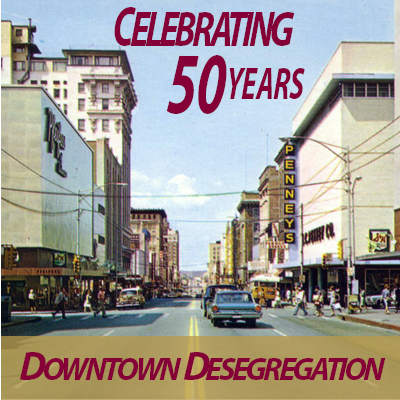
LR Look Back: Fifty Years of Desegregated Downtown Little Rock

widget_2013commerationThe UALR Institute on Race and Ethnicity is partnering with the Little Rock Regional Chamber of Commerce to mark the 50th anniversary of the desegregation of downtown Little Rock businesses from 10:30 a.m. – 2 p.m. Saturday, Sept. 21, 2013, at the Chamber.

This event is part of the Chamber’s 31st Annual Minority Enterprise Development Week and will include a public unveiling of the markers, reception, and the seminar, “Developing Future Leaders: How Strong Mentors Can Increase Diversity in Leadership Positions.”

Eleven  individuals from the Council on Community Affairs, Downtown Negotiating Committee, and Philander Smith College, will be honored with bronze markers placed on the Arkansas Civil Rights Heritage Trail in front of the Chamber. This will mark the third year of the Civil Rights Heritage Commemoration.

In 1963, this diverse group made up of members from COCA, DNC, and students from Philander Smith College worked together to plan a peaceful integration of downtown retail and restaurant establishments. Because of their efforts and others, by the end of 1963 most of the downtown retail businesses and restaurants had integrated.

2013 Arkansas Civil Rights Heritage Trail Honorees
The following individuals will be honored:

    • Dr. Garman P. Freeman, COCA
    • Dr. Morris A. Jackson, COCA
    • William Starr Mitchell, DNC
    • James H. Penick, DNC
    • Arthur Phillips, DNC
    • Rev. Negail Riley, Pastor, Wesley Chapel at Philander Smith College; COCA
    • Bert Strauss, Philander Smith College student; DNC
    • Ozell Sutton, COCA
    • Dr. William H. Townsend, COCA
    • Dr. Evangeline Upshur, COCA
    • B. Finley Vinson, DNC

Public Commemoration Ceremony – 10:30 a.m.
Civil Rights Heritage Markers Unveiling

Reception – 11 a.m.

Little Rock Look Back: Mayor John Elliott Knight

Jno E Knight sigOn September 20, 1816, future Little Rock Mayor John Elliott Knight was born in Newburyport, Massachusetts. In 1843 he married Hannah Donnell in New York, and came to Little Rock that same year.

Knight was editor of the Arkansas Democrat from 1846 to 1850. He was also associated with the Arkansas Gazette and published the short-lived Chronicle. In 1851, Knight served as Mayor of Little Rock. In 1855, he served as a member of the City Council.

In 1858 a song was published entitled “I Am Near to Thee” which featured music by Arkansan Benjamin Scull and lyrics by Knight.  The song was dedicated to Mary Woodruff.

During the Civil War, he served as a Colonel.  During the 1850, 1860 and 1880 census, he was listed as an attorney.

He had one daughter, Elizabeth Knight, who married James S. Pollock, a banker in Little Rock. Knight died in Little Rock, Arkansas, on October 28, 1901, and was buried in Mount Holly Cemetery. Elizabeth Knight Pollock died in 1910.

As an attorney and newspaper editor, John E. Knight collected documents about the settlement of Little Rock. Those papers are now part of a collection at the Arkansas History Commission.  The majority of these papers are from William Russell to Chester Ashley, pertaining to pre-emption claims in and around Little Rock. Other material concerns the 1819-1822 dispute related to the the New Madrid Certificate and pre-emption claims of James Bryant, Stephen F. Austin, and William M. O’Hara.

UALR Public Radio welcomes Frank Deford

book3-maggyThe Friends of KLRE/KUAR will host a fundraiser featuring an evening with legendary sportswriter and public radio commentator Frank Deford on Thursday, September 19, at 7 p.m.

Admission to the event at Embassy Suites in Little Rock is $100, and tickets can be purchased online or by calling us at 501-569-8485.

$50 of the ticket amount is a tax-deductible donation to your non-profit public radio stations.

“Sports: The Hype and The Hypocrisy” will be the theme, and the event will include a dinner, talk and book signing with Deford.

Arkadelphia native and Southern Fried blogger Rex Nelson will be the master of ceremonies. A cash bar will precede the dinner in the foyer of the Embassy Suites ballroom.

“We are very excited to welcome Frank Deford to Little Rock,” says Katherine Lu, board president of the Friends of KLRE/KUAR. “He’s more than just an NPR personality. He’s a writer of great fiction and a national sports icon,” she says of the Baltimore native whose work appears regularly in Sports Illustrated, on HBO’s Real Sports with Bryant Gumbel and on National Public Radio.

Deford is the author of 18 books, nine of them novels, and was awarded a National Humanities Medal by President Obama on July 10. His Wednesday morning sports commentaries are broadcast on KUAR FM 89 at 7:50.

Rex Nelson will be introducing Deford and conducting a question-and-answer session at the end of Deford’s presentation. Nelson is a regular political commentator on KUAR news, head of Arkansas’ Independent Colleges & Universities association, and a columnist for the Arkansas Democrat-Gazette. His career started as broadcaster and sportswriter covering the Ouachita Baptist Tigers.

“Nelson is going to be a great host because he’s an expert on Arkansas culture with a background in politics, sports, and writing,” says Lu. “We hope that this event will help public radio reach a new segment of our listeners and get to know some of our more occasional listeners better.”

klre_logoImportance of the Fundraiser
The top priority is replacing the stations’ aging audio control boards used to broadcast programming and record local content.

“The equipment is more than 15 years old and starting to fail,” says General Manager Ben Fry, “and some of the parts for these control boards are getting hard to replace because they are no longer available.”

“Reporters, producers, and board operators are having technical problems. It’s time to update,” says Fry.

KUARAbout The Friends of KLRE/KUAR
The Friends of KLRE/KUAR is a non-profit organization that financially supports the two stations of UALR Public Radio.

With public radio, “members” of the Friends of KLRE/KUAR make financial contributions to support the stations’ annual operating budgets.

“Hundreds of listeners participate in our semi-annual fund drives and become members of UALR Public Radio,” says Development Director Mary Waldo. “But it’s been several years since we’ve hosted a major fundraiser,” she says. “This year our focus is to improve the equipment for KUAR FM 89 and KLRE Classical 90.5. We do rely on the support of our listeners and members to serve central Arkansas.”

About KUAR FM 89.1 and KLRE Classical 90.5
KLRE FM 90.5, Little Rock’s first public radio station, went live in 1973 and became a member of National Public Radio in 1984. KUAR FM 89.1 went on the air in 1986. Today, the two stations serve a third of the state’s population and even more people through live streaming on the internet. KUAR broadcasts news and information programming, including daily newsmagazines from NPR and local news. KLRE broadcasts classical music 24 hours a day.

Encyclopedia of Arkansas Music launched tonight

butler-welkyWhat do a rockabilly musician turned cinematic swamp monster, an instrument that lent its name to a weapon, and the creator of Schoolhouse Rock! have in common? They all come from Arkansas. The Butler Center for Arkansas Studies, a department of the Central Arkansas Library System (CALS), will host a cocktail party to celebrate the release of the Encyclopedia of Arkansas Music, a new Butler Center Book, on Thursday, September 19, at 5:30 p.m. in the Main Library’s Darragh Center, 100 Rock Street. Reservations are appreciated, but not required. To RSVP, email kchagnon@cals.org or call 918-3033.
The Encyclopedia of Arkansas Music is a special project of the Encyclopedia of Arkansas History & Culture (EOA), an online encyclopedia launched in 2006 by the Butler Center. This colorful, photo-filled reference work spanning all aspects of Arkansas’s musical past and present includes more than 150 entries on musicians, ensembles, musical works, and events.
Also included is a musical map of Arkansas showing important musical sites-both defunct and still in existence-including the Rock ‘n’ Roll Highway. Covering the genres of blues/R&B, classical/opera, country, folk, gospel/contemporary Christian, jazz, rock, and rockabilly, this encyclopedia has something to interest any lover of Arkansas music and Arkansas history-as the state’s past, present, and future are tied to its music.
The Encyclopedia of Arkansas Music is available at River Market Books & Gifts, 120 River Market Ave., and from the University of Arkansas Press, Butler Center Books’ distributor, www.uapress.com. Butler Center Books is a division of the Butler Center for Arkansas Studies. The Butler Center’s research collections, art galleries, and offices are located in the Arkansas Studies Institute building at 401 President Clinton Ave. on the campus of the CALS Main Library. For more information, contact Rod Lorenzen at (501) 320-5716 or rlorenzen@cals.org.

Exhibit at Clinton Library pays tribute to March on Washington

(Copyright Estate of Stanley Tretick LLC)

(Copyright Estate of Stanley Tretick LLC)

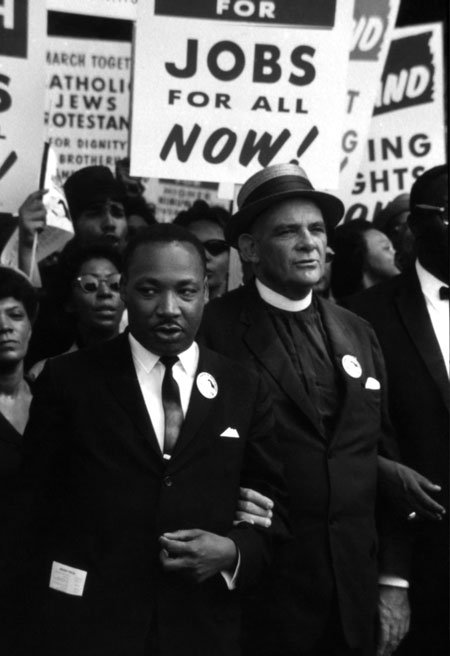
The William J. Clinton Presidential Library opened a new exhibit last month in conjunction with the 50th anniversary of the March on Washington.

Entitled, “And Freedom for All: The March on Washington for Jobs and Freedom,” this exhibit pays tribute to the 50th anniversary of The March on Washington. The March took place in Washington, D.C., on August 28, 1963.  It was attended by approximately 250,000 people, it was the largest demonstration ever seen in the nation’s capital.

Stanley Tretick was assigned by LOOK magazine to cover the march behind-the-scenes with organizers and program speakers.  The exhibit features his pictures and videos of speeches by Daisy Bates, John Lewis and a performance by Mahaila Jackson.

Dr. Martin Luther King Jr’s “I Have a Dream” speech is also featured in the exhibit.  President Clinton declared it to be “the clearest clarion call to the more perfect union of America in the 21 century.”

Stanley Tretick was an American photojournalist who worked for United Press International, Look and People (where he was a founding photo editor). He covered every president from Harry S. Truman through George H. W. Bush. For UPI, he followed the Kennedy presidential candidacy.  He resigned when UPI would not assign him to the White House once JFK took office.  The President promised his broad access which prompted Look to hire him.  His photos of the Kennedys helped form the collective iconic images for which the family is now remembered.

The exhibit runs through November 17.

Little Rock Look Back: Mayor Henry Lewis Fletcher

Mayor H L FletcherOn September 15, 1833, future Little Rock Mayor Henry Lewis Fletcher was born in Saline County.  His parents were Henry Lewis and Mary Lindsey Fletcher.  One of his siblings was future Little Rock Mayor John Gould Fletcher.  The Fletcher brothers are the only set of siblings to serve as Mayors of Little Rock.

Though the life of John Gould Fletcher is fairly well documented, not much information is out there on his brother Henry Lewis (and some of what is out there is incorrect).  He married Susan Bricelin August 30, 1855, in Pulaski County.  During the Civil War, he served as a sergeant in the cavalry for the Confederate Army in Captain Ed Nowland’s Company.

As a civic leader, Fletcher oversaw Arkansas’ contribution to the Philadelphia Centennial Exposition in 1876. The building received as a prize a cast-iron fountain still standing in front of the Old State House Museum.

Fletcher served as Mayor of Little Rock from 1891 to 1893.  When Fletcher became Mayor he appointed a new Police Chief (as most Mayors did) and the entire police force was dismissed.  A new police force was hired by E. H. Sanders, who served as chief for 18 months.  Upon his resignation, Frank MacMahon (who had been dismissed from the force when Fletcher came to office), was appointed Chief by Mayor Fletcher.  He would serve from 1892 until 1905.

Mayor Fletcher died on June 30, 1896 and is buried at Oakland Cemetery next to his wife (who died in 1911).