 102 years ago today (May 29, 1917), John Fitzgerald Kennedy was born to Joe and Rose Kennedy, the second of nine children. Groomed for leadership by his parents, he was thrust even more into the path of political greatness following the World War II death of his elder brother Joe Jr.
A war hero himself, following his leadership after the attack of PT-109, he was first elected to Congress from Massachusetts in 1946. He would be re-elected in 1948 and 1950. In 1952, he challenged incumbent Senator Henry Cabot Lodge and beat him. He was re-elected to the Senate in 1958.
Kennedy had been seen as a strong potential Vice Presidential candidate for the Democrats in 1956. But his father discouraged this fearing that a loss to Eisenhower/Nixon would set him back in the future. In 1960, the young, dashing Senator from the Bay State sought the Democratic nomination. After a contentious primary season where he often ran against senate colleagues, Kennedy headed into the Democratic convention with the most delegates. He added his chief rival, Texas Senator Lyndon Baines Johnson as his running mate.
After a close election, the Kennedy-Johnson ticket bested Vice President Richard Nixon and his running mate Henry Cabot Lodge (the selfsame former Senator who had been defeated by Kennedy 8 years earlier).
Following the oldest President (at the time), the young Kennedy administration seemed to captivate the country. During his 1,000 days in office, Kennedy faced many challenges both foreign (Bay of Pigs, Cuba missile crisis, start of Vietnam) and domestic (civil rights, organized crime). His ambitious “New Frontier” focused on education, additional services to rural areas and medical care for the elderly. He also focused on getting the US to the moon.
Together with Franklin Roosevelt and Ronald Reagan, JFK embodied not only his generation but the mood of the country. And his quotes resonate today including:
My fellow Americans, ask not what your country can do for you, ask what you can do for your country.
Let every nation know, whether it wishes us well or ill, that we shall pay any price, bear any burden, meet any hardship, support any friend, oppose any foe to assure the survival and the success of liberty.
Ich bin ein Berliner
On October 3, 1963, President Kennedy delivered remarks at the Arkansas State Fairgrounds. Only a few weeks later, he would be felled by an assassins bullet in Texas. In the speech, the President praised Arkansas’ congressional delegation including Senators John McClellan and J. William Fulbright and Congressmen Took Gathings, Bill Trimble, Wilbur Mills and Oren Harris. Each of these men held senior leadership positions in key committees. The main focus of the speech was to discuss President Kennedy’s vision for a new economy in the South.
The President was actually in the state to speak at the dedication of the Greers Ferry Dam. He agreed to make that appearance as a part of a negotiation with Congressman Mills as they were deadlocked over changes to the tax code. He had previously visited Little Rock in 1957 when he came to the state to address the Arkansas Bar Association meeting in Hot Springs.

 Eighty years ago today, on June 1, 1939, the cornice was installed on Robinson Auditorium.
 On May 31, 1955, the U.S. Supreme Court issued its ruling in Brown vs. Board of Education of Topeka II.
  Another historic high school graduation took place on May 28, 1958. It was the first graduation ceremony for Little Rock Hall High School.
 Principal Terrell E. Powell (who would be tapped as superintendent of the district in a few months) presided over the ceremonies. Superintendent Virgil Blossom (whose daughter had graduated from Central High the day before) spoke briefly to introduce the School Board members. One of them, R. A. Lile, presented the students with their diplomas.
 On May 27, 1955, on the stage of Robinson Auditorium, the Dunbar High School senior class graduated. This academic year marked not only the 25th anniversary of Dunbar’s opening, but it was the last year that the school building would offer junior high through junior college classes.
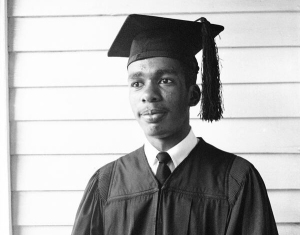 Last week, the Class of 2018 graduated from Little Rock Central High School. Perhaps the most famous Last week, the Class of 2019 graduated from Little Rock Central High School. Perhaps the most famous graduation ceremony in the long-storied history of Little Rock Central High took place on May 27, 1958. It was on that date that Ernest Green became the first African American to graduate from the formerly all-white school.
 Today is Memorial Day – a time to pay tribute to the men and women in uniform who died in service to their country.
 Little Rock Culture Vulture