Little Rock Look Back: Museum of Discovery opens in River Market

Museum of Discovery Logo when it opened in 1998

Founded in 1927 as the Arkansas Museum of Natural History and Antiquities in a downtown storefront, by 1997, the museum had been located in at least two other spots and had several different names.

On February 21, 1998, it reopened as the Museum of Discovery in its new location in the recently launched River Market district.  It occupied space on the first floor and basement of the Museum Center building (formerly the Terminal building the erstwhile train station which later was used for printing the Arkansas Democrat.)

The new name and new space reflected a greater emphasis on the science aspect of the museum’s mission.  It featured many hands on and interactive exhibits.

The museum spent one-third of its $10.6 million cost on exhibits.  Of the $10.2 million pledged for the museum, 47 percent — or about $4 million — came from a half-cent city sales tax approved by voters about five years ago. Another 14 percent came from foundations and 2 percent from private organizations and individuals. The remaining 37 percent came from corporations, sometimes in connection with specific exhibits.

Following a February 20, 1998, preview party, the official grand opening was held on February 21, 1998.

The previous museum space (inside the Arsenal building in MacArthur Park) occupied 14,000 square feet, 8,000 of which was display space. After the move, the museum had 35,000 square feet of display space.

Late Night at Arkansas Arts Center features Art of Motion and Music: Movement and Frida

Art of Motion and Music: Movement and Frida

Artifact Dance Project Artistic Director Ashley Bowman will discuss her quest to portray Frida Kahlo through movement. The program will begin at 6pm tonight (February 21) at the Arkansas Arts Center Lecture Hall.  A wine reception at 5:30 precedes it.  As part of the Late Night at the Arkansas Arts Center, all galleries, the museum shop, and Watercolor restaurant are open until 9:00 p.m.

Frida Kahlo suffered great physical and emotional pain throughout her life that manifested through her art. Because of her many surgeries, she was often committed to long periods of bed rest and healing time. Portraying Frida through movement is a challenging task because the artist was bound by her body and made that clear throughout her journal and self-portraits. Bowman will discuss how dance became the perfect artform to communicate the inner-workings of an artist who could barely move at times.

Following the lecture, guests are invited to view the galleries, shop in the Museum Shop or enjoy dinner at Watercolor in the Park.

SELMA on CALS Ron Robinson Theatre screen tonight as part of “Movies of a Movement” series

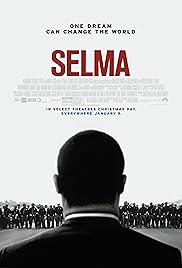
Selma PosterTonight (February 21) at the CALS Ron Robinson Theater, there is the chance to view SELMA, the 2014 movie about Dr. Martin Luther King, Jr.’s campaign to secure equal voting rights via an epic march from Selma to Montgomery, Alabama, in 1965.. The screening starts at 6:30.  Admission is $5.00

This movie is a part of the CALS Movies of a Movement: the Civil Rights & Social Change Collection.

The unforgettable true story chronicles the tumultuous three-month period in 1965, when Dr. Martin Luther King, Jr. led a dangerous campaign to secure equal voting rights in the face of violent opposition. The epic march from Selma to Montgomery culminated in President Johnson signing the Voting Rights Act of 1965, one of the most significant victories for the civil rights movement.

Direced by Ava DuVernay, it stars David Oyelowo as Dr. King and Carmen Ejogo as Coretta Scott King. Others in the cast include Tom Wilkinson, Giovanni Ribisi, Andre Holland, Ruben Santiago-Hudson, Colman Domingo, Common, Lorraine Toussaint, Dylan Baker, Niecy Nash, Tim Roth, and Stephen Root.  John Lavelle plays former Arkansas Gazette reporter Roy Reed who covered Selma for The New York Times.

Rock the Oscars 2019: Roy Reed

It is possible that journalist extraordinaire Roy Reed appears in archival footage of the Oscar winning documentary “Nine from Little Rock” (Documentary, Short-1964) and Oscar nominated Eyes on the Prize: Bridge to Freedom 1965 (Documentary, Feature-1988).  First for the Arkansas Gazette and then for The New York Times, Reed was an eyewitness to history being made.  What is not in doubt is that he is a character in the Oscar winning film Selma.  In that movie, he was played by actor John Lavelle.
Roy Reed was born on February 14, 1930, in Hot Springs and grew up in Garland County. After attending Ouachita Baptist College and the University of Missouri (from which he would receive a Bachelor’s and a Master’s in Journalism), Reed worked for a newspaper in Joplin and served in the US Army.  In 1956, he returned to Arkansas to work for the Arkansas Gazette.

While he did not specifically cover the integration of Little Rock Central High in 1957, he was part of the paper’s coverage of civil rights. He later was assigned to cover the Faubus administration.  In 1965, he was hired by The New York Times and covered the South. He covered the historic Freedom March to the state Capitol in Montgomery in March 1965.  After spending 1965 and 1966 in the South, he was assigned to the Times’ Washington DC bureau.  In 1969, he moved to New Orleans to open a Southern bureau for the paper.  He remained in the Crescent City until 1976, when he was transferred to the London bureau.

After retiring in 1978, he moved to Northwest Arkansas and taught journalism at the University of Arkansas until 1995.  Reed continued to write essays and books including Faubus: The Life and Times of an American Prodigal (1997),  Looking Back at the Arkansas Gazette: An Oral History (2009) and Beware of Limbo Dancers: A Correspondent’s Adventures with the New York Times (2012).  Reed died in December 2017.

2017 documentary DREAM LAND about Little Rock’s West 9th Street in its heyday as African American center and its legacy tonight

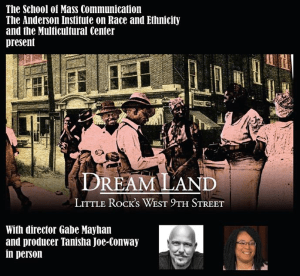
Tonight at 6pm at the Stella Boyle Smith Concert Hall the UA Little Rock School of Mass Communication, Anderson Institute on Race and Ethnicity, and Multicultural Center present the 2017 documentary DREAM LAND.
Little Rock’s West 9th Street was once a vibrant, African-American business and entertainment district. Taborian Hall is the only remaining historic structure on West 9th Street and stands as a living witness of the street’s former glory days. Throughout the 1920s and 1930s, Taborian Hall housed varied and important black businesses, including professional offices, a USO, the Gem Pharmacy and the Dreamland Ballroom. By the 1930s, Dreamland was firmly established as a stop on the “Chitlin Circuit,” which showcased regional and national African-American bands and stage shows. It was also host to local musicians, dances, socials, concerts and sporting events.

This documentary seeks to recognize, memorialize and share this history. The spirit and hard work of the people and the implications of federal programs such as Urban Renewal, school desegregation, the Housing Act of 1949 and the Eisenhower Interstate Program are explored. West 9th Street and the Dreamland Ballroom have patiently waited for their story to unfold so new audiences can connect to their historical past and unknown future.

Following the screening, director Gabe Mayan and producer Tanisha Joe-Conway will participate in a discussion.

Little Rock Look Back: First Elvis performance in LR

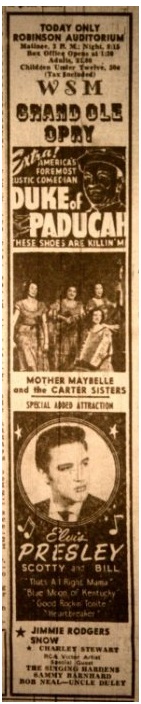
Sixty-four years ago today, on February 20, 1955, Elvis Presley made his first appearance on stage in Little Rock. He performed at Joseph Taylor Robinson Memorial Auditorium.

He was billed as “an added attraction” to a Grand Ole Opry Show headlined by the Duke of Paducah.  Others on the bill included Mother Maybelle and the Carter Sisters, Jimmie Rodgers Snow, Charlie Stewart, the Singing Hardens, Sammy Barnhart, Bob Neal, Uncle Dudley and Smilin’ Mac Cyclone. (It is interesting to note that at least some of the advance tickets billed it as The Elvis Presley Show, though the newspaper ads billed the Duke of Paducah as the headliner.)

This concert was part of a weeklong tour of Arkansas and Louisiana.  There were two shows that day – one at 3p.m. and the other at 8:15p.m.  Tickets on the day of the concert were $1.00 for adults and fifty cents for children.  Advanced tickets had sold for 75 cents at Walgreens.

The night before, Elvis played the Louisiana Hayride in Shreveport.  Following his Little Rock appearance (for which he and his band were paid $350 instead of their usual $200), they played in Camden, Hope, and Pine Bluff.

It is believed that Elvis’ parents attended this concert in Little Rock. Gladys Presley was a big fan of the Duke of Paducah. Elvis apparently also wanted his parents to meet with Colonel Tom Parker, who would become inexorably linked with Elvis’ career.

Warhol, Lichtenstein and More as Arkansas Arts Center opens POP! Out of the Vault exhibit

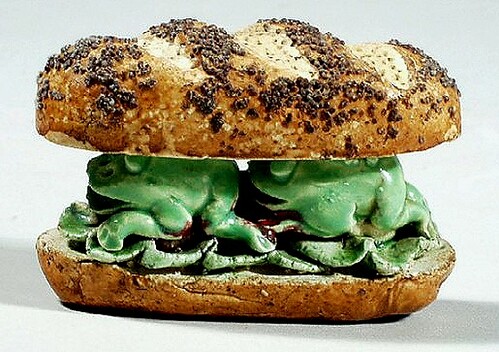
Mini Frog Sub

David Gilhooly, American (Auburn, California, 1943 – 2013, Newport, Oregon), Mini Frog Sub, 1980, hand-built, glazed low-fire whiteware, 2 ¼ x 1 3/8 inches, Arkansas Arts Center Foundation Collection: Gift from the Diane and Sandy Besser Collection, 1987.043.003.

POP! Out of the Vault, on view February 19 through July 7, 2019 at the Arkansas Arts Center, features more than 50 works from the Arkansas Arts Center Foundation Collection by some of Pop Art’s most influential figures, including Andy Warhol, Roy Lichtenstein, Claes Oldenburg, and Mel Ramos.

In 2013, the Arkansas Arts Center received a book of Polaroids by Andy Warhol as a gift from the Warhol Foundation. Throughout his career, Warhol was fascinated with Polaroids. In the 1970s, long before digital photography, these photographs that instantly developed themselves were a wonder – and very convenient for artists. The “Prince of Pop Art” made hundreds of Polaroids as sketches for his Pop Art portraits. The Arts Center’s 1975 Little Red Book #9 (Warhol produced hundreds of such books) features images of Easha McCleary. The Polaroids served as source material for a portfolio of prints related to a suite of 105 paintings, both titled Ladies and Gentlemen and commissioned by an Italian art dealer.

To show Warhol’s Polaroids of drag queens and transgender women of color in context, the curators of the Arkansas Arts Center went to the vaults in search work by of Warhol’s peers. They found a treasure trove of Pop Art and art from related movements.

POP! Out of the Vault will feature some rare examples of the first iterations of Pop Art, which arose in Britain in the 1950s. There, the artists of the Independent Group created collages that used American magazine pictures to mock the commercialism of contemporary life. Eduardo Paolozzi, a leading Independent Group artist, made collages, but also gathered popular imagery in prints, drawings, and sculptures like the Arts Center’s Triple Fuse.

In the early 1960s, young American artists created their own, independent version of Pop Art as they turned away from the hyper-expressive Abstract Expressionist works that had dominated American art through the 1940s and 1950s. Lichtenstein, Warhol, Oldenburg, and  Ramos were among the first American Pop artists. They shocked art critics by making fine art paintings and sculpture that appropriated mass-produced commercial images.

Lichtenstein used the colorful, hard-edged visual language of commercial art to reimagine a procession of different artistic subjects and movements from comic books to Cubism. Warhol mass-produced his paintings and prints of soup cans and celebrities using silkscreen – a process previously only used to print posters and packaging. Oldenburg turned the dignified tradition of monumental sculpture on its head with his giant hamburgers and clothes pins. Ramos, who was working in California while the others worked on the East Coast, appropriated images of Superman, Wonder Woman, and other heroes before he began creating his signature paintings pin-up advertising women and his sendups of famous art works.

At about the same time that American Pop artists were beginning their work, other artists found their own ways of reacting against Abstract Expressionism. In England, painter and printmaker Patrick Caulfield found an elegant modernist approach to every-day subject matter. Often referred to as a Pop artist, Caulfield abhorred the label. In California’s San Francisco Bay Area, an irreverent approach to art took the form of self-depreciating, ironic Funk Art. Funk artist David Gilhooly even founded his own ceramic amphibian-based planet – The FrogWorld.

POP! Out of the Vault is organized by the Arkansas Arts Center.