Sandwich in History at the Mills-Davis House today

Image may contain: tree, sky, house, plant and outdoor

You are invited to join the Arkansas Historic Preservation Program’s next “Sandwiching in History” tour, which will visit the Mills-Davis House at 523 East 6th Street in Little Rock beginning at noon on Friday, October 4, 2019.

The Mills-Davis House is an outstanding example of Italianate architecture built in 1878. The house was originally occupied by Abraham Anderson Mills and his wife Eliza Missouri “Eudie” LeFevre Mills, who lived in the house until the early 1940s when Dr. Emmett N. Davis acquired the property. Davis later passed it to his son, famed Arkansas photographer William “Bill” E. Davis. The house has recently been restored by its current owner, Jennifer Carman.

Sandwiching in History tours are worth one hour of AIA continuing education credit. If you would like to receive email notifications of upcoming tours instead of postcards or need additional information, please contact Callie Williams, Education and Outreach Coordinator for AHPP, at 501-324-9880 or Callie.Williams@arkansas.gov.

This evening at the Clinton School – Theo Witsell discusses his Bicentenary interpretation of Thomas Nuttall’s exploration of the Arkansas Territory

Image result for theo witsellThe year 2019 marks the 200th anniversary of the great botanist and naturalist Thomas Nuttall’s year-long journey of discovery through the Arkansas Territory, present day Arkansas and Oklahoma.

Tonight at 6pm, as part of the Clinton School Speaker Series, Theo Witsell will discuss Nuttall’s trek and the implications it has for today.

Nuttall would be the first trained naturalist to record observations and collect specimens in most of the territory. His first-hand account of this trip, later published as “A Journal of Travels into the Arkansas Territory in the Year 1819,” provides some of the earliest reliable information on the natural history of the region. These observations and his surviving botanical specimens are central to our understanding of what the region was like before it was forever altered by the ravages of human progress.

To commemorate the bicentennial of Nuttall’s trip, Theo Witsell, Ecologist and Chief of Research for the Arkansas Natural Heritage Commission and the Curator of the ANHC Herbarium, worked for the past several years on a “200 years later” reinterpretation of all the natural history observations he made in Arkansas Territory.

This included retracing his route using both historical and modern geospatial datasets, updating the nomenclature and taxonomy of all the plants and animals he mentions, and weaving his own observations gained over the past 24 years conducting field work for the Arkansas Natural Heritage Commission. The aim is to provide a fairly detailed interpretation of Nuttall’s natural history observations, and discuss changes in the landscape since his trip, specifically as they relate to ecological and biological diversity.

All Clinton School Speaker Series events are free and open to the public. Reserve your seats by emailing publicprograms@clintonschool.uasys.edu or by calling (501) 683-5239.

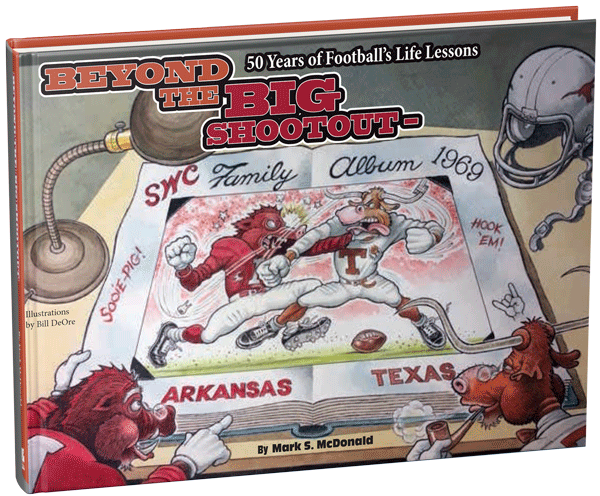
BEYOND THE BIG SHOOTOUT is topic of noon Clinton School program today

Image result for mark mcdonald beyond the big shootout

December 1969 – the top two college football teams in the country faced off in Fayetteville with the national championship on the line.  In the stands were the US President, a future US President and several leaders of congress.

Known as The Big Shootout, it was more than just a football game.  Today (September 24) at noon, author Mark S. McDonald will be discussing his book at that historic game that changed the face of football forever. This is part of the Clinton School’s speaker series and will be held at Sturgis Hall.

Right after the game, your life changed, everything changed … recruiting of black athletes in Dixie, new safety rules in football, tighter crowd control, more TV coverage and bigger money in college athletics … Suddenly, for the Arkansas Razorbacks and Texas Longhorns, and players and coaches nationwide, bulbs on a scoreboard no longer defined them. Instead, life came rushing at them.

In a blur, these superior, highly trained athletes were no longer football stars. They were fathers, community leaders, victims of car wrecks and cancer, businesses and marriages gone bad. Some Saturday’s heroes lost their way, others used football to find faith. The competition took on new and different meaning. Who could have predicted such outcomes?

It’s all here, in words of those who lived this epic journey, supported by dozens of period photos and clever original illustrations from award-winning artist Bill DeOre. In his Beyond The Big Shootout – 50 Years of Football’s Life Lessons, author Mark S. McDonald has emerged from his own football past to create a historical narrative on a giant canvas, unlike any other.

For some, the game itself was cruelly damaging. For others, it brought dance-in-the-street joy. But today, looking back, who really won? Was there really a loser?

After reading this one, you will know.

All Clinton School Speaker Series events are free and open to the public. Reserve your seats by emailing publicprograms@clintonschool.uasys.edu or by calling (501) 683-5239.

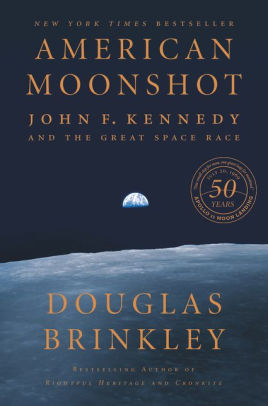
AMERICAN MOONSHOT is focus of Clinton School program tonight

American Moonshot: John F. Kennedy and the Great Space RaceAfter the fiftieth anniversary of the first lunar landing passes, the award-winning historian and perennial New York Times bestselling author takes a fresh look at the space program, President John F. Kennedy’s inspiring challenge, and America’s race to the moon.

“We choose to go to the Moon in this decade and do the other things, not because they are easy, but because they are hard; because that goal will serve to organize and measure the best of our energies and skills, because that challenge is one that we are willing to accept, one we are unwilling to postpone, and one we intend to win.”—President John F. Kennedy

On May 25, 1961, JFK made an astonishing announcement: his goal of putting a man on the moon by the end of the decade. In this engrossing, fast-paced epic, Douglas Brinkley returns to the 1960s to recreate one of the most exciting and ambitious achievements in the history of humankind. American Moonshot brings together the extraordinary political, cultural, and scientific factors that fueled the birth and development of NASA and the Mercury, Gemini and Apollo projects, which shot the United States to victory in the space race against the Soviet Union at the height of the Cold War.

Douglas Brinkley is the Katherine Tsanoff Brown Chair in Humanities and Professor of History at Rice University, a CNN Presidential Historian, and a contributing editor at Vanity Fair. In the world of public history, he serves on boards, at museums, at colleges, and for historical societies.The Chicago Tribune dubbed him “America’s New Past Master.” The New-York Historical Society has chosen Brinkley as its official U.S. Presidential Historian.

All Clinton School Speaker Series events are free and open to the public. Reserve your seats by emailing publicprograms@clintonschool.uasys.edu or by calling (501) 683-5239.

After the fiftieth anniversary of the first lunar landing passes, the award-winning historian and perennial New York Times bestselling author takes a fresh look at the space program, President John F. Kennedy’s inspiring challenge, and America’s race to the moon.

“We choose to go to the Moon in this decade and do the other things, not because they are easy, but because they are hard; because that goal will serve to organize and measure the best of our energies and skills, because that challenge is one that we are willing to accept, one we are unwilling to postpone, and one we intend to win.”—President John F. Kennedy

On May 25, 1961, JFK made an astonishing announcement: his goal of putting a man on the moon by the end of the decade. In this engrossing, fast-paced epic, Douglas Brinkley returns to the 1960s to recreate one of the most exciting and ambitious achievements in the history of humankind. American Moonshot brings together the extraordinary political, cultural, and scientific factors that fueled the birth and development of NASA and the Mercury, Gemini and Apollo projects, which shot the United States to victory in the space race against the Soviet Union at the height of the Cold War.

Douglas Brinkley is the Katherine Tsanoff Brown Chair in Humanities and Professor of History at Rice University, a CNN Presidential Historian, and a contributing editor at Vanity Fair. In the world of public history, he serves on boards, at museums, at colleges, and for historical societies.The Chicago Tribune dubbed him “America’s New Past Master.” The New-York Historical Society has chosen Brinkley as its official U.S. Presidential Historian.

All Clinton School Speaker Series events are free and open to the public. Reserve your seats by emailing publicprograms@clintonschool.uasys.edu or by calling (501) 683-5239.

New exhibit, Hateful Things, opens at Mosaic Templars Cultural Center tonight

“Someone will say ‘if you just stop traveling the country talking about race, racism will go away.’ That doesn’t even make stupid sense. The reality is that we won’t be who we need to be until we are mature enough to have the most difficult conversations about race.”

The man who said these words, David Pilgrim, professor and founder of the Jim Crow Museum of Racist Memorabilia at Ferris State University, will speak at the Sept. 19 opening of the “Hateful Things” exhibit at Mosaic Templars Cultural Center.

The objects and images in “Hateful Things” trace the history of the stereotyping of African Americans from the late 19th century to the present. The Jim Crow Museum created the “Hateful Things” traveling exhibit as a teaching tool to promote tolerance and social justice beyond the museum’s reach.

“We chose to host this exhibit because we want to help people understand how these types of depictions create a culture of fear and hatred that has led to tragedies like the Elaine Massacre,” MTCC Director Christina Shutt said.

“David Pilgrim’s message concerning open, honest, even painful discussions about race is especially relevant here in Arkansas as we remember the 100th anniversary of the Elaine Massacre,” added Stacy Hurst, secretary of the Department of Parks, Heritage and Tourism.