Little Rock Look Back: City Park becomes MacArthur Park

GOn March 9, 1942, Little Rock’s first public park was renamed by the Little Rock City Council.  By a vote of fourteen ayes, zero nays and four absent, the alderman approved Ordinance 6,388 which renamed the park in honor of General Douglas MacArthur. 

The text of the ordinance says that “it is fitting and proper that the bravery and glorious deeds of General Douglas MacArthur, a native son of Little Rock, should be commemorated.”  This was passed a few months after the United States’ entry into World War II. 

Though he was already a well-established military figure, most of the MacArthur legend during the war would take place after this naming. 

The park land had originally served as a horse racetrack in the early days of Little Rock.  By 1836, the federal government purchased the land for construction of a military arsenal.  The flagship building, the Arsenal Tower building, is the only remaining structure from that time period.  

The land served as a military outpost until 1892.  On April 23, 1892, a land swap took place where in the City of Little Rock was given the property with the stipulation that it would be “forever exclusively devoted to the uses and purposes of a public park.” (Never mind that the federal government took part of the land back for the construction of the Wilbur Mills Freeway.)  

In return for giving the City this land, the federal government took possession of land on the north side of the Arkansas River (then part of Little Rock) – that 1,000 acres became Fort Logan H. Roots. The park opened on July 4, 1893, with the name Arsenal Park. Since it was the City’s first and only park at the time, residents started referring to it as City Park. In time, the designation Arsenal Park fell from use.  In fact, it is referred to as City Park exclusively and officially in City documents throughout the first 42 years of the 20th Century. 

The action of the City Council in March 1942, was accompanied by petitions encouraging the action which were submitted by the Arkansas Authors and Composers Society, the Arkansas Engineers Club and the Pulaski County Republican Central Committee.  

City records do not indicate if anyone registered opposition to the name change. It would be another decade before General MacArthur would return to the site of his birth, a place he had not visited since his infancy.MacPark ordinance

Little Rock Look Back: Casimir Pulaski

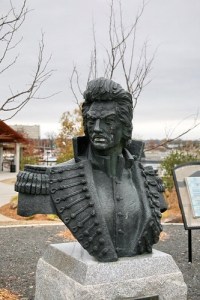
On March 6, 1745, Casimir Pulaski was born in Poland. A Polish nobleman and military commander he has been called a “father of the American cavalry.”

Born in Warsaw, he followed in his father’s footsteps he became involved in the military and the revolutionary affairs in Poland. Pulaski was one of the leading military commanders for the Bar Confederation and fought against Russian domination of Poland. When this uprising failed, he was driven into exile.

Following a recommendation by Benjamin Franklin, Pulaski emigrated to North America to help in the cause of the American Revolutionary War. He distinguished himself throughout the revolution, most notably when he saved the life of George Washington.

Pulaski became a general in the Continental Army, created the Pulaski Cavalry Legion and reformed the American cavalry as a whole. At the Battle of Savannah, while leading a daring charge against British forces, he was gravely wounded, and died shortly thereafter.

Pulaski is one of only eight people to be awarded honorary United States citizenship. He never married and had no descendants.

Arkansas is one of several states to have a county named in honor of Count Pulaski.  Pulaski County was Arkansas’s fifth county, formed on December 15, 1818. 

Women’s History Month Throw Back Thursday: The Aesthetic Club


One of the founders of the Aesthetic Club.

Since March is Women’s History Month, this month there will be a special “Throw Back Thursday” feature on a women’s organization which has shaped Little Rock’s cultural landscape. Up first is The Aesthetic Club

Founded in 1883, the Aesthetic Club is one of the oldest women’s clubs west of the Mississippi River.  The club first met on January 15, 1883 with founders Cynthia Polk, Sallie Martin, Ida Martin, Fannie Jabine, Jane Georgine Woodruff, Mary Knapp, Gertrude Hempstead, Harriet Jabine, and Virginia Hamilton.

Their purpose was “to present programs of a literary, artistic, musical, and timely trend” in order to “assist in educational uplift, and to bring its members together for social enjoyment.”

By 1894, the membership had increased to 100, and the group could no longer meet in members’ homes.  a new meeting place had become necessary. In 1893, the group started meeting in the Arsenal Tower Building, where they continue today. For several years they were the only tenant of the building and paid the utility bills for the structure when no other entity would.

The Aesthetic Club worked with the Arkansas Federation of Women’s Clubs to secure library legislation from the state of Arkansas in 1902. This allowed for cities to create municipal libraries.

The Aesthetic Club’s objective is “to present programs at various meetings of a literary, artistic, musical, and timely trend; to assist in educational uplift; and to bring its members together for social enjoyment.” A member of the Aesthetic Club may read a paper, play a musical instrument, sing, or be appointed chairman of the day and be responsible for introducing speakers and musicians or greeting members. Membership of the Aesthetic Club is still limited so that its active members total no more than 100, not including inactive and associate members.

Amelia Smith, an active Aesthetic Club member between 1940 and 1960, summed up the club’s strength: “It has always been a body of women who stood for and lived up to its motto, ‘The Good, the True, and the Beautiful.’ Never once, whether there were good times, wars, a Great Depression, or social changes, has it departed from remarkable standards.”

Over the years many of the members were wives, daughters and mothers of Luttle Rock leaders. As the role of women has changed, now he leaders are actual members–not relatives of leaders.

Little Rock Look Back: Arkansas Territory Authorized 


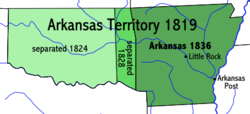
On March 2, 1819, the Arkansas Territory was authorized by an act of Congress, to take effect  on July 4, 1819.

The Arkansas Territory was created from the portion of the Missouri Territory. It originally encompassed all of what is now Arkansas and much of what is now Oklahoma. The westernmost portion of the territory was removed on November 15, 1824, a second westernmost portion was removed on May 6, 1828, reducing the territory to the extent of the present state of Arkansas.

The Territorial capital was Arkansas Post from July 1819 until June 1821. At that point in time it was moved to Little Rock. In 1819, there was no permanent settlement in Little Rock. It would my be until early 1820 that a permanent settlement would be established.  On 1818, the Quapaw Treaty had anticipated a future settlement in Little Rock. 

Little Rock Look Back: Byron Morse, 55th Mayor of Little Rock

On February 23, 1917, future Little Rock Mayor Byron R. Morse was born.
A founder of the real estate firm of Rector-Phillips- Morse, he was long active in civic affairs of Little Rock.

Mayor Morse was first elected to the City Board of Directors in November 1960. In 1963, he was chosen as Little Rock Mayor. After serving two years as Mayor, he chose to not seek re-election to the City Board.

In 1980, he was appointed to the City Board to fill out an unexpired term. He was later asked to fill another unexpired term but declined.

In 1983, he was elected national president of the Society of Industrial and Office Realtors. Mayor Morse also served as president of the Little Rock Chamber of Commerce, the Little Rock United Way, the Little Rock Red Cross, and was a member of the Board of Directors of the Little Rock Boy’s Club. He was a member of the Fifty for the Future.

On July 25, 2001, Mayor Morse died.

IMG_5431

Little Rock Look Back: George Washington

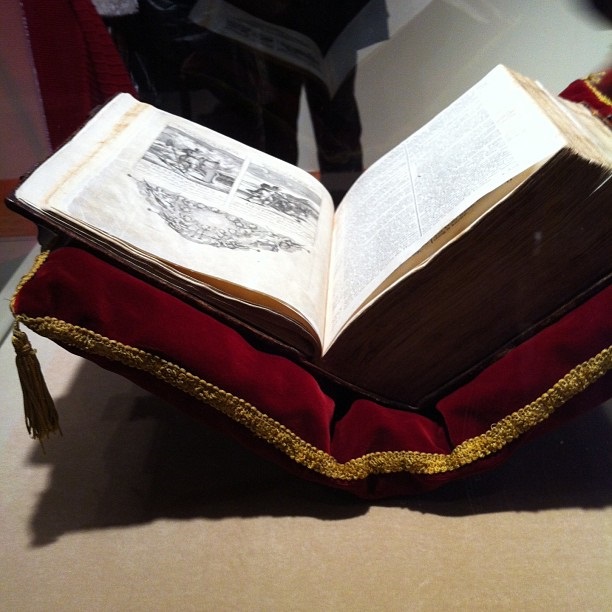
The Washington Inaugural Bible

Washington1George Washington was born on February 22, 1732, in Westmoreland, Virginia. He is one of only two American Presidents to not have any authority over the land now known as Little Rock. Washington never ventured west of the Mississippi River, so never visited Arkansas.

As the first President and Father of his Country, he has many things named after him. In Little Rock, Washington Street is named in his honor.

Recently, two Little Rock museums highlighted George Washington artifacts. Historic Arkansas Museum displayed the Washington family Bible for several months. At the start of that time, they also showcased the Bible on which Washington swore his first oath as President (the inaugural inaugural?).

A few months later, the Clinton Presidential Center featured Washington’s personal annotated copy of the 1789 “Acts Passed at a Congress of the United States of America.” This artifact had been purchased by the Mount Vernon Ladies Association in 2012.

Little Rock Look Back: Elvis plays first shows at Robinson Auditorium

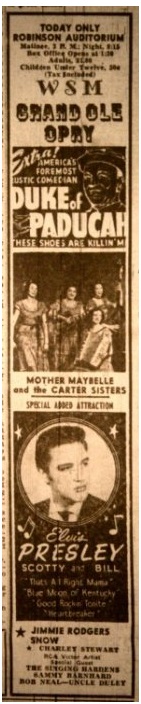
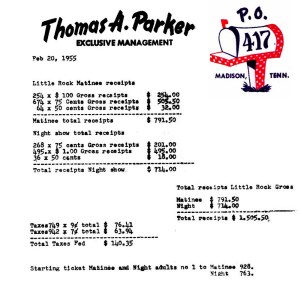
eap feb 55 adSixty years ago today, on February 20, 1955, Elvis Presley made his first appearance on stage in Little Rock. He performed at Joseph Taylor Robinson Memorial Auditorium.

He was billed as “an added attraction” to a Grand Ole Opry Show headlined by the Duke of Paducah.  Others on the bill included Mother Maybelle and the Carter Sisters, Jimmie Rodgers Snow, Charlie Stewart, the Singing Hardens, Sammy Barnhart, Bob Neal, Uncle Dudley and Smilin’ Mac Cyclone. (It is interesting to note that at least some of the advance tickets billed it as The Elvis Presley Show, though the newspaper ads billed the Duke of Paducah as the headliner.)

This concert was part of a weeklong tour of Arkansas and Louisiana.  There were two shows that day – one at 3p.m. and the other at 8:15p.m.  Tickets on the day of the concert were $1.00 for adults and fifty cents for children.  Advanced tickets had sold for 75 cents at Walgreens.

eap receits 05-little.rock_.feb_.55The night before, Elvis played the Louisiana Hayride in Shreveport.  Following his Little Rock appearance (for which he and his band were paid $350 instead of their usual $200), they played in Camden, Hope, and Pine Bluff.

eap 02-little.rock_It is believed that Elvis’ parents attended this concert in Little Rock. Gladys Presley was a big fan of the Duke of Paducah. Elvis apparently also wanted his parents to meet with Colonel Tom Parker, who would become inexorably linked with Elvis’ career.