
Birth of future Razorback football star and LR Mayor Sonney Henson

On July 18, 1928, future Little Rock Mayor Harold E. “Sonney” Henson, Jr. was born in Fayetteville to Harold E Henson Sr. and Dollie Croxdale Henson.  He and his sister Sara Sue grew up in Springdale.

Henson graduated from Springdale High School and was later inducted as one of the first inductees into the Springdale High School Hall of Fame where he participated in the state high school championship in football and basketball. He attended the University of Arkansas in 1945 on an athletic scholarship where he participated in three sports: golf, basketball and football, and graduated in 1949 with a degree in Business Administration.

He was active in ROTC at the university and graduated as a second lieutenant in the U.S. Army. Henson served in Korea as a captain and commander during the Korean conflict. He attained the rank of major as an active member of the Army reserve post his duty in Korea.

Henson’s professional career began with First National Bank of Springdale and soon moved to Little Rock where he served as Vice President at the Worthen Bank on Asher Avenue. In 1962 he was elected to the City of Little Rock Board of Directors.  From January 1965 to December 1966, he served as mayor of Little Rock.  In November 1966, he was unopposed in his bid for a second term on the City Board.  However in October 1967, he resigned from the City Board because he was taking a position with a bank in Joplin, Missouri.

From 1966 to 1972, he served as President of Security National Bank Joplin.  While there, he was a Missouri amateur championship golfer.  Herbert Thomas then asked him to move to Ft. Smith to head up City National Bank (present Bank Corp South) where he served as President and CEO from 1972 to his retirement in 1993 at the age of 65. He continued his service to Bank Corp South as an active board member for several years.

Among his many civic activities throughout his career were the Springdale Junior Chamber of Commerce,  Sparks Regional Medical Center board of directors of Fort Smith, president and active member of the board for the Arkansas Sports Hall of Fame and Razorback Foundation, on the board for the University of Arkansas for Medical Sciences foundation, the Westark area council for Boy Scouts, the Arkansas State Chamber of Commerce, the Small Colleges of Arkansas, Leadership Fort Smith, the Community Rescue Mission and the President of the Arkansas Bankers Association to name a few.  In 1995 he received the meritorious service award by the Arkansas Sports Hall of Honor for his lifelong commitment to Arkansas sports.

Henson was married for 53 years to Helen Garrott Henson. He had four children, 16 grandchildren and one great-grand child.  He died on August 8, 2013, and is buried in Fort Smith.

Four years since U.S.S. Little Rock christened

On July 18, 2015, the new U.S.S. Little Rock (LCS9) was christened and officially launched in a ceremony in Marinette, Wisconsin.
Among those in attendance at the ceremony were Little Rock Mayor Mark Stodola and US Senator John Boozman.   Then-Secretary of the Navy Ray Mabus, who served on the original U.S.S. Little Rock during the Vietnam War, was also present at the ceremony.

The U.S.S. Little Rock will be the nation’s ninth littoral combat ship.  It has been built for the U.S. Navy by Lockheed Martin and Marinette Marine Corporation (MMC) at the MMC shipyard in Marinette, Wisconsin.

The christening ceremony celebrated the ship’s physical transition from land to sea.  The ceremony was a symbolic transition from a hull number to a ship with a name and spirit of its own.

Following Janee Bonner’s shattering of the champagne bottle on the hull, the U.S.S. Little Rock was side launched into the Menominee River.  A side launch is unique, because the ship enters the water broadside. It is mostly used on inland waters, rivers and lakes.  To see the side launch, view the video here.

In December 2017, the ship was commissioned in Buffalo, New York.  Situated next to the original USS Little Rock (now docked in Buffalo as a museum), it was the first time a ship was commissioned adjacent to a former ship bearing the same name.

Birth of Little Rock Mayor James Woodson (aka – future Ron Swanson)

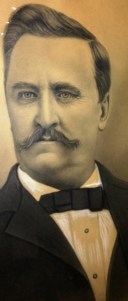
On July 14, 1848, future Little Rock Mayor James Alexander Woodson was born in North Carolina.  The son of two prominent eastern families, he and his parents moved to Pine Bluff in 1849.  His father died within two weeks of the family’s arrival in Arkansas.

With the outbreak of the Civil War, he enlisted as a drummer boy in the Ninth Arkansas infantry but was discharged because of his youth. He worked as a clerk at a general store in Pine Bluff. After the Civil War ended, he attended school in Virginia and Maryland before returning Pine Bluff. Upon his return he worked in the steamboat business and eventually started working in railroads. He was instrumental in putting together one of the forerunners of the Missouri Pacific Railroad and worked for them for 18 years.

Woodson moved to Little Rock in March 1881 and continued working for the railroad until 1891.  Working in the mercantile business allowed him more time to be engaged in civic affairs.  In 1895 he was elected mayor.   He handily defeated former mayor W. G. Whipple who was seeking to return to office.

During Mayor Woodson’s tenure, he oversaw renovations of the 1867 Little Rock City Hall (which was located at the time on the north side of Markham between Main Street and Louisiana Street).  He also championed the construction of a city hospital and the first free bridge across the Arkansas River.  Mayor Woodson was reelected in April 1897 and April 1899.

In April 1890, he resigned to take over the Arkansas and Southwestern Railway.  After restoring it to sound financial footing, he later led the Arkansas Asphalt Company.  That company provided the first asphalt for paving Little Rock city streets.

Woodson served as a director of the Little Rock board of trade (forerunner to the Little Rock Regional Chamber of Commerce), director of the Mercantile Trust Company and president of the state board of trade (forerunner of the Arkansas State Chamber of Commerce).

Woodson married Virginia Lanier in 1868.  They had six children, five of whom lived to adulthood.  Mayor Woodson died on October 19, 1908 and is buried in Mount Holly Cemetery.  His wife lived until 1937 and is buried next to him.  Also buried in Mount Holly are their children James Alexander Woodson, Benjamin Morehead Woodson and Gertrude Woodson Hardeman; each of whom died before their mother.  Mrs. Hardeman’s husband and son are also buried in Mount Holly.

Some have noted his resemblance to actor Nick Offerman of the show “Parks and Recreation.”

Remembering Joe T. Robinson

Eighty-two years ago today, on July 14, 1937, U.S. Senator Joseph Taylor Robinson died in his apartment in Washington D.C.
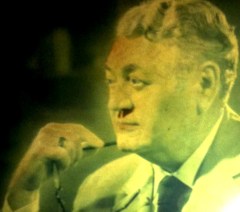
The Senator’s wife, Ewilda, was in Little Rock making preparations for a trip the couple was to take. (She was informed of her husband’s death when her sister-in-law called to express condolences. No one had yet notified her in Little Rock.) Following his demise, Mrs. Robinson went to Washington to accompany her husband’s body back to Arkansas.

As the Senate Majority Leader, Senator Robinson was usually President Franklin Roosevelt’s point person to shepherd legislation on Capitol Hill.  The Democrat’s 1928 Vice Presidential nominee, Senator Robinson was particularly close to FDR. He had successfully steered numerous pieces of New Deal legislation through Congress.  However, at the time of his death, the Senator was facing an uphill climb trying to build consensus on the President’s unpopular Court Packing scheme.

The Senator was honored with a memorial service in the Senate chambers on Friday, July 17.  President Roosevelt and the cabinet joined members of the senate on the floor in what was described as a state funeral without pomp.  Mrs. Robinson sat with her brothers and two nephews as well as Bernard Baruch and Arkansas Power & Light’s Harvey Couch, who were Senator Robinson’s closest friends.  Eleanor Roosevelt was one of the many crowded in the senate galleries observing the service.  Following the service his body remained in the chambers until it was transferred to a train to make the journey to Little Rock.

The funeral train bore his body, his family, 50 senators and over twenty congressmen. It reached Little Rock around 8am on Sunday the 19th.  From there, Senator Robinson’s body was taken to his house on Broadway Street until noon.  It subsequently lay in state at the Arkansas State Capitol until being escorted by military to First Methodist Church.

1,500 people packed the church a half hour before the service began. The sun shone through the windows onto the flag-draped coffin as Rev. H. Bascom Watts led the service. Among the pallbearers was former Vice President Charles G. Dawes. Governor Carl Bailey of Arkansas was joined by Governors Richard Leche of Louisiana and E.W. Marland of Oklahoma.

As the funeral procession reached Roselawn Cemetery, thunder echoed. The skies which had alternated between sun and rain that day, returned to rain. A deluge greeted the end of the service and sent visitors hurrying for shelter at the end.

Five months after her husband’s death, Mrs. Robinson participated in the groundbreaking of the Joseph Taylor Robinson Memorial Auditorium.  The ceremony was the first time it was announced that building would be named in his memory.   On a plaque inside that building today, a quote from President Roosevelt stands as a further testament of the importance of Senator Robinson to the US.  Taken from President Roosevelt’s remarks upon learning of the Senator’s death, the plaque reads, in part, “A pillar of strength is gone.”

Seventy-eight and a half years later, the church was the site of the funeral of longtime US Senator Dale Bumpers in January 2016.

July 9, 1906 – plans for new Little Rock City Hall are approved. And the fun has just begun

The 1906 plans for City Hall with the Municipal Auditorium on the left portion.

On July 9, 1906, the Little Rock City Council approved Resolution 281 and Ordinance 1,295. These actions approved the plans for a new City Hall complex to be constructed on land at the northwest corner of Markham and Broadway Streets.  A few days later, the contract was awarded for the construction of the new building.

Mayor Warren E. Lenon had first called for a new city hall complex in his annual address in April 1904. He repeated his request in April 1905.   The City Council took up Mayor Lenon’s quest for a new city hall in December of 1905.  The Council appropriated money for the purchase of land for a city hall, jail and auditorium.

In response to this, the Arkansas Gazette daily newspaper ran a story featuring the viewpoints of a few civic leaders weighing in on the need for a new city hall complex which would also include a new jail and a city auditorium.  Two of the respondents, L. B. Leigh and P. Raleigh, stressed the need for paved streets and better sewers instead of a new city hall and auditorium.

The other three businessmen interviewed were more favorable to Mayor Lenon’s proposal.  Morris M. Cohn, a former Little Rock City Attorney, stated “I do not think we can make a better investment than in a fine city hall and auditorium.”  (Mr. Cohn, though an M. M. Cohn, was not related the M. M. Cohn who was the namesake for the longtime Little Rock department store.) County Judge William Marmaduke Kavanaugh offered his satisfaction with the action of the City Council on that matter.  R. E. Walt, a banker, opined that he thought $150,000 was not enough; he suggested $200,000 should be spent.

Later that month the Gazette reported that a site had been selected for the city hall and auditorium complex.  The proposed location was most of a city block located at the corner of Markham and Broadway Streets.  Mayor Lenon was vague as to the details of the deal because negotiations were still underway with the property owners

As 1906 dawned, Mayor Lenon and other city leaders continued to take steps to build the new city hall and auditorium.  They invited three local architects to make presentations for the chance to design the new complex.  The three were Charles L. Thompson, Frank W. Gibb and George R. Mann.  Mr. Thompson was chosen to receive the assignment.

On February 5, 1906, Mayor Lenon announced the creation of a special committee to work on the planning for a future city hall complex.  This committee consisted of Aldermen Louis Walther, A. B. Poe, L. N. Whitcomb, Christopher Ledwidge, and John A. Adams.

Mayor Lenon further stated that the new city hall complex and several private developments would “put us in that march of progress with which nothing can prevent us from having a 100,000 population in a few years.”

The saga to get the building built was just starting.

Birthday of Little Rock first mayor, first physician, and many other firsts – Matthew Cunningham

Future Little Rock Mayor Dr. Matthew Cunningham was born on July 5, 1782, in Pennsylvania. After receiving his medical degree from the University of Pennsylvania, he ended up in New York City.  He also served in the Army during the War of 1812.

It was in New York, he met and married a young widow, Eliza Wilson Bertrand. After a brief stint in St. Louis, Dr. Cunningham was one of the first settlers of Little Rock in February 1820. With his arrival, he became the first physician in Little Rock.

In September 1820, Mrs. Cunningham and her children joined him. She became the first female in the Little Rock settlement. Dr. and Mrs. Cunningham had a son, Chester, who was the first white baby born in Little Rock. (Though not supported by any public records, there is some unsubstantiated thought that one of the African-American slaves they had gave birth to a child before Chester was born.) The Cunninghams had several other children.  One daughter, Matilda, would marry Little Rock businessman Peter Hanger.  (The Hanger Hill neighborhood is named after Peter Hanger.)

In 1831, Dr. Cunningham was elected the first Mayor of Little Rock. He won the race with 23 vote to 15 votes over Rev. W. W. Stevenson. The first City Council meeting took place at the Cunningham house on the block which is the southwest corner of what is now 3rd and Main Streets. Records are incomplete as to where on the block the Cunningham house was located, but a plaque is on 3rd Street near Main on the side of the Fulk Building which CJRW now calls home.

Dr. Cunningham served one year as Mayor. He lived until June 15, 1851, and is buried at Mount Holly Cemetery. His wife, son Chester, and the Hanger family are buried next to him.  Because he lived for two decades after serving as mayor, he was able to see Little Rock continue to grow.

His stepson – Charles P. Bertrand – also served as Mayor of Little Rock.  While there have not been any Little Rock father-son combinations serve as mayor, Dr. Cunningham and Mr. Bertrand certainly shared a kinship.

Descendants of Dr. Cunningham still reside in Little Rock.