Little Rock Look Back: W W Stevenson

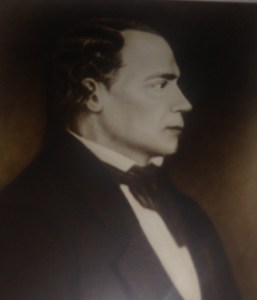
On January 29, 1797, future Little Rock Mayor William Wilson “W. W.” Stevenson was born in South Carolina.

In 1811, he came to Arkansas when his family settled in Batesville.  An ordained Presbyterian minister, he married Ruana Trimble in 1821 and had two children. After she died, he married Maria Tongray Watkins in 1831 and had two more children.

In 1831, he ran for Little Rock Mayor in the first election for the office but was defeated by Dr. Matthew Cunningham.  The next year he ran to succeed Cunningham and was elected.  After leaving the Mayor’s office on December 31, 1833, he continued public service.  He was asked to run for Mayor later in the 1830s, but declined.  He did serve as State Commissioner for Public Buildings in 1839.

In 1849, he delivered the funeral oration at the ceremony for Hon. Ambrose H. Sevier.  Later that year, he was hired as a geologist for the Little Rock and California Association which was created to take advantage of the gold rush.  He and his two oldest sons moved to California and never returned to Arkansas. He died in 1888.

Little Rock Look Back: A Municipal Auditorium approved by LR Voters in 1937

On January 26, 1937, Little Rock voters went to the polls to vote on three different municipal bond issues.  One of them was the construction of a municipal auditorium.
The bonds for the auditorium would be $468,000 in general obligation bonds which would be paid off between 1940 and 1971. This was toward a total cost of $760,000 for the entire project.

The official campaign for the auditorium was sponsored by the Little Rock Forward Committee which was led by W. H. Williams. In campaign advertisements it showed the value of conventions in New York City which was estimated at $100 per convention attendee. Little Rock organizers were estimating a $10 a day expenditure by visitors, which the committee stressed was very conservative. The campaign committee emphasized the importance of acting at that time due to the federal government money involved.

Various committees and organizations endorsed the auditorium project including the Little Rock Chamber of Commerce, Little Rock Federation of Women’s Clubs, and the Young Business Men’s Association.

The thrust of the campaign focused on the economic benefit to Little Rock as well as the fact that the auditorium would be for all citizens. This message was picked up in editorials by both the Democrat and Gazette. In editorials on January 23 and 25, the Democratopined that the benefits of the auditorium would be distributed among all classes of the citizenry. The next day, both papers ran editorials which touted the economic boon an auditorium would bring through conventions and meetings.

The Democrat’s approach broke down the current value of conventions to Little Rock with, what it termed, the city’s “existing inadequate” facilities. The paper emphasized a conservative estimate of what the added value to Little Rock’s economy would be with the new auditorium.

In expressing support for the auditorium the Gazette stressed the values for local, statewide and national groups. “An auditorium would provide a more convenient and better adapted community center for all kinds of local gathering,” and continued that it would make Little Rock “the logical meeting place for state conventions of every sort.” In discussing the value of state, regional and national meetings the paper stressed that the outside money spent by convention attendees has an impact beyond stores, hotels and restaurants.

Both papers also echoed the importance of the federal government financing to make this possible. The Democrat noted that the Public Works Administration grant and federal low cost loan made this an ideal time.

On January 26, 1937, Little Rock voters approved the auditorium bond by a vote of 1,518 to 519. It passed in each of the city’s 23 precincts. Little Rock Mayor R. E. Overman expressed his pleasure at the outcome of the vote and extended his thanks to the voters.

After the election, a Gazette editorial commented on the low turnout for the special election by commenting that the weather had been nice and there were no other barriers to voting. The editorial writer opined that those not voting in the election must not have been opposed to the endeavor.

Little Rock Look Back: Birth of a General

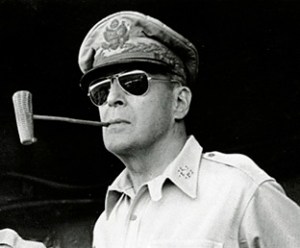
On January 26, 1880, Douglas MacArthur was born in the Arsenal Building while his father was stationed at the Little Rock Barracks.  Though he left Arkansas a few weeks later when his father was transferred, he returned to his birthplace on March 23, 1952. On that day he was greeted by crowds welcoming one of the USA’s most famous military figures.

Though Gen. MacArthur spent only a few weeks in Little Rock, he was baptized at Christ Episcopal Church.  The location of the baptism remains a mystery today because the church was meeting in temporary locations due to the first structure having been lost to a fire.

When the General returned to Little Rock in 1952, he did pay a brief visit to Christ Church.  He also spoke at the Foster Bandshell in the park which bore his name.

When General MacArthur died, he was granted a state funeral.  He was one of the few non-Presidents to have been given this honor.

Today, the MacArthur Museum of Arkansas Military History is located in the Arsenal building.  It was created to interpret our state’s military heritage from its territorial period to the present.

Located in the historic Tower Building of the Little Rock Arsenal–the birthplace of General Douglas MacArthur–the museum preserves the contributions of Arkansas men and women who served in the armed forces.

Exhibits feature artifacts, photographs, weapons, documents, uniforms and other military items that vividly portray Arkansas’s military history at home and abroad.

Little Rock Look Back: LR finally takes possession of Robinson Auditorium

On January 25, 1940, the City of Little Rock officially took complete possession of the Joseph Taylor Robinson Memorial Auditorium. By assuming custody of the structure from the contractor and the PWA, the City accepted responsibility for any of the remaining work to be completed.
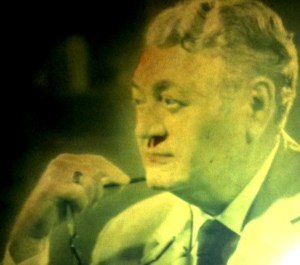
This event happened one day shy of the third anniversary of the election which approved plans to issue bonds for an auditorium.  The act took place only about five months behind schedule.

E. E. Beaumont, the Auditorium Commission chairman, stated that an opening date could not be set until more work was completed. A major unfinished task was the laying of the front sidewalk which had been delayed due to cold weather.

The night before Little Rock took possession, Robinson Auditorium had been a topic of discussion at the Little Rock Chamber of Commerce annual meeting. The new Chamber president Reeves E. Ritchie (who as an Arkansas Power & Light executive had been engaged in the lengthy discussions about the installation of the steam line and transformers of the building) pledged that the Chamber would work to bring more and larger conventions to Little Rock at the Joseph Taylor Robinson Memorial Auditorium.

Little Rock Look Back: A 1956 attempt at integrating LR schools

Arkansas Democrat photo by staff photographer Mr. Bisgood

Arkansas Democrat photo by staff photographer Mr. Bisgood

On Monday, January 23, 1956, twenty-seven African American students attempted to integrate four Little Rock schools.  By the end of the day, all four school principals had refused entry and some of the students had met with LRSD Superintendent Virgil Blossom.

Eight girls who were students at Horace Mann High School arrived at Central High at 9:30 am accompanied by Daisy Bates and Frank W. Smith both of the NAACP.  One male student attempted to integrate Little Rock Technical High School.  Four students arrived at Forest Heights Junior High (accompanied by three adults) and fourteen students attempted to integrate Forest Park Elementary (accompanied by four adults).  Neither the Arkansas Gazette nor the Arkansas Democrat broke down the age or gender of the junior high and elementary students.

Though all were referred to meet with Mr. Blossom, only the young women from Horace Mann visited with him.  After the conversation both he and Mrs. Bates declared the conversation had been friendly.   Mr. Blossom, in denying the request, noted that the Little Rock School District had a plan for integration. To allow them to integrate immediately would have been going against the plan.  The integration plan was connected to the completion of the new high school.  If it were ready to open in the fall of 1957, then integration at the high schools would start then.  The newspapers noted that there was no timeline for when it would extend down to the junior high and elementary levels.

That evening, Rev. J. C. Crenchaw, the president of the Little Rock NAACP, issued a statement.  In it he expressed frustration that the LRSD was vague on its timeline for integration.  He noted that the students lived near the schools which they tried to integrate and were therefore forced to travel several extra miles each day to attend school.  He also commented that the young man who attempted to enroll at Tech was not afforded the training available there at his current school.

The Arkansas Democrat ran a photo of the meeting with Mr. Blossom.  It identified the seven students who were pictured.  No mention was made as to whether the eighth student was present but not photographed, or if she did not attend the meeting.  As was the practice at the time, the addresses of the students were listed by their names.  Based on those addresses, the students lived between 0.4 and 0.9 miles from Central High School and were between 2.1 and 3.2 miles away from Horace Mann High School.  Of the seven students in the photo, two were seniors, three were juniors, and three were sophomores.  None of the students named became part of the Little Rock Nine who did integrate Central High twenty-one months later.

On January 24, the Gazette editorial writer opined they were glad for the amicable nature of the conversations. They hoped it did not affect the good race relations in Little Rock.  The writer concluded by saying they did not want it to incite extremists (but did not specify if they viewed the extremists as being for or against integration.)

Haco Hijacked, or 50 years ago this month Little Rock’s Mayor made an unscheduled trip to Havana

Less than a week after being selected Little Rock’s 58th mayor, Haco Boyd made an unscheduled stop in Cuba when the Eastern Airlines Boeing on which he was flying was hijacked.

The seventy passengers, including 44 from Arkansas, were hijacked to Cuba on January 9 on a flight that was originally scheduled to go from Miami to Nassau for an insurance convention.

Shortly after takeoff, a passenger, who described himself as a student at Purdue University, sat next to a flight attendant, told her the plane was going to Cuba, and showed her a knife.

After landing in Cuba, the plane, its crew, and two passengers (Mr. and Mrs. Keith Thrash of Little Rock) were allowed to return to Miami. The Thrashes were allowed to stay on the plane due to illness.  Several hours later, another plane picked up the remaining passengers and returned them to Miami.

Eastern Airlines then flew the passengers on to Nassau without further incident. Mayor Boyd’s wife was flying with him on the plane.

Once the media found out that Little Rock’s mayor was on the plane, he became of great interest to reporters.  “They treated us real well in Havana.” Boyd told the press. “They gave us the blue plate special treatment.” Boyd said everything was “just fine, no sweat, it’s just one of those things.” He went on to describe the hijacker (who stayed in Cuba) as “a rather decent looking person, except for his nose and his mouth, which were a little weak.

Mayor Boyd was back at City Hall to preside over the January 20, 1969, City Council meeting. It appears that the reminder of his airline flights went to their appropriate destinations.  During World War II, he had been a decorated pilot for the Army Air Corps.

Little Rock Look Back: Opening of 1868 LR City Hall

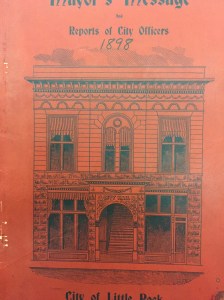
The 1868 City Hall as featured on a city report.

On January 22, 1868, a charity ball (including a supper) was the first special event held in the new Little Rock City Hall located at 120 to 122 West Markham.

The two story building featured city offices downstairs, including an engine house for the volunteer fire department. Upstairs was the council chambers and a special event space. The facility was the width of two storefronts. The upstairs was accessed by a central staircase which went from street level through an archway directly up to the second floor. The first floor had a stone exterior and the second floor was a combination of brick and woodwork.

Records do not indicate when the first city council in the new building took place. At the January 21, 1868, meeting, the body formally accepted the building and cancelled any clauses in the contract about penalties should the contractor not meet the construction deadline. But there is no indication whether that meeting took place in the new building or in the previous city hall. (The location of that prior city hall is a mystery.). The minutes from the council meetings just prior to and just after the January 21 meeting give no indication as to which building was the site for the meeting.

It IS known that March 30, 1908, was the date of the final council meeting in the 1868 City Hall. After that meeting, city offices completed their move to the edifice at Markham and Broadway, which still serves as Little Rock City Hall.

As early as November 1867, the City Council was getting requests for special events to be held in the new city hall. In November and December the council refused to take action on any requests because the building was still under construction.

The January 22, 1868, event was created to help the destitute in Little Rock. The ARKANSAS GAZETTE encouraged people to be generous and purchase tickets. Even the day before the event, the weekly version of the GAZETTE (which at the time had added daily editions in addition to its weekly issue) was assuring people there would be plenty of space in the splendid new building so there was still room for additional ticket purchases. Tickets were $5 to admit a lady and a gentleman.  (That would be the equivalent of $83.71 today. While cheap for two people to attend a Little Rock event in 2018, in the post-Civil War era, it was a definite hit to the pocketbook.)

The unnamed organization which put on the charity event was led by W. W. Wilshire (president), George W. Clark (secretary), Joseph Meyer (treasurer) and a standing committee of Dr. C. M. Taylor, Dr. P. O. Hooper, A. Adams, F. H. Moody, and E. Langley.  Donations could be made to any of the officers.  The arrangements for the event were handled by Joseph Meyer, A. Adams, J. P. Jones, Alexander George, Jr., Joseph W. Bossert, and Daniel Ottenheimer.  The reception committee was W. D. Blocher, H. C. Ashley, A. McDonald, P. W. McWhorter, T. Lafferty, and F. H. Moody.   Tickets could be purchased at the stores of J. E. Reardon, G. H. Gibbs, Joseph Meyer, Lafferty & Raleigh, S. L. Griffith, McAlmont & Stillwell, Beideman & Co., and Dodge & Co as well as at the Anthony and Commercial Houses.  (It is interesting to note how so many people at the time were publicly listed by only their first initial.)

The building stood for 56 years after City Hall vacated it.  It housed a variety of businesses over the years.  The building was torn down in 1964 as part of Urban Renewal.  Today it is the site of part of the Statehouse Convention Center.  It is directly across from the One-Eleven restaurant side of the Capital Hotel.