Little Rock Look Back: CROSS formed to Stop STOP

On May 16, 1959, a new organization emerged in an effort to keep Little Rock schools segregated.
The Committee to Retain Our Segregated Schools (CROSS) was launched by Rev. M. L. Moser, Jr., the pastor of Central Baptist Church.  The three leading segregationist organizations in Little Rock disavowed any connection to it.  Representatives from the Capitol Citizens Council, Central High Mother’s League and States Rights Council noted that he was not affiliated with them.

Approximately 300 people attended the CROSS kick off event at the Hotel Marion.   Joining Rev. Moser as a speaker at the rally was LRSD School Board President Ed McKinley.  It was announced that the CROSS office would be at 108 Scott Street.  Robert D. Lee was the campaign treasurer.

With STOP advocating for the removal of McKinley, Ben Rowland and Robert Laster from the school board, CROSS was now out to recall Everett Tucker, Ted Lamb and Russell Matson.

With the election on May 25, the final nine days were going to be intense.


Elvis Has Left the Building (Robinson Center, that is) – May 16, 1956

Photo by Wayne Cranford

After two visits in 1955 where he was down on the bill, Elvis Presley made his third and final appearance at Robinson Auditorium on May 16, 1956.  This time he was the star and Robinson was packed. The tickets were $1.50 in advance at Walgreens and $2.00 at the box office.

The ads featured 8 great acts in “his” variety show which consisted of the Jordonaires; Rick and Emil Flaim and their orchestra; vocalists Frankie Conners and Jackie Little and comedian-magician Phil Maraquin. A second show was added at 9:30 p.m. to accommodate the ticket demand.

About 30 minutes late, due to a missed flight, Elvis appeared on stage in a purple blazer and started singing “Heartbreak Hotel.”  The crowd rushed the stage. Little Rock police officers were able to control them eventually and get the teenagers back to their seats.  While the crowd was impressed, the police officers were less so.  One of the patrolmen told the Arkansas Gazettereporter: “I wouldn’t know him if I saw him. And I wouldn’t be here unless I was being paid.”

Disc jockey Ray Green recorded the concert that night.  Copies of the concert on CD (which also includes an interview with Presley) are prized possessions of Presley collectors.

The Arkansas Democrat-Gazette has a special section on its website containing quotes from some of the concert attendees.

Little Rock Look Back: Date set for 1959 Recall Election

On May 15, 1959, the Pulaski County Election Commission met to discuss the competing efforts to recall members of the Little Rock School Board.

The day prior, the Pulaski County Clerk had certified that petitions had enough valid signatures to have an election about recalling School Board members Ed McKinley, Robert Laster and Ben Rowland. There were also enough valid signatures to put before voters the recall of Ted Lamb, Everett Tucker and Russell Matson.

Because all of the school board members were to be on the ballot, the Election body decided to list them each alphabetically.  For each person there would be the question as to whether he should be recalled and voters would indicate “yes” or “no.”

The date of May 25, 1959, was set for the election.

It would be open to anyone with a valid 1958 poll tax receipt.  Voters must also live within the Little Rock School District boundaries (which were not coterminous with the city limits). They must have been residents of Arkansas for a year by election day, residents of Pulaski County for six months, and resided within their precinct for 30 days.

Meanwhile supporters of both trios were hard at work.  STOP had been in existence for a week to promote the efforts to recall the segregationist faction of the school board.  While the Central High Mothers League and Capitol Citizens Council had been working to recall the other three members of the school board, rumors were swirling about the emergence of a new organization which sought to fight for segregation.

Little Rock Look Back: Mayor J. V. Satterfield

On May 14, 1902, future Little Rock Mayor John Vines Satterfield, Jr. was born in Marion.   He grew up in Little Rock and Earle. J.V. was a star quarterback for the Earle football team and is featured in a painting of that team by respected painter Carroll Cloar.
Following high school, J.V. taught (including, much to his family’s amusement, a course in penmanship) and coached and sold Fords.  He then moved to Little Rock and sold insurance and later securities.  In 1931 he opened his own business; that same year he built a house at 40 Beverly Place in Little Rock, which would serve as his home until his death.

J. V. Satterfield was elected to serve as Mayor of Little Rock in 1939 and served one term, until 1941.  He was credited with saving the City from bankruptcy because of his fiscal policies. Among his efficiencies were the creation of a central purchasing office and using grass moved from the airport to feed the Zoo animals.

Though as a private citizen he had voted against the creation of a municipal auditorium in 1937, Mayor Satterfield fought valiantly to ensure that Robinson Auditorium opened to the public once he took office.  Shortly after he became Mayor, it was discovered that there were not sufficient funds to finish the construction. After the federal government refused to put in more money, he was able to negotiate with some of the contractors to arrange for the building to be completed. He also oversaw a successful special election to raise the money to finish the project.

Satterfield was a staunch supporter of the airport and worked to expand it.  He would serve as the chair of the first Municipal Airport Commission.  He also established the Little Rock Housing Authority (on which he would later serve on the board).  Mayor Satterfield also served as President of the Arkansas Municipal League in 1941.

Following the outbreak of World War II, Satterfield enlisted in the Army and was given the rank of a Major. He later was promoted to a Colonel and worked in the Pentagon during its early days.

In the late 1940s Satterfield became president of a small Little Rock bank called People’s Bank.  The bank changed its named to First National Bank when it moved into new offices at 3rd and Louisiana in 1953.  By focusing on smaller customers and courting corporate customers, Satterfield grew the bank into one of the state’s largest banks.  He maintained his desk in the lobby of the bank so he could interact with the customers and ensure they were having a positive experience.

Due to chronic health issues, Satterfield retired from the bank in 1964. He died in March 1966.

Mother’s Day in Little Rock: Founding Mother Eliza Cunningham

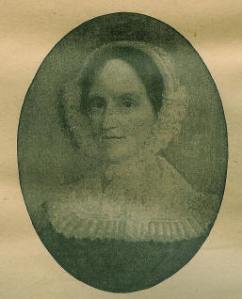
Eliza Wilson Bertrand Cunningham was the First Lady of Little Rock.  She literally was the first lady and the founding mother.
She became the first permanent female resident when she joined her husband Matthew Cunningham in Little Rock.  She gave birth to Chester Ashley Cunningham, the first baby born in Little Rock, as well as several other children with Cunningham.  When he became the first Mayor of Little Rock, she was the first First Lady of Little Rock. They hosted the first Little Rock Council meeting at their house on what is now the block downtown bounded by Third, Main, Fourth and Louisiana Streets.  Her son Charles P. Bertrand, from her first husband, later served as Mayor of Little Rock, making her the only woman to be married to a Mayor and be mother of a Mayor.

Born in Scotland in December 1788, she emigrated with her parents to the United States as a young girl.  In 1804 or 1805, she married a French businessman, Pierre Bertrand in New York City.  She lived in New York City, while he traveled to his various business ventures.  He never returned from a trip to his coffee plantation in Santo Domingo and was presumed to have died in 1808 or 1809.  She and Bertrand had three children, Charles Pierre, Arabella and Jane. (Jane may have died in childhood, because records and lore only indicated Charles and Arabella coming to Little Rock with their mother.)

Eliza married Dr. Matthew Cunningham in New York City.  He later moved to Saint Louis and settled in Little Rock in early 1820.  Eliza and her two children came to Little Rock in September 1820.  In 1822, she gave birth to Chester Ashley Cunningham, the first documented baby born in Little Rock.  (There are unsubstantiated reports that at least one slave child may have been born prior to Chester.)  She and Matthew also had Robert, Henrietta, Sarah and Matilda.  The latter married Peter Hanger, after whom the Hanger Hill neighborhood is named.

Dr. Cunningham died in June 1851.  Eliza died in September 1856. They and Chester (who died in December 1856) are buried in the Hanger family plot at Mount Holly Cemetery.

Little Rock Look Back: Miss America Donna Axum sings at Robinson Auditorium

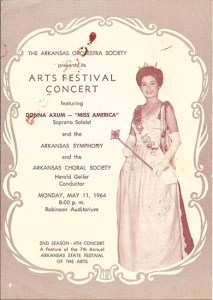
Photo from Encyclopedia of Arkansas, courtesy of Mike Polston

While she had made a few other appearances in Little Rock during her reign as Miss America, on May 11, 1964, Donna Axum appeared in concert at Robinson Auditorium.

She sang with the Arkansas Symphony (not directly connected with the current Arkansas Symphony Orchestra) and the Arkansas Choral Society.

The concert was part of the Arkansas State Festival of the Arts which was an annual event from the late 1950s until the mid 1960s.

Miss Axum’s most recent appearance at Robinson was last June when she appeared, along with several other former Miss Arkansas title holders, at the 2017 Miss Arkansas pageant.  She was joined on stage by Savvy Shields, who like Miss Axum, was a former Miss Arkansas who held the title of Miss America.

Little Rock Look Back: William Grant Still

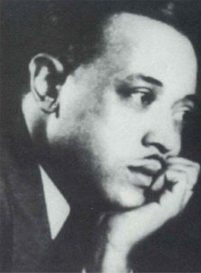
Long known as the Dean of African American composers, Dr. William Grant Still was a legend in his own lifetime.

Dr. Still, who wrote more than 150 compositions ranging from operas to arrangements of folk themes, is best known as a pioneer. He was the first African-American in the United States to have a symphonic composition performed by a major orchestra. He was the first to conduct a major symphony orchestra in the US; the first to conduct a major symphony in the south; first to conduct a white radio orchestra in New York City; first to have an opera produced by a major company. Dr. Still was also the first African-American to have an opera televised over a national network

Dr. Still was born May 11, 1895 in Woodville, Mississippi to parents who were teachers and musicians. When Dr. Still was only a few months old, his father died and his mother took him to Little Rock. Inspired by RCA Red Seal operatic recordings, his musical education began with violin lessons.  He graduated from Gibbs High School in Little Rock.

After his studies at Wilberforce University and the Oberlin Conservatory of Music, he played in orchestras and orchestrated for various employers including the great W. C. Handy. For several years he arranged and conducted the “Deep River Hour” over CBS and WOR.  He also played in the orchestra for the 1921 musical Shuffle Along, which was the first Broadway musical to feature an all African-American cast and writing team.

In the 1920’s, Still made his first appearances as a serious composer in New York. Several fellowships and commissions followed. In 1994, his “Festive Overture” captured the Jubilee prize of the Cincinnati Symphony orchestra. In 1953, he won a Freedoms Foundation Award for “To You, America!” which honored West Point’s Sesquicentennial Celebration. In 1961, he received honors for this orchestral work, “The Peaceful Land”. Dr. Still also received numerous honorary degrees from various colleges and universities, as well as various awards and a citation from Arkansas Governor Dale Bumpers in 1972.

In 1939, Dr. Still married journalist and concert pianist Verna Avery, who became his principal collaborator. They remained together until Dr. Still’s death in 1978.  In a proclamation marking the centennial of Dr. Still’s birth, President Bill Clinton praised the composer for creating “works of such beauty and passion that they pierced the artificial barriers of race, nationality and time.”

In 1995, Dr. Still was posthumously inducted into the Arkansas Black Hall of Fame.  In 2016, the ballroom at Robinson Center was named in his honor.  Earlier this month, Opera in the Rock performed Still’s opera Troubled Island.
