
Little Rock Look Back: Mayoral Races without Incumbents

The announcement by Little Rock’s 72nd Mayor, Mark Stodola, that he will not seek a fourth term in 2018, sent the Little Rock Culture Vulture thinking about past mayoral races in Little Rock history.

Election records in the 1800s are spotty at best, so this discussion focuses on those who have run for Mayor once the current City Hall opened in April 1908.

The November 2018 election will be only the sixth mayoral election since 1908 without an incumbent or former mayor on the ballot.  (Assuming that none of Little Rock’s living seven former mayors choose to run.)

The most recent election without a current or former mayor was in 2006, when Jim Dailey had announced he would not seek another term. It was at that election that former City Attorney Mark Stodola, faced off against two former City Directors (Barbara Graves and Jesse Mason) and former State Senator Bill Walker.

From 1908 through 1957, Little Rock elections were partisan in nature.  In most instances, if one won the Democratic Primary, one was assured of being mayor.  Looking back at municipal general election results (where there was usually only token opposition at best) in those decades does not give a true picture to the spirited nature of races for City Hall.

The first election since 1908 without an incumbent or former mayor was in 1911. Charles Taylor ran as a reforming outsider and won an open seat for mayor.  He would serve until 1919. That year, former alderman Ben Brickhouse won the open seat.

R. E. Overman was elected to his first term as mayor in 1935, after incumbent mayor Horace Knowlton did  not seek a third term.  After returning to City Hall in 1941 and being re-elected, Mayor Moyer retired a second time in 1945. In that election, Dan Sprick was elected mayor.  That would be the final election in Little Rock without an incumbent or former mayor until 2006.

From 1957 until 1994, the mayor was chosen every two years by members of the City Board of Directors from among their membership.  The last person to be selected in that manner, Jim Dailey, won city-wide election to the mayoral position in 1994 and served until 2006.

Here is a history of all the mayor races since 1908:

1908 Special – Incumbent acting mayor John Herndon Hollis did not seek election to full term.  Former Mayor W. R. Duley elected
1909 – Mayor Duley re-elected
1911 – Charles Taylor elected after Mayor Duley forgoes seeking another term.
1913 – Mayor Taylor re-elected
1915 – Mayor Taylor re-elected
1917 – Mayor Taylor re-elected
1919 – Ben D. Brickhouse elected after Mayor Taylor forgoes seeking another term.
1921 – Mayor Brickhouse re-elected
1923 – Mayor Brickhouse re-elected
1925 – Mayor Brickhouse loses Democratic Primary to County Judge Charles Moyer, who wins the general election.
1927 – Mayor Moyer re-elected
1929 – Mayor Moyer loses Democratic Primary to City Attorney Pat L. Robinson, who wins the general election.
1931 – Mayor Robinson loses Democratic Primary to Horace Knowlton, who wins the general election.
1933 – Mayor Knowlton re-elected
1935 – R. E. Overman elected after Mayor Knowlton forgoes another term.
1937 – Mayor Overman re-elected
1939 – J. V. Satterfield defeats Mayor Overman in the Democratic Primary. He subsequently wins general election.
1941 – Former mayor Moyer returns to City Hall after Mayor Satterfield opts to retire after one term.
1943 – Mayor Moyer is re-elected
1945 – Dan Sprick is elected after Mayor Moyer forgoes another term.
1947 – Sam Wassell defeats Mayor Sprick in the Democratic Primary, subsequently wins general election.
1949 – Mayor Wassell is re-elected
1951 – Republican Pratt Remmel defeats Democratic incumbent Sam Wassell in the general election to become mayor.
1953 – Mayor Remmel is re-elected.
1955 – Democratic nominee Woodrow Mann defeats GOP incumbent Mayor Remmel in the general election to become mayor.
1956 – Voters switch to City Manager form of government, partially in response to actions by Mayor Mann’s administration.  Mayor Mann leaves office in November 1957.

1957 to 1994 – City Manager form with mayor selected from among membership

1994 – Mayor Jim Dailey wins election as Little Rock’s first popularly elected mayor since 1957.  He had previously been selected mayor by his city board colleagues.
1998 – Mayor Dailey is re-elected
2002 – Mayor Dailey is re-elected
2006 – Mark Stodola is elected mayor after Mayor Dailey forgoes another term.
2010 – Mayor Stodola is re-elected
2014 – Mayor Stodola is re-elected
2018 – Mayor Stodola announces he will not seek another term.

Little Rock Look Back: STOP announced to end Teacher Purge

Following the success of meetings at Forest Park Elementary and the Little Rock Chamber of Commerce, as well as other school, PTA, and civic meetings, the effort was underway to recall the three segregationist members of the Little Rock School Board.

On May 7, 1959, at Brier’s Restaurant, a group of young civic leaders gathered as they often did. This time, their conversation focused on how to capitalize on the momentum mounting in the desire to recall the three segregationist School Board members.  Attorneys Edward Lester, Robert Shults, and Maurice Mitchell were present as well as Gene Fretz, a Gazette editor.  It was he who came up with the acronym STOP – Stop This Outrageous Purge.

That afternoon, the group reconvened at the Grady Manning Hotel.  This time joined by esteemed attorney Will Mitchell.  Among the other men who were instrumental in getting STOP started were attorney Henry Woods, attorney W. P. Hamilton Jr., and banker B. Finley Vinson.  As chair of the Chamber of Commerce, Grainger Williams had been a vocal supporter of the efforts to reopen the school.  His leadership was, no doubt, instrumental in the Chamber’s quick and vocal support for the fired LRSD personnel.

Dr. Drew Agar was chosen to be the chair of STOP.  The father of three children at Forest Park Elementary School, he was vice president of the Forest Park PTA.  It was he who had presided over the successful Forest Park PTA meeting which saw several hundred parents oppose the firing and endorse the recall of the three segregationist members. (Dr. Agar had to use some fancy footing to get the items added to the agenda at the last minute, but with creative parliamentary maneuvering, he succeeded.)

On May 8, 1959, STOP was publicly announced.  The event took place at Union National Bank.  Approximately 179 men were in attendance.  Those present were asked to contribute or solicit $100.  (In time, approximately $36,000 would be raised.)

In addition to Dr. Agar serving as chair, Maurice Mitchell served as finance chair, Will Mitchell and Henry Woods were political strategists behind the campaign.  Many other men stepped up.  Dr. Agar announced at the May 8 meeting that a STOP office would open in room 1010 of the Pyramid Life building on May 9.  It was to be open between 9am and 5pm to accept donations and to to collect recall petitions.

At the meeting standing ovations were given to R. A. Lile, a former member of the Little Rock School Board, and Everett Tucker, Ted Lamb and Russell Matson, current members.  (Remember, this was back in the day when standing ovations were few and far between.)

Because most of the STOP members were younger, and second-tier business executives, the leadership of Will Mitchell and the chamber’s leadership by Grainger Williams was crucial in giving not only sage advice, but adding gravitas.

In the coming weeks, STOP would work closely with the Women’s Emergency Committee. The WEC had studied voter registration lists. They would put this skill to use as potential voters were identified as “Saints,” “Sinners,” or “Savables.”  The two groups, working hand in hand behind the scenes, had their work cut out for them.

When the issue about reopening the schools had been put to the voters the previous autumn, Little Rock voters had overwhelmingly approved keeping the schools closed.  There were many factors which had led to it – confusing ballot title, short campaign time, belief that the schools would reopen soon, etc.  But even though there were some key factors in favor of STOP and the WEC this time, nothing could be taken for granted.

Little Rock Look Back: 1959 School district patrons show support of fired teachers

Arkansas Gazette photo of some of the patrons leaving Bale Elementary dedication

Following the May 5, 1959, firing of 44 administrators, teachers and staff, sections of the Little Rock community continued to coalesce in opposition to the actions taken by three members of the Little Rock School Board.

Later the evening of May 5, at a ceremony to dedicate Williams Elementary, Everett Tucker spoke against the teacher purge. His remarks were greeted enthusiastically by the patrons of the school.

On May 6, 1959, approximately 400 district patrons filled the auditorium at Forest Heights Junior High for a meeting. They expressed their opposition to the firing of the district employees. While the sight of the hands raised in support of the fired employees was an impressive visual, there was more community response to come.

May 7, 1959, had been set as the date for the dedication of the new Hardin Bale Elementary School.  School Board President Ed McKinley, who had been one of the three who fired the 44 employees, was scheduled to give remarks at the ceremony.  As he was starting the remarks, some patrons stood and challenged him.  Then approximately 75 of them got up and walked out.   McKinley then proceeded to use his remarks to defend his actions and to attack opponents.

Both Williams Elementary and Forest Heights Junior High served the more moderate-leaning Pulaski Heights neighborhood. That they would be in support of the fired employees was less of a surprise.  It was a bit more unexpected that Bale Elementary patrons reacted in the way they did.  That neighborhood was more working class and zoned for Central High, two elements that segregationist forces had been counting on for allies.

Mr. McKinley’s remarks were so strident that fellow School Board member Judge Robert Laster called a press conference distancing himself from Mr. McKinley.  He used that opportunity to also criticize Mr. Tucker, Ted Lamb, and Russell Matson for what he termed the politicization of the Williams Elementary event.  After Judge Laster’s comments, the remaining member, Ben Rowland, expressed support for Mr. McKinley. He further stated that he, Mr. McKinley and Judge Laster had previously discussed what Mr. McKinley would mention in his Bale Elementary remarks.

With a school board in turmoil, teachers uncertain as to the legality of their contracts or non-renewal of them, and civic organizations largely calling for the reversal of the firings, the Little Rock education scene was in turmoil.  There was talk swirling through Little Rock about the need to recall school board members.  But who would take the lead on this?

Little Rock Look Back: Rabbi and longtime CALS Trustee Ira Sanders

On May 6, 1894, Ira Eugene Sanders was born in Missouri.  After receiving an undergraduate degree and rabbinate degree in Cincinnati, he was ordained a rabbi in 1919.  He served congregations in Pennsylvania and New York before coming to Little Rock in September 1926.

Shortly after arriving to lead the B’nai Israel congregation, Rabbi Sanders became active in the Little Rock community.  Among his projects were the Little Rock Community Fund, Little Rock School of Social Work (which he founded), Central Council of Social Agencies, and University of Arkansas Extension Department. During the Great Depression, he helped organize the Pulaski County Public Welfare Commission.  Other areas of involvement over his career included the Arkansas Human Betterment League, Urban League of Greater Little Rock and Arkansas Lighthouse for the Blind.  On November 3, 1930, Rabbi Sanders debated Clarence Darrow about the existence of God in front of a packed house at Little Rock High School.

For his many involvements, he received an honorary Doctor of Humanities degree in 1951 from the University of Arkansas.  Three years later he received an honorary Doctor of Divinity degree from Hebrew Union College’s Jewish Institute of Religion.

A lifelong supporter of a Jewish state, he participated in nineteen bond drives for the state of Israel.  In August 1963, he retired as the leader of B’nai Israel after over 35 years. He would remain as Rabbi Emeritus until his deal in 1985.

In January 1978, Rabbi Sanders tendered his resignation from the Central Arkansas Library board of directors.  The City Board of Directors passed resolution 5873 which noted that he had served for 51 years on the Library Board. He was first appointed in 1926.  He served during 19 different Mayoral administrations from Charles Moyer’s first term through Donald Mehlburger’s.

On April 8, 1985, Rabbi Ira Eugene Sanders died of natural causes.  He is buried in the City’s Oakland Jewish Cemetery.  The Central Arkansas Library System honors his memory with an annual distinguished lecture series.

Little Rock Look Back: City of Little Rock formally establishes Museum of Fine Arts

On May 6, 1935, the Little Rock City Council formally established the Museum of Fine Arts by Ordinance 5235.  The ordinance was sponsored by Alderman Henry G. Leiser.
The ordinance authorized the construction of the museum in City Park.  The money for the construction was all privately raised. Once the building was completed, it would become the property of the City.

The ordinance also created the museum’s board. The original members were named by the ordinance.  They were: Fred W. Allsopp (appointed as a life member), Mrs. Frederick Hanger, Mrs. F.B.T. Hollenberg, George B. Rose, Mrs. C.M. Taylor, Mrs. Frank Tillar, and Dr. Frank Vinsonhaler. In addition, the Mayor and President of the Fine Arts Club were ex-officio members.

The building would start construction in 1936. The groundbreaking was in January 1936, and the cornerstone was laid in October 1936. The Museum of Fine Arts opened in October 1937.

Little Rock Look Back: 44 Teachers fired by divided LRSD School Board in 1959

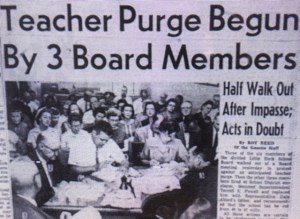
Arkansas Gazette coverage of the teacher purge

On Tuesday, May 5, 1959, the deeply divided Little Rock School Board met to consider contracts for the coming year.  The topic of contract renewal had been on the April agenda, but with two of the six members out of town, it had been delayed.

The 1958-1959 school year had been anything but routine in Little Rock.  To keep the high schools segregated, the city’s four high schools had been closed – first by action of Governor Orval Faubus and then by Little Rock voters.  Frustrated by actions taken at the State level, the School Board had resigned en masse by November 1958, except for the one member who had won a surprise write-in election to unseat Congressman Brooks Hays.  A new school board was elected in December and was equally divided between segregationists and those who felt the law and federal court rulings should be followed.

The May 5, 1959, School Board meeting began at 9am with a room packed full of spectators and was carried live on the radio.  There had been rumblings that the pro-segregation school board members were going to try to fire any teachers they viewed as in favor of desegregation.  Every vote in the morning session ended with a 3/3 vote as Everett Tucker, Russell Matson and Ted Lamb voted one way and the other three: Ed McKinley, Robert Laster and Ben Rowland, voted the other.

After lunch, Tucker, Matson and Lamb decided to leave the meeting. They saw no way to break the stalemate that was paralyzing the discussions. Upon advice of attorneys, they walked out. With only three members remaining, they three thought it end the meeting for lack of quorum.

School Board President Ed McKinley declared the remaining members a quorum. The trio alternated between open and closed sessions. At the end of the day, they had fired forty-four LRSD employees who they viewed as integrationists.  This included 39 whites and five African Americans.  Twenty-seven worked at Central High, while the other seventeen were scattered across other Little Rock schools.  Seven principals, thirty-four teachers, and three secretaries made up the group.  The meeting had lasted the entire day.  The afternoon Arkansas Democrat (with a mid-day deadline) carried a story pondering whether teachers would be fired.

At the same meeting, Superintendent Terrell Powell was fired.  He had taken the reins of the district in December 1958 after having been Hall High’s first principal.  Mr. Powell was replaced by Tom Alford, a former Jacksonville superintendent who was the father of congressman (and former LRSD school board member) Dale Alford.

During a portion of the school board meeting (which was at the corner of Eighth Street and Louisiana Street), phone calls were being made from the LRSD headquarters to a house a few blocks away.  That house was the home of Adolphine Fletcher Terry.  She was hosting an executive board meeting of the Women’s Emergency Committee that day.

Not ones to shy away on anything, the WEC executive board voted to condemn the firings and support the teachers.  Fairly quickly, the Parent Teachers Association of Little Rock, the Arkansas Education Association, League of Women Voters, and Little Rock Ministerial Alliance joined in the call condemning the action.  Leadership at the Little Rock Chamber of Commerce also joined in decrying the purge.

And the fallout was just beginning……

Little Rock Look Back: Arkansas Arts Center produces first play at its theatre

The Arts Center Theatre view from the stage in 1963

On May 3, 1963, at 8:30 pm, the curtain rose as the Arkansas Arts Center produced its first show in its own theatre.  Though the building would not be officially dedicated until later in May (more about that later), programming had been taking place in the facility for several months.

In December 1962, a community theatre production was the first play in the Arkansas Arts Center theatre.  Over the ensuing months, it would play host to a variety of concerts and performances.  At the time, the Arkansas Arts Center planned to use the theatre as a house for its own productions (one series geared to adults, the other series geared to kids), other shows produced by Little Rock organizations, and touring shows which might be too small for Robinson Auditorium.

Friday, May 3, 1963, was a momentous evening, as the Arkansas Arts Center presented Rumpelstiltskin.  (Since the theatre space has been focused on children’s theatre since the late 1970s, it seems prescient that the first AAC produced play was a children’s production some fifteen years earlier.)

The production was overseen Joseph N. Carner, who was the theatre director.  It was his hope that the Arts Center plays geared toward children would also encourage other groups throughout the state to produce plays specifically for younger audiences.  Margaret Davies Carner, who taught speech at Little Rock University, directed the play.  She also taught drama classes at the Arts Center.

The cast included Garry White as the title character with Dell Blaine, Michael Hosman, Lesie Smith, Tom Abraham, Dickie Atchison, Butch Lashee, henry Fletcher, Charles McRaven, Ann Thomson, Dannette Joe Baker, Sallie Penn, Paul Motes, Leslie Newell, and Robin Hosman.

In addition to a Friday night performance, there were 2:30 matinees on Saturday and Sunday that were geared toward children’s audiences.