Arkansas Heritage Month – Sibelius’ FINLANDIA rings out at Robinson Auditorium

finlandia_kansi_300This fall, when the newly renovated Robinson Center Music Hall reopens, the Arkansas Symphony Orchestra will play the first notes in the new space.

The first notes in the original space were Jean Sibelius’ Finlandia.  The piece was commissioned in 1899 as part of a three day arts festival to celebrate the Finnish press.  At the time, Tsarist Russia was cracking down on the press in Finland, so this festival was planned as a way to show solidarity. The selection was one of seven composed to be played against tableaus of scenes of Finnish history.  The pieces were played in a new music hall.

Given the political nature of the music, subsequent performances of it were often given fake names to avoid Russian censorship in the ensuing years.

Because of the fact it had been played at the opening of a new facility, Finlandia was chosen to be played at the opening of the Joseph Taylor Robinson Memorial Auditorium in February 1940.  It would be played by the Arkansas State Symphony Orchestra (a forerunner, though not directly connected, to the current Arkansas Symphony Orchestra).

In the weeks leading up to the opening of Robinson, the Russians invaded Finland sparking the “Winter War.” Against overwhelming odds the Finnish people fought back though the Russians had far more soldiers and military weaponry.  However, by February 1, the Russians started breaking through lines on several fronts, and it became apparent that they would likely best the Finns.

With Finland dominating the front pages of newspapers, the performance of Finlandia took on additional significance for the audience at Robinson’s first performance on February 16, 1940. Press accounts indicate that the selection was very warmly received by the audience.

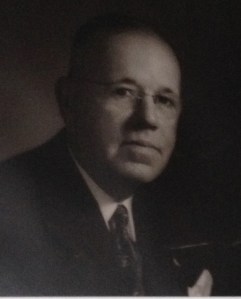
Though not noticed at the time, there was another reason that Finlandia was an apt selection to open the building.  The location of Robinson Auditorium had been chosen by Arkansas Gazette editor J.N. Heiskell. It was no one else’s first choice as the site for the building. As other options fell away, Heiskell kept trumpeting the northeast corner of Markham and Broadway.  So it was appropriate that the first piece of music be a selection that celebrated newspapers and the people who published them.
Little Rock Look Back: Original STAR WARS Trilogy

StarWarsTrilogyadsToday, May the 4th, is Star Wars Day.

The classic film first opened in May 1977 (though after May 4).  It did not reach Little Rock until June 24, 1977.

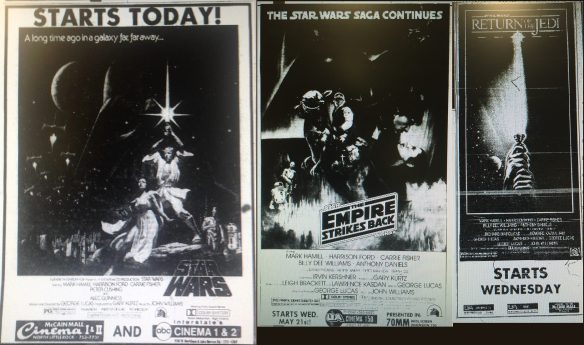
Given its status as a sleeper hit, it is no surprise that it came into Little Rock largely unnoticed.  In that day, major films opening on a Friday would be heralded the previous Sunday with a substantial advertisement.  The first Star Wars ad ran on Thursday, June 23, 1977, the day before it opened.  By contrast, Herbie Goes to Monte Carlo, which would play at the same theatre, had a large ad on Sunday, June 19.

While Star Wars would seem like the perfect movie for the great UA Cinema 150, it did not play there.  The film playing at the 150 was A Bridge Too Far, which was, at least an action movie.  Star Wars did not even open at a UA theatre.  It opened at the ABC Cinema 1 & 2 (located at Markham and John Barrow) and at the McCain Mall Cinema.  (The ABC Cinema location is now home to discount cellphone and discount clothing businesses; a cinema has returned to McCain Mall, but now in the location of the former MM Cohn’s store.)

The day it opened, there was a fairly large ad which incorporated the familiar beefcake Luke, Leia in flowing gowns, and Darth Vader mask.  On the Sunday after it opened, there was a slightly smaller ad with the same artwork.  McCain Mall also ran a small add for both Star Wars and Herbie. It noted that Star Wars was a film that management “does not recommend for children.”

Three years later, The Empire Strikes Back opened nationwide on May 21, 1980. Opening a film on the same date was a newer phenomenon, due in part to the success of Star Wars.  For the opening weeks, The Empire Strikes Back played an exclusive showing at the UA Cinema 150.  It would eventually play at other theatres in Little Rock.   It is interesting to note what was playing at the two theatres which had originally screened the 1977 film.  The McCain Mall Cinema was showing Coal Miner’s Daughter and The Fog. The former ABC Cinema was now the Plitt Southern Theatre and showed the Bill Murray comedy Where the Buffalo Roam and the Get Smart movie The Nude Bomb.  None were likely to attract the same number of audience members as The Empire Strikes Back.

On the day The Empire Strikes Back opened, the Arkansas Gazette had four different stories about the movie in that day’s edition.  While the Arkansas Democrat did not have any stories that day (though they would in subsequent days), they did carry a story on David Letterman preparing to start his (what would turn out to be short-lived) morning TV show.

On May 25, 1983, The Return of the Jedi opened.  Like the first film, though it would have been perfect for the Cinema 150, it did not play there.  Instead it played at the UA Cinema City (Breckenridge Village), the UA Four (at Geyer Springs and I-30 – now the Ron Sherman production studios), and at McCain Mall.  Flashdance was playing at the Cinema 150. In a forerunner of what is now standard practice, The Return of the Jedi played simultaneously on two of the seven screens at UA Cinema City and two of the four screens at UA Four.  While this is now part of the modus operandi, at the time, it was extremely rare to have a movie play on more than one screen in the same complex.  Though each of the theatres was smaller than the Cinema 150, the five combined exceeded the availability if it had played an exclusive run at the Cinema 150.

By the time The Return of the Jedi opened, the former ABC Cinema was now part of the ill-fated locally-based Rand Cinema chain and was known as the Markham 1 & 2.  It was showing the Roy Scheider film Blue Thunder and Dan Aykroyd in Dr. Detroit.

The cost to see The Return of the Jedi in Little Rock in 1983 was $5.00 for adults and $2.50 for children.


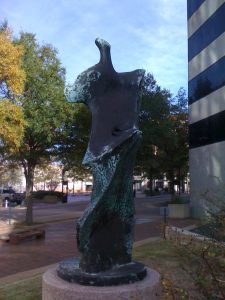
Arkansas Heritage Month – Public Art comes to Little Rock with Henry Moore’s LARGE STANDING FIGURE: KNIFE EDGE

HenryMooreIt was 1978, Bill Clinton was making his first run for Governor, Dallas and Robin Williams both made their TV debuts, disco was dominating the music scene, and Little Rock received its first major piece of public art.

Arguably Little Rock’s most famous piece of public art is Henry Moore’s 1961 creation Large Standing Figure: Knife Edge, which is known locally as “The Henry Moore Sculpture.”

The original model was created in 1961; this sculpture was cast in 1976 and purchased in June 1978 by the Little Rock Metrocentre Improvement District.

The purchase price was $185,000 — a princely sum at the time but now a bargain for a Henry Moore sculpture. (Adjusted for inflation, that amount would be the equivalent of $705,000 today.)

A committee consisting of Townsend Wolfe (then the director and chief curator of the Arkansas Arts Center), James Dyke and Dr. Virginia Rembert traveled to England to meet with Moore about the sculpture.

It was originally placed on Main Street when the street had been bricked over as part of the Metrocentre Mall pedestrian mall plan. As portions of the street became unbricked and reopened to vehicular traffic, it was moved to the intersection of Capitol and Main. Finally, when the last segment was reopened to vehicular traffic, it was put at its current location of the southeast corner of Capitol and Louisiana. Because it was purchased by the Improvement District, it must stay within the boundaries of the district.

There is currently discussion about the Metrocentre Improvement District disbanding and the sculpture being relocated elsewhere in the City.

A replica of the sculpture is featured in the 1980s classic The Breakfast Club.

Arkansas Heritage Month – LR Mayor John E. Knight

May is Arkansas Heritage Month. This year’s theme is “Arkansas Arts: Celebrating Our Creative Culture.”

Did you know that a former Little Rock mayor was a published songwriter?

John Elliott KJno E Knight signight (1816-1901) published a song entitled “I A Near to Thee” in 1858. He wrote the lyrics while Benjamin Scull wrote the music.  The song was dedicated to Mary Woodruff, a daughter of Arkansas Gazette publisher William Woodruff.


As an attorney and newspaper editor, John E. Knight collected documents about the settlement of Little Rock. Those papers are now part of a collection at the Arkansas History Commission.  The majority of these papers are from William Russell to Chester Ashley, pertaining to pre-emption claims in and around Little Rock. Other material concerns the 1819-1822 dispute related to the the New Madrid Certificate and pre-emption claims of James Bryant, Stephen F. Austin, and William M. O’Hara.

Little Rock Look Back: Lottie Shackelford

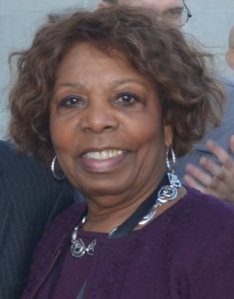
Lottie at Civil RightsWhile this headline may say “Little Rock Look Back,” Lottie Shackelford is still very much focused on the present and the future!

On April 30, 1941, future Little Rock Mayor Lottie Shackelford was born. Throughout her career in public service she has been a trailblazer.

Active in community activities and politics, she ran for the City Board in 1974 and lost.  But she was appointed to the Little Rock City Board in September 1978 to fill a vacancy.  This made her the first African American woman to serve on he City Board, and indeed on any governing board for the City (during Reconstruction, there were at least three African Americans on the City Council, but they were all men.) She was subsequently elected to a full-term on the City Board in 1980 winning 55% of the vote over three male candidates.

She was subsequently re-elected in 1984 (unopposed) and in 1988 (with 60% of the vote).

In January 1987, Shackelford became the first female mayor of Little Rock when she was chosen by her colleagues on the City Board to serve in that position. She was Mayor until December 1988.

From 1982 until 1992, she served as Executive Director of the Arkansas Regional Minority Purchasing Council.  She left that position to serve as Deputy Campaign Manager of Clinton for President.  She subsequently served on the Clinton/Gore transition team. She later served on the Overseas Private Investment Corporation from 1993 to 2003. She was the first African American to be in that position.

A graduate of Philander Smith College, she has also studied at the Arkansas Institute of Politics at Hendrix College and the Kennedy School of Government at Harvard University.

Mayor Shackelford has also served on numerous boards including the Little Rock Airport Commission, Philander Smith College, Chapman Funds (Maryland) and Medicis Pharmaceutical Corporation (Arizona).  She has been the longest serving Vice-Chair of the Democratic National Committee.

Mayor Shackelford was in the first class of inductees for the Arkansas Black Hall of Fame.  In 2015, she was inducted into the Arkansas Civil Rights Heritage Trail.

Little Rock Look Back: Nicholas Peay

LR sealOn April 28, 1784, in Virginia, future Little Rock Alderman (and acting Mayor) Major Nicholas Peay was born the eleventh of at least thirteen children.  (His gravestone lists a May date for his birth, but other records indicate April 28, 1784.) A veteran of the War of 1812 and the Indian Wars, he later moved to Kentucky (where he met and married his wife, Juliet Neill, in 1814) before settling in Arkansas on September 18, 1825.  At the time, they were the ninth family to set up residence in Little Rock.

After arriving in Little Rock, he bought the Little Rock Tavern. This started a fifty year tradition of his family owning taverns and hotels in Little Rock. In 1828, he was appointed Assistant Postmaster of Little Rock.  From 1825 to 1831, Little Rock residents were allowed to elect five Trustees prior to the formal incorporation. Major Peay was one of those who served on the Board of Trustees.

He later served on the Little Rock City Council, and in 1839 served for seven months as Acting Mayor due to the prolonged absence of Mayor Jesse Brown.  In 1841, his friend Gen. Zachary Taylor, paid a visit to Little Rock and stayed with him on the General’s way to Fort Smith.

Nicholas and Juliet Peay had at least eleven children, though only five appeared to have lived until adulthood. One of those, Gordon Neill Peay, served as Little Rock’s 23rd Mayor from 1859 to 1861. Other descendants of Nicholas Peay who followed him into public service include his grandson Ashley Peay, who was an Alderman in the 1920s (son of John Coleman Peay) and great-great-grandson Joseph B. Hurst (a great-grandson of Mayor Peay), who was a City Director from 1967 to 1970. In addition, City Director Hurst’s daughter-in-law, Stacy Hurst served three terms on the City Board from 2003 to 2014; she is now Director of the Department of Arkansas Heritage.

Major Peay’s egg-nog recipe has been passed down for generations. It is the inspiration for the Historic Arkansas Museum yearly Nog-Off.  This past year, museum director Bill Worthen and his daughter were the sixth and seventh generation of the family to make Peay’s egg-nog. The Worthens are descended from Mayor Peay’s son who was also named Gordon Neill Peay.

Major Nicholas Peay is buried with his wife and many other family members in Mount Holly Cemetery.

The Smithsonian Institution records indicate they have an oil painting of Major Peay as well as of his wife. But there are conflicting records as to whether they have been lost or are in private collections.

Little Rock Look Back: Mayor Sam Wassell

S WassellOn April 28, 1883, future Little Rock Mayor Sam M. Wassell was born.  His grandfather John W. Wassell had been appointed Mayor of Little Rock in 1868.  He is the only Little Rock Mayor to be a grandson of another Little Rock Mayor.

Sam Wassell served on the Little Rock City Council from 1928 through 1934 and again from 1940 through 1946.  He is one of the few 20th Century Little Rock Mayors who previously served on the City Council.

Wassell was an attorney.  He practiced law privately and also served as an Assistant US Attorney.  In 1930, he ran unsuccessfully for the Democratic nomination for the US Congress representing the 5th Congressional District, which at the time included Little Rock.

Wassell ran for Mayor in 1947 and was unopposed in the general election.  He was unopposed in his bid for re-election in 1949.  During his second term, President Harry S. Truman visited Little Rock.  In 1951, he sought a third term as Mayor.  No Little Rock Mayor had been successful in achieving a third consecutive term since 1923.  Though he received the Democratic nomination, the Republican party nominated Pratt Remmel who defeated Wassell by a 2 to 1 margin.

With a new USS Little Rock nearing commissioning, it is interesting to note that Mrs. Sam Wassell christened the previous USS Little Rock in 1944.  At the time, she was a City Councilor’s wife.

Mayor Wassell died on December 23, 1954 and is buried at Roselawn Cemetery in Little Rock.