
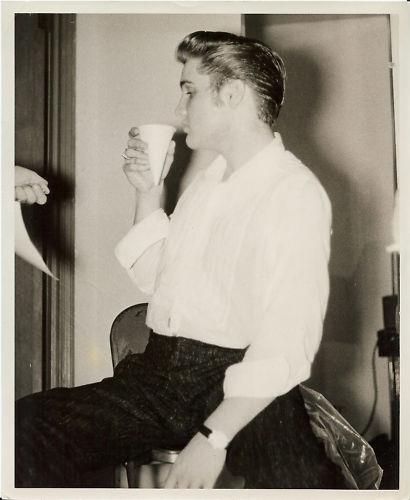
On 1/8, celebrating 81 Years of Elvis Presley

Photo by Wayne Cranford

Photo by Wayne Cranford

Eighty-0ne years ago today, Elvis Presley was born in Tupelo, Mississippi.  He would, of course, grow up to become a cultural phenomenon.

Elvis performed in Little Rock throughout his career.  In April 1972, he played at Barton Coliseum (with tickets on the arena floor going for a whopping $10!).  In the 1950s, he played three at Robinson Auditorium. His first appearance was as his career was just starting to take off. The final appearance on that stage, a mere 15 months later, was when he had become a national icon.

His first appearance at Robinson was on February 20, 1955.  Billed as the “WSM Grand Ole Opry” show, Elvis Presley was third on the bill behind the Duke of Paducah and Mother Maybelle and the Carter Sisters as he began week long tour of Arkansas and Louisiana.  On this date there were a pair of shows, at 3:00 and 8:15 p.m., at Robinson Auditorium. Tickets were 75-cents in advance, $1.00 at the box office and 50-cents for kids. It is believed that Gladys and Vernon Presley attended this performance, invited by Elvis who wanted to introduce them to the Colonel. Gladys was a big fan of the Duke of Paducah. Elvis Presley, Scotty Moore, and Bill Black receive $350 for these two shows instead of their usual $200 per day.  In August 1955, he returned and played Robinson as part of the All-Star Jamboree.

His third and final appearance at Robinson Auditorium was on May 16, 1956.  This time, the Auditorium was packed. The tickets were $1.50 in advance at Walgreens and $2.00 at the box office.  The ads featured 8 great acts in “his” variety show which consisted of the Jordonaires; Rick and Emil Flaim and their orchestra; vocalists Frankie Conners and Jackie Little and comedian-magician Phil Maraquin. A second show was added to accommodate the ticket demand.

About 30 minutes late, due to a missed flight, Elvis appeared on stage in a purple blazer and started singing “Heartbreak Hotel.”  The crowd rushed the stage. Little Rock police officers were able to control them eventually and get the teenagers back to their seats.  While the crowd was impressed, the police officers were less so.  One of the patrolmen told the Arkansas Gazette reporter: “I wouldn’t know him if I saw him. And I wouldn’t be here unless I was being paid.”

Little Rock Look Back: Mayor John Gould Fletcher

IMG_4006Future Little Rock Mayor John Gould Fletcher was born on this date in 1831. The son of Henry Lewis and Mary Lindsey Fletcher, he later served as a Captain in the Capital Guards during the Civil War. One of his fellow soldiers was Peter Hotze.

Following the war, he and Hotze began a general merchandise store in Little Rock. They were so successful that they eventually dropped the retail trade and dealt only in cotton. Peter Hotze had his office in New York, while Fletcher supervised company operations in Little Rock. In 1878 Fletcher married Miss Adolphine Krause, sister-in-law of Hotze.

John Gould Fletcher was elected Mayor of Little Rock from 1875 to 1881. He was the first Mayor under Arkansas’ new constitution which returned all executive powers to the office of the Mayor (they had been split under a reconstruction constitution). Following his service as Mayor, he served one term as Pulaski County Sheriff. Mayor Fletcher also later served as president of the German National Bank in Little Rock.

Mayor and Mrs. Fletcher had five children, three of whom lived into adulthood. Their son was future Pulitzer Prize winning poet John Gould Fletcher (neither father nor son used the Sr. or Jr. designation). Their two daughters who lived to adulthood were Adolphine Fletcher Terry (whose husband David served in Congress) and Mary Fletcher Drennan.

In 1889, Mayor Fletcher purchased the Pike House in downtown Little Rock. The structure later became known as the Pike-Fletcher-Terry House. It was from this house that Adolphine Fletcher Terry organized the Women’s Emergency Committee which worked to reopen the Little Rock public schools during the 1958-1959 school year.

In the 1960s, sisters Adolphine Fletcher Terry and Mary Fletcher Drennan deeded the house to the City of Little Rock for use by the Arkansas Arts Center. For several decades it served as home to the Arts Center’s contemporary craft collection. It now is used for special events and exhibitions.

Mayor Fletcher died in 1906 and is buried in Mount Holly Cemetery along with various members of his family. His grandson William Terry (son of Adolphine Fletcher Terry) and members of his family still reside in Little Rock.

Little Rock Look Back: 100 Years Ago Today, Pulaski Heights Annexation Election Took Place

010416 PH election On January 4, 1916, voters in Little Rock and Pulaski Heights voted overwhelmingly to annex the latter into the former.

First platted in 1890, Pulaski Heights had been incorporated as a city in August 1905.  By 1915, Pulaski Heights was booming.  It was growing so fast, that its infrastructure and public safety needs were far outpacing the city’s ability to pay for them.  Though there was a ribbon of commercial businesses along Prospect Avenue (now Kavanaugh Boulevard), it did not produce enough sales tax revenue to pay for City services. Then, as now, property taxes were also an important part of city revenue sources but not sufficient without sales taxes.

The City of Little Rock, likewise, was looking for ways to grow physically. At the time, the City was hemmed in by a river to the north and low, marshy land to the east. Current development was to the south, but even that presented limits in the foreseeable future. The best option was to grow to the west, but Pulaski Heights was in the way.  In 1915, Little Rock Mayor Charles Taylor (after failing in a previous attempt to re-annex North Little Rock into Little Rock), approached Pulaski Heights leadership about the possibility of annexation.

010516 PH electionIn November 1915, there were public meetings in Little Rock and Pulaski Heights to discuss the issue.  As a part of the annexation, Little Rock promised to build a fire station in the area and to install traffic lights, sidewalks and pave more streets.
On January 4, 1916, Little Rock voters approved the annexation of Pulaski Heights by a ten-to-one margin. The majority of Pulaski Heights residents also approved the deal.  The suburb became the city’s ninth ward.

Another special election was held in January 1916 to select the first two aldermen from the 9th Ward.  L. H. Bradley, John P. Streepey and Tom Reaves ran for the two slots. Bradley and Streepey were the top two vote recipients.  Streepey served until April 1921 and Bradley served until April 1928.

This established a couple of precedents for the City of Little Rock which are in effect to this day.  The first is that Little Rock would not be a central city surrounded by a variety of small incorporated towns (in the manner that St. Louis and other cities are).  It was this thought process which has led the City to continue to annex properties.

Little Rock Look Back: Mayor David Fulton

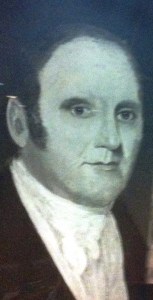
MayorFultonOn January 2, 1771 in Ireland, future Little Rock Mayor David Fulton was born.

He served as the fourth and final mayor of the Town of Little Rock in 1835. His term was cut short by the transition of Little Rock from town to city status. Once that happened in November 1835, a new election had to be held.

Mayor Fulton was also proprieter of the Tan Yard, a tanning operation in Little Rock.   He later served as a judge and was appointed as  Surveyor General of Public Lands in Arkansas by President Martin Van Buren in 1838.

Mayor Fulton married Elizabeth Savin in June 1795 in Maryland.  She died in November 1829, while they resided in Alabama.  Among their children was William Savin Fulton who served as Territorial Governor of Arkansas in 1835 and 1836 and was one of Arkansas’ first US Senators upon statehood in 1836.  Mayor Fulton was serving as Mayor at the same time his son was Governor.

Mayor Fulton came to Little Rock in 1833.  His daughter Jane Juliet Shall and her four children came to Little Rock as well.  The family made the move to be nearer to the future governor.  The Fultons and Shalls rented the Hinderliter House (now part of Historic Arkansas Museum) in 1834.

In addition to serving as Mayor, he was president of the Anti-Gambling Society and a Pulaski County Justice of the Peace.  From 1836 until 1838, he was County Judge of Pulaski County.

Mayor Fulton died on August 7, 1843 and is buried at Mount Holly Cemetery as are several other members of his family.

Little Rock Look Back: Mayor J.G. Botsford

Botsford GraveOn December 30, 1838, future Little Rock Mayor Jefferson George Botsford was born in Port Huron, Michigan.  He married Charlotte Adelia Henry on June 13, 1867.  She had been born in Massachusetts, but moved to Little Rock with her parents and grandparents.

The couple had seven children: Nellie, Charlotte, Harriett, James, Edward, George and Charles. Nellie, James and Charles died in childhood.

Botsford had served in the Union Army and fought in frontier battles against Indians.  Among his commercial involvements in Little Rock were serving as mail contractor between Little Rock and Baton Rouge, proprietor of Anthony House, organizer of Merchants National Bank and president of the White River Valley & Texas Railroad.

In 1868, Botsford was elected to the Little Rock City Council.  The City Council suspended Mayor A. K. Hartman in February 1870.  Elected in 1869, he was disliked by the aldermen, the press and a portion of the public.  A court order overturned the suspension in June 1870.  In January 1871, Mayor Hartman was again suspended by the Council.  This time, Botsford was declared Mayor.  However Hartman also still claimed the title of Mayor through the remainder of his term in November 1871.

After stepping down as Mayor with the election of Robert Catterson in November 1871, Botsford returned to private life.  He died on October 29, 1915 and is buried at Mount Holly Cemetery.

Little Rock Look Back: Mayor Frederick Kramer

Mayor KramerOn December 29, 1829, future Little Rock Mayor Frederick G. Kramer was born in Halle, Prussia.  In 1848, he immigrated to the United States.  Kramer enlisted in the United States Army and served in the Seventh Infantry until his discharge at Fort Gibson, Indian Territory, in July 1857. After his discharge, Kramer settled in Little Rock, and became a citizen in 1859. He married Adaline Margaret Reichardt, an emigrant from Germany, in 1857. They had six children Louisa, Mattie, Emma, Charles, Fred, and Henry.

From 1869 to 1894, Kramer served on the Little Rock School Board.  He was the first School Board president.  Among his other civic activities were serving as president of the Masonic Mutual Relief Association, a founder of the Mount Holly Cemetery Commission, and a founder of Temple B’nai Israel.  In 1875 he and F. A. Sarasin opened a mercantile business. Kramer later became the president of the Bank of Commerce.

Frederick Kramer was elected Mayor of Little Rock in November 1873.  He served until April 1875, when a new Arkansas Constitution took effect.

From November 1869 through March 1875, the City Council President presided over City Council meetings and signed ordinances, performing many of the duties formerly ascribed to the Mayor.  As such, during his Mayoral tenure from 1873 to 1875, Kramer was the Chief Executive of the City but did not preside over Council Meeting.  When he had served on the City Council, however, Kramer had been elected President of the Council and had presided over Council meetings from October 1871 to May 1872

Kramer was returned to the Mayoralty in April 1881 and served three more terms leaving office in April 1887.  His tenure as an Alderman and as Mayor overlapped with his service on the school board.

A new Little Rock elementary school which opened in 1895 on Sherman Street was named the Fred Kramer Elementary School in his honor.  Though the building’s bell tower was removed in the 1950s, the structure still stands today.  It now houses loft apartments.

Frederick G. Kramer died on September 8, 1896, in Colorado Springs, Colorado.  A few months earlier, he had traveled there with his wife and daughter Emma to recuperate from an illness. He is buried in Oakland Cemetery.

Little Rock Look Back: Boxing Day look at Robinson Auditorium boxing

Boxer Al Globe lays in the ring after being knocked down by Bob Sikes in this GAZETTE staff photo

Boxer Al Globe lays in the ring after being knocked down by Bob Sikes in this GAZETTE staff photo

Though the origins of the name Boxing Day have nothing to do with pugilism, today’s entry looks at early boxing matches at Robinson Auditorium.

Though the building did not open until February 1940, there were a few preview events in the lower level exhibition hall beginning in October 1939.  (The construction upstairs would not be completed until January 1940.)

Wrestling was a more common sport on the lower level. But from time to time there was boxing.  It appears that the first boxing matches took place on November 9, 1939.

Pine Bluff’s heavyweight Bob Sikes was the star attraction on the main card as he faced off against Chicago’s Al Globe.  The two were fairly evenly matched through the first three rounds. In the fourth round, Globe sent Sikes to the mat, before the latter arose on the seventh count. (He was a bit groggy and could not name the city in which he was boxing.)  Ninety seconds into the fifth round, however, Sikes delivered a knockout punch to Globe.

The warm-up bout featured Carolinian Maxie Doyle against Jimmy Merritt of Oklahoma. After the ref called the match on a TKO in favor of Doyle, the two continued to fight in the ring. It took their seconds to leave the corner and help the ref break it up.  The boxers were threatened with suspension if they continued it any further.

Prior to the Doyle-Merritt bout, Bauxite’s Woody Bell edged out Young Leonard in six rounds. Charley Regan and Bobbie Lee came to a draw after their six.  The first match of the evening featured two African American boxers: Little Rock’s Bill Walker, who earned a decision over North Little Rock’s Herbert Taylor.

Since the heating system was not yet operational at Robinson Auditorium, promoters for the early wrestling and boxing matches touted the fact that a temporary heating system was in place as temperatures started to drop.

Sikes was back at Robinson in another marquee match on February 9, 1940, one week before the official opening of the upstairs Music Hall.  By this time permanent heating and lighting had been connected.

Boxer Bob Sikes, GAZETTE staffer Lou MacDuff and boxer Joe Regan in a GAZETTE staff photo

Boxer Bob Sikes, GAZETTE staffer Lou MacDuff and boxer Joe Regan in a GAZETTE staff photo

The headline bout was Sikes against Joe Regan of Ames, Iowa.  They were scheduled for ten rounds.

Earlier fights on the card were the six-round middleweight match of Gould Nix of Willow meeting Buck Buchanan of Rogers; welterweight Doyle Venable of Dierks vs. Little Rock’s Freddie Richardson; Johnny Allen of Saint Louis meeting Woody Bell of Bauxite; and, in the first match, Kid Tobey of Hot Springs vs. Bill Walker of Little Rock. The latter was a four round bout featuring two African American boxers.

The marquee fight did not go anywhere near as long as ten rounds.  Fifty-four seconds into the second round, Sikes pummeled Regan with a right to the chin, a right to the cheek and a left hook to the head. After that Regan was down for the count. Though at the eight count he did manage to turn over from his back to his stomach and remained in that position until being helped to his corner following the bell.

Earlier in the evening, Nix, Venable, and Bell all won their bouts by decisions of the judges. Walker won the curtain raiser by a knock out in the second round.

It was a capacity crowd for the boxing event at Robinson Auditorium.  Tickets, which were available for purchase at Rube & Scott, Inc. men’s clothing store, ranged from 55 cents for general admission, to $1.10 for reserved seating and ringside seats of $1.65 or @2.20.