Documentary on MLK in Arkansas shown at Clinton School

mlk filmToday (January 15) at 12 noon, the Clinton School of Public Service is hosting a screening of the documentary “Dr. Martin Luther King Jr. in Arkansas.”

It originally aired on KATV-7 on January 19, 1987, as a 30-minute television special. Narrated by Arkansas native Deborah Mathis, it includes Dr. King’s attendance at Ernest Green’s Little Rock Central High School graduation and his commencement address at the University of Arkansas Pine Bluff.

It will be shown at the Clinton School.


Art+History Throwback Thursday: Museum of Fine Arts

MFA postcardOn February 9, Little Rock voters will have the chance to say Yes to improving the Arkansas Arts Center, MacArthur Museum of Arkansas Military History and MacArthur Park.

Leading up to that election is a good time to look back at the development of these two MacArthur Park sited museums.

The Museum of Fine Arts opened in October 1937.  The groundbreaking was held on January 3, 1936, with the cornerstone laid on October 6 of that year.  Nearly one year later, the Fine Arts Club held its first meeting in the building and hosted a grand open house on October 5, 1937.

The front doorway to the museum is visible today inside a gallery of the Arkansas Arts Center.

Little Rock Look Back: Pulaski Heights officially part of Little Rock 100 years ago today

Ninth WardOn January 13, 1916, the Little Rock City Council formally accepted Pulaski Heights into the City of Little Rock.

The Council had held a regular meeting on Monday, January 10, 1916, which was the same evening as the final meeting of the Pulaski Heights City Council.  Three days later, on Thursday, January 13, 1916, Mayor Charles Taylor again convened the Little Rock City Council to take the steps to officially annex Pulaski Heights into Little Rock.

By Ordinance 2259, the City’s boundaries were increased to include the land which had been Pulaski Heights.  Resolution 918 directed city staff to replat the land, which was necessary to bring the land in accordance with existing city plats and documents.

Resolution 919 set forth January 20 as a special election date to elect the two new members of the Little Rock City Council who would represent the new Ninth Ward of Little Rock.  Those who won would serve until April 1916.  The election would also serve as the primary for the April election.  Back then, winning the Democratic primary for a City race was tantamount to winning the race.  Since there were two seats being created, one would have a two year term, the other would be for only one year.  The candidate receiving the most votes on January 20 would, after April, take up the two year term and be able to run for re-election in April 1918. The candidate with the second highest total of votes would win the one-year term and be up for re-election in April 1917.  At the time, there were three publicly declared candidates for the two seats.  Another had been interested, but dropped out that morning.

Making Pulaski Heights the Ninth Ward was not the only focus of the City Council meeting.  An ordinance was also approved which allocated $438 for the purchase of beds, mattresses, chairs and other furniture for the City hospital.  (That is the equivalent of nearly $10,000 today.)  The Council then reimbursed a doctor the $438, which presumably had been spent on making the purchases.

Little Rock Look Back: Little Rock City Hall resumes after Civil War

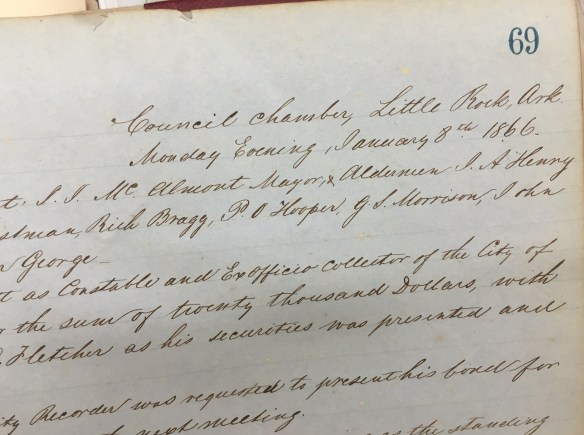
Jan 1866 minsOne hundred and fifty years ago this month, Little Rock City Hall resumed functioning after the Civil War.  The City government had disbanded in September 1863 after the Battle of Little Rock.  From September 1863 through the end of the war (on on through part of Reconstruction), Little Rock was under control of Union forces.

Following the April 1865 conclusion of the Civil War, plans were made to restart local government in Little Rock.  Even though Arkansas would not have Congressional representation in Washington until June 1868 (becoming the second Confederate state after Tennessee), the establishment of local government took place in January 1866.

The first City Council meeting took place on Monday, January 8, 1866. The council met again on Tuesday, January 9 and Monday, January 15 as they were trying to establish committees and rules for the new government.

The first post-Civil War mayor was Dr. J. J. McAlmont, who was a physician and pharmacist. Following his service as the city’s chief executive, he would later be a co-founder of what is now UAMS.  The initial aldermen were I.A. Henry (who had been on the City Council when it ceased in 1863), Henry Ashley, M. H. Eastman, Rick Bragg, P. O. Hooper, G. S. Morrison, John Collins and Alexander George.

Their first action was to approve the bond of Thomas C. Scott as Constable and City Collector.  Vouching for him were S. H. Tucker and John Gould Fletcher.  The Recorder was asked to present his bond and the next meeting.

The Mayor then established several committees of the City Council and named his appointments. Among the committees were Finances, Streets, Ordinances, Mount Holly Cemetery, Fire Department and Police.

That meeting and the following two meetings, the City continued to approve motions, resolutions and ordinances to set up the duties and responsibilities of a government.

Ordinance Number 1 established the rates of Licenses for 1866.  Among those were:

  • $100 for the privilege of selling goods at auction
  • $20 for a one-horse wagon, paid quarterly
  • $35 for a two-horse wagon, paid quarterly
  • $50 for a four-horse wagon, paid quarterly
  • $25 to run a cab or bus (which would have been in some horse drawn conveyance), paid quarterly
  • $40 a month to sell liquor, wine, ale, beer, etc., by the glass or bottle to be consumed in a store, tavern, shop or store
  • $25 each quarter for each billiard table
  • $50 each quarter for each ten pin alley


Little Rock Look Back: Robinson Baskeball Arena

Former entrance to Robinson off Garland Street. Used to attend basketball games.

Former entrance to Robinson off Garland Street. Used to attend basketball games.

While Joseph Taylor Robinson Memorial Auditorium is known today as a performance and meeting venue, in its early days it was also the home to sports. Seventy-six years ago tonight the first basketball game was played at Robinson.

One of the first regular activities which took place in the lower level exhibition hall was a series of boxing and wrestling matches.  Building on the success of this, basketball came to the convention hall in January 1940.

A series of games featuring Little Rock High School and North Little Rock High School were announced by Coach Earl Quigley to take place from January 11 through February 16, the official opening day for the facility.

At that time, neither high school had a gymnasium; therefore both schools played their basketball games on their school auditorium stages with fans seated in the audience. The convention hall offered a regulation size floor (made of pecan block parquet) with seating for over 1,300 people along the sidelines and in the balcony.  The first men’s basketball game in Robinson Auditorium took place between the Little Rock High School Tigers and the North Little Rock High School Wildcats on January 11, 1940.

The Tigers lost the game before a crowd estimated to be 1,300.  Earlier in the evening there had been an exhibition between two women’s basketball teams.  The cost for admission to the games was 35 cents for the reserved seating and 25 cents for general admission.

Little Rock Look Back: Final meeting of Pulaski Heights City Council

Final PHCC mtg

The signatures by Recorder A. M. Edwards and Mayor L. H. Bradley on the final Pulaski Heights City Council minutes.

100 years ago today, the Pulaski Heights City Council held its final meeting.  Following the January 4 annexation election, Mayor L. H. Bradley convened the Pulaski Height City Council for the final time on January 10, 1916.

Five of the eight aldermen were present for the final meeting.  E. T. Reaves, R. G. Trickett, W.A. Turner, J. B. Webster, and H.C. Locklar.  Absent were J. S. Murphy, J.H. Hicks, and W. H. Keeton.

The City Recorder was A. M. Edwards, while O. E. White was Treasurer and Jonathan P. Streepey was City Attorney.

At the meeting, bills were paid and allowances were made for the transfer of assets and responsibilities to the City of Little Rock.  The minutes do not reflect if there were any valedictory addresses by any of the elected officials, which were common at that era.

Once Mayor Bradley and the Council had worked their way through the agenda, Alderman Reaves made the motion to adjourn the council sine die which was seconded by Alderman Webster. The motion passed unanimously.  With that, the Pulaski Heights City Council, which had first met in 1904, finished its business.

Little Rock Look Back: Senator Joseph T. Robinson Funeral at Little Rock First Methodist

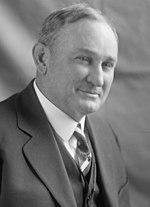
Senator Joseph Taylor Robinson

Today, Arkansas political icon and longtime United States Senator Dale Bumpers is being remembered in a memorial service at Little Rock’s First United Methodist Church.

On another Sunday afternoon, this time in July 1937, another United States Senator and former Arkansas Governor was also remembered in a service in the same church.  That man was Joseph Taylor Robinson.

Unlike Senator Bumpers, Senator Robinson died in office. Both men, however, shared many of the same qualities. Both were recognized as leaders within their parties and within the Senate. Both were counselors to Presidents. Senator Robinson was usually President Franklin Roosevelt’s point person to shepherd legislation on Capitol Hill.  Senator Bumpers worked closely with Presidents Carter and Clinton.  Both men flirted with national politics. Robinson was the Vice Presidential nominee of the Democratic Party in 1928. Bumpers seriously contemplated a run for the White House on more than one occasion.

It seems fitting that Senator Bumpers would be memorialized at a place of worship which had also been the site of the final rites for another Arkansas lion of the Senate.

Senator Robinson died in Washington D.C. on July 14, 1937.  His wife was in Little Rock making preparations for a trip the couple was to take. Following his demise, Mrs. Robinson went to Washington to accompany her husband’s body back to Arkansas.

The Senator was honored with a memorial service in the Senate chambers on Friday, July 17.  President Roosevelt and the cabinet joined members of the senate on the floor in what was described as a state funeral without pomp.  Mrs. Robinson sat with her brothers and two nephews as well as Bernard Baruch and Arkansas Power & Light’s Harvey Couch, who were Senator Robinson’s closest friends.  Eleanor Roosevelt was one of the many crowded in the senate galleries observing the service.  Following the service his body remained in the chambers until it was transferred to a train to make the journey to Little Rock.

The funeral train bore his body, his family, 50 senators and over twenty congressmen. It reached Little Rock around 8am on Sunday the 19th.  From there, Senator Robinson’s body was taken to his house on Broadway Street until noon.  It subsequently lay in state at the Arkansas State Capitol until being escorted by military to First Methodist Church.

1,500 people packed the church a half hour before the service began. The sun shone through the windows onto the flag-draped coffin as Rev. H. Bascom Watts led the service. Among the pallbearers was former Vice President Charles G. Dawes. Governor Carl Bailey of Arkansas was joined by Governors Richard Leche of Louisiana and E.W. Marland of Oklahoma.

As the funeral procession reached Roselawn Cemetery, thunder echoed. The skies which had alternated between sun and rain that day, returned to rain. A deluge greeted the end of the service and sent visitors hurrying for shelter at the end.
