
Black History Month Spotlight: O.C. Smith

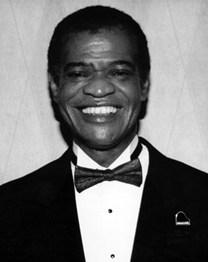
bhm o cThe life of O. C. Smith, according to one biography, ‘has had the flow and tempo of a hit song that finds its audience and never lets go.” His million-seller song “Little Green Apples” won a Grammy nomination.

Smith also is known for the hits “Hickory Holler’s Tramp” and “Daddy’s Little Man,” and is remembered for singing the themes from the motion pictures “The Learning Tree”and “Shaft’s Big Score.” Songs such as “Help Me Make It Through the Night,” “For the Good Times,” “That’s Life,” “Don’t Misunderstand,” “Dreams Come True” and “What “Cha Gonna Do” are all contributions to the music world from Smith.

Smith’s story begins in the small community of Mansfield, LA. At age 10, his parents, both teachers, relocated to Little Rock. After his parents divorced, Smith and his mother moved to Los Angeles.

Smith later returned to Louisiana to attended Southern University at Baton Rouge, majoring in psychology. He served the Air Force and Special Services as an entertainer on military bases all over the world.

After his stint with Uncle Sam, Smith settled in New York and began his singing career, working in clubs in the winter and at the legendary “Borsch Belt” hotels in the Catskill Mountains in the summer. He eventually signed on with Count Basie and toured with him for three years. He left Basie for a solo career that got a boost with the hit “Little Green Apples.”

At the height of his music career, Smith began studying Religious Science and subsequently became a minister. In 1985, he founded the City of Angels Church of Religious Science, where he practiced for 16 years. One of his last recordings, “Save The Last Dance For Me” reached the number one position on the Rhythm n’ Beach Top 40 chart.

He died on November 23, 2001.  In 1996, Smith was inducted into the Arkansas Black Hall of Fame.  For more on O.C. Smith and other inductees into the Arkansas Black Hall of Fame, visit the permanent exhibit at the Mosaic Templars Cultural Center. That museum is an agency of the Department of Arkansas Heritage.
Black History Month Spotlight: Henry Shead

bhm shedHenry Wallace Shead, Sr., better known as “Shed” was born in Fordyce, Arkansas, on March 31, 1941.  He was raised in Little Rock, the son of a reverend, Henry Arthur Shead.  At the tender age of six, Henry was introduced to the keyboards by his mother, Willie LeBethel, who immediately recognized his natural talent. Henry’s mother saw to it that her son had piano lessons, while his father’s church provided the place for his early public performances.

At the start of his career, he performed regularly on a local American Bandstand-type TV show called Center Stage. He also became a fixture at the Little Rock Country Club. He made his mark playing in intimate settings as a solo artist, dazzling listeners with his absolute mastery of the piano, singing in that slightly raspy, yet smooth sounding baritone voice. Shead was awarded a scholarship to the University of Arkansas at Pine Bluff, and majored in music while entertaining around the area. Henry met his wife, Jeanette Mazique, while attending college in Pine Bluff. They married in January of 1964 and had four children.

He became a high school choral director and music teacher, all the while continuing to work in local nightspots like the Drummer‘s Club in Little Rock. In 1971, he moved to Los Angeles where he made his acting debut appearing with Henry Fonda, Richard Dreyfuss and Jane Alexander in William Saroyan’s The Time of Your Life. He wrote and arranged music for stage plays and television, sang the title song for a United Artist film, did studio work on a Johnny Mathis album, and recorded for the Liberty/United Artists and Cream labels.

Shed created national radio jingles and appeared on network television with Dinah Shore, Johnny Carson and Jerry Lewis. He has also performed at parties for the Rockefellers, Pearl Bailey, The Carpenters, President Lyndon Johnson, President Bill Clinton, Henry Mancini, Sergio Mendes, hotelier Peter Morton, Ed McMahon and Barbra Streisand.

In Las Vegas, the city where he lived since 1974, Shed entertained at most of the major hotels, with long engagements at the Aladdin, Stardust, Hacienda, MGM Grand, Caesar’s Palace and Sahara. In 1977, the Henry Shead Band with Denise Clemente was voted Las Vegas’ Best Lounge Act of the Year. His last long-term run was at AJ’s Steakhouse at the Hard Rock Hotel & Casino, retiring in 2007. In October 2006, he was inducted into the Arkansas Black Hall of Fame.

He died on October 5, 2012 in Las Vegas and is buried in Forest Lawn Cemetery in Hollywood CA.

For more on Henry Shead and other inductees into the Arkansas Black Hall of Fame, visit the permanent exhibit at the Mosaic Templars Cultural Center. That museum is an agency of the Department of Arkansas Heritage.
 

Little Rock Look Back: Elvis plays first shows at Robinson Auditorium

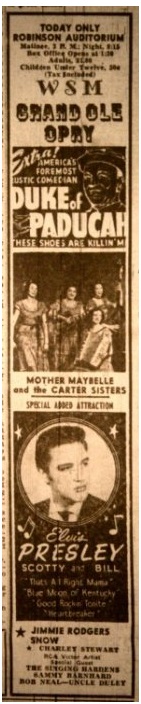
eap feb 55 adSixty years ago today, on February 20, 1955, Elvis Presley made his first appearance on stage in Little Rock. He performed at Joseph Taylor Robinson Memorial Auditorium.

He was billed as “an added attraction” to a Grand Ole Opry Show headlined by the Duke of Paducah.  Others on the bill included Mother Maybelle and the Carter Sisters, Jimmie Rodgers Snow, Charlie Stewart, the Singing Hardens, Sammy Barnhart, Bob Neal, Uncle Dudley and Smilin’ Mac Cyclone. (It is interesting to note that at least some of the advance tickets billed it as The Elvis Presley Show, though the newspaper ads billed the Duke of Paducah as the headliner.)

This concert was part of a weeklong tour of Arkansas and Louisiana.  There were two shows that day – one at 3p.m. and the other at 8:15p.m.  Tickets on the day of the concert were $1.00 for adults and fifty cents for children.  Advanced tickets had sold for 75 cents at Walgreens.

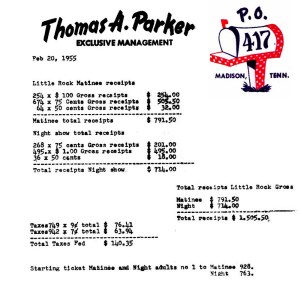
eap receits 05-little.rock_.feb_.55The night before, Elvis played the Louisiana Hayride in Shreveport.  Following his Little Rock appearance (for which he and his band were paid $350 instead of their usual $200), they played in Camden, Hope, and Pine Bluff.

eap 02-little.rock_It is believed that Elvis’ parents attended this concert in Little Rock. Gladys Presley was a big fan of the Duke of Paducah. Elvis apparently also wanted his parents to meet with Colonel Tom Parker, who would become inexorably linked with Elvis’ career.
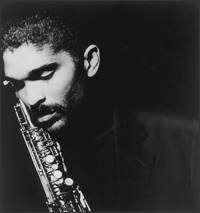
Black History Month Spotlight: Pharoah Sanders

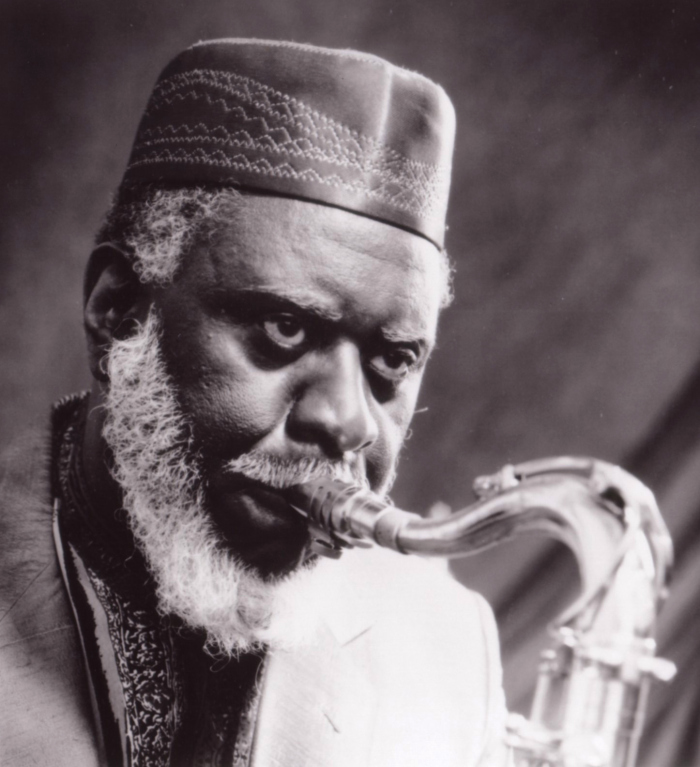
bhm pharoahPharoah Sanders (his given name, Ferrell Sanders) was born into a musical family. Sanders’ early favorites included Harold Land, James Moody, Sonny Rollins, Charlie Parker, and John Coltrane. Known in the San Francisco Bay Area as “Little Rock,” Sanders soon began playing bebop, rhythm & blues, and free jazz with many of the region’s finest musicians, including fellow saxophonists Dewey Redman and Sonny Simmons, as well as pianist Ed Kelly and drummer Smiley Winters. In 1961, Sanders moved to New York, where he struggled. Unable to make a living with his music, Sanders took to pawning his horn, working non-musical jobs, and sometimes sleeping on the subway. During this period he played with a number of free jazz luminaries, including Sun Ra, Don Cherry, and Billy Higgins.

In 1964, Coltrane asked Sanders to sit in with his band. The following year, Sanders was playing regularly with the Coltrane group. Coltrane’s ensembles with Sanders were some of the most controversial in the history of jazz. Their music represents a near total desertion of traditional jazz concepts, like swing and functional harmony, in favor of a teeming, irregularly structured, organic mixture of sound for sound’s sake. Strength was a necessity in that band, and as Coltrane realized, Sanders had it in abundance.

Sanders made his first record as a leader in 1964. After John Coltrane’s death in 1967, Sanders worked briefly with his widow, Alice Coltrane. From the late ’60s, he worked primarily as a leader of his own ensembles.

In the decades after his first recordings with Coltrane, Sanders developed into a more well-rounded artist, capable of playing convincingly in a variety of contexts, from free to mainstream. Some of his best work is his most accessible. As a mature artist, Sanders discovered a hard-edged lyricism that has served him well.

In 2004, he was inducted into the Arkansas Black Hall of Fame.  That night, he headlined a concert in Little Rock as a fundraiser for the Hall of Fame.  For more on Pharoah Sanders and other inductees into the Arkansas Black Hall of Fame, visit the permanent exhibit at the Mosaic Templars Cultural Center. That museum is an agency of the Department of Arkansas Heritage.

Tonight at South on Main’s Local Live – Hired Guns featuring Bruce Johnston, Tyndall Jackson, and Cliff Aaron

LOCAL_LIVE_Logo2The streets are clearing, and things are returning to normal. This includes the fact that Local Live concert series takes the stage tonight at South on Main at 7:30 pm.

Join the Oxford American magazine for this week’s free concert starring Hired Guns featuring Bruce Johnston, Tyndall Jackson, and Cliff Aaron! Call ahead at (501) 244-9660 to guarantee your seat for this popular series. Local Live is made possible by the generous sponsorship of Cosmic Cowboy Music.

Bruce Johnston is a bassist and award-winning composer with a doctorate in music composition from the University of Miami. He is a lecturer at Ouachita Baptist University where he overseas the Classical Guitar and String Bass programs. Johnston has studied with the likes of jazz legends Donald Brown and Jerry Coker, and he can be seen around the region performing with Charlotte Taylor, Kim Griffin, and David Rosen, as well as a host of other great talents.

Tyndall Jackson is a thirty-year veteran of the delta region, and he holds a guitar performance degree and received the Outstanding Musicianship award as a student. He has toured extensively with his band, Mojo Depot, and was active in Los Angeles for ten years before moving back home to Little Rock. Jackson has a true gift of seamlessly connecting ideas with blazing speed that builds in ever-increasing intensity, and he is quickly becoming a local guitar legend.

Cliff Aaron is a seasoned professional drummer and the CEO/Founder of Drummerboyinfinity—dedicated to bringing attention and respect to the incredible musical talent that exists in the region. He grew up in central Arkansas and has performed, toured, and recorded with the likes of Beyonce, 311, and Victor Wooten. Aaron’s aggressive yet finessing approach to the drum set is incredibly unique and boundless; he creates sheets of sound that truly transcend the audience to a higher plane.

Black History Month Spotlight: Art Porter Jr.

bhm art jr.Just like his father and namesake, Art Porter Jr. was a talented musician on a variety of instruments and in a variety of musical genres.

Arthur Lee (Art) Porter Jr. was born in Little Rock on August 3, 1961. Porter began his music career under the tutelage of his father, legendary jazz musician, Arthur Porter, Sr. who surrounded him with everything musical. He performed proficiently on drums, saxophone and piano. He was classically trained but his performances ranged across jazz, rhythm and blues, funk, and ballads.

During high school, under the supervision of Sterling Ingram, private teacher and band director at Parkview High School, Art Jr. was selected to be a member of the Arkansas All-State Band for three consecutive years.  At age 16, he was awarded the “Most Talented Young Jazz Artist in America” by the National Association for Jazz Education.

During Porter’s youth, his playing while underage in venues where liquor was sold proved controversial. Bill Clinton, then attorney general, established a framework for the legislature that would allow minors to work in such venues with parental supervision. Act 321 known as The “Art Porter Bill” became Arkansas law.

Porter graduated from Northeastern University in Chicago, Illinois, in 1986 with a BA degree in music education and performance. While in college, he won two certificates for excellence in jazz at the Notre Dame University Festival of Music in South Bend, Indiana. He later earned graduate hours at Roosevelt University studying music education and performance, and at Virginia Commonwealth University where he studied under the tutelage of Ellis Marsalis, patriarch of the Marsalis jazz family. Jack McDuff, a renowned jazz organist, heard Porter’s performances and asked him to join his band. His first performance while on tour with McDuff was in a New Orleans jazz club.

Porter started the Art Porter Quartet in Chicago and developed a loyal following in the area. He continued to write his own music and in 1991 was offered a contract to record on the Verve label, a division of Polygram Classics and Jazz.

Art burst on the music scene with his debut album, Pocket City (1992), followed by Straight to the Point (1993). In 1994, his third album, Undercover, placed Porter solidly on the “wave” radio charts with R&B artists as well as “cool jazz” artists. During this same year, he performed at Carnegie Hall for the Polygram Anniversary Celebration. His final album, Lay Your Hands on Me (1996), contained the radio favorite “Lake Shore Drive.”

Many of his compositions were expressions of his spirituality, such as the song “Lay Your Hands on Me.” Porter performed at the inaugural ceremonies of President Bill Clinton in 1993. During the inaugural prayer service, in collaboration with his father, he received a standing ovation for his solo renditions of “Amazing Grace” and “My Tribute.”

Porter traveled the world with performances but no matter where his music would carry him, he always returned to his beloved hometown of Little Rock. He conducted workshops for music students at his alma maters, Dunbar Magnet Junior High School and Parkview Arts and Science Magnet School. He was a founder of the Art Porter Sr. Music Education, Inc. (now the Art Porter Music Education, Inc. in memory of Art Sr. and Art Jr.), a nonprofit organization that provides scholarships to musically talented Arkansas students who need financial assistance to pursue their dream of obtaining a musical degree.

Porter died on November 23, 1996, in a boating accident in Thailand. He had just completed a performance at the Thailand International Golden Jubilee Jazz Festival commemorating the fiftieth anniversary of King Bhumibol Adulyadej’s reign.  In 2013, he was posthumously inducted into the Arkansas Black Hall of Fame.  For more on Art Porter Jr. and other inductees into the Arkansas Black Hall of Fame, visit the permanent exhibit at the Mosaic Templars Cultural Center. That museum is an agency of the Department of Arkansas Heritage.

Black History Month Spotlight – Art Porter Sr.

bhm art srArthur Lee (Art) Porter Sr. was a pianist, composer, conductor, and music teacher. His musical interest spanned from jazz to classical and spirituals.

Born on February 8, 1934 in Little Rock, he began his music education at home. He played in church at age eight; played his first recital at twelve; and, by fourteen, hosted a half-hour classical music radio program on KLRA-AM. He earned a bachelor’s degree in music from Arkansas AM&N College (now UAPB) in May 1954. The next year, he married Thelma Pauline Minton. Following his marriage, he pursued graduate study a the University of Illinois, University of Texas and Henderson State University.

He began his teaching career at Mississippi Valley State University in 1954.  When he was drafted into the Army, his musical talents were responsible for him being assigned as a chaplain’s assistant in New York.  In the late 1950s he returned to Little Rock and taught at Horace Mann High School, Parkview High School and Philander Smith College.

He also started playing piano jazz in the evenings. This led to the creation of the Art Porter Trio, which became THE music group for events.  Many musicians who came to Arkansas to perform in Little Rock or Hot Springs would often stop by and join in with Porter as he played.  From 1971 to 1981 he hosted The Minor Key musical showcase on AETN.  His Porterhouse Cuts program was shown in 13 states.

Often encouraged to tour, he instead chose to stay based in Arkansas.  He did, from time time, perform at jazz or music festivals.   He also performed classical piano with the Arkansas Symphony Orchestra, founded the Art Porter Singers, and created a music group featuring his four oldest children.  Though Porter received many honors and awards, he found particular satisfaction in the “Art Porter Bill” enacted by the state legislature, which allowed minors to perform in clubs while under adult supervision. Porter’s children thus were able to perform with him throughout the state. Governor Bill Clinton, at the time a huge fan and friend of Porter, often joined Porter’s group on his saxophone.

In January 1993, Porter and his son Art Porter, Jr., performed at festivities in Washington DC for the Presidential Inauguration of his friend Bill Clinton.  In July 1993, he died of lung cancer.  He was eulogized at Bethal AME Church, where he had been organist for 35 years.  He is buried at Little Rock National Cemetery.  Today his legacy lives on in the Art Porter Music Education Fund as well as in the lives of the many musicians and fans he touched.

He was posthumously inducted into the Arkansas Black Hall of Fame in 1994.  For more on Art Porter Sr. and other inductees into the Arkansas Black Hall of Fame, visit the permanent exhibit at the Mosaic Templars Cultural Center. That museum is an agency of the Department of Arkansas Heritage.