
Rock the Oscars: Leo Robin and Jule Styne

Lyricist Leo Robin with composer Jule Styne working together on the score of Gentlemen Prefer Blondes at the time of the original production in 1949.

Perhaps the most famous song about Little Rock is “(I’m Just a) Little Girl from Little Rock.”  Written by Leo Robin and Jule Styne, it first appeared on Broadway in Gentlemen Prefer Blondes where it was sung by Carol Channing.  When the title was made into a movie, it was sung by Marilyn Monroe and Jane Russell.

Because it was not written for the screen, the song was not eligible for an Oscar.  However, the duo who wrote it had their fair share of Oscar nominations and wins.

Robin, earned ten nominations between 1934 and 1953.  As a lyricist, he collaborated with seven different composers in earning these nominations. His one Oscar came for “Thanks for the Memory” from The Big Broadcast of 1938.  In the film it was sung by Bob Hope and Shirley Ross.  It would be associated with Hope the rest of his life.

Styne also earned ten nominations; his were between 1940 and 1968.  Seven of the nominations were for collaborations with Sammy Cahn.  (There were three other partners with whom he shared nominations, too.)  His win came for “Three Coins in the Fountain” from the film of the same name.  In the movie it was sung by an uncredited Frank Sinatra during the opening title sequence. During the closing credits, an unnamed chorus repeated the song.

Gentlemen Prefer Blondes received no Oscar nominations, though Charles Lederer did receive a Writers Guild of America nomination for screenplay of an American Musical.  Though Jane Russell introduced an Oscar winning Best Song in Paleface (“Buttons and Bows”) and Oscar nominated Best Song in Son of Paleface (“Am I in Love”) she never received an Oscar nomination.  Monroe never received one either.  Only co-star Charles Coburn had any luck with Oscar.  He received three nominations, winning once.

Little Rock Look Back: Little Rock High School Auditorium Dedicated

On October 31, 1927, a recital took place in the auditorium of the new Little Rock High School which served as a dedication ceremony for the new high school auditorium.  The school had been serving students for several weeks by the time the recital took place.  The first day of school was Wednesday, September 14, 1927.

The star of the recital was Mary Lewis, a Little Rock High School graduate (from the previous location on Scott Street) who had made her Metropolitan Opera debut and become a toast of New York City.

The evening started with remarks from former Arkansas Governor Charles Brough, who had made a name for himself as an advocate for education before, during and after his stint in the statehouse.  He was followed by Miss Lewis, who sang over a dozen arias and musical selections.  For her first encore, Miss Lewis sang “Dixie.”  Her second encore was supposed to be “Home Sweet Home.”  After several attempts to sing it, she was so overcome that she had to abandon the effort.

For more on the opening event, read Jay Jennings’ excellent book Carry the Rock: Race, Football, and the Soul of an American City.

The 1927 schoolbuilding replaced one built in 1905 at 14th and Scott Streets (with an auditorium completed a few years later at 14th and Cumberland).  This new building was located in the western edges of Little Rock on what had been city parkland.  The former West End Park was now site to Little Rock High School.  The adjoining Kavanaugh Field was a baseball field on which Earl Quigley’s football Tigers also played their games.

Architects John Parks Almand, Lawson L. Delony, George R. Mann, Eugene John Stern, and George H. Wittenberg (virtually all of Little Rock’s full-time working architects at the time) designed the $1.5 million structure, which the New York Times dubbed the most expensive school ever built in the United States at that time.

Featuring a combination of Collegiate Gothic and Art Deco architecture, Central High spans two city blocks, comprising over 150,000 square feet of floor space, upon its completion. Requiring 36 million pounds of concrete and 370 tons of steel, the finished product consisted of 100 classrooms (accommodating over 1,800 students), a fireproof 2,000-seat auditorium, a gymnasium, and a greenhouse.

The six-story structure (counting the bell tower and basement) features a middle section containing the auditorium with four classroom wings (two per side) flanking a reflection pool in the foreground of the building. Faced with brick, the building’s highlights include pilasters and colonnades of cut stone, double-hung window frames with twelve lights per sash, and a main entry terrace supported by a colonnade of five masonry arches rising above Corinthian columns of stone.


Central to Creativity – Charlotte Moorman

tvbra2For 2017’s Arts and Humanities Month, the blog will focus on cultural personalities who are connected with Little Rock Central High School.
Up first – the Topless Cellist, a 1951 graduate.  Charlotte Moorman

Born in Little Rock, at the age of ten she began to study cello.  After graduating from Little Rock high school in 1951, she attended Centenary College.  She undertook subsequent studies at the University of Texas and Julliard.

After spending time with the American Symphony Orchestra, she participated in the experimental art scene including with her friend Yoko Ono.

In 1963 Moorman founded the Annual Avant Garde Festival of New York, which presented the experimental music of the Fluxus group and Happenings alongside performance, kinetic art, and video art. Despite the event’s title the festival was not held annually. There were fifteen festivals from 1963 to 1980.

On February 9, 1967 Moorman achieved widespread notoriety for her performance of Paik’s Opera Sextronique at the Film-Makers Cinematheque in New York City. For this performance, Moorman was to perform movements on the cello in various states of nudity. For the second movement, she played International Lullaby by Max Matthews while wearing a black skirt, but while being topless, and was arrested mid-performance by three plainclothes police officers For her court trial, Moorman and Paik restaged and filmed the first two movements of Opera Sextronique with the filmmaker Jud Yalkut.

In the late 1970s she was diagnosed with breast cancer. She underwent a mastectomy and further treatment, to continue performing through the 1980s in spite of pain and deteriorating health. She died of cancer in New York City on November 8, 1991, aged 57.


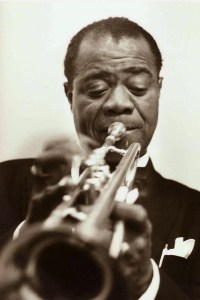
Little Rock Look Back: Louis Armstrong speaks out

As the Civil Rights movement started taking hold in the mid-1950s, many African American entertainers were vocal in their support.  Louis Armstrong stayed silent.  Until, that is, September 17, 1957.

That night, in Grand Forks, North Dakota, Armstrong blasted President Dwight Eisenhower for his lack of action to make Governor Orval Faubus obey the law.  This was in an interview conducted by a 21 year old University of North Dakota journalism student named Larry Lubenow.

Journalist David Margolick wrote about the incident in The New York Times in September 2007 in conjunction with the 50th anniversary of the integration of Little Rock Central High School.  He recounted how the story, written for the Grand Forks Herald, was picked up all over the country.  The entire Margolick piece can be read here.  Margolick tells that when Armstrong was given the chance to back off the comments, he asserted that he meant all of it.

On September 24, 1957, the night that the 101st Airborne was being mobilized to come into Little Rock, Armstrong sent Eisenhower a telegram again criticizing him for lack of action.  He used colorful language which sarcastically spoofed the “Uncle Tom” moniker which some of his critics had bestowed when they felt he was not doing enough for Civil Rights.  The Eisenhower Presidential Library has a copy of that telegram.  The incident between Satchmo and Ike was the basis for two different plays: Terry Teachout’s Satchmo at the Waldorf and Ishmael Reed’s The C Above C Above High C.

Little Rock Look Back: Duke Ellington refuses to play in segregated Robinson

Newspaper ad for the concert that was not to be

In August 1961, it was announced that Duke Ellington would perform in concert at Robinson Center.  He had previously played there in the 1940s and early 1950s.  His concert was set to be at 8:30 pm on Tuesday, September 5.

Due to the changes of times, the NAACP had a relatively new rule that they would boycott performers who played at segregated venues.  When it became apparent that Robinson would remain segregated (African Americans restricted to the balcony), the NAACP announced they would boycott any future Ellington performances if he went ahead and played Robinson.

The music promoters in Little Rock (who were white) petitioned the Robinson Auditorium Commission asking them to desegregate Robinson – even if for only that concert.  The Commission refused to do so.  Though the auditorium was finding it harder to book acts into a segregated house, they felt that if it were integrated, fewer tickets would be sold.

On September 1, 1961, Ellington cancelled the concert.

Robinson remained segregated until a 1963 judge’s decision which integrated all public City of Little Rock facilities (except for swimming pools).

Open Studios Little Rock today

oslr_logo_goldred_ac-lineThe City of Little Rock Arts+Culture Commission is thrilled to announce its first-ever Open Studios Little Rock.

From 10 a.m. to 5 p.m. on Saturday, June 10, gain exclusive access to 30 artist studios and cultural institutions that will open their doors and give you a firsthand look at their creative process. The lineup of studios visits includes artists working in the visual and performing arts, plus cultural institutions that will open their respective studios for guided tours and demonstrations.

Referred to as a city-wide exhibition, Open Studios gives you unparalleled access to artists living and working in Little Rock. Studio visits are free and open to the public.
To plan your Open Studio visits:

  • Download the Open Studios map (click here)
  • Visit the Open Studios Welcome Booth in the Creative Corridor the day of the event. Complimentary coffee and doughnuts will be provided, plus the opportunity to tour two participating studios – Matt McCleod Fine Art and Arkansas Repertory Theatre’s Education Annex. The Welcome Booth will be located in front of Matt McLeod Fine Art, 108 West 6th Street, 72201.

Artists who are unable to welcome the public into their studios will showcase their work at the Alternative Space hosted at the West Central Community Center, 8616 Colonel Glenn Road, 72204.

During Open Studios, the colorful “Open Studio” signs will alert you to Open Studio spaces.

SALES

Sales are handled by each artist and we do not take a percentage. You may sell prints, other artistic projects and commission customized work for the future. It is suggested that you are equipped to accept credit cards.

Participating Artists (as of 5.15.2017)

  • Adrian Quintanar Pottery
  • Catherine Rodgers Contemporary Art
  • Co-Op Art
  • Elizabeth Weber
  • Felice Farrell
  • Gary Cawood
  • Glenda McCune
  • Ike Garlington
  • Jeff Horton
  • Jennifer Cox Coleman
  • Jennifer Perren
  • Jerry Phillips’ Studio
  • Jimmy Parks
  • Linda Ferstl Watercolors
  • Little Rock Violin Shop
  • Marisa Cook
  • Maritza and Terry Bean Artists
  • Mary Pat Tate
  • Matt McLeod Fine Art
  • MichaelWardArt
  • Michael Warrick
  • New Deal Studios and Gallery, featuring the work of Jeff Waddle
  • Ruth Pasquine
  • Sandy Furrer, Certified Scottish Country Dance Teacher
  • Sandra Sell

Participating Cultural Institutions:

  • Arkansas Arts Center
  • Arkansas Repertory Theatre’s Education Annex
  • Mosaic Templars Cultural Center featuring the work of Nina Robinson

Little Rock Look Back: Elvis headlines Robinson

Photo by Wayne Cranford

After two visits in 1955 where he was down on the bill, Elvis Presley made his third and final appearance at Robinson Auditorium on May 16, 1956.  This time he was the star and Robinson was packed. The tickets were $1.50 in advance at Walgreens and $2.00 at the box office.

The ads featured 8 great acts in “his” variety show which consisted of the Jordonaires; Rick and Emil Flaim and their orchestra; vocalists Frankie Conners and Jackie Little and comedian-magician Phil Maraquin. A second show was added at 9:30 p.m. to accommodate the ticket demand.

About 30 minutes late, due to a missed flight, Elvis appeared on stage in a purple blazer and started singing “Heartbreak Hotel.”  The crowd rushed the stage. Little Rock police officers were able to control them eventually and get the teenagers back to their seats.  While the crowd was impressed, the police officers were less so.  One of the patrolmen told the Arkansas Gazettereporter: “I wouldn’t know him if I saw him. And I wouldn’t be here unless I was being paid.”

Disc jockey Ray Green recorded the concert that night.  Copies of the concert on CD (which also includes an interview with Presley) are prized possessions of Presley collectors.

The Arkansas Democrat-Gazette has a special section on its website containing quotes from some of the concert attendees.