Rock the Oscars: Carol Channing

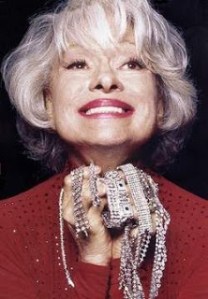
On January 31, 1921, future “Little Girl from Little Rock” and Oscar nominee Carol Channing was born. Alas it was in Seattle.

After gaining the notice of New York critics and audiences in the musical revue, Lend an Ear, Channing achieved Broadway stardom playing fictional Little Rock native Lorelei Lee (the creation of Anita Loos) in Gentlemen Prefer Blondes.  In this show, which opened in December 1949, she introduced the Leo Robin-Jule Styne songs “Little Girl from Little Rock” and “Diamonds Are a Girl’s Best Friend.”   In 1964, she won the Actress in a Musical Tony for her second signature role playing the title character in Hello, Dolly!  Channing also earned a special Tony in 1968 for Dolly when it became the longest-running Broadway musical.

On November 15, 1966, Carol Channing opened a six day stint in HELLO, DOLLY! at Robinson Auditorium.  She would play 8 sold out shows over those six days.  She had just wrapped filming THOROUGHLY MODERN MILLIE (for which she would receive an Oscar nomination). She had specifically requested that Little Rock be added to the tour.

While in Little Rock, Channing was entertained at the Arkansas Governor’s Mansion and feted at parties.  She was made an honorary citizen of Little Rock, as well.  But she was here to perform. And perform she did. She was rarely known to miss a performance and always gave her utmost.  Bill Lewis, in his review in the ARKANSAS GAZETTE, stated “To hear Channing sing ‘Hello, Dolly!’ Is one of the great experiences of all musical theater to date…”

In 1993, she spent her birthday in Washington DC at a White House dinner for the National Governors’ Association.  This was the Clintons’ first official White House dinner after moving in to the residence eleven days prior.  President Bill Clinton led the crowd in singing “Happy Birthday” to her.  She remarked to the President that she was Christian Scientist and didn’t celebrate birthdays, which meant she didn’t get any older.  He replied that it meant the night was her first birthday (it was her 72nd in actuality).

Little Rock Look Back: LR Votes FOR a Municipal Auditorium

On January 26, 1937, Little Rock voters went to the polls to vote on three different municipal bond issues.  One of them was the construction of a municipal auditorium.

The bonds for the auditorium would be $468,000 in general obligation bonds which would be paid off between 1940 and 1971. This was toward a total cost of $760,000 for the entire project.

The official campaign for the auditorium was sponsored by the Little Rock Forward Committee which was led by W. H. Williams. In campaign advertisements it showed the value of conventions in New York City which was estimated at $100 per convention attendee. Little Rock organizers were estimating a $10 a day expenditure by visitors, which the committee stressed was very conservative. The campaign committee emphasized the importance of acting at that time due to the federal government money involved.

Various committees and organizations endorsed the auditorium project including the Little Rock Chamber of Commerce, Little Rock Federation of Women’s Clubs, and the Young Business Men’s Association.

The thrust of the campaign focused on the economic benefit to Little Rock as well as the fact that the auditorium would be for all citizens. This message was picked up in editorials by both the Democrat and Gazette. In editorials on January 23 and 25, the Democratopined that the benefits of the auditorium would be distributed among all classes of the citizenry. The next day, both papers ran editorials which touted the economic boon an auditorium would bring through conventions and meetings.

The Democrat’s approach broke down the current value of conventions to Little Rock with, what it termed, the city’s “existing inadequate” facilities. The paper emphasized a conservative estimate of what the added value to Little Rock’s economy would be with the new auditorium.

In expressing support for the auditorium the Gazette stressed the values for local, statewide and national groups. “An auditorium would provide a more convenient and better adapted community center for all kinds of local gathering,” and continued that it would make Little Rock “the logical meeting place for state conventions of every sort.” In discussing the value of state, regional and national meetings the paper stressed that the outside money spent by convention attendees has an impact beyond stores, hotels and restaurants.

Both papers also echoed the importance of the federal government financing to make this possible. The Democrat noted that the Public Works Administration grant and federal low cost loan made this an ideal time.

On January 26, 1937, Little Rock voters approved the auditorium bond by a vote of 1,518 to 519. It passed in each of the city’s 23 precincts. Little Rock Mayor R. E. Overman expressed his pleasure at the outcome of the vote and extended his thanks to the voters.

After the election, a Gazette editorial commented on the low turnout for the special election by commenting that the weather had been nice and there were no other barriers to voting. The editorial writer opined that those not voting in the election must not have been opposed to the endeavor.

Rock the Oscars: Leo Robin and Jule Styne

Lyricist Leo Robin with composer Jule Styne working together on the score of Gentlemen Prefer Blondes at the time of the original production in 1949.

Perhaps the most famous song about Little Rock is “(I’m Just a) Little Girl from Little Rock.”  Written by Leo Robin and Jule Styne, it first appeared on Broadway in Gentlemen Prefer Blondes where it was sung by Carol Channing.  When the title was made into a movie, it was sung by Marilyn Monroe and Jane Russell.

Because it was not written for the screen, the song was not eligible for an Oscar.  However, the duo who wrote it had their fair share of Oscar nominations and wins.

Robin, earned ten nominations between 1934 and 1953.  As a lyricist, he collaborated with seven different composers in earning these nominations. His one Oscar came for “Thanks for the Memory” from The Big Broadcast of 1938.  In the film it was sung by Bob Hope and Shirley Ross.  It would be associated with Hope the rest of his life.

Styne also earned ten nominations; his were between 1940 and 1968.  Seven of the nominations were for collaborations with Sammy Cahn.  (There were three other partners with whom he shared nominations, too.)  His win came for “Three Coins in the Fountain” from the film of the same name.  In the movie it was sung by an uncredited Frank Sinatra during the opening title sequence. During the closing credits, an unnamed chorus repeated the song.

Gentlemen Prefer Blondes received no Oscar nominations, though Charles Lederer did receive a Writers Guild of America nomination for screenplay of an American Musical.  Though Jane Russell introduced an Oscar winning Best Song in Paleface (“Buttons and Bows”) and Oscar nominated Best Song in Son of Paleface (“Am I in Love”) she never received an Oscar nomination.  Monroe never received one either.  Only co-star Charles Coburn had any luck with Oscar.  He received three nominations, winning once.

Little Rock Look Back: HAIR’s Sun Shines In to Robinson Auditorium

Ad for the original production of HAIR in Little Rock. Note the ticket prices. And that they could be purchased at Moses Music Shops.

Ad for the original production of HAIR in Little Rock. Note the ticket prices. And that they could be purchased at Moses Music Shops.

Forty-six years ago today, on January 18, 1972, the musical Hair settled in for a week-long run at Robinson Auditorium.  The saga to bring the national tour to Little Rock had actually begun eleven months earlier.

In February 1971, a young Little Rock attorney named Phil Kaplan petitioned the Little Rock Board of Censors to see if it would allow a production of Hair to play in the city. He was asking on behalf of a client who was interested in bringing a national tour to Arkansas’ capital city. The show, which had opened on Broadway to great acclaim in April 1968 after an Off Broadway run in 1967, was known for containing a nude scene as well for a script which was fairly liberally sprinkled with four-letter words. The Censors stated they could not offer an opinion without having seen a production.

By July 1971, Kaplan and his client (who by then had been identified as Southwest Productions) were seeking permission for a January 1972 booking of Hair from the City’s Auditorium Commission which was charged with overseeing operations at Robinson Auditorium. At its July meeting, the Commissioners voted against allowing Hair because of its “brief nude scene” and “bawdy language.”

Kaplan decried the decision. He stated that the body couldn’t “sit in censorship of legitimate theatrical productions.” He noted courts had held that Hair  could be produced and that the Auditorium Commission, as an agent for the State, “clearly can’t exercise prior censorship.” He proffered that if the production was obscene it would be a matter for law enforcement not the Auditorium Commission.

The Commission countered that they had an opinion from City Attorney Joseph Kemp stating they had the authority. One of the Commissioners, Mrs. Grady Miller (sister-in-law of the building’s namesake the late Senator Robinson, she had served on the Commission since 1940), expressed her concern that allowing Hair would open the door to other productions such as Oh! Calcutta!

On July 26, 1971, Southwest Productions filed suit against the Auditorium Commission. Four days later there was a hearing before federal Judge G. Thomas Eisele. At that hearing, Auditorium Commission member Lee Rogers read aloud excerpts from the script he found objectionable. Under questioning from Kaplan, a recent touring production of Neil Simon’s Plaza Suite was discussed. That play has adultery as a central theme of one of its acts. Rogers admitted he found the play funny, and that since the adultery did not take place on stage, he did not object to it. Among those testifying in favor of it was Robert Reddington, who was director of performing arts at the Arkansas Arts Center.

Judge Eisele offered a ruling on August 11 which compelled the Auditorium Commission to allow Hair to be performed. Prior to the ruling, some of the Auditorium Commissioners had publicly stated that if they had to allow Hair, they would close it after the first performance on the grounds of obscenity. To combat this, Judge Eisele stated that the Commission had to allow Hair to perform the entire six day engagement it sought.

Upon hearing of the Judge’s ruling, Commissioner Miller offered a succinct, two word response. “Oh, Dear!”

In the end, the production of Hair at Robinson would not be the first performance in the state.  The tour came through Fayetteville for two performances in October 1971 at Barnhill Arena.

On January 18, 1972, Hair played the first of its 8 performances over 6 days at Robinson Auditorium.  In his review the next day, the Arkansas Gazette’s Bill Lewis noted that Hair “threw out all it had to offer” and that Little Rock had survived.

The ads promoting the production carried the tagline “Arkansas will never be the same.”  Tickets (from $2 all the way up to $8.50) could be purchased at Moses Melody Shops both downtown and in “The Mall” (meaning Park Plaza). That business is gone from downtown, but the scion of that family, Jimmy Moses, is actively involved in building downtown through countless projects. His sons are carrying on the family tradition too.

Little Rock was by no means unique in trying to stop productions of Hair.  St. Louis, Birmingham, Los Angeles, Tallahassee, Boston, Atlanta, Charlotte NC, West Palm Beach, Oklahoma City, Mobile and Chattanooga all tried unsuccessfully to stop performances in their public auditoriums.  Despite Judge Eisele’s ruling against the City of Little Rock, members of the Fort Smith City Council also tried to stop a production later in 1972 in that city. This was despite warnings from City staff that there was not legal standing.

Within a few years, the Board of Censors of the City of Little Rock would be dissolved (as similar bodies also were disappearing across the US). Likewise, the Auditorium Commission was discontinued before Hair even opened with its duties being taken over by the Advertising and Promotion Commission and the Convention & Visitors Bureau staff.  This was not connected to the Hair decision; it was, instead, related to expanding convention facilities in Robinson and the new adjacent hotel.  Regardless of the reasons for their demise, both bygone bodies were vestiges of earlier, simpler and differently focused days in Little Rock.

20 years of THE LION KING

On November 13, 1997, THE LION KING opened on Broadway.  It would go on to win six 1998 Tony Awards including Best Musical.  Today it celebrates its 20th Birthday!  It has played 8,325 performances on Broadway.

This coming April the entire Serengeti will come to life inside the newly renovated Robinson Performance Hall when Celebrity Attractions brings this Disney production to Little Rock!

More than 90 million people around the world have experienced the awe-inspiring visual artistry, the unforgettable music, and the uniquely theatrical storytelling of this Broadway spectacular “one of the most breathtaking and beloved productions ever to grace the stage.

THE LION KING brings together one of the most imaginative creative teams on Broadway.  Tony Award®-winning director Julie Taymor brings to life a story filled with hope and adventure set against an amazing backdrop of stunning visuals.  THE LION KING also features the extraordinary work of Tony Award®-winning choreographer Garth Fagan and some of Broadway’s most recognizable music, crafted by Tony Award®-winning artists Elton John and Tim Rice.

Central to Creativity – Ben Piazza


benpiazza book coverActor-director-playwright-author Ben Piazza was born on July 30, 1933, in Little Rock, and graduated from Little Rock High School in 1951 as valedictorian. He also had starred in the senior play that year (The Man Who Came to Dinner) and edited the literary magazine.

After graduating from Princeton, he moved to New York City to become an actor.  He made his Broadway debut in 1958 in Winesburg, Ohio.  In April 1959, he starred in Kataki and received a Theatre World Award for his performance.

As the 1960s dawned, Piazza joined a small cadre of actors who had achieved status on Broadway who then also returned to acting Off Broadway.  Colleen Dewhurst, George C. Scott, and James Earl Jones were others in this select group who helped establish Off Broadway as an entity in itself, instead of being just a farm team for Broadway.

In February 1963, he took over the role of Nick in the original run of Who’s Afraid of Virginia Woolf? on Broadway.  During the run of this show, Piazza’s novel The Exact and Very Strange Truth was published.  It is a fictionalized account of his growing up in Little Rock during the 1930s and 1940s.  The book is filled with references to Centennial Elementary, Westside Junior High, Central High School, Immanuel Baptist Church and various stores and shops in Little Rock during that era.

In August of 1967, his play The Sunday Agreement premiered at LaMaMa.  This was Piazza’s first playwright output to be professionally staged.  In March 1969, a double bill of his one-acts: Lime Green/Khaki Blue opened at the Provincetown Playhouse.  It

Throughout the 1960s and early 1970s, Piazza toured in many plays nationally and internationally. He also appeared in major regional theatres as an actor and a director.  As the 1970s progressed, he turned his focus to television and movies.

Piazza’s film debut had been in a 1959 Canadian film called The Dangerous Age. That same year, his Hollywood film debut came opposite Gary Cooper in The Hanging Tree.  Throughout the 1950s and 1960s, he appeared in a number of TV shows including Studio One, Kraft Theatre, Zane Grey Theatre, The Naked City and Dick Powell Theatre.

In the 1970s and 1980s, his appearances included I Never Promised You a Rose Garden, The Bad News Bears, The Blues Brothers, and Mask.  On TV, he appeared in Dallas, Dynasty, Saint Elsewhere, Barnaby Miller, Moonlighting and Family Ties. 

Piazza’s final big screen appearance was in the 1991 film Guilty by Suspicion.  He played studio head Darryl Zanuck in this Robert DeNiro-Annette Bening tale of Hollywood during the Red scare.

Ben Piazza died on September 7, 1991.  In 2016, a meeting room in the new Robinson Conference Center was named in his memory.

Central to Creativity – Kathryn Pryor

While she may be a successful attorney by day, Kathryn Pryor, is also an accomplished singer and actor.

Having grown up appearing on stage (including starring in productions while a student at Central High School), it is no surprise she continues to appear in productions throughout Central Arkansas.

In 2016, she reprised her role of Hillary Clinton in the biennial political spoof Gridiron.   Earlier this year, she appeared in Arkansas Rep’s production of SISTER ACT.   Over the years she has also played leading roles on various Little Rock stages in GYPSY, CABARET, SWEENEY TODD, COMPANY, VICTOR/VICTORIA, SOUTH PACIFIC, and MERRILY WE ROLL ALONG.  

In addition, she has appeared in New York in a cabaret act with her brother Will Trice. For the 2015 edition of the Arkansas Arts Center’s Tabriz, she and Will reprised their act.