This month at The Studio Theatre – BEAUTY AND THE BEAST

tst-batb-11x17The Studio Theatre invites audiences to be their guest at the musical Beauty and the Beast this December.

The production opened last night ant runs through December 18.

Beauty and the Beast is directed by Mark Burbank, with music direction by Jeannie Cross, and choreography by Stacy Hawking. Beauty and the Beast was Disney Theatrical’s first Broadway production. It won a 1994 Tony Award for costume design and a 1998 Olivier for Best New Musical.

With music by Alan Menken, lyrics by Howard Ashman and Tim Rice, and book by Linda Woolverton, it was adapted from Walt Disney Pictures’ Academy Award-winning 1991 animated musical film of the same name – which in turn had been based on the classic French fairy tale by Jeanne-Marie Leprince de Beaumont.  Beauty and the Beast tells the story of a cold-hearted prince who has been magically transformed into an unsightly creature as punishment for his selfish ways. To revert back into his true human form, the Beast must first earn the love of a bright, beautiful young woman whom he has imprisoned in his enchanted castle before it is too late.

Performances are Thursdays through Sundays.  Thursday, Friday, and Saturday performances (December 1, 2, 3, 8, 9, 10, 15, 16, 17) will begin at 7:30pm and Sunday matinees (December 4, 11, 18) will begin at 2:30pm.  Tickets are $25.00 for general admission, $20.00 for Seniors (65+), Military, and Students. Tickets are $15.00 for children 12 and under.   There are no assigned seats at The Studio Theatre.

A CHRISTMAS STORY opens tonight at Arkansas Rep.

All Ralphie Parker wants for Christmas is an Official Red Ryder Carbine-Action Two-Hundred-Shot Range Model Air Rifle with a compass in the stock, and this thing which tells time. All his parents can say in response? “You’ll shoot your eye out!”

Based upon the memoirs of Jean Shepherd, the 1983 film A Christmas Story has become a modern holiday classic. This winter, relive your favorite moments from the movie as they come to life onstage at Arkansas Repertory Theatre.  The play was adapted by Philip Grecian.  The play opens tonight and runs through December 25.

Enjoy Ralphie’s hilarious misadventures as his family struggles to enjoy an All-American Christmas on the brink of World War II. Armed with an overactive imagination and the wide-eyed optimism of childhood, he creates fantastic schemes to guarantee that he will find a BB gun under the tree, which backfire with hysterical results.

Bullies, his salty Old Man, even a store Santa, all conspire to prevent Ralphie from attaining his heart’s desire in this bittersweet, quirky slice of life from a more innocent time. In the end, nothing can defeat the spirit of Christmas when you are surrounded by a family who loves you, warts and all.

“We’ve got a wonderful present to wrap up and put under the tree this year at The Rep,” said Director Mark Shanahan. “Audiences will be delighted as this classic Christmas tale comes to life in a uniquely theatrical way. A Christmas Story transports us to the bygone era of the 1940s and the recollections of a family Christmas like no other. Full of wit, imagination and heartfelt nostalgia, A Christmas Story is a holiday gift you’ll remember all year-round.”

The Rep triple-dog dares you to keep a straight face at A Christmas Story. This raucous, heartwarming yuletide favorite will have the whole family rolling in the aisles. It is not for the fra-gee-lay of heart!

RobinsoNovember: Ben Piazza

benpiazza book coverAnother of the spaces in Robinson Center is named in memory of actor-director-playwright-author Ben Piazza.  He was born on July 30, 1933, in Little Rock, and graduated from Little Rock High School in 1951 as valedictorian. He also had starred in the senior play that year (The Man Who Came to Dinner) and edited the literary magazine.

After graduating from Princeton, he moved to New York City to become an actor.  He made his Broadway debut in 1958 in Winesburg, Ohio.  In April 1959, he starred in Kataki and received a Theatre World Award for his performance.

As the 1960s dawned, Piazza joined a small cadre of actors who had achieved status on Broadway who then also returned to acting Off Broadway.  Colleen Dewhurst, George C. Scott, and James Earl Jones were others in this select group who helped establish Off Broadway as an entity in itself, instead of being just a farm team for Broadway.

In February 1963, he took over the role of Nick in the original run of Who’s Afraid of Virginia Woolf? on Broadway.  During the run of this show, Piazza’s novel The Exact and Very Strange Truth was published.  It is a fictionalized account of his growing up in Little Rock during the 1930s and 1940s.  The book is filled with references to Centennial Elementary, Westside Junior High, Central High School, Immanuel Baptist Church and various stores and shops in Little Rock during that era.

In August of 1967, his play The Sunday Agreement premiered at LaMaMa.  This was Piazza’s first playwright output to be professionally staged.  In March 1969, a double bill of his one-acts: Lime Green/Khaki Blue opened at the Provincetown Playhouse.  It

Throughout the 1960s and early 1970s, Piazza toured in many plays nationally and internationally. He also appeared in major regional theatres as an actor and a director.  As the 1970s progressed, he turned his focus to television and movies.

Piazza’s film debut had been in a 1959 Canadian film called The Dangerous Age. That same year, his Hollywood film debut came opposite Gary Cooper in The Hanging Tree.  Throughout the 1950s and 1960s, he appeared in a number of TV shows including Studio One, Kraft Theatre, Zane Grey Theatre, The Naked City and Dick Powell Theatre.

In the 1970s and 1980s, his appearances included I Never Promised You a Rose Garden, The Bad News Bears, The Blues Brothers, and Mask.  On TV, he appeared in Dallas, Dynasty, Saint Elsewhere, Barnaby Miller, Moonlighting and Family Ties. 

Piazza’s final big screen appearance was in the 1991 film Guilty by Suspicion.  He played studio head Darryl Zanuck in this Robert DeNiro-Annette Bening tale of Hollywood during the Red scare.

Ben Piazza died on September 7, 1991.

RobinsoNovember: Carol Channing brings HELLO, DOLLY! to Little Rock

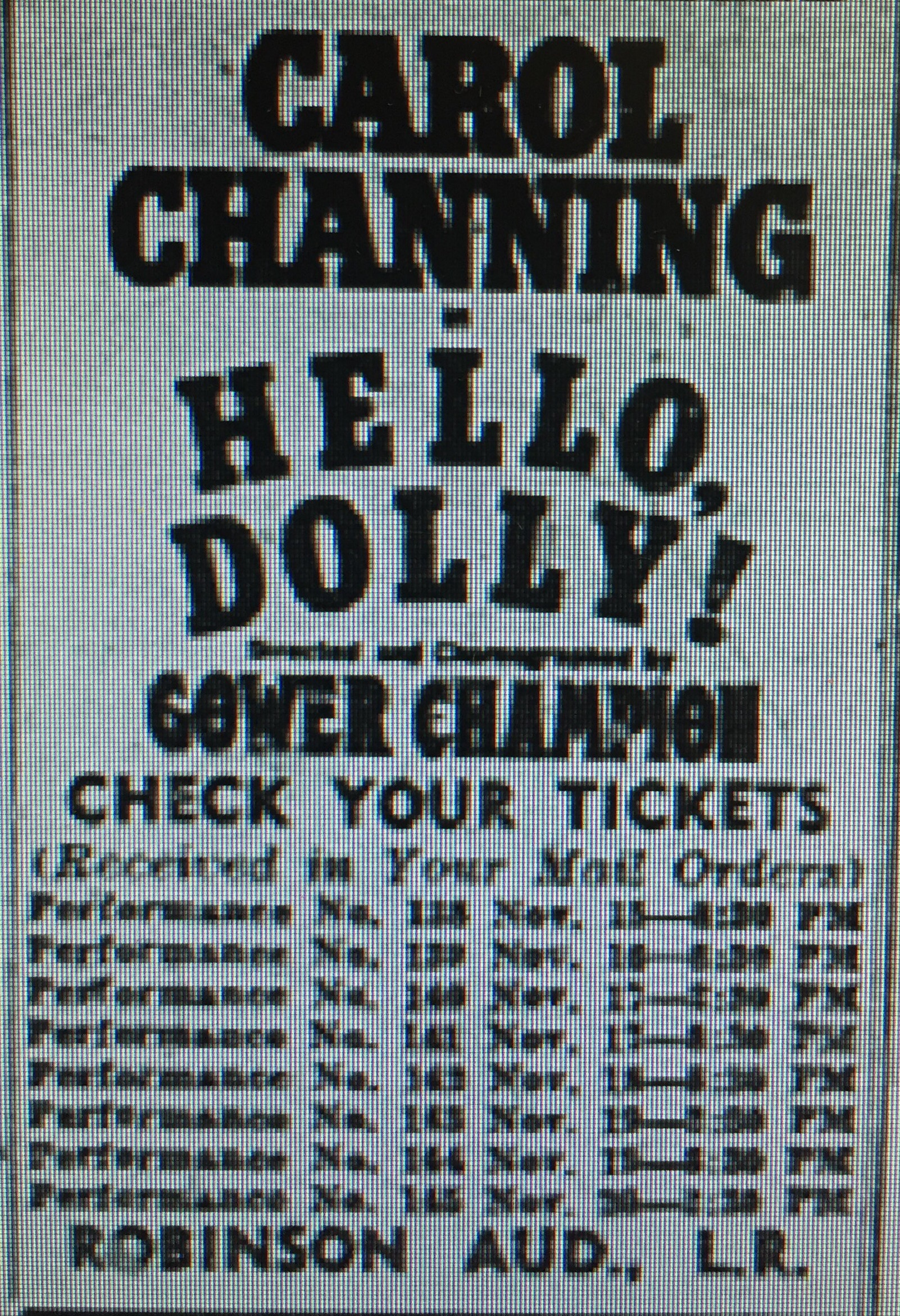
50 years ago tonight, on November 15, 1966, Carol Channing opened a six day stint in HELLO, DOLLY! at Robinson Auditorium.  She would play 8 sold out shows over those six days.

Channing, who had won the 1964 Tony Award for Best Actress in a Musical for her role in this show, had recently returned to the national tour.  She had just wrapped filming THOROUGHLY MODERN MILLIE (for which she would receive an Oscar nomination). She had specifically requested that Little Rock be added to the tour.

Her breakout role was in 1949’s GENTLEMEN PREFER BLONDS. In that show she introduced the song “Little Girl from Little Rock.”  Since it had helped make her a star, she had long felt an affinity for the Arkansas capital.  Therefore when she rejoined the tour, she required that LR be one of her stops before she left the tour.

While in Little Rock, Channing was entertained at the Arkansas Governor’s Mansion and feted at parties.  She was made an honorary citizen of Little Rock, as well.

But she was here to perform. And perform she did. She was rarely known to miss a performance and always gave her utmost.  Bill Lewis, in his review in the ARKANSAS GAZETTE, stated “To hear Channing sing ‘Hello, Dolly!’ Is one of the great experiences of all musical theater to date…”

In assessing the show’s run in Little Rock (which would be seen by more than 20,000 people), Lewis summed up what many felt at the time — and to hear the reminiscences from a half century later, it still is a heartfelt sentiment — “A week’s too little.”

Little Rock Look Back: Arkansas Rep’s First Show

rep-firstOn November 11, 1976, the curtain went up on the first Arkansas Repertory Theatre production.  It was the Kurt Weill-Bertolt Brecht musical The Threepenny Opera.  Rep founder Cliff Baker directed the show and played the leading role of Macheath aka Mack the Knife.

Others in the cast included local attorney Herb Rule, Jean Lind, Theresa Glasscock, Connie Gordon and Guy Couch.  Byl Harriell was the technical director and production designer while Donia Crofton was the costume designer.

The production took place in the Rep’s home which was the converted former home of Hunter United Methodist Church on the eastern edge of MacArthur Park.  (Harriell’s business Bylites is now in that location.)

Baker had previously worked at the Arkansas Arts Center theatre when it was attached to a degree granting MFA program. He had also directed shows in other parts of Arkansas.  He returned to Little Rock and founded the Arkansas Philharmonic Theatre which performed in Hillcrest.  The Arkansas Repertory Theatre was a step forward with the establishment of a professional repertory company.

The first season of the Rep would include Company, Suddenly Last Summer, Marat/Sade, and Stop the World–I Want to Get Off. Season tickets for a total of seven shows were $30.

Baker served as Artistic Director of Arkansas Rep from 1976 until 1999.  Earlier this year, he stepped in as Interim Artistic Director between the tenures of Bob Hupp and John Miller-Stephany.  He is currently preparing to direct Sister Act for the Rep in January 2017.


RobinsoNovember: Election Days in 1937, 1940 and 2013

Since today is Election Day, it is appropriate to look back at the three different campaigns to build, furnish, and restore Robinson Center Music Hall.  (Note, there have been at least two other General Capital Bond elections which contained money for Robinson, but those were not stand alone elections about the auditorium and have thus been excluded.

1937-robinson-election1937

On January 26, 1937, Little Rock voters were asked to approve three bond programs which would build a municipal auditorium, expand the City library, and construct a park for African Americans.  Each issue had its own group of supporters, though they all encouraged “Yes” votes for each question.  The “Forward Little Rock Committee” (sometimes referred to as the “Little Rock Forward Committee) was headed by W. H. Williams and led the charge for the auditorium.   The bonds for the auditorium would be $468,000 in general obligation bonds which would be paid off between 1940 and 1971.  This was toward a total cost of $760,000 for the entire project.

The campaign stressed the economic benefits from all the conventions which would be held in Little Rock after an auditorium was constructed.  The focus was as much, if not more, on the exhibition hall space as it was about the music hall space.   The Municipal Auditorium had the lowest level of support of all three issues, but it still passed overwhelmingly.  It is interesting to note that the design featured in the campaign ad bears little resemblance to the project which was actually constructed.

The final vote total was 1,518 for and 519 against. The project passed in each of the City’s 23 precincts.


1940-robinson-election1940

Because the project ran out of money, Robinson Auditorium opened in February 1940 with out any landscaping, furnishings in the meeting rooms, and a lack of equipment in various areas throughout the facility.  To remedy this, additional bonds for the auditorium were added to a request put to the voters on April 2, 1940.  The dollar amount was $30,000 for the completion of the project.  The other two issues were additional fire equipment and establishment of an administrative building at the municipal airport.

The campaign for the new bonds used a similar structure and message as the 1937 election to build the auditorium.  There were newspaper ads by the steering committee (this time simply called the Citizen’s Committee and led by Omar Throgmorton) and support from civic organizations.  One thing very different from the 1937 campaign was the presence of an actual building.  On Sunday, March 31, just two days before the election, there was an open house for the public to explore the edifice.  From 1:00 p.m. to 9:00 p.m., members of various Little Rock Boy Scout troops led 4,000 visitors on tours of the auditorium.  Visitors were shown all over the building; one scout calculated that the walking tour equated to two miles.  Though most people were from Little Rock, the guest registry indicated visitors from California and Pennsylvania

On election day, the Auditorium bonds passed with a vote of 1,413 to 423.  Every precinct in every ward of the city voted in favor of the new bonds.


restore-robinson-20132013

In an effort to bring Robinson Center Music Hall into the 21st Century, the Advertising and Promotion Commission (which took over administration of Robinson in 1971) leadership decided to dedicate the renewal of their bonds to the renovation of Robinson.  What had been built as a 1940 civic auditorium did not meet the artistic or convention needs of the 2010s.  The Restore Robinson Committee was led by former LR Mayor Jim Dailey, civic leader Charles Stewart and A&P Commissioner Capi Peck.  In campaign literature Mr. Stewart noted: “An upgraded Robinson will allow thousands of children and residents from Little Rock to enjoy future dance recitals, graduations and community gathering in a spectacular new performance and events center.”

Plans called for taking the historic building down to its exterior walls (except for the front lobby which remained).  The music hall level was to be dropped 30 feet to street level.  A new conference center would wrap around the northern facade of the structure.

The referendum passed with 5,183 For vs. 1,800 Against.

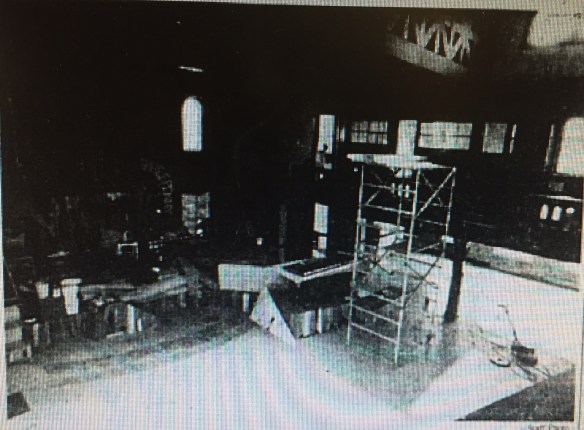
The building closed on July 1, 2014 with a ceremonial breaking of the stage flooring.  On July 1, 2015, the reconstruction “topping out” ceremony took place.  The ribbon cutting for the new structure will take place on November 10, 2016, at 10 a.m.

Creative Class 2016: Ruth Shepherd

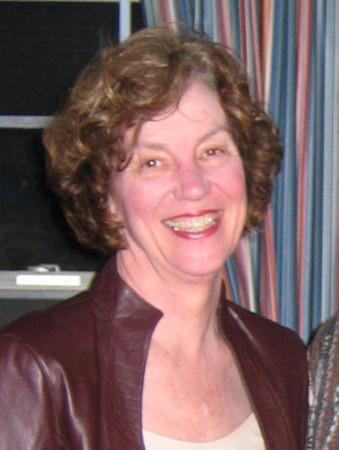
cc16-shepherdThough Arts & Humanities Month ended yesterday, today is a bonus for the Creative Class 2016.  Ruth D. Shepherd has spent her career utilizing the arts and creativity to spread joy, messages of hope, and to change hearts and minds.

She is “retiring” later this year after having served as Director of Just Communities of Arkansas since 2000.  Though she will leave that post, her work in Little Rock and Arkansas will continue.

In her other careers, she has been a school teacher and worked in various non-profits.  She is probably most closely identified with the Arkansas Repertory Theatre having served as a volunteer, staff member, and Board member off and on for most of its 40 years of existence.  She has also served as Tabriz co-chair for the Arkansas Arts Center.

Ruth has graced several Little Rock stages including UALR (where she was in Hair), Community Theatre of Little Rock, the Weekend Theatre, and the Phoenix Theatre among others.  The Culture Vulture’s favorite performance was her riveting portrayal of a frustrated and frustrating matriarch in Edward Albee’s Three Tall Women.

While wrapping up her current role with JCA, she is busy putting the finishing touches on next Sunday’s Walk for CommUNITY.  It is not too late to sign up.  For more information on that and other JCA projects and programs, visit their website.