Mozart’s THE MAGIC FLUTE brings opera back to LR in joint venture of ASO and Opera in the Rock

680 Magic Flute LogoFully-staged, full-length opera returns to the Rock for the first time in over a decade tonight and tomorrow!

The Arkansas Symphony Orchestra, Philip Mann, Music Director and Conductor, in partnership with Opera In The Rock, opens the 2014-2015 Intimate Neighborhood Concerts series with Mozart’s Magic Flute. Performances are on Thursday, January 22nd and Friday January 23rd at 7 p.m. at the Albert Pike Masonic Center in downtown Little Rock.  Dancers from Arkansas Festival Ballet also appear in the performances which is stage directed by Robert Hupp, Producing Artistic Director of the Arkansas Repertory Theatre.

The opera is filled with symbolism, especially focused on the number three.  Examples include the opening with Der Dreimalige Akkord, the thrice-repeated chord, three Ladies, three Spirits, and even the selection of key: E-flat major in three flats.

Die Zauberflöte (The Magic Flute) was written during the last year of Mozart’s life (1791). The opera was composed in the style of Singspiel (using sung and spoken text) and was an outlet for Mozart’s Masonic belief.

Magic Flute was an immediate success, performed over 100 times in the first two years of its existence. Mozart was not alive to see the 100th performance, having died only months after the premiere.

Tickets are $25; active duty military and student tickets are $10 are can be purchased online ; at the Albert Pike Masonic Center beginning 60 minutes prior to the concert; or by phone at 501-666-1761, ext. 100.  The Friday performance is sold out, but tickets remain for tonight’s opening.

CAST
Dana Pundt, Queen of the Night
Nicholas Nelson, Sarastro
Darren Drone, Papageno
Genevieve West Fulks, Papagena
Vernon DiCarlo, Tamino
Bonnie Frauenthal, Pamina

Others in the cast include Maria Fasciano DiCarlo, Stephanie Smittle, Kelley Ponder, Daniel Foltz-Morrison, Suzanne Banister, Kathryne Overturf, Satia Spencer, Robert Holden, Luke Frauenthal, Chase Burns and Sam Prescott

CHORUS
Sopranos: Alisa Dixon, Hayley Coughlin, Margaret McMurray, LaSheena Gordon
Altos: Claire Wilkinson, Melissa Wilcox, Sarah Blakey
Tenors: Adam Baldwin, Aaron Baker, Jonathan Treloggen, Josiah Wheeler, Sage Shaddox
Basses: J.J. Albrecht, Luke Frauenthal

PROGRAM
MOZART: Die Zauberflöte, K. 620 (text by Ruth and Thomas Martin)

About the Arkansas Symphony Orchestra
The Arkansas Symphony Orchestra celebrates its 49th season in 2014-2015, under the leadership of Music Director Philip Mann. ASO is the resident orchestra of Robinson Center Music Hall, and performs more than sixty concerts each year for more than 165,000 people through its Stella Boyle Smith Masterworks Series, ACXIOM Pops LIVE! Series, River Rhapsodies Chamber Music Series, and numerous concerts performed around the state of Arkansas, in addition to serving central Arkansas through numerous community outreach programs and bringing live symphonic music education to over 26,000 school children and over 200 schools.

Opera In The Rock
Opera in the Rock is 501(c)3 professional opera company that was formed in the spring of 2012. Our mission is to enrich the cultural life of Arkansas through opera by utilizing local, state and regional talents. Our purpose is to produce main stage opera and a continuing opera review series, in addition to providing educational and outreach programs for our community youth through the Jennifer Boccarossa Young Artist Program. Our goal is to provide local, state and regional talents an opportunity to further their artistic careers. Opera In The Rock is partially funded by the Arkansas Arts Council, an agency of the Department of Arkansas Heritage.

THE WHIPPING MAN at Arkansas Rep is focus of Clinton School lunchtime conversation

THEREP_THE WHIPPINGMAN (no credits)-page-001The Arkansas Repertory Theatre works in partnership with the Clinton School of Public Service to participate in the UACS’s Distinguished Speaker Series, hosting educational panel discussions on various Rep productions.

The latest in these takes place today, Thursday, January 22 at 12 noon at Sturgis Hall in Clinton Presidential Park.  It focuses on the Rep’s upcoming production of Matthew Lopez’s The Whipping Man.

Arkansas Repertory Theatre producing artistic director, Bob Hupp, will host a panel discussion on the upcoming production of The Whipping Man, winner of the 2011 John Gassner New Play Award from the NY Outer Critics Circle and becoming one of the most produced plays in the country.

In this post-Civil War drama, a Jewish confederate officer, Caleb DeLeon, returns from the war, badly wounded, to find his family missing and only two former slaves remaining, Simon and John, the two men who are forced to care for him. As Caleb, Simon and John wait for the family’s return, they wrestle with their shared past as master and slave, digging up long-buried family secrets, as well as new ones. The Whipping Man is critically acclaimed drama full of loyalty, deceit, and deliverance.

Join members of the production team as they discuss this chilling play selected for the Halloween season.

The Whipping Man opens officially on Friday evening and runs through Sunday, February 8.

LR Look Back: HAIR flows at Robinson Auditorium

Ad for the original production of HAIR in Little Rock. Note the ticket prices. And that they could be purchased at Moses Music Shops.

Ad for the original production of HAIR in Little Rock. Note the ticket prices. And that they could be purchased at Moses Music Shops.

Forty-three years ago today, on January 18, 1972, the musical Hair settled in for a week-long run at Robinson Auditorium.  The saga to bring the national tour to Little Rock had actually begun eleven months earlier.

In February 1971, a young Little Rock attorney named Phil Kaplan petitioned the Little Rock Board of Censors to see if it would allow a production of Hair to play in the city. He was asking on behalf of a client who was interested in bringing a national tour to Arkansas’ capital city. The show, which had opened on Broadway to great acclaim in April 1968 after an Off Broadway run in 1967, was known for containing a nude scene as well for a script which was fairly liberally sprinkled with four-letter words. The Censors stated they could not offer an opinion without having seen a production.

By July 1971, Kaplan and his client (who by then had been identified as local promoter Jim Porter and his company Southwest Productions) were seeking permission for a January 1972 booking of Hair from the City’s Auditorium Commission which was charged with overseeing operations at Robinson Auditorium. At its July meeting, the Commissioners voted against allowing Hair because of its “brief nude scene” and “bawdy language.”

Kaplan decried the decision. He stated that the body couldn’t “sit in censorship of legitimate theatrical productions.” He noted courts had held that Hair could be produced and that the Auditorium Commission, as an agent for the State, “clearly can’t exercise prior censorship.” He proffered that if the production was obscene it would be a matter for law enforcement not the Auditorium Commission.

The Commission countered that they had an opinion from City Attorney Joseph Kemp stating they had the authority. One of the Commissioners, Mrs. Grady Miller (sister-in-law of the building’s namesake the late Senator Robinson, she had served on the Commission since 1940), expressed her concern that allowing Hair would open the door to other productions such as Oh! Calcutta!

On July 26, 1971, Southwest Productions filed suit against the Auditorium Commission. Four days later there was a hearing before federal Judge G. Thomas Eisele. At that hearing, Auditorium Commission member Lee Rogers read aloud excerpts from the script he found objectionable. Under questioning from Kaplan, a recent touring production of Neil Simon’s Plaza Suite was discussed. That play has adultery as a central theme of one of its acts. Rogers admitted he found the play funny, and that since the adultery did not take place on stage, he did not object to it. Among those testifying in favor of it was Robert Reddington, who was director of performing arts at the Arkansas Arts Center.

Judge Eisele offered a ruling on August 11 which compelled the Auditorium Commission to allow Hair to be performed. Prior to the ruling, some of the Auditorium Commissioners had publicly stated that if they had to allow Hair, they would close it after the first performance on the grounds of obscenity. To combat this, Judge Eisele stated that the Commission had to allow Hair to perform the entire six day engagement it sought.

Upon hearing of the Judge’s ruling, Commissioner Miller offered a succinct, two word response. “Oh, Dear!”

In the end, the production of Hair at Robinson would not be the first performance in the state.  The tour came through Fayetteville for two performances in October 1971 at Barnhill Arena.

On January 18, 1972, Hair played the first of its 8 performances over 6 days at Robinson Auditorium.  In his review the next day, the Arkansas Gazette’s Bill Lewis noted that Hair “threw out all it had to offer” and that Little Rock had survived.

The ads promoting the production carried the tagline “Arkansas will never be the same.”  Tickets (from $2 all the way up to $8.50) could be purchased at Moses Melody Shops both downtown and in “The Mall” (meaning Park Plaza). That business is gone from downtown, but the scion of that family, Jimmy Moses, is actively involved in building downtown through countless projects. His sons are carrying on the family tradition too.

Little Rock was by no means unique in trying to stop productions of Hair.  St. Louis, Birmingham, Los Angeles, Tallahassee, Boston, Atlanta, Charlotte NC, West Palm Beach, Oklahoma City, Mobile and Chattanooga all tried unsuccessfully to stop performances in their public auditoriums.  Despite Judge Eisele’s ruling against the City of Little Rock, members of the Fort Smith City Council also tried to stop a production later in 1972 in that city. This was despite warnings from City staff that there was not legal standing.

Within a few years, the Board of Censors of the City of Little Rock would be dissolved (as similar bodies also were disappearing across the US). Likewise, the Auditorium Commission was discontinued before Hair even opened with its duties being taken over by the Advertising and Promotion Commission and the Convention & Visitors Bureau staff.  This was not connected to the Hair decision; it was, instead, related to expanding convention facilities in Robinson and the new adjacent hotel.  Regardless of the reasons for their demise, both bygone bodies were vestiges of earlier, simpler and differently focused days in Little Rock.

Next at Weekend Theater – Sartre’s NO EXIT

No Exit at The Weekend Theater in Little Rock, ARJean-Paul Sartre’s existential World Ward II era play No Exit is the next offering at the Weekend Theatre.
If you’ve asked the question, “Why am I here?” or “What is my purpose?” then this play is for you. Sartre attempts to answer the age old question, “What happens after life?” in his New York Drama Critics Circle winning play, No Exit.

Imagine yourself in a room with two people whom you’ve never met. There is no darkness, only light. Each of your thoughts and actions affect the other. You reflect on the past while seeing the present in a world you are no longer a part. Is this Heaven or Hell? You decide. Come see how three souls deal with the afterlife and each other in this dark dramedy.No Exit

This production is from a script adapted from French by Paul Bowles.  Directed by Tommie Tinker, the play runs Friday and Saturday at 7:30pm through January 31.  There may not be an exit in the play, but the production will exit with the month of January.

Tickets are $16 for adults and $12 for students & seniors.  Tonight (January 17) is “Roll-Back Saturday Night” with a $2 discount from the regular price.

The cast includes Kayla Esmond, Claudia Moskova-Cremeens, Jacob Sturgeon and Brittany Cook.


THE LAST FIVE YEARS for 5 performances only at the Studio Theatre

last-five-years-musical-54There are always at least two sides to every story.  In Jason Robert Brown’s musical The Last Five Years, the audience get the “his” and “her” perspectives of a relationship. But there is a twist. One is told forwards, while one is told backwards with the characters meeting in the middle.  It is a funny, charming, heartwarming, heartbreaking look at life, love and loss.  Jamie is a rising novelist and Cathy is a struggling actress.  The challenges of their two careers add a layer to the complexities of their relationship.

The Studio Theatre is presenting this two character musical January 16, 17, 23, 24 & 25.  The Friday and Saturday performances are at 7pm and the Sunday performance starts at 2pm.

Ryan Whitfield directed Jeremy Hall and Erin Martinez in the production. Mark Binns in the musical director.

The Studio Theatre is connected to the Lobby Bar which provides opportunities for libations (beer, wine and non-alocholic) before the show, at intermission and after the show.

Robinson Center Redux- January

WAVW LR Jan65Since Robinson Center Music Hall is closed for renovations and restoration, this year the Culture Vulture will take a monthly look back at some of the featured attractions which have played there.  This month looks at January of years ending in “0” and “5.”

As noted earlier on the blog, even before the February 1940 opening of the music hall, the lover level exhibition hall was playing host to events including basketball games.

By 1945, things were well underway on both levels. Buddy Johnson & his Orchestra were playing a dance for African Americans in the lower level on January 10. Upstairs events ranged from a lecture on Christian Science (January 7), a play Good Night Ladies (January 17), a lecture by Dr. Emil Ludwig on Germany after World War II, and Paul Draper & Larry Adler in concert (January 23).

In 1950, Tallulah Bankhead starred in a revival of Private Lives (January 13), a Passion Play booked it for over a week (January 21 – 28) and a double-header of Shakespeare plays held court on January 30. Margaret Webster’s Shakespeare Company played The Taming of the Shrew in the afternoon and Julius Caesar in the evening. Also that month the Arkansas State Symphony (a forerunner to today’s Arkansas Symphony Orchestra) gave a concert on the 17th.

A highlight of 1955 was a women’s wrestling match on January 4 in the lower level.

In 1960, two theatrical productions were presented. On January 8 & 9, Odd Man In was presented “pre-Broadway” (it didn’t make it). Much more successful was the national tour of My Fair Lady from January 18 through 23.

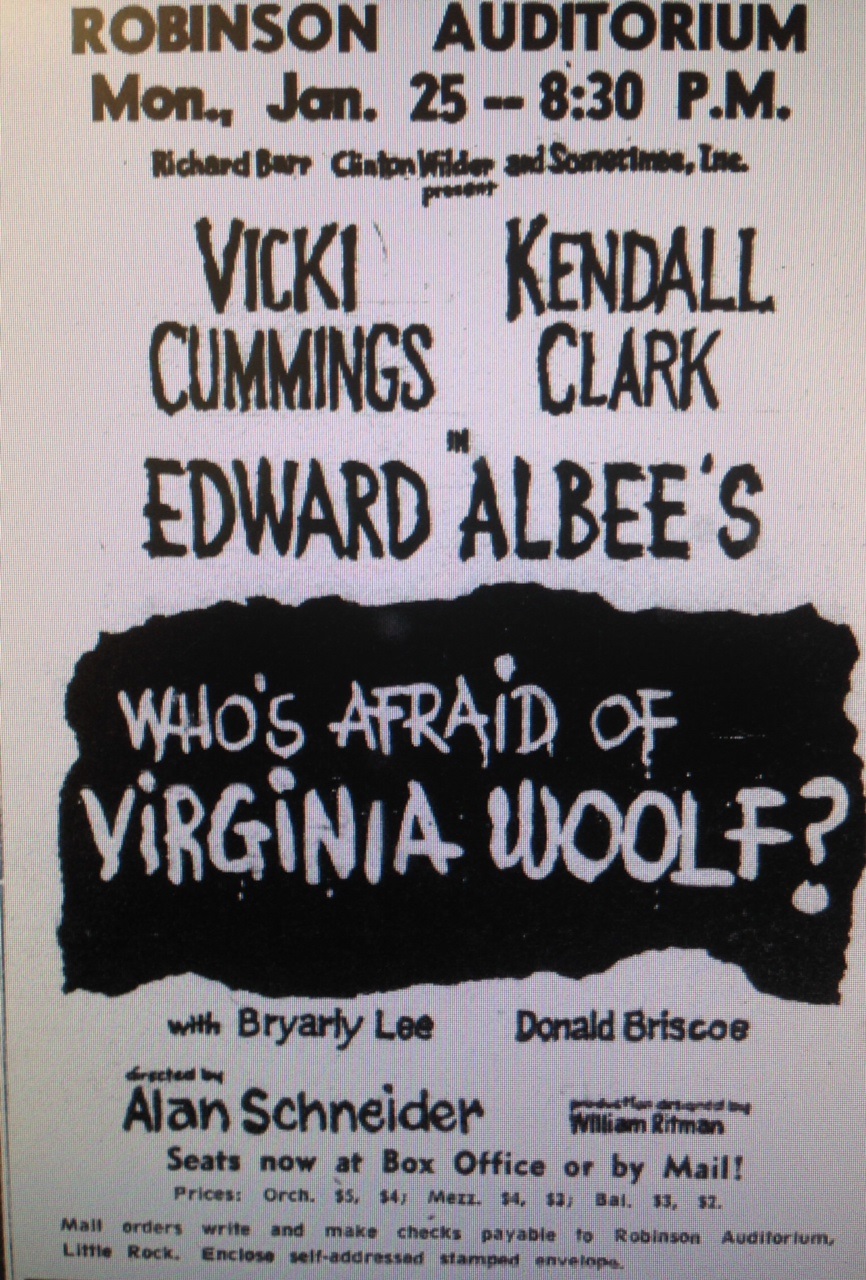
Though Little Rock native Ben Piazza had helped develop the play, he wasn’t in the cast when the national tour of Who’s Afraid of Virginia Woolf? played Robinson on Januayr 25, 1965.

By the late 1960s and early 1970s, Robinson was at a crossroads.  Many performers wanted to play at larger spaces (such as Barton Coliseum) or smaller venues (such as churches or the UALR recital hall).  In 1970, the Happy Goodman Family gave a concert on January 21.  Five years later they returned on January 10, 1975 in a concert with Vestel Goodman. The next night, Johnny Paycheck was in concert.  On January 21, 1975, Robert Alda headlined a tour of The Sunshine Boys.

Orchestra concerts dominated most January offerings from 1980 onward.  On January 27, 1980, the Pittsburgh Symphony Orchestra gave a concert at Robinson. In 1985, the Arkansas Symphony Orchestra presented concerts (January 19 & 20) with Misha Dichter, pianist.  January 1990 saw the ASO with Stephen Burns, trumpet on January 20 & 21.

In 1995, the ASO performed Rimsky-Korskaov’s Scheherazade on January 13 & 14.  Composer, pianist and conductor Marvin Hamlisch highlighted a concert with the ASO on January 22 in 2000. Earlier in the month the ASO performed Der Freischatz on the 15 & 16th.  The day before Hamlisch, the Martins were in concert.

2005 highlights included the ASO with Elmer Oliveira, violinist (Jan 15 & 16), the ASO Side by Side concert (where Arkansas Symphony Youth Orchestra musicians and ASO musicians perform together) on January 29 and the ASO Family Series: Secrets of the Orchestra on January 30.  The Irish dance spectacular Riverdance played Robinson from January 17 through 19.

Five years ago, Ron “Tater Salad” White performed his stand-up at Robinson on January 8, 2010. Later that month the ASO offered Edvard Grieg’s Piano Concerto on January 16 & 17. The 2010 ASO Side by Side concert was on January 30.  On January 20 the Shen Yun Chinese cultural performance took place in Robinson.

Remembering 14 Cultural Figures from 2014

Little Rock lost several cultural luminaries in 2014. Some were practitioners, others were volunteers and donors.  All were passionate about the role the arts and culture play in not only everyday lives, but in making a city great.

While there are doubtless omissions to this list, these 14 are representative of the loss in 2014 but also the rich cultural legacy of the Little Rock area. They are presented in alphabetical order.

1414mayaThough never a Little Rock resident, Maya Angelou is linked to the City’s cultural life. Throughout her career, she would make appearances in Little Rock at a variety of venues. As an actress, dancer, poet and professor, she lived life to the fullest and encouraged others to do likewise.

1414jeffbJeff Baskin was more than a librarian in North Little Rock. He was a religious scholar, an actor, and an appreciator of many art forms. He was a regular fixture at cultural events on both sides of the Arkansas River. With his sly smile and quick wit, he put others at ease. His charm was disarming and his circle of friends was boundless.

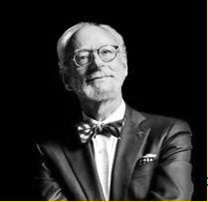
1414BowenAttorney, banker, historian, author, Dean, advisor, raconteur. This was Bill Bowen. And so much more.  He helped build Little Rock and Arkansas into modern entities. As such, he realized the value of arts and culture to the big picture.  He was not only generous with money, he was generous with wise advice.

1414tcT.C. Edwards was far more than the lead singer of TC and The Eddies, TC and The Ponies and The Piranhas. One of the most familiar faces in the Little Rock music scene over the last 25 years, he was an icon. Much more could be said about him, but he’d prefer the music just keep playing.

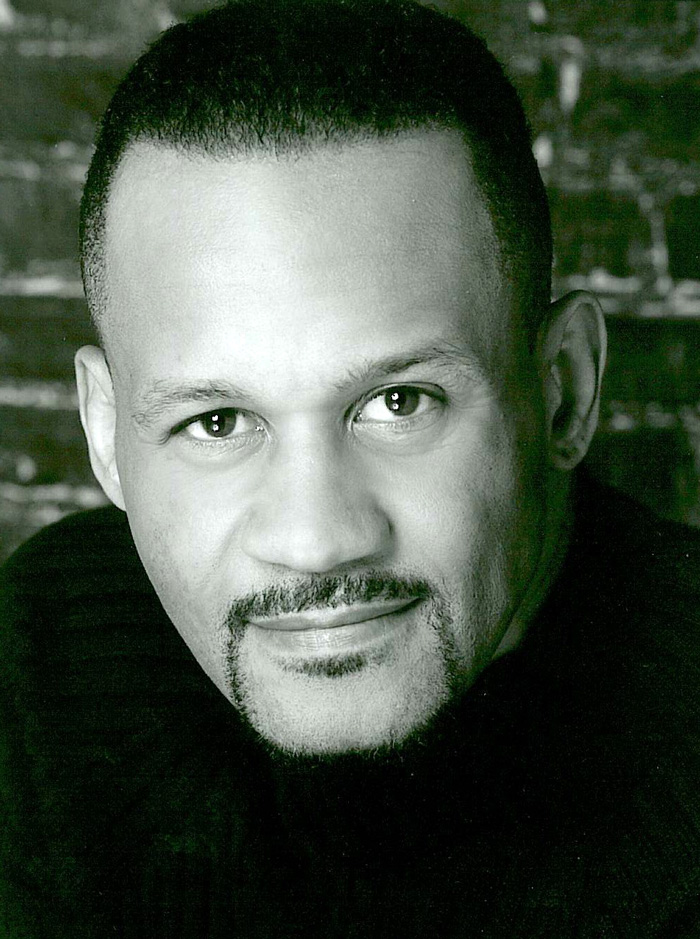
1414lawrenceBroadway star Lawrence Hamilton. After conquering the Great White Way, he conquered the Rock. Whether with the Philander Smith College Choir, the Arkansas Rep, Arkansas Symphony, surprising Governor Beebe, or at an event, Lawrence was a consummate performer and warm and welcoming individual.

1414anneAnne Hickman was ever-present at the Arkansas Arts Center. For over forty years she gave time and money to make sure this museum could fulfill its mission. Her generous smile and ebullience were also part and parcel of many Arts Center events. In recognition of her dedication, she received the Arts Center’s Winthrop Rockefeller Award in 2008.

1414geraldGerald Johnson was a tenor saxophone player and Little Rock music scene mainstay. Whether headlining a concert or as a side man in a recording session, he brought the same level of cool excellence to his playing. He also mentored younger musicians and worked to instill love of music in many generations.

1414warrenWarren Law lit up Little Rock. For nearly three decades he was lighting designer and a teacher at UALR.  He designed the lighting for many Ballet Arkansas, Murry’s Dinner Playhouse and Arkansas Arts Center productions as well. At the time of his death, he was the lighting designer for Robinson Auditorium and the Little Rock School District.

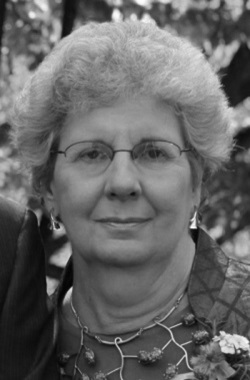
1414barbaraBarbara Patty was a force of nature, especially when it came to support of music and art. As a singer, master gardener at museums, Arkansas Symphony Orchestra volunteer and board member, Arts Center docent, Aesthetic Club president, and general lover of the arts, she not only enjoyed the arts, she was a mentor and encourager of arts patrons and practitioners.

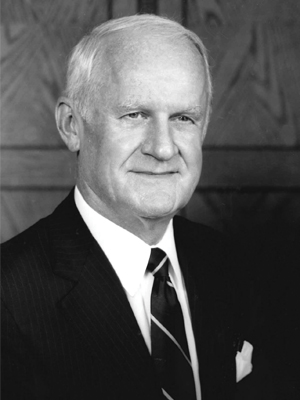
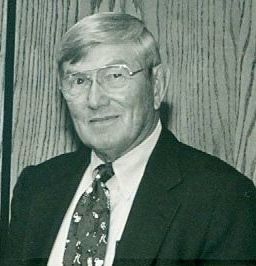
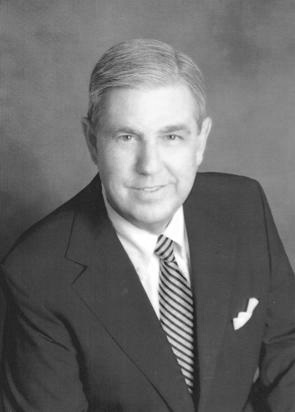
1414pennickBanker Edward M. Penick served on the Arkansas Arts Center Board of Trustees.  As a longtime leader at Worthen Bank, he was instrumental in helping establish many nascent cultural institutions such as the Arts Center, Arkansas Symphony and Arkansas Rep as they were getting established in the 1960s and 1970s.

1414TTheresa Quick, or “T,” was a founding member of the Arkansas Rep. She spent over three decades on stage as an actress. She also was a teacher and mentor.  In addition to usually stealing the show when she appeared at the Rep, she shone at Murry’s, the Arts Center and countless radio commercials.

1414kayKay Terry Spencer enjoyed being on stage, but also enjoyed volunteering to make sure others had the opportunities to shine in their artistic talents. After moving to Little Rock, she spent countless hours as a volunteer at the Arkansas Arts Center, Arkansas Symphony Orchestra and with the Fine Arts Club.

1414billTBill Trice. That name is synonymous with the arts in Little Rock. He was an actor, director, dancer, singer, teacher, student and mentor. From small blackboxes to large halls, bars to churches, his smile and talents left their mark. He was an expert attorney too. And a lover of music (all types), politics (Democratic), and his exceptionally talented family.

1414pollyCaroline “Polly” Murphy Keller Winter embraced the arts as she embraced all aspects of life – fully and without reservation. She served as board chair for the Arkansas Symphony and established the ASO endowment, which continues to grow.  She was an active supporter of the arts in Little Rock, south Arkansas and other states.