2nd Friday Art Night – Doris Williamson Mapes retrospective at The Rep

Image may contain: mountain, cloud, sky, nature and textOne of the newer venues participating in 2nd Friday Art Night is the Arkansas Repertory Theatre.  While one thinks of The Rep as a performing arts venue (and it certainly is), the Rep has also long been a promoter of the visual arts.

Drop by The Rep and enjoy paintings by late Arkansas artist, Doris Williamson Mapes. Known for her brilliant use of color, Doris described herself as a mixed media artist, using watercolors, acrylic, pencil, ink, gouache, casein, pastel, crayons, etc.

She studied design and encaustic painting under Townsend Wolfe at the Arkansas Arts Center and advanced painting with Edwin Brewer in the Adrian Brewer Studio. In 1970, Mapes, along with four other artists, founded and incorporated the Mid-Southern Watercolorists (MSW) in Little Rock. Mapes was elected as the organization’s founding president and served until 1972.

Doris was a long-time supporter of The Rep. The collection hangs in her memory

3 Exhibits open on 2nd Friday Art Night at 1 Historic Arkansas Museum

Join Historic Arkansas Museum for a reception for the openings of “Flourish,” “Olivia Trimble: Ozark Comforts” and “Featured Focus from the Permanent Collection.” Tonya Leeks and Company will be the evening’s live entertainment. New Province Brewing Company will be the evening’s featured brewery.

The reception is sponsored by the Historic Arkansas Museum Foundation, with special thanks to 107 Liquor. Beverages and appetizers will be served in the Stella Boyle Smith Atrium. The exhibits and reception are free and open to the public.

• • •

“Flourish”
Jessica Mongeon and Cara Sullivan
Trinity Gallery, February 8 – April 7, 2019

Mongeon’s inspiration comes from the Ozark-St. Francis National Forest and Petit Jean State Park in Arkansas. She creates her paintings on stone paper, an eco-friendly tree-free material made of calcium carbonate and resin. She says, “I hope that by capturing the unique landscapes of these protected natural areas, I will have encouraged people to support policies which fund their protection and to oppose decisions which may threaten them.”

Sullivan’s recent paintings pay homage to the overgrowth. Her spray painted surfaces reserve attention for the cast-aways: the uncultivated blooms of common weeds. She says, “More than a nod to the lowly weed, these paintings are for me a meditation on the irreverent, persistent nature and joy of rebellion.”

“Olivia Trimble: Ozark Comforts”
Second Floor Gallery, February 8 – May 5, 2019

Olivia Trimble cares about her community, and she understands the power of words and images to lift people up or tear them down. Using the tools of a traditional sign painter, she aims to improve the urban landscape and positively impact the people of Northwest Arkansas. Trimble opened her business, Sleet City Signs, determined to recapture the excitement and individuality common to hand-painted signs of times past. The quilt square paintings she is now known for began as a simple craft project to produce a gift for a friend, but as she made more of them, the meaning of her painted quilts became more significant. Olivia appreciates the long history of quilting in Arkansas, and the many hours of hidden work contained within a completed quilt. She was invited to paint quilt squares at Crystal Bridges Museum of American Art for their American Made exhibit in 2016, and her work has appeared outside the Shiloh Museum of Ozark History, Perrodin Supply Co. in Springdale, and on many hand-painted signs around Northwest Arkansas.

“Featured Focus from the Permanent Collection”
Foyer of Cabe Gallery, Feb. 1 – 28, 2019

In honor of Black History Month, the Cabe Gallery foyer will display a selection of contemporary fine art by influential African American Arkansas artists during the month of February. The focused look includes an iconic delta landscape by Henri Linton, Larry Wade Hampton’s impressionistic scene of daily life, a country church by Glenda McCune and the delicate silverpoint realism of a Marjorie Williams-Smith still life.

This weekend at the Clinton Center – Fusion 2019: Arts+Humanities Arkansas looks at “The Mighty Mississippi: A Mosaic of America’s Growth”

Fusion: Arts + Humanities Arkansas The third edition of FUSION: Arts + Humanities Arkansas takes place on February 10 and 11 at the Clinton Presidential Center.

There is a Fusion public symposium, The Mighty Mississippi: A Mosaic of America’s Growth, on Sunday, February 10, at 5:30 p.m. The program will include a keynote address featuring nationally-recognized photographer, filmmaker, and folklorist Tom Rankin; a Delta Blues musical performance by Grammy Award-winning musician David Evans; and special performances by the Arkansas Symphony Youth Orchestra Jazz Ensemble and North Little Rock High School theater students.

While flowing more than 2,300 miles through ten states and defining eight state borders, the Mighty Mississippi River is an imperative physical aspect that continues to play an integral role in the shaping of our nation’s economics, politics, geography, and culture.

An accompanying exhibit will take you on a journey down the Mississippi River as you view dozens of artifacts and ephemera, including first editions of Mark Twain’s novels, The Prince and the Pauper and The Connecticut Yankee in King Arthur’s Court; original Norman Rockwell lithographs from Twain’s works; the Epiphone guitar and playing knife of Helena native and famed blues guitar player Cedell Davis; and more.

RSVP for the Fusion Public Symposium

Fusion: Arts + Humanities Arkansas
The Mighty Mississippi: A Mosaic of America’s Growth
Sunday, February 10, 2019
Doors Open: 5 p.m. | Program Begins: 5:30 p.m.

Reception and exhibit tours to follow the program
Clinton Presidential Center, Great Hall
Fusion 2019 is made possible because of the generous support of the Quapaw Tribe, Centennial Bank, and the Little Rock Port Authority.

Sign Up Now to Volunteer with LRSD’s Artistry in the Rock!

The Little Rock School District is hosting the 2019 Artistry in the Rock, a 4 day student showcase highlighting the creative and performing art talents of students K-12.

Volunteers are needed to work the front desk, student art gallery and performance area.

Artistry in the Rock will occur March 12-15 in the Hall of Industry located in the State Fairground complex off of Roosevelt.

There are two shifts each day, 9am-11am and 11am-1pm.

Sign Up to help with 2019 Artistry in the Rock

Lunar New Year – Year of the Pig

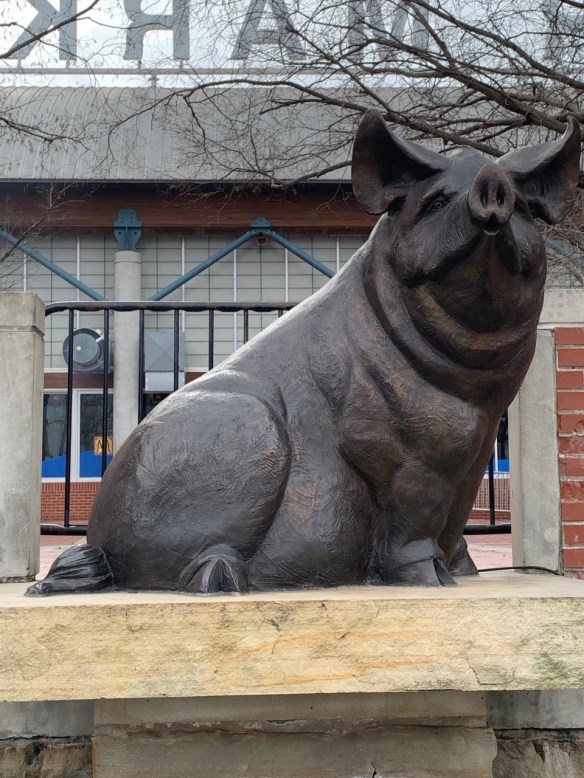
Today marks the start of the Lunar New Year. This year is the Year of the Pig!

To celebrate this, here is a photo of Sandy Scott’s River Market Pig.  It is located in Riverfront Park adjacent to the River Market pavilions.

River Market Pig was one of the initial six sculptures installed in the River Market area and dedicated in November 2004 on the Sunday prior to the opening of the Clinton Library.


Photographing Frida: Portraits of Frida Kahlo/Fotografiando Frida: Retratos de Frida Kahlo exhibit at Arkansas Arts Center from Feb 1 to April 14

Nickolas Muray, American (Szeged, Hungary, 1892 – 1965, New York, New York), Frida Kahlo on White Bench, New York (2nd Edition), 1939, color carbon print, 19 x 14 ½ inches. Courtesy of Throckmorton Fine Art, New York, New York.

The Arkansas Arts Center presents a rare opportunity to see one of Mexico’s greatest painters captured by some of the 20th century’s most important photographers. 

Photographing Frida: Portraits of Frida Kahlo/ Fotografiando Frida: Retratos de Frida Kahlo will be on view at the Arkansas Arts Center through April 14, 2019.

Photographing Frida: Portraits of Frida Kahlo features 65 images of Kahlo as art and artist. The photographs document Kahlo’s life as seen by the greatest photographers of the time – Lola and Manuel Álvarez Bravo, Imogen Cunningham, Emmy Lou Packard, Graciela Iturbide, Nickolas Muray, and Edward Weston, among others. From casual snapshots to intimate family photographs to artfully posed studio portraits, viewers will see the full spectrum of Kahlo’s life, from self-assured adolescent, to influential artist, fashion icon and passionate lover, as she takes on a mythic presence in our collective imagination.

In the hands of photojournalists, friends and artists, the camera allowed Kahlo to explore her own image and identity, document her marriage to the great muralist Diego Rivera, express her strong political views, and artfully reveal her life-long struggle to overcome her physical challenges. In the process, she ultimately defined the principal subject of her own art – herself.

Photographing Frida is an opportunity to see Frida Kahlo as you’ve never seen her before,” Chief Curator Brian J. Lang said. “These images defined not only the way the world saw her – and continues to see her – but how she saw and depicted herself through her own work.”

Frida Kahlo was born in Coyoacán, Mexico City, Mexico in 1907. Her father, Guillermo Kahlo, was a photographer, and often photographed the young Frida. Through her father’s portraits, she became acquainted with the power of her own image.

In 1929, Kahlo married muralist Diego Rivera. Throughout their tumultuous marriage, the couple was often photographed together, both in Mexico and in the United States. Rivera was a major presence, both in Kahlo’s life and in the photographs that document their life. As they traveled through Mexico and the United States, “Frida and Diego” – as they were affectionately known – became a source of fascination and intrigue for the paparazzi: Kahlo, stunning in her Tehuana dresses, beribboned hair and beaded jewelry, accompanied her famous muralist husband. Photos of their second wedding (the couple divorced in 1939, only to remarry a year later) in California were captured by American press photographers.

The exhibition reveals Kahlo’s fascination with fashion – as self-expression, political expression, and a means for concealing her physical disabilities. She was often photographed wearing traditional Mexican clothing – Tehuana dresses, huipils and rebozos, and beaded jewelry. Under the voluminous skirts and flowing dresses, she was able to hide the injuries that had affected her since youth. The pre-Hispanic clothing she was so fond of allowed her to express her belief in mexicanidad – the nationalist movement that found its inspiration in pre-Columbian Mexico after the end of the Mexican Revolution.

Kahlo continued to be photographed until her death in 1954. To each photographer she encountered, she became something new – ever present and continually beguiling – but made different through their lens. In the process, she herself became a work of art.

Photographing Frida features images by Lola Álvarez Bravo, Manuel Álvarez Bravo, Florence Arquin, Lucienne Bloch, Imogen Cunningham, Gisèle Freund, Hector Garcia, Juan Guzman, Graciela Iturbide, Peter Juley, Guillermo Kahlo, Bernice Kolko, Leo Matiz, Nickolas Muray, Emmy Lou Packard, Victor Reyes, Bernard Silberstein, Edward Weston and Guillermo Zamora. A fully-illustrated catalogue, Mirror, Mirror: Portraits of Frida Kahlo, featuring an essay by Salomon Grimberg, a noted authority on Latin American art, accompanies the exhibition.

Photographing Frida: Portraits of Frida Kahlo/Fotografiando Frida: Retratos de Frida Kahlo is organized by the Arkansas Arts Center in collaboration with Throckmorton Fine Art, New York, New York. The exhibition is sponsored by Bank of America; JC Thompson Trust; Judy Fletcher, In Memory of John R. Fletcher; Belinda Shults; Laura Sandage Harden and Lon Clark; Holleman & Associates, P.A.; Barbara House; and Rhonda and Tim Jordan. Additional support by Consulate of Mexico in Little Rock.

Little Rock Look Back: Installation of Lorri Acott’s PEACE Sculpture in 2015

On January 26, 2015, the City of Little Rock and Sculpture at the River Market installed Lorri Acott’s PEACE sculpture at the southeast corner of the intersection of Main Street and Second Street.

Peace was the winner of the 2014 Sculpture at the River Market Show and Sale public monument competition. The 12-feet-tall sculpture is made of bronze. It features a human figure standing with hands outstretched over its head. In between the hands is an arc made up of origami cranes.

The Sculpture at the River Market Committee commissioned the $60,000 sculpture and donated it to the City of Little Rock. “Peace” is made of bronze and features a long silhouette with colorful bronze origami cranes, known as symbols of peace and hope.

The sculpture design has won several accolades, including an “Art to Change the World” award from the American Civil Liberties Union and the 2014 World Citizens Artist Award from an international competition featuring art inspired the theme of peace.