2017 documentary DREAM LAND about Little Rock’s West 9th Street in its heyday as African American center and its legacy tonight

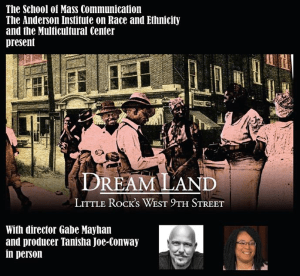
Tonight at 6pm at the Stella Boyle Smith Concert Hall the UA Little Rock School of Mass Communication, Anderson Institute on Race and Ethnicity, and Multicultural Center present the 2017 documentary DREAM LAND.

Little Rock’s West 9th Street was once a vibrant, African-American business and entertainment district. Taborian Hall is the only remaining historic structure on West 9th Street and stands as a living witness of the street’s former glory days. Throughout the 1920s and 1930s, Taborian Hall housed varied and important black businesses, including professional offices, a USO, the Gem Pharmacy and the Dreamland Ballroom. By the 1930s, Dreamland was firmly established as a stop on the “Chitlin Circuit,” which showcased regional and national African-American bands and stage shows. It was also host to local musicians, dances, socials, concerts and sporting events.

This documentary seeks to recognize, memorialize and share this history. The spirit and hard work of the people and the implications of federal programs such as Urban Renewal, school desegregation, the Housing Act of 1949 and the Eisenhower Interstate Program are explored. West 9th Street and the Dreamland Ballroom have patiently waited for their story to unfold so new audiences can connect to their historical past and unknown future.

Following the screening, director Gabe Mayan and producer Tanisha Joe-Conway will participate in a discussion.

Little Rock Look Back: First Elvis performance in LR

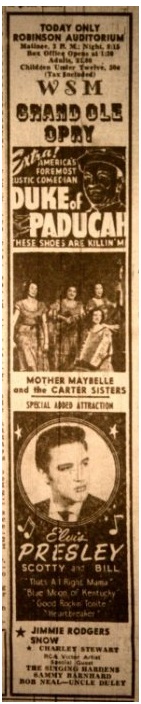
Sixty-four years ago today, on February 20, 1955, Elvis Presley made his first appearance on stage in Little Rock. He performed at Joseph Taylor Robinson Memorial Auditorium.

He was billed as “an added attraction” to a Grand Ole Opry Show headlined by the Duke of Paducah.  Others on the bill included Mother Maybelle and the Carter Sisters, Jimmie Rodgers Snow, Charlie Stewart, the Singing Hardens, Sammy Barnhart, Bob Neal, Uncle Dudley and Smilin’ Mac Cyclone. (It is interesting to note that at least some of the advance tickets billed it as The Elvis Presley Show, though the newspaper ads billed the Duke of Paducah as the headliner.)

This concert was part of a weeklong tour of Arkansas and Louisiana.  There were two shows that day – one at 3p.m. and the other at 8:15p.m.  Tickets on the day of the concert were $1.00 for adults and fifty cents for children.  Advanced tickets had sold for 75 cents at Walgreens.

The night before, Elvis played the Louisiana Hayride in Shreveport.  Following his Little Rock appearance (for which he and his band were paid $350 instead of their usual $200), they played in Camden, Hope, and Pine Bluff.

It is believed that Elvis’ parents attended this concert in Little Rock. Gladys Presley was a big fan of the Duke of Paducah. Elvis apparently also wanted his parents to meet with Colonel Tom Parker, who would become inexorably linked with Elvis’ career.

Warhol, Lichtenstein and More as Arkansas Arts Center opens POP! Out of the Vault exhibit

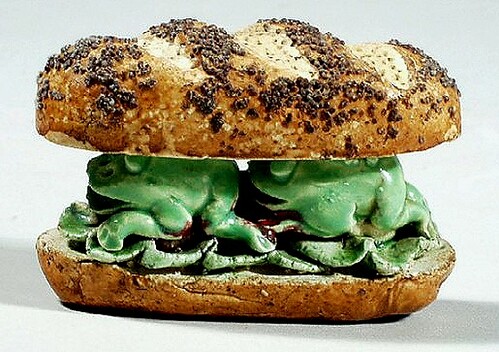
Mini Frog Sub

David Gilhooly, American (Auburn, California, 1943 – 2013, Newport, Oregon), Mini Frog Sub, 1980, hand-built, glazed low-fire whiteware, 2 ¼ x 1 3/8 inches, Arkansas Arts Center Foundation Collection: Gift from the Diane and Sandy Besser Collection, 1987.043.003.

POP! Out of the Vault, on view February 19 through July 7, 2019 at the Arkansas Arts Center, features more than 50 works from the Arkansas Arts Center Foundation Collection by some of Pop Art’s most influential figures, including Andy Warhol, Roy Lichtenstein, Claes Oldenburg, and Mel Ramos.

In 2013, the Arkansas Arts Center received a book of Polaroids by Andy Warhol as a gift from the Warhol Foundation. Throughout his career, Warhol was fascinated with Polaroids. In the 1970s, long before digital photography, these photographs that instantly developed themselves were a wonder – and very convenient for artists. The “Prince of Pop Art” made hundreds of Polaroids as sketches for his Pop Art portraits. The Arts Center’s 1975 Little Red Book #9 (Warhol produced hundreds of such books) features images of Easha McCleary. The Polaroids served as source material for a portfolio of prints related to a suite of 105 paintings, both titled Ladies and Gentlemen and commissioned by an Italian art dealer.

To show Warhol’s Polaroids of drag queens and transgender women of color in context, the curators of the Arkansas Arts Center went to the vaults in search work by of Warhol’s peers. They found a treasure trove of Pop Art and art from related movements.

POP! Out of the Vault will feature some rare examples of the first iterations of Pop Art, which arose in Britain in the 1950s. There, the artists of the Independent Group created collages that used American magazine pictures to mock the commercialism of contemporary life. Eduardo Paolozzi, a leading Independent Group artist, made collages, but also gathered popular imagery in prints, drawings, and sculptures like the Arts Center’s Triple Fuse.

In the early 1960s, young American artists created their own, independent version of Pop Art as they turned away from the hyper-expressive Abstract Expressionist works that had dominated American art through the 1940s and 1950s. Lichtenstein, Warhol, Oldenburg, and  Ramos were among the first American Pop artists. They shocked art critics by making fine art paintings and sculpture that appropriated mass-produced commercial images.

Lichtenstein used the colorful, hard-edged visual language of commercial art to reimagine a procession of different artistic subjects and movements from comic books to Cubism. Warhol mass-produced his paintings and prints of soup cans and celebrities using silkscreen – a process previously only used to print posters and packaging. Oldenburg turned the dignified tradition of monumental sculpture on its head with his giant hamburgers and clothes pins. Ramos, who was working in California while the others worked on the East Coast, appropriated images of Superman, Wonder Woman, and other heroes before he began creating his signature paintings pin-up advertising women and his sendups of famous art works.

At about the same time that American Pop artists were beginning their work, other artists found their own ways of reacting against Abstract Expressionism. In England, painter and printmaker Patrick Caulfield found an elegant modernist approach to every-day subject matter. Often referred to as a Pop artist, Caulfield abhorred the label. In California’s San Francisco Bay Area, an irreverent approach to art took the form of self-depreciating, ironic Funk Art. Funk artist David Gilhooly even founded his own ceramic amphibian-based planet – The FrogWorld.

POP! Out of the Vault is organized by the Arkansas Arts Center.

Rock the Oscars 2019: TRUE GRIT (both versions)

In 1969, Arkansan Charles Portis’ novel True Grit was made into a movie starring John Wayne and Arkansan Glen Campbell.  Kim Darby, Robert Duvall, Dennis Hopper, Jeff Corey and Strother Martin are also in the cast.
The movie was directed by Henry Hathaway, produced by Hal B. Wallis, and written by Marguerite Roberts.  Wilford Brimley and Jay Silverheels are uncredited actors in the movie.

Though set in Arkansas and Oklahoma, the movie was filmed in Colorado.  Elvis Presley was the first choice for the part Campbell would play. But when his manager demanded top billing (over Wayne), he was bypassed and the part went to Campbell.

The movie was nominated for two Oscars: Wayne for Best Actor and composer Elmer Bernstein and lyricist Don Black for the song “True Grit.”  The latter had been sung by Campbell in the movie.

Wayne won the Oscar that night, his only win.  He would reprise the character of Rooster Cogburn in the eponymously named sequel in 1975. This film, in which he co-starred with Katharine Hepburn, was his penultimate film.

In 1970, Campbell teamed up with Kim Darby again in a film written by Roberts based on a Portis book. This time it was Norwood.  It also starred Joe Namath, Carol Lynley, Meredith MacRae, and Dom DeLuise.  It did not repeat the success of the earlier Portis based movie.

In 2010, the Coen Brothers released a new version of Charles Portis’ True Grit.  Co-written and co-directed by Ethan and Joel Coen, it starred Jeff Bridges, Matt Damon, Hailee Steinfeld, Josh Brolin, Barry Pepper, Domhnall Gleeson and Elizabeth Marvel.  Unlike the original film, which was filmed in Colorado, this film was actually filmed partially in Arkansas, where  several scenes takes place.  Filming also took place in Texas.  Many Arkansas actors appeared in the film, but at the risk of omitting some, there will not be an attempt to name them.

The film received ten Oscar nominations: Best Picture, Adapted Screenplay, Directing, Leading Actor (Bridges), Supporting Actress (Steinfeld), Cinematography, Costume Design, Sound Mixing, Sound Editing, and Art Direction.  Sadly, the film went home empty handed.

THE PRINCESS BRIDE on the CALS Ron Robinson Theater screen tonight

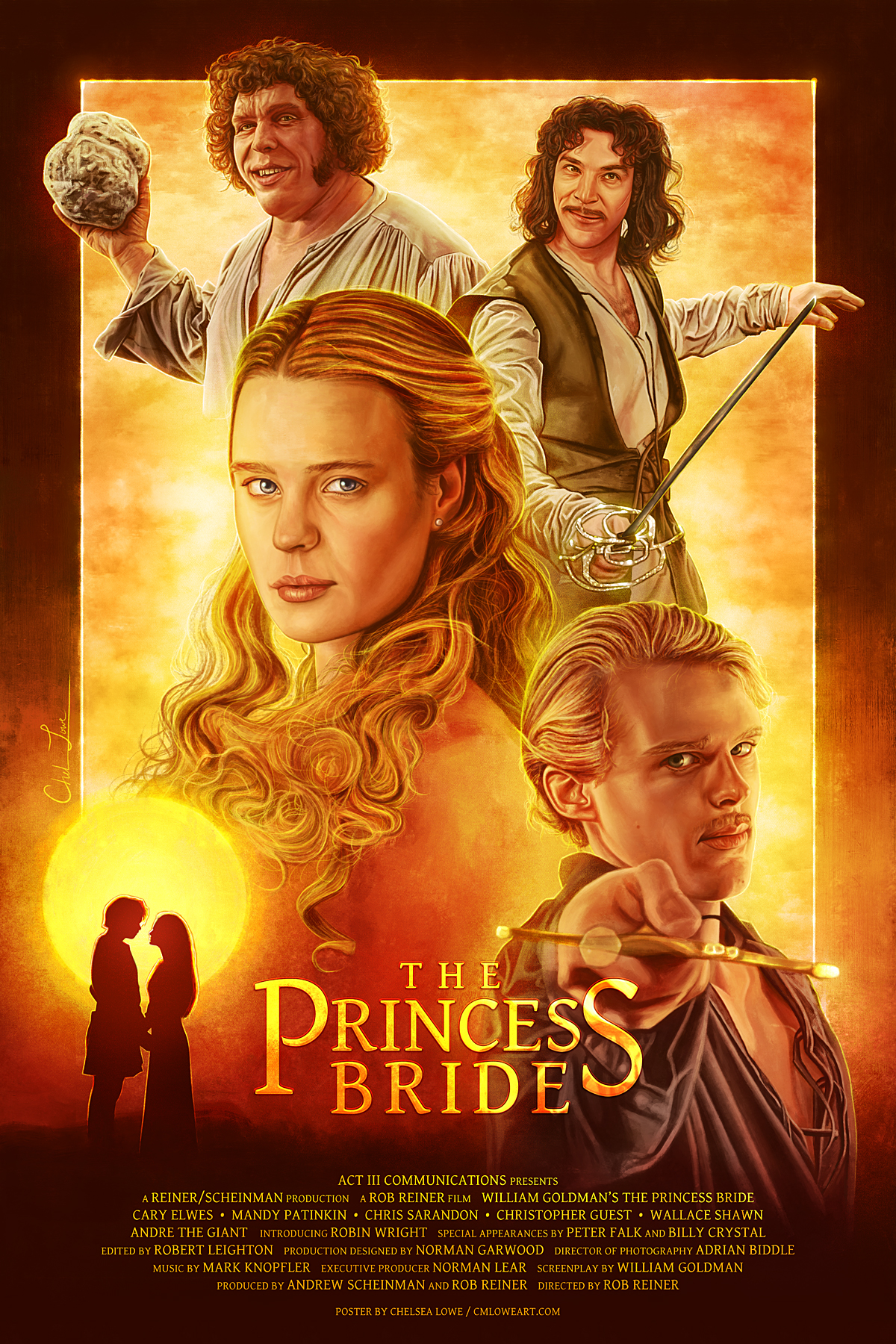
Image result for the princess brideAs part of their “Date Night Tuesdays” series, the CALS Ron Robinson Theater is showing the romantic action thriller comedy The Princess Bride. The fact that this film spans so many genres successfully is a reason for its endearing and enduring success.

Directed by Rob Reiner, this film tells William Goldman’s story of love and adventure.  A kindly grandfather sits down with his ill grandson and reads him a story. The story is one that has been passed down from father to son for generations.

As the grandfather reads the story, the action comes alive. The story is a classic tale of love and adventure as the beautiful Buttercup, engaged to the odious Prince Humperdinck, is kidnapped and held against her will in order to start a war, It is up to Westley (her childhood beau, now returned as the Dread Pirate Roberts) to save her. On the way he meets a thief and his hired helpers, an accomplished swordsman and a huge, super strong giant, both of whom become Westley’s companions in his quest.

Robin Wright, Cary Elwes, Mandy Patinkin, Chris Sarandon, Andre the Giant, Wallace Shawn, Christopher Guest, Billy Crystal, Carol Kane, Peter Cook, Peter Falk, and Fred Savage make up the main cast.  Surprisingly, the film’s only Oscar nomination was for “Best Song.”

The film starts at 7:00 pm.  Admission is $5.  Concessions are available for purchase.

Rock the Oscars 2019: John Lithgow

On February 18, 2008, two time Oscar nominee John Lithgow appeared in Little Rock before a packed house at the Statehouse Convention Center.  Sponsored by the Clinton School for Public Service speaker series, he spoke about the importance of the arts.  He also read from his children’s stories to the kids in attendance who he brought up to the front.
Actor, author and singer John Lithgow has appeared in more than 30 films, been nominated for two Oscars and had roles in numerous television shows. Perhaps his most celebrated work came as the loopy character of the alien High Commander, Dick Solomon, on the hit NBC comedy series “3rd Rock from the Sun.”

As an author, Lithgow has written seven New York Times best-selling children’s picture books, including “The Remarkable Farkle McBride,” “Marsupial Sue,” “Micawber,” and “I’m a Manatee.” A graduate of Harvard University, Lithgow helped to establish “Arts First,” a weeklong festival on campus dedicated to the arts, and the “Arts Medal,” given annually to a Harvard graduate for outstanding achievement in the arts.

As a New York Times best-selling author of children’s, Lithgow says he writes in order to educate children “without them knowing it” and labels himself “the perfect man for the job.” Lithgow calls for successful people who achieve their ambitious goals to ask, “What else can I do here?” and “How can I use my success to make things happen?”

His 2008 appearance can be viewed here.

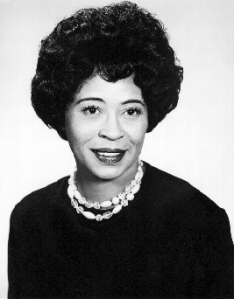
Remembering Daisy Bates

Today is the Daisy Bates Holiday in the State of Arkansas.  So it is an appropriate day to pay tribute to Mrs. Bates, who played a leading role in the Little Rock Integration Crisis of 1957.

Daisy Lee Gatson Bates and her husband were important figures in the African American community in the capital city of Little Rock.  Realizing her intense involvement and dedication to education and school integration, Daisy was the chosen agent after nine black students were selected to attend and integrate a Little Rock High School.  Bates guided and advised the nine students, known as the Little Rock Nine, when they enrolled in 1957 at Little Rock Central High School. President Clinton presented the Little Rock Nine with the Congressional Gold Medal and spoke at the 40th anniversary of the desegregation while he was in office.

When Mrs. Bates died, a memorial service was held at Robinson Center on April 27, 2000.  Among the speakers were President Bill Clinton, Secretary of Transportation Rodney Slater, and Rev. Rufus K. Young, pastor of the Bethel AME Church.  Others in attendance included Lt. Gov. Winthrop Paul Rockefeller, Mayor Jim Dailey, Presidential diarist Janis Kearney, former senator and governor David Pryor, and five members of the Little Rock Nine:  Carlotta Walls Lanier, Ernest Green, Minnijean Brown Trickey, Jefferson Thomas, and Elizabeth Eckford.

It was during his remarks at the service that President Clinton announced he had asked that Bates’ south-central Little Rock home be designated as a national historic landmark.