31 Days of Arkansas Rep: Charles Portis’ DELRAY’S NEW MOON in 1996

When you’ve written one of the great American novels of the second half of the 20th Century and seen it turned into an Oscar winning movie, what do you do next?  You continue writing.

And if you are Charles Portis, you decide in the 1990s to try your hand at a play.  So in 1996, the Arkansas Rep offered a staged reading of Portis’ play Delray’s New Moon. 

Directed by Rep Artistic Director Cliff Baker, it was set in a honky tonk hotel halfway between Little Rock and Texarkana. Most of the people there are senior citizens awaiting their next location whether it be a nursing home or a relative’s house.

The cast featured Scott Edmonds played a father being shuffled each month between his daughters played by Judy Trice and Natalie Canerday.  Others in the cast included Danielle Rosenthal, Jean Lind, John Stiritz, Michael Davis, Graham Gordy, Stacy Breeding, Angel Bailey, Rhonda Atwood and Tom Kagy.

The production ran from April 18 to 28.  The normally reclusive Portis participated in talkback sessions following performances.

30 Years of the City of Little Rock Flag

On October 18, 1988, the City of Little Rock Board of Directors adopted the first official flag for the City of Little Rock.

The adoption of Ordinance No. 15,566 was the culmination of a design competition which had been spearheaded by Little Rock City Director Sharon Priest (later Little Rock Mayor, Arkansas Secretary of State and Executive Director of the Downtown Little Rock Partnership).

Prior to the Official Board of Directors meeting that day, a press conference was held in the Little Rock City Board Chambers for presentation of the City’s flag.  The City Beautiful Commission, a commission of the Department of  Parks and Recreation, sponsored a the contest which received a total of fifteen flag designs.

The flags were judged October 12, 1988, by City Directors and City Beautiful Commission Members. Director Sharon Priest presented the winning flag and introduced David Wilson, a law clerk at the Mitchell Law Firm, who designed the flag chosen for the $1,000 first prize. The second-place winner was Craig Rains, who received $500; and the third-place recipient was David Tullis, who received $250.

The flag was adopted by the City Board that night by a 6-0 vote; former mayor and current director Charles Bussey was absent.  Those voting to adopt the flag were Mayor Lottie Shackelford and directors Sharon Priest, Tom Prince, Buddy Villines, Buddy Benafield and Tom Milton.  Priest would be a future mayor while Prince, Villines and Benafield had all served as mayor.

The official description of the flag is as follows:

As the official flag of the City of Little Rock, its symbolism is described as follows: A clean white background of the banner represents the optimism and open potential that the city has to offer. The royal blue horizontal broad stripe symbolizes the Arkansas River which borders Little Rock, and has served as an economical and historical emblem since the city’s beginning. The forest green stripe runs vertical to the royal blue stripe, creating a cross which symbolizes the location and statute of Little Rock—a city serving not only as the crossroads of Arkansas, but a crossroad of the mid-southern United States as well.

The strong forest green color depicts the fields, parks and forests which contribute to the natural beauty of the city. The seal of the flag is a modernized adaptation of the current Little Rock seal. The razorback red silhouette of the great State of Arkansas shows her capitol, the City of Little Rock, represented by the centered star. The star rises directly above “The Little Rock”—the protruding cliff along the Arkansas River, which was discovered in 1722 by French explorer La Harpe, when the city was given the name. The Arkansas River behind the rock and the symmetrical oak leaves in the border of the seal are a stylized illustration of what the flag’s stripes represent—the natural beauty of the city. Finally, the gold color of the seal and bordering stripes symbolize the superior economic history, and the future economic potential that is available in the City of Little Rock, Arkansas.

Little Rock Look Back: Little Rock named Capital of Arkansas

On October 18, 1820, Territorial Governor James Miller signed legislation designating Little Rock as the new capital for Arkansas.  This was a mere 10 months after the first permanent settlement was established in Little Rock.

While Little Rock became the Capital, technically it was not the Capital City, since it would not be incorporated as a City until 1835. It wasn’t even incorporated as a town until 1831.

The Act provided that after June 1, 1821, the sessions of the Legislature and the Superior Court would be held at Little Rock.  This caused Arkansas Post, the first territorial capital, to fade from prominence.

The move was made based on the lobbying of Amos Wheeler, Chester Ashley and William Russell.  These men all owned land in the Little Rock area and would benefit from the move of the Capital to Little Rock. The official reason given was Little Rock’s geographical center to the Arkansas Territory and that it was elevated land less prone to flooding.

But just as important, Messrs. Wheeler, Ashley and Russell promised to donate land for a capitol building and a guarantee of $20,000 for construction of a suitable building. (That would be the equivalent of $432,000 today.)

Around the time the legislation was approved, several members of the Territorial legislature purchased land around Little Rock.  When a subsequent effort to relocate the Capital upstream was launched, it failed due to the financial ties of these legislators to land in Little Rock.

31 Days of Arkansas Rep: ANGELS IN AMERICA (1996 and 1997)

In 1996, the Arkansas Rep presented Tony Kushner’s Angels in America: Millennium Approaches.  It was one of seven professional theatres granted the rights to do the show that season.  The production ran from February 29 to March 17 of that year.

Directed by Brad Mooy, the production came about due to lobbying of the Broadway producers by Rep Artistic Director Cliff Baker.  There was skepticism in New York as to how Little Rock audiences would respond. And, to be honest, there was skepticism in Little Rock, too.  But the rights were granted, and Little Rock embraced the play.

The next season, the Rep brought Part I back to be joined by Part II for the opportunity experience a theatrical marathon.  The Rep’s production was unprecedented in Little Rock. It was not just a rarity for the Rep, such an undertaking had never been done by any theatre in town.

Directed by Brad Mooy, the 1997 dual production required five weeks of rehearsals (more than the usual amount).  Six of the eight actors from the 1996 production returned for the second go around.

As it had been in 1996, the cast was led by Rep favorite Steve Wilkerson. Others in the cast were Caitlin Hart, Jo Anne Robinson, Jonathan Lamer, Jonna McElrath and Ray Ford. The two new additions were Christopher Swan and Ken Kramer.  They played the roles which Barry Stewart Mann and Fred Baker had played the prior year.

The design team included Mike Nichols (sets), Don Bolinger (costumes), David Neville (lighting), Melissa Wakefield (properties), Rob Milburn (sound), and ZFX Inc. (flying).

Little Rock Look Back: Final ARKANSAS GAZETTE Published

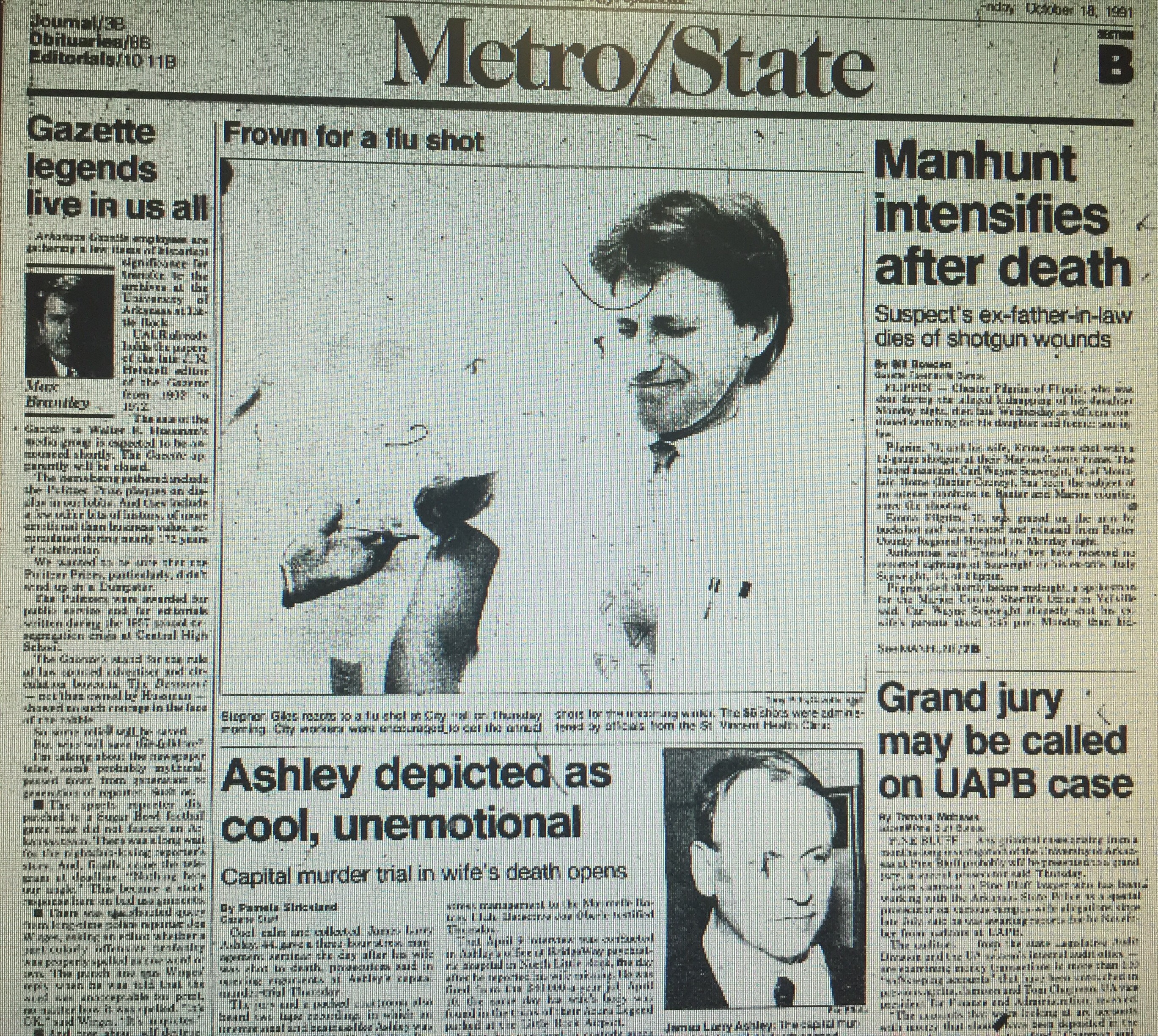
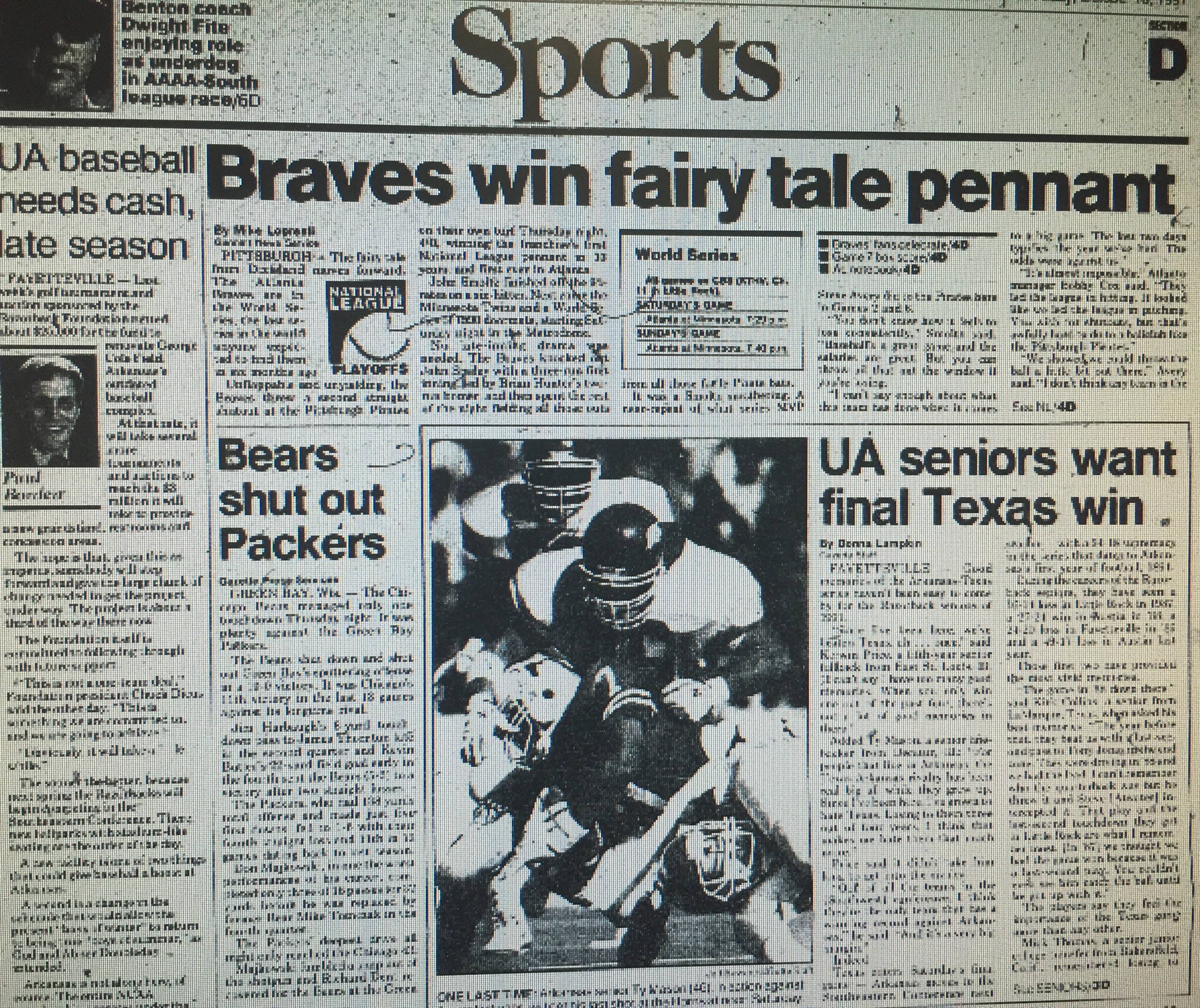
Twenty-seven years ago today, on October 18, 1991, the final edition of the Arkansas Gazette was delivered.

The front page featured a story on the demise of a Gazette employee effort to buy the paper.

Max Brantley’s column on the front page of the B section also addressed the then-eminent end of the paper. However, as a newspaper all of the sections spent most of their space on the news of the day. While Gazette staffers felt the end was likely near, few felt that the paper on October 18, 1991, would be the final edition.

The back page of the last section of the Gazette featured an ad for Premiere Pontiac Nissan Audi which was throwing a “Beat Texas” party featuring Craig O’Neill.  The Arkansas Razorbacks were scheduled to play the Texas Longhorns on Saturday, October 19.

Here are the top halves of the front pages of sections B, C, D, and E for the final Arkansas Gazette.  They tell the stories of trials, football games, corporate earnings, and cultural events.

Little Rock Port Authority seeks artist to create anniversary artwork

Project Intent
The Little Rock Port Authority is seeking Requests for Qualifications (RFQ) from an artist to create an original piece of artwork to celebrate the upcoming 60th anniversary of the establishment of the Little Rock Port Authority.

Artists working in a variety of media are encouraged to apply as long as their works fit in the parameters of this RFQ.  The artwork is envisioned to be a painting, approximately 4’ x 6’ that will be displayed in the offices of the Little Rock Port Authority. The size may be modified for artistic purposes.  It is also anticipated that the Little Rock Port Authority will produce approximately 150 smaller prints of the work to be signed and numbered by the artist to give out as a part of the anniversary celebration.

A $5,000 commission will be given to the artist chosen to create the work.

About the Little Rock Port Authority

The Little Rock Port Authority (LRPA) was created in 1959 to oversee the Port and provide intermodal transportation services connecting U.S. markets and the deep-water ports of the Gulf of Mexico. The Port of Little Rock is located approximately seven miles east of downtown along the banks of the Arkansas River.  All modes of transportation converge at the Port: water, rail, and motor freight, offering convenient intermodal shipping solutions. More than 40 businesses are active within the Port’s 3,000-acre industrial park. The Port is part of the 448-mile McClellan-Kerr Arkansas River Navigation System, which runs from the Mississippi River northwest to 15 miles east of Tulsa.

Mission Statement – “The mission of the Port of Little Rock is to drive economic development by providing a world-class transportation hub that connects Arkansas to the global economy”.

Vision Statement – “Little Rock Port Authority’s vision is to be America’s leading inland river port advancing Arkansas’ economic growth and job creation”.

Criteria for Selection
  • An initial proposal that reflects Project Intent as described in this document.
  • A body of work reflecting artistic excellence.
  • Experience working in public settings and public process
  • Previous experience with meeting time schedules and budget parameters
  • References provided as part of this application which will be contacted prior to final selection.
  • The Little Rock Port Authority is committed to reflecting the diversity and cultural richness of the City of Little Rock in our selection process.

 
Eligibility
The project is open to all artists, regardless of race, color, religion, national origin, gender, age, military status, sexual orientation, marital status or physical or mental disability.

Time Line
The Little Rock Port Authority reserves the right to change the project time line.

October 2018                        Request for Qualifications (RFQ) due and accepted

November 2018                    Selection Committee meets to review RFQs and choose finalists

November 2018                    Finalists interviewed if appropriate; artist selected

December 2018                    Contract agreement prepared and submitted for Port Authority Board approval

January 2019                       Notice to Proceed issued

May 2019                             Project completed and installed

How to Apply

Artists interested in this project shall prepare and submit the following as a part of the requests for qualifications:

  • Proposed Artwork Concept: This proposal shall include conceptual design drawings or sketches sufficient to communicate the artist concept.
  • Letter of Interest, no more than one page in length, which explains your interest in the competition. your name and contact information.
  • Artist’s Statement, no more than 200 words in length, describing your work.
  • Current Resume. If submitting as a team, an individual resume should be submitted for each team member.
  • A list of at least three professional references familiar with your work and working methods. The list must include complete addresses and telephone numbers.
  • Work samples on CD or DVD of your work. Artists applying as a team should submit work samples of each individual artist’s work.

Submittal:

To be considered, four copies of the proposal shall be received by the date and time set and noted herein.  It shall be packaged in such a manner that the sealed, envelope clearly reflects the project name and the applicant’s name and address.  All materials submitted become the property of the Little Rock Port Authority and will not be returned unless a self-addressed and stamped envelope, with sufficient postage, is provided.  The Little Rock Port Authority will make every effort to protect submitted materials; however, it will not be responsible for any loss or damage.  Submit proposals to:

Bryan Day
Little Rock Port Authority
10600 Industrial Harbor Drive
Little Rock, AR 72206
501-490-1468

The Little Rock Port Authority reserves the right to reject any and all applications.

All Proposals must be submitted by October 31, 2018 at noon.

For additional information, please contact Bryan Day at 501-490-1468.

31 Days of Arkansas Rep: 1995’s THE RAINMAKER

N. Richard Nash’s romantic drama with comedy, The Rainmaker took over the Arkansas Rep stage in January and February 1995. Following the run in Little Rock, it toured the US through April of that year.

The production was directed by Rep founder and Artistic Director Cliff Fannin Baker. It reunited him with several long-time Rep actors Vivian Morrison, Ronald J. Aulgur, Steve Wilkerson, Richard Glover, and Mark Johnson.

Baker had previously directed Robert Standley in a production of the show, and brought him in to reprise his role as the title character.  Rounding out the cast was Rep newcomer John Stiritz.

The creative team included Mike Nichols (sets), Don Bolinger (costumes), David Neville (lighting) and Chip Salerno (sound).  Salerno also wrote and recorded the music which underscored the production.