
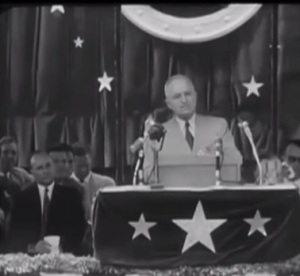
Little Rock Look Back: President Truman dedicates War Memorial PARK in a national address

Though President Truman was in Little Rock for a military reunion, he did conduct some official business while here.  In his Presidential role, he spoke at the dedication of War Memorial Park on June 11, 1949.

(It is sometimes erroneously reported that he dedicated the stadium.  That took place in September 1948, at a Razorback game with former Razorback player and future Lt. Governor Maurice “Footsie” Britt delivering the keynote.)

President Truman’s address took place inside War Memorial Stadium at 2:30 p.m..   It was not a brief dedicatory speech, but instead was a lengthy treatise on foreign affairs.  The address was carried live on nationwide radio (though some radio networks opted to broadcast it later).  The text of his address can be found here.

The stadium was by no means full.  A major reason for that was that many thousand individuals had turned out to witness a parade downtown in which President Truman marched along side Governor Sid McMath.  The parade was in conjunction with the military reunion.  Given the June heat in Arkansas (in which parade spectators had been standing for several hours) and the difficulty of getting from the parade route to the stadium, most (if not all) parade spectators opted for skipping the presidential address.

Before the parade, President Truman (who was still riding high from his upset victory in the 1948 election) was asked by a local reporter if he would run in 1952. He refused to answer stating that the national media would think he had planted the question with a local member of the press.

Prior to the name War Memorial Park, the land had been known as Fair Park.  It was a former location of the State Fair.  In the 1930s, it had briefly been known as Overman Park in honor of then-Mayor R. E. Overman.  The City Council had named it for him as a tribute to his work on a variety of projects. When he displeased them, they reversed their decision and renamed it to Fair Park.

Little Rock Look Back: Truman attends WWI Reunion

Outside of his capacity as President of the United States, Harry S. Truman visited Little Rock on June 10, 1949, for the annual reunion of the 35th Division, his World War I unit.  He was joined on this trip by members of Arkansas’ congressional delegation and his sister.
Upon arriving in Little Rock, President Truman gave brief remarks at a welcome reception inside Robinson Auditorium.  He also spoke at a reception at the Hotel Marion and following a ball given at Robinson Auditorium.

In all of his June 10th remarks, President Truman spoke of the hospitality he always enjoyed in Little Rock. He discussed visits he had made over the years, including a stay at the Hotel Marion while in Arkansas campaigning for Senator Hattie Caraway.

At the ball, he commented on how, as a Baptist, he had not learned how to dance.  He then joked that however he had picked up other habits which were perhaps not in keeping with his Baptist faith.

At one event, President Truman asked all in attendance to shake hands with their neighbors as a way to shake his hand by proxy.  He explained that on inauguration day, he had shaken over 25,000 hands. Given the fact that he signed 600 documents a day, regardless whether he was in Washington or not, he felt he could not keep up with shaking hands all day.

As he concluded the day, he previewed that he would be giving a national address the next day while in Little Rock.  In his usual, self-deprecating way, Truman remarked “…if you want to hear the President of the United States you had better come out to the stadium tomorrow, and I will tell you something that will be good for your souls.”

The texts of all of his remarks while in Little Rock can be found here.

Rocking the Tonys: The Boss in The Rock!

One guaranteed winner at the 2018 Tony Awards is Bruce Springsteen.   His show Springsteen on Broadway continues to sell out at the Walter Kerr Theatre.
His one man show is part concert, part conversation, and all hit.  After previews beginning in early October, it opened on October 27 for a run that was originally to be one month.  It has been extended multiple times, and is now set to conclude in December 2018 – a full 13 months later than the original plan.

He will perform on the Tony Awards and receive an Special Tony Award tonight in recognition of his artistic contributions (and the unspoken financial contributions) to this season.

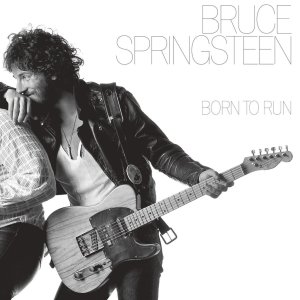
On May 3, 1976, Springsteen appeared on stage at Robinson Auditorium.  He was on a national tour riding the wave of the success of his August 1975 album Born to Run.  His set list for the concert included:  “Tenth Avenue Freeze-Out,” “Spirit in the Night,” “It’s My Life,” “Thunder Road,” “She’s the One,” “Born to Run,” “Pretty Flamingo,” “Growin’ Up,” “It’s Hard to Be a Saint in the City,” “Backstreets,” “Jungleland,” and “Rosalita (Come Out Tonight).” The encore was “4th of July, Asbury Park (Sandy)” and “Detroit Medley.

The concert sold poorly. Springsteen vowed never to return to Little Rock again.  He did eventually come back, but it would be the year 2000.

Little Rock Look Back: FDR at ARK 100

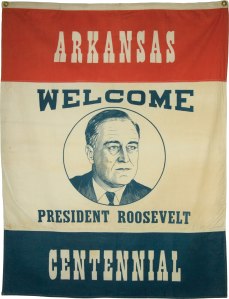
On June 10, 1936, President Franklin D. Roosevelt visited Little Rock as part of a day-long series of appearances in conjunction with the Arkansas Centennial celebration.  (The actual statehood dates is June 15.)

His day started in Memphis before he journeyed by train to Hot Springs. After events there that morning and lunch at Couchwood (his longtime friend Harvey Couch was chairman of the Centennial celebration).  He then traveled to Rockport and Malvern for appearances before arriving in Little Rock.  He made his remarks at the State Fairgrounds in a temporary structure called “Centennial Stadium.”

The street he traveled to get to the fairgrounds had been renamed Roosevelt Road in February 1935 in anticipation that he would visit Little Rock in 1936 as part of the state centennial and would likely use that route.  The street was officially named Franklin D. Roosevelt Road.  But given the unwieldy street signs that would be required to bear that name, the ordinance was amended to note that the signs would bear the name “Roosevelt Road.”

Following his remarks, which officially kicked off the six month Arkansas Centennial celebration, he retired to Senator Joseph T. Robinson’s house on South Broadway.  He dined with the Robinsons in the house before departing with the Senator at 8:45 that evening.  The Presidential entourage then journeyed to Texas for the next day.

Rocking the Tonys: Baryshnikov at Robinson (part 2)

One of the presenters at Sunday’s 72nd Tony Awards is Mikhail Baryshnikov.  Twenty-nine years ago, he himself was a 1989 Tony nominee for Actor in a Play (for playing a man-turned-cockroach in an adaptation of Kafka’s Metamorphosis.
In 1985, Baryshnikov returned to Little Rock to perform again at Robinson Center under the auspices of Ballet Arkansas.   He had performed here two years earlier, as well.

Among the dancers who joined him in the program was future Tony nominee Robert LaFosse.  He would be nominated for a 1989 Tony as well. But he was up for Best Actor in a Musical for his performance in Jerome Robbins’ Broadway.  Other dancers in the company were Cynthia Harvey, Susan Jaffe, Leslie Browne, Elaine Kudo, Cheryl Yeager, Amanda McKerrow, Deirdre Carberry, Bonnie Moore, Valerie Madonia, Ross Stretton, Peter Fonseca, Gil Boggs, John Gardner, and John Turjoman.

The company danced to pieces choreographed by George Balanchine, Jerome Robbins, Marius Petipa, future Tony Award winner Twyla Tharp, Lisa de Ribere, and La Fosse.  The music composers included George Gershwin, Jacques Offenbach, Frederic Chopin, Peter Ilyich Tchaikovsky, Hector Berlioz, as well as composers who wrote songs for Frank Sinatra.

While Ballet Arkansas did not have any dancers perform during the evening, the organization presented it and was able to receive the proceeds which exceeded the expenses.  For several years in the 1980s, the Ballet would either commence or conclude their season with such an performance. In fact, the 1985 Baryshnikov program contained a promotion of a 1986 visit by Alvin Ailey’s dance company.

Whereas the 1983 Baryshnikov appearance had been sponsored by the Arkansas Democrat, this time, the rival Arkansas Gazette was the sponsor.


Little Rock Look Back: Ben D. Brickhouse, LR mayor and state representative

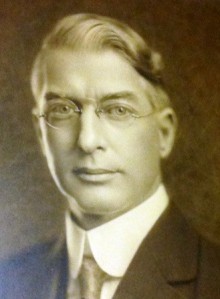
On June 8, 1873, future Little Rock Mayor Ben D. Brickhouse was born in Virginia.  He moved to Texas as a child before his family settled in Arkansas.
His first job was with the Missouri Pacific Railroad.  He eventually attended law school at the University of Arkansas.  As an attorney, he remained interested in labor relations throughout the rest of his life.

In 1914, Brickhouse was elected to the Little Rock City Council.  He was reelected in 1916.  In 1918, he was appointed Labor Commissioner for the State of Arkansas by Governor Charles Brough.

Brickhouse was elected Mayor of Little Rock in 1919.  He was relected twice (1921 and 1923). Though other Little Rock mayors in the 1920s to 1950s would seek a third consecutive term, Brickhouse was the last who succeeded prior to the change to the City Manager form of government in 1957.

Mayor Brickhouse ran for a fourth term as Mayor but was defeated.  In 1923, he had openly opposed the Ku Klux Klan, which was then a major player in Democratic politics in Little Rock, in Arkansas and in the nation. In the next Democratic primary for Mayor, Brickhouse did not secure the nomination.

During Mayor Brickhouse’s tenure the City purchased the land to make Fair Park (now War Memorial Park).  He also served as chair of the State Fairgrounds. After leaving office Brickhouse remained active in civic affairs, often speaking out in favor or opposition to local issues.

Brickhouse retired from public life in 1925 but returned in 1938 when he was elected to the Arkansas House of Representatives.  He was reelected in 1940.  On June 1, 1941, not long after the conclusion of the legislative session, Brickhouse died.

Little Rock Look Back: The Rices and Little Rock auditoriums

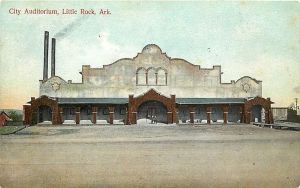
On June 7, 1920, the Little Rock City Council finally authorized the demolition of Little Rock’s 1906 temporary auditorium.  The structure had originally been built as a skating rink which, when chairs were added, could be used for public meetings.  Since the mid 1910’s, the City Council had discussed tearing it down over safety concerns.  But since Little Rock had no other structure as a substitute, the Council kept delaying the decision.

J Rice 1920In 1920, though there was not alternative space available, the Council decided that the structure had to come down.  So City Engineer James H. Rice was authorized to have the building removed.

JimRice RobinsonToday, Rice’s grandson, Jim Rice, is the COO of the Little Rock Convention & Visitors Bureau.

In that capacity he  oversaw the renovation of Little Rock’s 1940 municipal auditorium – Robinson Center Performance Hall.