Little Rock Look Back: Members Preview of Arkansas Arts Center on May 16, 1963

Mrs. Rockefeller

Two days before the Grand Opening of the Arkansas Arts Center, the institution’s members were given a sneak preview. On May 16, 1963, at 8:00pm, members were given a preview of the opening exhibition: Five Centuries of European Painting.

Members were greeted with remarks by Jeannette Rockefeller, the Board of Trustees president. Following her were comments by Alan R. Symonds, who was the Arts Center’s executive director.  James Rorimer, the director of the Metropolitan Museum of Art, which had created the opening exhibition, also spoke.

The exhibition featured works by Titian, El Greco, van Dyck, Murillo, Gainsborough, Monet, Courbet, Renoir, Degas, Pissarro, and Gauguin.  Another artist featured was Paul Signac.  Today the Arts Center has one of the largest collections or works by Signac due to the generosity of collector James T. Dyke.

Mr. Symonds had been hired by the Rockefellers to lead the planned automobile museum on Petit Jean. He was loaned to the Arts Center to get the museum open.  A year after the AAC grand opening, he returned to the assignment on Petit Jean.

$644,600 from NEA is going to the Arkansas Arts Council

In pursuit of its commitment to advance the creative capacity of people and communities across the nation, the National Endowment for the Arts announces its second round of funding for FY 2018.

This funding round includes annual partnerships with state, jurisdictional, and regional arts agencies as well as the categories of Art Works, Creativity Connects, Our Town, and Research: Art Works.

One of the grantees was the Arkansas Arts Council which will receive $644,600.  This will support arts programs, services, and activities associated with carrying out the Arkansas Arts Council’s NEA-approved strategic plan.  The Arts Council is an agency of the Department of Arkansas Heritage.

There were a total number of six (6) grants to entities in Arkansas.  These grants are worth $814,600.  As noted yesterday in a post, one of the grantees was the Arkansas Arts Center.

Earlier this year, the NEA announced its first round of grants which included $10,00 for the Arkansas Repertory Theatre to support production of The Call; $12,500 to the Arkansas Symphony Orchestra to support the Canvas Festival, which combined visual arts and the performance of live symphonic music; $10,000 to the Chamber Music Society of Little Rock to support a series of chamber music performances and related educational programming; and $25,000 to the Oxford American to support the publication and promotion of the magazine.

Dr. Jane Chu, who is the Chairman of the NEA, has announced she will be stepping down on June 4, 2018, at the conclusion of her four year term.  A graduate of Arkadelphia High School and Ouachita Baptist University, she has visited Little Rock during her tenure at the helm of the NEA.

$50,000 grant from the NEA goes to Arkansas Arts Center

National Endowment for the Arts Chairman (and former Arkansas resident) Jane Chu has approved more than $80 million in grants as part of the NEA’s second major funding announcement for fiscal year 2018. Included in this announcement is an Art Works grant of $50,000 to the Arkansas Arts Center to support the conservation of art works by John Marin.

The Art Works category is the NEA’s largest funding category and supports projects that focus on the creation of art that meets the highest standards of excellence, public engagement with diverse and excellent art, lifelong learning in the arts, and/or the strengthening of communities through the arts.

“The variety and quality of these projects speaks to the wealth of creativity and diversity in our country,” said NEA Chairman Jane Chu. “Through the work of organizations such as the Arkansas Arts Center in Little Rock, NEA funding invests in local communities, helping people celebrate the arts wherever they are.”

The Arkansas Arts Center’s 290-work collection is the second largest repository of John Marin works in the world. The collection was donated to the Arts Center by the artist’s daughter-in-law, Norma Marin, in 2013. Beginning with his 1909 debut exhibition of watercolors at Alfred Stieglitz’s 291 Gallery in New York, until his death in 1953, Marin was a major force among the cutting-edge modern artists in America. The artist was best known for his lively, idiosyncratic watercolors, etchings and oil paintings of the disparate worlds of gritty New York City and coastal Maine.

“We are incredibly grateful for this support from the NEA,” said Todd Herman, Arkansas Arts Center Executive Director. “This grant will allow us to continue to preserve this spectacular collection of works by iconic American modernist John Marin for future generations.”

Little Rock Look Back: City of Little Rock formally establishes Museum of Fine Arts

On May 6, 1935, the Little Rock City Council formally established the Museum of Fine Arts by Ordinance 5235.  The ordinance was sponsored by Alderman Henry G. Leiser.

The ordinance authorized the construction of the museum in City Park.  The money for the construction was all privately raised. Once the building was completed, it would become the property of the City.

The ordinance also created the museum’s board. The original members were named by the ordinance.  They were: Fred W. Allsopp (appointed as a life member), Mrs. Frederick Hanger, Mrs. F.B.T. Hollenberg, George B. Rose, Mrs. C.M. Taylor, Mrs. Frank Tillar, and Dr. Frank Vinsonhaler. In addition, the Mayor and President of the Fine Arts Club were ex-officio members.

The building would start construction in 1936. The groundbreaking was in January 1936, and the cornerstone was laid in October 1936. The Museum of Fine Arts opened in October 1937.

Little Rock Look Back: Arkansas Arts Center produces first play at its theatre

The Arts Center Theatre view from the stage in 1963

On May 3, 1963, at 8:30 pm, the curtain rose as the Arkansas Arts Center produced its first show in its own theatre.  Though the building would not be officially dedicated until later in May (more about that later), programming had been taking place in the facility for several months.

In December 1962, a community theatre production was the first play in the Arkansas Arts Center theatre.  Over the ensuing months, it would play host to a variety of concerts and performances.  At the time, the Arkansas Arts Center planned to use the theatre as a house for its own productions (one series geared to adults, the other series geared to kids), other shows produced by Little Rock organizations, and touring shows which might be too small for Robinson Auditorium.

Friday, May 3, 1963, was a momentous evening, as the Arkansas Arts Center presented Rumpelstiltskin.  (Since the theatre space has been focused on children’s theatre since the late 1970s, it seems prescient that the first AAC produced play was a children’s production some fifteen years earlier.)

The production was overseen Joseph N. Carner, who was the theatre director.  It was his hope that the Arts Center plays geared toward children would also encourage other groups throughout the state to produce plays specifically for younger audiences.  Margaret Davies Carner, who taught speech at Little Rock University, directed the play.  She also taught drama classes at the Arts Center.

The cast included Garry White as the title character with Dell Blaine, Michael Hosman, Lesie Smith, Tom Abraham, Dickie Atchison, Butch Lashee, henry Fletcher, Charles McRaven, Ann Thomson, Dannette Joe Baker, Sallie Penn, Paul Motes, Leslie Newell, and Robin Hosman.

In addition to a Friday night performance, there were 2:30 matinees on Saturday and Sunday that were geared toward children’s audiences.

Little Rock Look Back: National Balloon Race starts in Little Rock

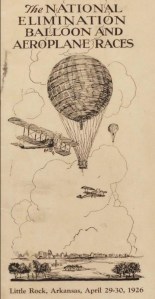
On April 29, 1926, nine hot air balloons took off from Little Rock’s airport (which was actually just an airfield at the time) in a national race to win the Litchfield Trophy.  In addition to the trophy, the winner would be on the American team in an international balloon race in Belgium.

The New York Times coverage noted that the weather conditions were ideal as the balloons took off in five minute intervals between 5:00pm and 5:30pm.  The test balloon (akin to a pace car in a car race) was the Arkansas Gazette‘s Skylark.  It took off at 4:25 and headed in the direction of the northeast, which was the desired direction.

The nine balloons, in order of liftoff were: the US Army from Phillips Field in Maryland; the US Army from McCook Field in Ohio; the Goodyear Southern California; the Detroit; the Goodyear IV (whose pilot Ward T. Van Orman had won the 1924 and 1925 contests); US Army from Scott Field; a balloon piloted by a Danish pilot Svend A. U. Rasmussen; US Army balloon from Langley Field in Virginia; and the Akron National Aeronautic Association balloon.

The pilots carried provisions for 48 hours and were equipped for sea flying.  Each had a radio and loud speaker.  KTHS radio of Hot Springs (a forerunner to today’s KTHV TV station) was broadcasting the location of each balloon.  As they left the Arkansas radio station’s range, there was a network of other stations which would do the same.

It was expected that the race would last between eighteen and thirty-six hours.  The last balloon aloft was Van Orman for the third year.  He lasted approximately 31 hours and landed near Chesapeake Bay.

Though no headcount was given, the New York Times called the viewing audience “the largest crowd ever assembled in Little Rock.”

Many thanks to Brian Lang of the Arkansas Arts Center for giving me the tip on this.

Little Rock Look Back: OKLAHOMA! first comes to LR

OkLRbill

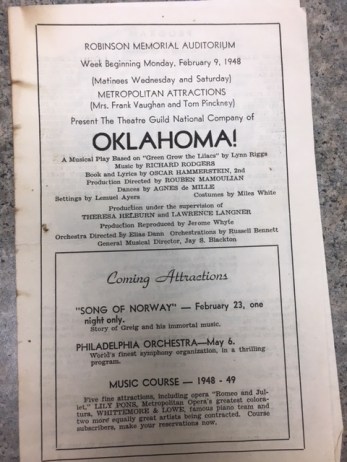
Program cover from OKLAHOMA!’s February 1948 visit to Little Rock. From the collection of Mary and Booker Worthen.

On March 31, 1943, Alfred Drake sauntered on the stage of Broadway’s St. James Theatre and sang “Oh, what a beautiful mornin'” to launch OKLAHOMA! into not only theatrical history but popular culture as well.

In February 1948, as the original Broadway run was about to mark five years on Broadway, the national tour of Oklahoma! made its way to Little Rock for eight performances. The week-long stay it had in Little Rock at Robinson Center was a record for that building that would last until Wicked came in 2010.  (Hello, Dolly! in 1966 and Beauty and the Beast in 2002 had both equalled the record.)

By the time Richard Rodgers and Oscar Hammerstein II’s first show made it to Little Rock, they were working on their fourth stage show, South Pacific, which had a leading character from Little Rock.

To get Robinson Auditorium ready for Oklahoma!, the Auditorium Commission had to spend $2,000 on upgrades.  That would be the equivalent of just under $21,000 today.

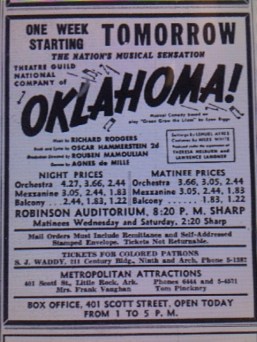
Oklahoma! opened at Robinson on Monday, February 9, 1948.  With eight performances, approximately 24,000 tickets were on sale during the run of the show.  There was a cast of 67 actors and 28 musicians.  The cast was led by Ridge Bond, Carolyn Adair, Alfred Cibelli Jr., Patricia Englund, and David Morris.  Mr. Bond had relatives who lived in Little Rock.  He was a native of Claremore, Oklahoma, which was the town in which the story took place.
OkAdLR

Ad in ARKANSAS GAZETTE on February 8, 1948.

While they were in Little Rock, the stars of the show made an appearance at Reed Music on February 10.  The music store (located at 112 and 114 East 7th Street–across the street from the Donaghey Building) was promoting the sale of the Oklahoma! cast albums, sheet music, and recordings of songs from Oklahoma! by other singers.

Both the Arkansas Gazette and Arkansas Democrat carried reviews of the show.  Another item, which appeared in the paper that week was a syndicated column which noted that the film rights for the show had been sold. It was speculated that the star would be Bing Crosby.  It would actually be 1955 before the film was made, and Mr. Crosby had no connection to that movie.  By the time it was made, the stars were Gordon MacRae and Shirley Jones.  Mr. MacRae would appear in Little Rock for the 1963 opening of the Arkansas Arts Center.  Ms. Jones has made several concert appearances in Little Rock over the years.

Little Rock had seen its fair share of top Broadway shows on tour.  Prior to Robinson’s opening and since then, many well-known actors and popular shows had played Little Rock.  But just as it had been on Broadway, Oklahoma! in Little Rock was more than a show — it was an event!

Over the years, Oklahoma! has been performed by schools, churches, community theatres, dinner theatres, and colleges.  National tours have come through Arkansas again.  People have become jaded or dismissive of it, because they have seen it performed so often — and sometimes badly.  So it is hard to understand the excitement that was felt by Little Rock audiences in 1948 when they first saw it on the stage of Robinson Center.

But 75 years later (and 25 years after it was commemorated by the US Postal Service with its own stamp), Oklahoma! is still doing fine.  Countless new generations sing the songs and say the lines.

Two upcoming cultural events in Little Rock are a testament to the genius that helped create Oklahoma!  In May, Ballet Arkansas will present a dance piece which was the final dance created by Agnes de Mille.  Before choreographing Oklahoma!, Miss de Mille was already making her mark in the world of ballet.  She alternated between the two for decades.  At the 1993 Tony Awards, Miss de Mille accepted a special Tony upon the show’s 50th anniversary milestone.

The second connection to Oklahoma! will take place in February 2019.  The Arkansas Symphony Orchestra is bringing Oscar “Andy” Hammerstein III, grandson of the beloved librettist and lyricist Oscar Hammerstein II, to host a celebration of some of America’s most cherished music from the stage.