
Black History Month Spotlight – Healthcare Pioneers

UALR Trail HealthcareThe new Arkansas Civil Rights History Audio Tour was launched in November 2015. Produced by the City of Little Rock and the University of Arkansas at Little Rock allows the many places and stories of the City’s Civil Rights history to come to life an interactive tour.  This month, during Black History Month, the Culture Vulture looks at some of the stops on this tour which focus on African American history.

The Arkansas Civil Rights Heritage Trail was launched in 2011 by the UALR’s Institute on Race and Ethnicity.  Each year, a theme is chosen to honor a particular group of people who were active in Arkansas’s civil rights movement.  Year by year, the trail grows.  The plan is that over time the trail will stretch from the current starting point at the Old State House, down West Markham Street and President Clinton Avenue to the Clinton Presidential Library and Museum, and then back up the other side of the street to opposite the Old State House.

Healthcare

Healthcare has long been a civil rights issue. In the age of segregation, many blacks were denied healthcare by white physicians and hospitals under Jim Crow laws. African American physicians-such as Cleon A. Flowers, Sr., and John Marshall Robinson-played important roles in serving the black community. Nurse Lena Lowe Jordan founded the Lena Jordan Hospital in Little Rock in the 1930s. Edith Mae Irby desegregated the University of Arkansas Medical School in Little Rock in 1948. Dr. Irby paved the way for other black students and professors at the school. Thomas A. Bruce promoted access to quality healthcare to the underserved. Henry W. Foster became dean of Meharry Medical College in Tennessee. Billy Ray Thomas and Phillip Leon Rayford worked to increase underrepresented groups in the medical profession. Samuel Lee Kountz pioneered organ transplants. Joycelyn Elders, a UAMS graduate and director of the Arkansas Department of Health, served as the surgeon general of the United States during the presidency of Bill Clinton.

The app, funded by a generous grant from the Arkansas Humanities Council, was a collaboration among UALR’s Institute on Race and Ethnicity, the City of Little Rock, the Mayor’s Tourism Commission, and KUAR, UALR’s public radio station, with assistance from the Little Rock Convention and Visitors Bureau.

Black History Month Spotlight – Downtown Desegregation

Ozell Sutton, one of the honorees

Ozell Sutton, one of the honorees

The new Arkansas Civil Rights History Audio Tour was launched in November 2015. Produced by the City of Little Rock and the University of Arkansas at Little Rock allows the many places and stories of the City’s Civil Rights history to come to life an interactive tour.  This month, during Black History Month, the Culture Vulture looks at some of the stops on this tour which focus on African American history.

The Arkansas Civil Rights Heritage Trail was launched in 2011 by the UALR’s Institute on Race and Ethnicity.  Each year, a theme is chosen to honor a particular group of people who were active in Arkansas’s civil rights movement.  Year by year, the trail grows.  The plan is that over time the trail will stretch from the current starting point at the Old State House, down West Markham Street and President Clinton Avenue to the Clinton Presidential Library and Museum, and then back up the other side of the street to opposite the Old State House.

Downtown Desegregation

In January 1963, Little Rock set in motion a process that ended segregation in its downtown businesses.  Following student sit-ins coordinated by the Student Nonviolent Coordinating Committee and Philander Smith College students, in November 1962 white businessmen and merchants formed a secret Downtown Negotiating Committee to set out a timetable for change in consultation with black community representatives.  On January 1, 1963, lunch counters in downtown Little Rock began to serve black customers on an equal basis.  Downtown hotels desegregated their facilities.  Drinking fountains and restrooms had their “White” and “Colored” signs removed.  In June, movie theaters desegregated.  In October, city restaurants desegregated.  That same year, Robinson Auditorium, the Arkansas Arts Center, and city parks desegregated.  In April 1963, in Jet magazine, James Forman, executive secretary of the Student Nonviolent Coordinating Committee, hailed the city as “just about the most integrated…in the South.”

The app, funded by a generous grant from the Arkansas Humanities Council, was a collaboration among UALR’s Institute on Race and Ethnicity, the City of Little Rock, the Mayor’s Tourism Commission, and KUAR, UALR’s public radio station, with assistance from the Little Rock Convention and Visitors Bureau.

Black History Month Spotlight – Freedom Riders and Sit-In Demonstrators

UALR Trail Sit inThe new Arkansas Civil Rights History Audio Tour was launched in November 2015. Produced by the City of Little Rock and the University of Arkansas at Little Rock allows the many places and stories of the City’s Civil Rights history to come to life an interactive tour.  This month, during Black History Month, the Culture Vulture looks at some of the stops on this tour which focus on African American history.

The Arkansas Civil Rights Heritage Trail was launched in 2011 by the UALR’s Institute on Race and Ethnicity.  Each year, a theme is chosen to honor a particular group of people who were active in Arkansas’s civil rights movement.  Year by year, the trail grows.  The plan is that over time the trail will stretch from the current starting point at the Old State House, down West Markham Street and President Clinton Avenue to the Clinton Presidential Library and Museum, and then back up the other side of the street to opposite the Old State House.

Freedom Riders and Sit-In Demonstrators

In 1961, the Freedom Rides spread across the South to place pressure on local communities and the federal government to implement court-ordered desegregation of bus terminal facilities.  Little Rock’s first Freedom Riders, a contingent of five members of the St. Louis branch of the Congress of Racial Equality, arrived on the evening of July 10 at the Mid-West Trailways bus station at Markham and Louisiana.  A plaque there marks the site and tells the story of the Little Rock Freedom Rides.  The pressure exerted by the Freedom Rides, together with an Interstate Commerce Commission order to desegregate, led to the integration of all Little Rock’s bus terminals on November 1, 1961.  Five markers also commemorate Philander Smith College students involved in sit-in demonstrations between 1960 and 1962, as well as members of the Arkansas Student Non-violent Coordinating Committee.  SNCC was active in Arkansas from 1962 to 1967.

The app, funded by a generous grant from the Arkansas Humanities Council, was a collaboration among UALR’s Institute on Race and Ethnicity, the City of Little Rock, the Mayor’s Tourism Commission, and KUAR, UALR’s public radio station, with assistance from the Little Rock Convention and Visitors Bureau.
2015 In Memoriam – Ozell Sutton

1515 Sutton

In these final days of 2015, we pause to look back at 15 who influenced Little Rock’s cultural scene who left us in 2015.

Ozell Sutton was a writer and eyewitness to history, while making some of his own too.

Born in Gould, he moved with his family to Little Rock and graduate from Dunbar High School and Philander Smith College. In 1950, he became the Arkansas Democrat‘s first African American reporter.

He was at Central High when the Little a Rock Nine integrated, marched with Dr Martin Luther King Jr. in Washington in 1963 and was with Dr King when he was assassinated in 1968.

He served as an aide to Gov. Winthrop Rockefeller from 1968 to 1970. From 1972 to 2003 he work for the U.S. Department of Justice Community Relations Service in Atlanta. In that capacity he was often on the forefront in efforts to diffuse racially tense situations.

In 1962, he received an honorary doctorate from Philander Smith in recognition of his political activism in the civil rights movement. He was awarded the Distinguished Service Award by the Department of Justice in 1994.  He also was awarded the Medallion of Freedom by the National Association for the Advancement of Colored People (NAACP).

In 2012, he was presented with the Congressional Gold Medal in recognition for his being one of the first African Americans to serve in the Marine Corps. His book “From Yonder to Here:” A Memoir of Dr. Ozell Sutton was published in 2009.  In 2013, he was honored by inclusion on the Arkansas Civil Rights Heritage This designation came for his work in 1963 to desegregate downtown Little Rock’s businesses.

Ozell Sutton was inducted into the Arkansas Black Hall of Fame in 2001.

Little Rock Look Back: LR Mayor Charles Bussey

Mayor Bussey BWFuture Little Rock Mayor Charles Bussey was born on December 18 in 1918.  Throughout his life he was a trailblazer.  He was the first African American Sheriff’s Deputy in Pulaski County and expanded the Junior Deputy program into the African American community.

In 1968 he became the first African American elected to the Little Rock City Board of Directors. He was not the first African American to run for the City Board, but he was the first to win a race.  Mr. Bussey sought support not just from the African American community, but from all sectors of Little Rock.  Apparently, while campaigning in 1968, he deliberately went into the Arkansas headquarters of segregationist presidential candidate George Wallace to see about leaving campaign literature.  A hulking man with a broad smile, he shocked the young receptionist. He was undoubtedly the first (and probably last) African American to enter that campaign headquarters.

He served from 1969-1977 and again from 1979 through 1991.  In 1981 he was selected by his fellow City Directors to serve as Little Rock’s Mayor, which made him the first African American Mayor of Little Rock.  He served as Vice Mayor of Little Rock for a total of 8.5 years which is the longest of anyone in the City’s history.

Throughout his lifetime Mayor Bussey championed youth outreach efforts.  He also was active in the Arkansas Municipal League, National League of Cities, West Little Rock Rotary Club, Elks, Shriners and many other organizations.

In 2006 he was posthumously inducted into the Arkansas Black Hall of Fame.  The previous year, 20th Street in Little Rock was renamed in his honor. In 2015 he was included in the Arkansas Civil Rights Heritage Trail.

Fourteen new names added to 2015 Arkansas Civil Rights Heritage Trail

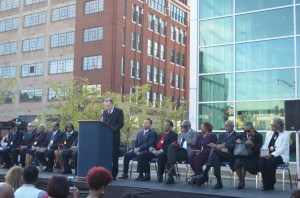
2015 ACRHTLast month, the University of Arkansas at Little Rock Institute on Race and Ethnicity unveiled the 2015 Arkansas Civil Rights Heritage Trail markers. This year’s theme is “Politics and Law” to commemorate the 50th anniversary of the passage of the Voting Rights Act of 1965.

The fourteen new markers are installed at Scott and Markham Streets near the Statehouse Convention Center.

Established in the summer of 2011, the Arkansas Civil Rights Heritage Trail honors those who made significant contributions to civil rights in Arkansas. The trail raises public awareness of the long and rich legacy of Arkansas’s civil rights history.

A 12-inch bronze marker is placed in the sidewalk for each honoree. The trail begins in front of the Old State House Convention Center on Markham Street and will eventually extend to the William J. Clinton Presidential Center and Park and other points throughout the downtown corridor.

This year’s 14 honorees are:

  • Annie Mae Bankhead, who was a community activist in Pulaski County’s black College Station neighborhood
  • Wiley Branton, Sr., who was head of the Southern Regional Council’s Voter Education Project in the 1960s
  • Charles Bussey, who was leader of the Veterans Good Government Association and became Little Rock’s first black mayor in 1980
  • William Harold Flowers, who laid the foundations for the Arkansas State Conference of National Association for the Advancement of Colored People branches
  • Jeffrey Hawkins, who was for decades the unofficial mayor of Little Rock’s black East End neighborhood
  • Irma Hunter Brown, who was the first black woman elected to the Arkansas General Assembly
  • Scipio Africanus Jones, a leading black Republican who defended 12 prisoners for their role in the 1919 Elaine Race Riot
  • Mahlon Martin, who was the first black city manager of Little Rock
  • I.S. McClinton, who was head of the Arkansas Democratic Voters Association, a forerunner of today’s Black Democratic Caucus
  • Richard L. Mays and Henry Wilkins III, who were among the first blacks elected to the Arkansas General Assembly in the 20th century in 1972
  • Olly Neal, who was the first black district prosecuting attorney in Arkansas and later served on the Arkansas Court of Appeals
  • Lottie Shackelford, who was the first black woman mayor of Little Rock
  • John Walker, who for more than five decades has been involved in civil rights activism in the courts, most notably in school desegregation cases

Dr. John Kirk is the director of the Institute.  At the November ceremony, he spoke along with UALR Chancellor Joel Anderson. At a reception following the ceremony, Senator Joyce Elliott gave a toast in honor of the 14 and several of the honorees or their descendants spoke.