
 On January 26, 1937, Little Rock voters went to the polls to vote on three different municipal bond issues. One of them was the construction of a municipal auditorium.
The bonds for the auditorium would be $468,000 in general obligation bonds which would be paid off between 1940 and 1971. This was toward a total cost of $760,000 for the entire project.
The official campaign for the auditorium was sponsored by the Little Rock Forward Committee which was led by W. H. Williams. In campaign advertisements it showed the value of conventions in New York City which was estimated at $100 per convention attendee. Little Rock organizers were estimating a $10 a day expenditure by visitors, which the committee stressed was very conservative. The campaign committee emphasized the importance of acting at that time due to the federal government money involved.
Various committees and organizations endorsed the auditorium project including the Little Rock Chamber of Commerce, Little Rock Federation of Women’s Clubs, and the Young Business Men’s Association.
The thrust of the campaign focused on the economic benefit to Little Rock as well as the fact that the auditorium would be for all citizens. This message was picked up in editorials by both the Democrat and Gazette. In editorials on January 23 and 25, the Democratopined that the benefits of the auditorium would be distributed among all classes of the citizenry. The next day, both papers ran editorials which touted the economic boon an auditorium would bring through conventions and meetings.
The Democrat’s approach broke down the current value of conventions to Little Rock with, what it termed, the city’s “existing inadequate” facilities. The paper emphasized a conservative estimate of what the added value to Little Rock’s economy would be with the new auditorium.
In expressing support for the auditorium the Gazette stressed the values for local, statewide and national groups. “An auditorium would provide a more convenient and better adapted community center for all kinds of local gathering,” and continued that it would make Little Rock “the logical meeting place for state conventions of every sort.” In discussing the value of state, regional and national meetings the paper stressed that the outside money spent by convention attendees has an impact beyond stores, hotels and restaurants.
Both papers also echoed the importance of the federal government financing to make this possible. The Democrat noted that the Public Works Administration grant and federal low cost loan made this an ideal time.
On January 26, 1937, Little Rock voters approved the auditorium bond by a vote of 1,518 to 519. It passed in each of the city’s 23 precincts. Little Rock Mayor R. E. Overman expressed his pleasure at the outcome of the vote and extended his thanks to the voters. (The City Library addition received 1,673 for and 359 against, while the African American park received 1,588 for and 442 against.)
After the election, a Gazette editorial commented on the low turnout for the special election by commenting that the weather had been nice and there were no other barriers to voting. The editorial writer opined that those not voting in the election must not have been opposed to the endeavor.


 On January 16, 1832, Mayor Matthew Cunningham MD presided over Little Rock’s first council meeting.
 100 Years Ago
 The Democrat (an afternoon paper) ran an article stating that New Year’s celebrations in DC were somewhat muted, perhaps because of concerns about the health of President Wilson, who had suffered a stroke in October 1919. There was also an article about planning being underway for the 300th anniversary of the Mayflower with events set for England, Holland, and the US.
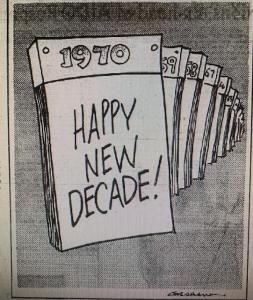 As 1970 dawned, the Gazette and Democrat both carried stories about Vietnam and the Department of Justice seeking a delay in implementation of school desegregation. Locally, it was announced that KATV was purchasing the old Worthen Bank Building at Main and Fourth Streets. The Hogs were getting ready to face Ole Miss in the Sugar Bowl (which the Razorbacks would lose by a score of 27 to 22 to the Archie Manning led Rebels).
 Teamsters Union president Jimmy Hoffa, in the middle of an eight year prison term, had indicated he would share information with authorities in return for President Nixon commuting his sentence. In local crime news, City Hall and the municipal garage behind the building had been broken into. While there had been a failed attempt to pry open the Collector’s office, thieves had apparently only been able to get a small amount of cash by breaking a vending machine in the building.
 Little Rock Culture Vulture