Little Rock Look Back: Voters approve Municipal Auditorium

1937-robinson-electionOn January 26, 1937, Little Rock voters went to the polls to vote on three different municipal bond issues.  One of them was the construction of a municipal auditorium.

The bonds for the auditorium would be $468,000 in general obligation bonds which would be paid off between 1940 and 1971. This was toward a total cost of $760,000 for the entire project.

The official campaign for the auditorium was sponsored by the Little Rock Forward Committee which was led by W. H. Williams. In campaign advertisements it showed the value of conventions in New York City which was estimated at $100 per convention attendee. Little Rock organizers were estimating a $10 a day expenditure by visitors, which the committee stressed was very conservative. The campaign committee emphasized the importance of acting at that time due to the federal government money involved.

Various committees and organizations endorsed the auditorium project including the Little Rock Chamber of Commerce, Little Rock Federation of Women’s Clubs, and the Young Business Men’s Association.

The thrust of the campaign focused on the economic benefit to Little Rock as well as the fact that the auditorium would be for all citizens. This message was picked up in editorials by both the Democrat and Gazette. In editorials on January 23 and 25, the Democrat opined that the benefits of the auditorium would be distributed among all classes of the citizenry. The next day, both papers ran editorials which touted the economic boon an auditorium would bring through conventions and meetings.

The Democrat’s approach broke down the current value of conventions to Little Rock with, what it termed, the city’s “existing inadequate” facilities. The paper emphasized a conservative estimate of what the added value to Little Rock’s economy would be with the new auditorium.

In expressing support for the auditorium the Gazette stressed the values for local, statewide and national groups. “An auditorium would provide a more convenient and better adapted community center for all kinds of local gathering,” and continued that it would make Little Rock “the logical meeting place for state conventions of every sort.” In discussing the value of state, regional and national meetings the paper stressed that the outside money spent by convention attendees has an impact beyond stores, hotels and restaurants.

Both papers also echoed the importance of the federal government financing to make this possible. The Democrat noted that the Public Works Administration grant and federal low cost loan made this an ideal time.


On January 26, 1937, Little Rock voters approved the auditorium bond by a vote of 1,518 to 519. It passed in each of the city’s 23 precincts. Little Rock Mayor R. E. Overman expressed his pleasure at the outcome of the vote and extended his thanks to the voters.

After the election, a Gazette editorial commented on the low turnout for the special election by commenting that the weather had been nice and there were no other barriers to voting. The editorial writer opined that those not voting in the election must not have been opposed to the endeavor.

Little Rock Look Back: The Sun shines in as HAIR plays Robinson Center

Ad for the original production of HAIR in Little Rock. Note the ticket prices. And that they could be purchased at Moses Music Shops.

Ad for the original production of HAIR in Little Rock. Note the ticket prices. And that they could be purchased at Moses Music Shops.

Forty-five years ago today, on January 18, 1972, the musical Hair settled in for a week-long run at Robinson Auditorium.  The saga to bring the national tour to Little Rock had actually begun eleven months earlier.

In February 1971, a young Little Rock attorney named Phil Kaplan petitioned the Little Rock Board of Censors to see if it would allow a production of Hair to play in the city. He was asking on behalf of a client who was interested in bringing a national tour to Arkansas’ capital city. The show, which had opened on Broadway to great acclaim in April 1968 after an Off Broadway run in 1967, was known for containing a nude scene as well for a script which was fairly liberally sprinkled with four-letter words. The Censors stated they could not offer an opinion without having seen a production.

By July 1971, Kaplan and his client (who by then had been identified as Southwest Productions) were seeking permission for a January 1972 booking of Hair from the City’s Auditorium Commission which was charged with overseeing operations at Robinson Auditorium. At its July meeting, the Commissioners voted against allowing Hair because of its “brief nude scene” and “bawdy language.”

Kaplan decried the decision. He stated that the body couldn’t “sit in censorship of legitimate theatrical productions.” He noted courts had held that Hair  could be produced and that the Auditorium Commission, as an agent for the State, “clearly can’t exercise prior censorship.” He proffered that if the production was obscene it would be a matter for law enforcement not the Auditorium Commission.

The Commission countered that they had an opinion from City Attorney Joseph Kemp stating they had the authority. One of the Commissioners, Mrs. Grady Miller (sister-in-law of the building’s namesake the late Senator Robinson, she had served on the Commission since 1940), expressed her concern that allowing Hair would open the door to other productions such as Oh! Calcutta!

On July 26, 1971, Southwest Productions filed suit against the Auditorium Commission. Four days later there was a hearing before federal Judge G. Thomas Eisele. At that hearing, Auditorium Commission member Lee Rogers read aloud excerpts from the script he found objectionable. Under questioning from Kaplan, a recent touring production of Neil Simon’s Plaza Suite was discussed. That play has adultery as a central theme of one of its acts. Rogers admitted he found the play funny, and that since the adultery did not take place on stage, he did not object to it. Among those testifying in favor of it was Robert Reddington, who was director of performing arts at the Arkansas Arts Center.

Judge Eisele offered a ruling on August 11 which compelled the Auditorium Commission to allow Hair to be performed. Prior to the ruling, some of the Auditorium Commissioners had publicly stated that if they had to allow Hair, they would close it after the first performance on the grounds of obscenity. To combat this, Judge Eisele stated that the Commission had to allow Hair to perform the entire six day engagement it sought.

Upon hearing of the Judge’s ruling, Commissioner Miller offered a succinct, two word response. “Oh, Dear!”

In the end, the production of Hair at Robinson would not be the first performance in the state.  The tour came through Fayetteville for two performances in October 1971 at Barnhill Arena.

On January 18, 1972, Hair played the first of its 8 performances over 6 days at Robinson Auditorium.  In his review the next day, the Arkansas Gazette’s Bill Lewis noted that Hair “threw out all it had to offer” and that Little Rock had survived.

The ads promoting the production carried the tagline “Arkansas will never be the same.”  Tickets (from $2 all the way up to $8.50) could be purchased at Moses Melody Shops both downtown and in “The Mall” (meaning Park Plaza). That business is gone from downtown, but the scion of that family, Jimmy Moses, is actively involved in building downtown through countless projects. His sons are carrying on the family tradition too.

Little Rock was by no means unique in trying to stop productions of Hair.  St. Louis, Birmingham, Los Angeles, Tallahassee, Boston, Atlanta, Charlotte NC, West Palm Beach, Oklahoma City, Mobile and Chattanooga all tried unsuccessfully to stop performances in their public auditoriums.  Despite Judge Eisele’s ruling against the City of Little Rock, members of the Fort Smith City Council also tried to stop a production later in 1972 in that city. This was despite warnings from City staff that there was not legal standing.

Within a few years, the Board of Censors of the City of Little Rock would be dissolved (as similar bodies also were disappearing across the US). Likewise, the Auditorium Commission was discontinued before Hair even opened with its duties being taken over by the Advertising and Promotion Commission and the Convention & Visitors Bureau staff.  This was not connected to the Hair decision; it was, instead, related to expanding convention facilities in Robinson and the new adjacent hotel.  Regardless of the reasons for their demise, both bygone bodies were vestiges of earlier, simpler and differently focused days in Little Rock.

Little Rock Look Back: Boxing Day remembrance of Muhammad Ali vs. Dan Sprick

Ali SprickDan T. Sprick was a Little Rock Mayor for two years in the 1940s after having previously served on the City Council.  From 1961 until 1970, he served as a State Senator from Little Rock and was a reliable ally for Governor Orval Faubus. Once Faubus left office and was replaced by Governor Winthrop Rockefeller, Sprick continued to wave the banner of segregation and agitation.  One of his new focuses was boxer Muhammad Ali.

In 1969, the University of Arkansas announced that Ali would be one of the speakers for its public appearance series.  After refusing to be drafted and go to Vietnam, Ali was barred from earning a living as a professional boxer and so was making a living giving lectures.  His refusal to submit to the draft was based on his religious beliefs as a recent convert to the Nation of Islam.

Opposition to Ali’s appearance rose almost immediately, and from Little Rock not Fayetteville. The Pulaski Businessman’s Association sent a letter to UA president David Mullins asking him to bar Ali from speaking. President Mullins insisted that he had the right to speak on campus. When that didn’t work, Senator Sprick and his cohorts in the state’s upper chamber went to work. A resolution calling for Ali to be barred from speaking failed on a voice vote after much debate.

While there were certainly some racial overtones to Sprick’s opposition, he and others seemed to be more concerned over the former Cassius Clay’s conversion to Islam plus his ensuing refusal to be drafted.  Senator Sprick declared that if President Nixon would draft him now he would go to serve in Vietnam.  (Sprick was in his late 60s at the time.)

Ali’s speech on the campus actually caused some controversy on its own.  One of the things he advocated for segregation. He praised Alabama Governor George Wallace.  The Arkansas Gazette which had been following the saga in both news stories and editorials, noted that remarks like that should have endeared Ali to Dan Sprick and others.

Ali, of course, resumed his boxing career and defined that sport in the 1970s with his talent in the ring and his showmanship.

Based on an editorial, Sprick sued the Gazette for libel. The paper settled with him out of court because his health was poor. Sprick died in 1972.

Little Rock Look Back: Robinson Auditorium Groundbreaking

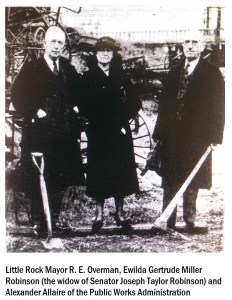
122437 GroundbreakOn December 24, 1937, at 11:30 a.m., Little Rock Mayor R. E. Overman, Ewilda Gertrude Miller Robinson (the widow of Senator Joseph Taylor Robinson) and  Alexander Allaire of the PWA turned dirt to participate in the brief groundbreaking ceremony for Little Rock’s municipal auditorium.  That morning, the Arkansas Gazette ran a brief story on the upcoming groundbreaking.  The story mentioned that the building would be named in memory of the late beloved Arkansas politician.  This appears to be the first public pronouncement of the Robinson name for this civic structure.

Among others in attendance at the groundbreaking were Mrs. Charles Miller (sister-in-law of Mrs. Robinson), Mr. and Mrs. Grady Miller (brother and sister-in-law of Mrs. Robinson), the mayor’s wife, the three architects (George Wittenberg, Lawson Delony and Eugene John Stern), and D. H. Daugherty and Will Terry of the City’s Board of Public Affairs.

Construction had to start by January 1, 1938, in order to receive PWA funds.  By breaking ground on December 24, there was over a week to spare.  The site had been selected in late October 1937, and the purchase had not been finalized.  But the PWA did give permission for the City to let a contract for excavation, demolition and filling on the site.

The groundbreaking took place at the corner of Garland and Spring Streets which was on the northeast corner of the block set aside for the auditorium.  Today, Spring Street does not extend north of Markham; the street was closed to make way for the parking structure and what is now the Doubletree Hotel.  Garland Street is basically an alley that runs parallel to Markham north of City Hall, Robinson Auditorium and the Doubletree Hotel.

Little Rock Look Back: Prohibition Repealed on December 5, 1933

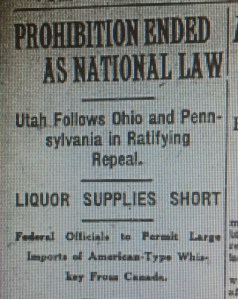
prohibition-repealOn December 5, 1933, Ohio, Pennsylvania and Utah provided the necessary support to officially repeal “the great experiment.”

Because this was such a foregone conclusion, the Arkansas Gazette and Arkansas Democrat carried only small, single column stories on their front pages.  Perhaps because this was Arkansas, it did not appear that any Little Rock businesses immediately set about to capitalize on this.  At least there were not any large scale advertisements in the days following that would indicate any specials or activities planned for the December 15 official end.

In fact, the only mention in the newspapers on December 15 was that President Roosevelt was trying to decide what the alcohol taxing structure should be.

One amusing story that ran in the Arkansas Democrat on December 6 was that Mrs. Roosevelt was keeping the wine glasses in storage at the White House for the time being.  She was awaiting action by Congress once it convened in January 1934 as to how it would deal with properly ending Prohibition in the District of Columbia.  Over 3,000 wine glasses had been in storage since Prohibition had been enacted.

Turkey Day Football – Central vs. Hall from 1958 to 1982

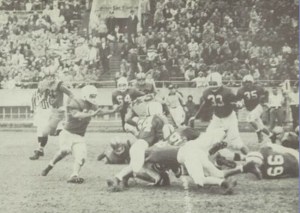
hall-central-1966For many years Little Rock dominated the state in football. First as Little Rock High School, then as Little Rock Central, the City’s oldest high school won over 20 state championships from the 1910s through the 1950s. With the emergence of Little Rock Hall, the 1960s were dominated by the City’s newer high school.  Together these schools led the state in football for over 60 years.

While the 1970s and 1980s saw less consistency in the quality of gridiron prowess at Little Rock’s two oldest public high schools, it did not matter.  A Hall vs. Central Turkey Day football game was often like a football season unto to itself.  The previous weeks of the football season did not matter – all that mattered was the Warriors against the Tigers.

The games were always played at Quigley Stadium, which was at the time the home stadium for all three of the Little Rock School District’s high schools (the third high school Parkview opened in 1968).  Each year Central and Hall would alternate which was the “Home” team.

The week leading to the game would feature skits and pep rallies at both high schools.  Pranks, rumors of pranks, and threats of retribution would abound between the schools.  Cars wrapped in orange and white would circle the Central campus one day, while black and gold cars would encircle Hall’s campus another day.

On game day there would be special performances at the stadium by the drill teams, cheerleaders and bands of both schools.  The Tiger and Warrior mascots would taunt each other.  Friendships between students at the rival schools were put on hold.  It was all about the tradition and THE GAME.  Church services, family dinners and any other activities were scheduled around the festivities at Quigley.

Hall High opened its doors and started playing football in 1957. As a new school with a largely younger student body, it only played smaller schools that initial season.  The first Hall vs. Central game was set for Thanksgiving 1958.

During the 1958-1959 school year, Little Rock’s high schools were closed for the ill-conceived, ill-advised reason to keep them from being integrated schools.  Though classes were not in session, football teams practiced and played.  The Arkansas Gazette noted that most of those games that season drew only 1,000 spectators, which was down from the usual 5,000 to 8,000 a game.

With the future of Little Rock’s high schools in doubt, there was some hand wringing about whether the 1958 game would be not only the first meeting between Hall and Central, but perhaps also the last.  In only its second year of playing, Hall was undefeated and poised to win the state championship heading into the Thanksgiving game.  Central surprised the Warriors by winning 7-0 before a crowd of 5,000, which cost Hall the undefeated season and the championship (El Dorado became state champs).  This game set the tone for the high stakes of the rest of the series.

The next year classes were back in session at Hall and Central. The future of the series was not in doubt. Hall achieved its first win with a 16-13 victory over the Tigers. Hall also captured a state championship with the win.

Over the years, the Thanksgiving Day game would deliver state championships to Central in 1960, 1975, 1978, 1980 and 1981.  Hall walked away on Thanksgiving Day with championships in 1964, 1966, 1969, 1977, and 1979.  On several other occasions, Central or Hall kept the other team from winning a championship.

Three times the teams fought to ties: 1962, 1963 and 1969. (The latter two games ended in 0-0 ties.)  The 1980 game was notable for being played in snow at Quigley Stadium. While the Thanksgiving Day games at Quigley (and its predecessor Kavanaugh Field) had often been played in the rain, snow was a new experience for the day.

With the changes of state athletic conference classification, the 1982 game was announced as the final Thanksgiving Day game between Hall and Central. The top two classifications were being combined which would necessitate conferences and playoffs to determine the state champion. This would mean that Hall and Central would need to meet before Thanksgiving.  Going into the game Hall led the series with 13 wins to Central’s 8 wins.

The 1982 edition lived up to the hype.  This was the 25th edition of the Hall and Central rivalry. While there was no doubt that Hall would end up with the most wins, Central wanted to make sure that they ended it in the way they started it in 1958 – with a win.

Central boasted a 4-1 record. Pine Bluff and LR Parkview were both 4-1-1. Hall was 3-0-2. As long as Central or Hall won outright, the winner would be state champ. A tie (and there had been three previous ones) would result in a four-way tie for first place.  Hall’s coach C. W. Keopple had led the team since 1964 and amassed a 10-6-1 record against Central.  The Tigers were mentored by Bernie Cox who was 4-3 against the Warriors since taking over in 1975.

Nearly 9,000 fans packed Quigley Stadium for a cold but dry day. As the buzzer sounded after four quarters, the Hall High Warriors were jubilant. They had won the game 14-3 after putting together a nearly flawless offensive effort. The win moved them into first place with a 4-0-2 record. Central, which had sat atop the conference most of the season, ended up in fourth place with a 4-2 record.  The defeat also ended the Tiger’s hopes for a third consecutive championship.  This game, like so many before it, provided high drama and excitement as it confounded some pundits yet also lived up to billing.

And with that, the series concluded.  In the end, Hall had fourteen wins while Central had eight.  There were also three hard-fought ties.  Central achieved four shutouts of Hall, while the Warriors blanked the Tigers three times.  In the twenty-five games, Central scored 228 points, and Hall scored 297 points.

From 1983 until 2005, Hall and Central continued to play each other in football. This time, they played for the ceremonial bell in what became known as “The Battle for the Bell.”  Today, the bell is proudly displayed at Quigley Stadium.  After 2005, Hall moved into a lower classification than Central. This put them on separate tracts facing different sets of teams.


Central Hall Central Hall
1958 7 0 1971 7 28
1959 13 16 1972 7 10
1960 20 0 1973 7 3
1961 6 9 1974 25 24
1962 14 14 1975 26 6
1963 0 0 1976 10 11
1964 0 8 1977 8 18
1965 7 20 1978 17 14
1966 3 7 1979 0 17
1967 0 28 1980 7 0
1968 14 17 1981 15 0
1969 0 0 1982 3 14
1970 14 35


Turkey Day Football in LR – Little Rock High vs NLR

lrhs-nlrhs-grid-1957After 20 years of playing a variety of schools on Thanksgiving, in 1934 Little Rock High School had started the new tradition of playing the North Little Rock High School Wildcats.  These cross-river rivals had played a few games previously in the 1910s and early 1920s. The competition was resumed in 1931, but was not on Thanksgiving Day until 1934.  With that game, the Tigers of Little Rock would begin a 49-year tradition of taking on their biggest rival on Turkey Day.

For much of the 1920s and 1930s, a Thanksgiving Day game for Little Rock High School meant rain.  That was the case in the 1934 meeting at Kavanaugh Field. (Located at the current spot of Quigley Stadium, it was a baseball field on which football games could also be played.  In 1936, the current stadium opened.)  The Tigers and Wildcats played to a 2-0 win achieved by the southside Bengals of Earl Quigley.

Another notable matchup was the 1938 game.  Little Rock won 12 to 7. With that win, it captured its first official state football championship. (Though the Arkansas Activities Association does now credit LRHS with several prior championships.)

The 1939 edition took place on Arkansas Thanksgiving.  That November featured five Thursdays.  President Roosevelt issued a proclamation that Thanksgiving would be the fourth Thursday, as it traditionally was. However Arkansas and a few other states chose to observe it on the final Thursday.  Little Rock won 6 to 0, but it was a messy game. Some sports fans joked that the game was FDR’s revenge on Arkansas for ignoring him regarding Thanksgiving.

In 1941, only a few days before the US would be plunged into World War II, North Little Rock achieved its first Turkey Day win over Little Rock.  The score was 26 for the Wildcats and 0 for the Tigers.  This was only the third ever loss for the Tigers on a Thanksgiving Day.  The Tigers were so dominant on Turkey Day games, a student had once remarked to a Gazette reporter that the matchup against Pine Bluff should be moved to Thanksgiving since the Tigers always seemed to win on that day.  (Pine Bluff was the state’s other football powerhouse at the time and often gave the Tigers fits in games.)

North Little Rock repeated as winner in the 1942 game, this time with a 31 to 12 score.  Writing for the Gazette, Orville Henry wondered if this would be the final meeting for the duration of the war.  He opined that many of the players might be in a different type of uniform for future games and that rubber might be needed for the war effort instead of athletic equipment.  While some colleges and high schools did drop football during the war, neither LR nor NLR did.

The Tigers were back on top in 1943 by a 13-7 score.  (It would be the last football game for the NLR coach who had been drafted.)  The 1944 game also featured a 13-7 score, but this time it was flipped and the Wildcats were winners.  The 1945 edition ground to a 13-13 tie.

In 1947, both teams were undefeated heading into the Turkey Day classic.  The inky wretches and scribes were predicting another evenly matched slugfest.  Instead Little Rock owned the game and came out with a 13-0 win.

The teams met eight times in the 1950s on Thanksgiving.  Little Rock won seven of the eight, losing the 1951 game by one point (13 to 14).

With the anticipation of a second Little Rock high school to be opened in a few years, Little Rock High School was rechristened as Little Rock Central High in 1954. The new school, named Hall High, opened in 1957 but played much smaller schools for its first year on the gridiron.  Plans were underway for Hall and Central to meet on Turkey Day in 1958, so the 1957 meeting of Little Rock and North Little Rock would be the final time the two teams would meet on Thanksgiving Day.

Little Rock Central High had dominated world headlines in September and October 1957 with the integration of the Little Rock Nine.  The sports coverage of this game however belied all the drama off the field. News reports focused on Turkey Day as the final game between the longtime rivals and on the fact that it had a morning start time instead of the traditional afternoon start time.  In the end, the Tigers had the same result as they did in the first Turkey Day meeting: a win.  The Bengals scored 40 while the Cats only managed 7.

After 24 meetings on Thanksgiving Day, Little Rock had 19 wins, 4 losses, and one tie.  Seven times they shut out the Wildcats, and one time the northern team blanked them.  The fewest total points scored were 2 in the 1934 game, while the 1950 game produced a cumulative total of 71 points (LR 64, NLR 7).  The Tigers scored a total of 517 points over 24 games and gave up only 203.