Turkey Day Football in LR – Beating a Variety of Opponents from 1914 to 1933

Turkey Day 1921From the first Thanksgiving football game for Little Rock High School in 1914 until 1933, the Tigers played a variety of opponents.  They faced off against other Arkansas high schools, out of state high schools, a college and a team of soldiers.  Their record in these twenty games was 18 wins and 2 losses.  While the opponent may have varied, each year the Tiger eleven lined up against their foes at home in Little Rock. The team had enough of a reputation that they could invite opponents and never had to travel.

Playing games on Thanksgiving had become a tradition by the time Little Rock joined in the fray in 1914. Their first Thanksgiving Day opponent was Texarkana High School.  The Tigers won by a score of 20 to 0. The crowd of 1,500 at West End Park (now the site of Quigley Stadium) not only witnessed the high school game, but also saw Arkansas College (now Lyon College) defeat Little Rock College (no association with UALR) by a score of 40 to 0.  With their win, Little Rock captured the state championship – their fourth since 1907.

By the next Thanksgiving Day, the field at West End Park was known as Kavanaugh Field. It would have that name until it was replaced by Quigley Stadium in 1936.  From 1915 until 1933, Little Rock would defeat three Arkansas high schools Van Buren, Benton and Hot Springs as well as high schools from Oklahoma, Mississippi, Louisiana, Texas, Alabama, Kansas, Illinois and Missouri.  Three of their out of state opponents returned for a second time, so even though these schools were generally overwhelmed by Little Rock High, it was obviously viewed as a positive experience.  Playing out of state teams garnered other benefits. In 1920, they played Tupelo Military Institute, which held the Mississippi-Alabama championship. By defeating them, Little Rock High School claimed the state championship of four states: Arkansas, Alabama, Tennessee and Mississippi.

In 1917, they beat the college team of Arkansas State Normal School (now UCA) by a score of 45 to 0. (The Tigers so overpowered State Normal that the Gazette mused that the extremely muddy field was all that kept LR from scoring more than 45 points.)

The Tigers’ only two defeats came in 1918 and 1924.  The first Thanksgiving Day defeat came in 1918 when Little Rock played a team of soldiers from Camp Pike. The soldiers were an average of 20 pounds heavier than the Tigers. They used that weight to their advantage to defeat the high schoolers by a score of 42 to 0.  This was at the height of the US involvement in The Great War. So this game was certainly part of Little Rock’s war effort as the City worked to extend hospitality to soldiers. The Tigers’ 1924 defeat was at the hands of Atlanta Tech High School by a score of 35 to 7.

While the Thanksgiving games were serious business for the Tigers and their fans, they also provided for moments of entertainment.  In 1923, the Gazette reported that the Tigers had hosted a dance at the Capital Hotel for the visiting Ensley High football team from Birmingham, Alabama.  One wonders if there were a motive to their hospitality considering that the next day the Tigers won by a score of 20-7. Perhaps distracting the opposing players the night before the game was all part of Coach Earl Quigley’s strategy.  On Thanksgiving 1929, Little Rock hosted previously undefeated Soldan High from Saint Louis. At halftime of the game (which would end with LR scoring 26 to their opponent’s 6), there was a performance by the Little Rock High School band as well as a group of girls called Quigley’s Quackers.

Based on their reputation as a powerhouse, Little Rock would continue to play teams from other states. But after 1933, Little Rock would play a close rival: first North Little Rock (1934-1957) and then Hall High (1958-1982).  During the two decades of playing various teams, the Little Rock Tigers achieved ten shutouts and suffered one shut out.  The Tigers scored 492 points and gave up 133 points.

1914 Little Rock 20 Texarkana 12
1915 Little Rock 40 Muskogee Central High 0
1916 Little Rock 46 Van Buren 0
1917 Little Rock 45 Arkansas State Normal 0
1918 Little Rock 0 Camp Pike 42
1919 Little Rock 52 Benton 0
1920 Little Rock 6 Tupelo Military Institute 3
1921 Little Rock 21 New Orleans Warren Easton High 3
1922 Little Rock 7 Bryan (TX) High 0
1923 Little Rock 20 Birmingham Ensley High 7
1924 Little Rock 7 Atlanta Technical High 35
1925 Little Rock 6 New Orleans Warren Easton High 0
1926 Little Rock 18 Birmingham Ensley High 6
1927 Little Rock 37 Wichita Central High 0
1928 Little Rock 18 Chicago Lindblom High 0
1929 Little Rock 26 Saint Louis Soldan High 6
1930 Little Rock 33 Chicago Lindblom High 13
1931 Little Rock 31 Dallas Woodrow Wilson High 0
1932 Little Rock 6 Saint Louis Cleveland High 0
1933 Little Rock 13 Hot Springs 6
  • Muskogee Central High has been known as Muskogee High since the 1970 integration of the formerly all-white school with an African American high school.
  • Tupelo Military Institute existed from 1913 to 1937.
  • Warren Easton High is Louisiana’s oldest high school. After Hurricane Katrina it is now a charter high school.
  • Bryan High School was replaced by Stephen F. Austin High School, which was replaced by a new Bryan High School.
  • Ensley High in Birmingham closed in 2006.
  • Atlanta Technical High closed in 1947. A charter school with the same name operated from 2004 to 2012.
  • Wichita Central High has been known as Wichita East High since 1929. It is the largest high school in Kansas.
  • Chicago Lindblom High now educates under the name Lindblom Math and Science Academy.
  • Saint Louis Soldan High now educates as Soldan International Studies High School
  • Woodrow Wilson High School continues to operate in the Lakewood neighborhood of East Dallas.
  • Saint Louis Cleveland High now educates as Cleveland Junior Naval Academy and is no longer in the longtime Grover Cleveland High School building.
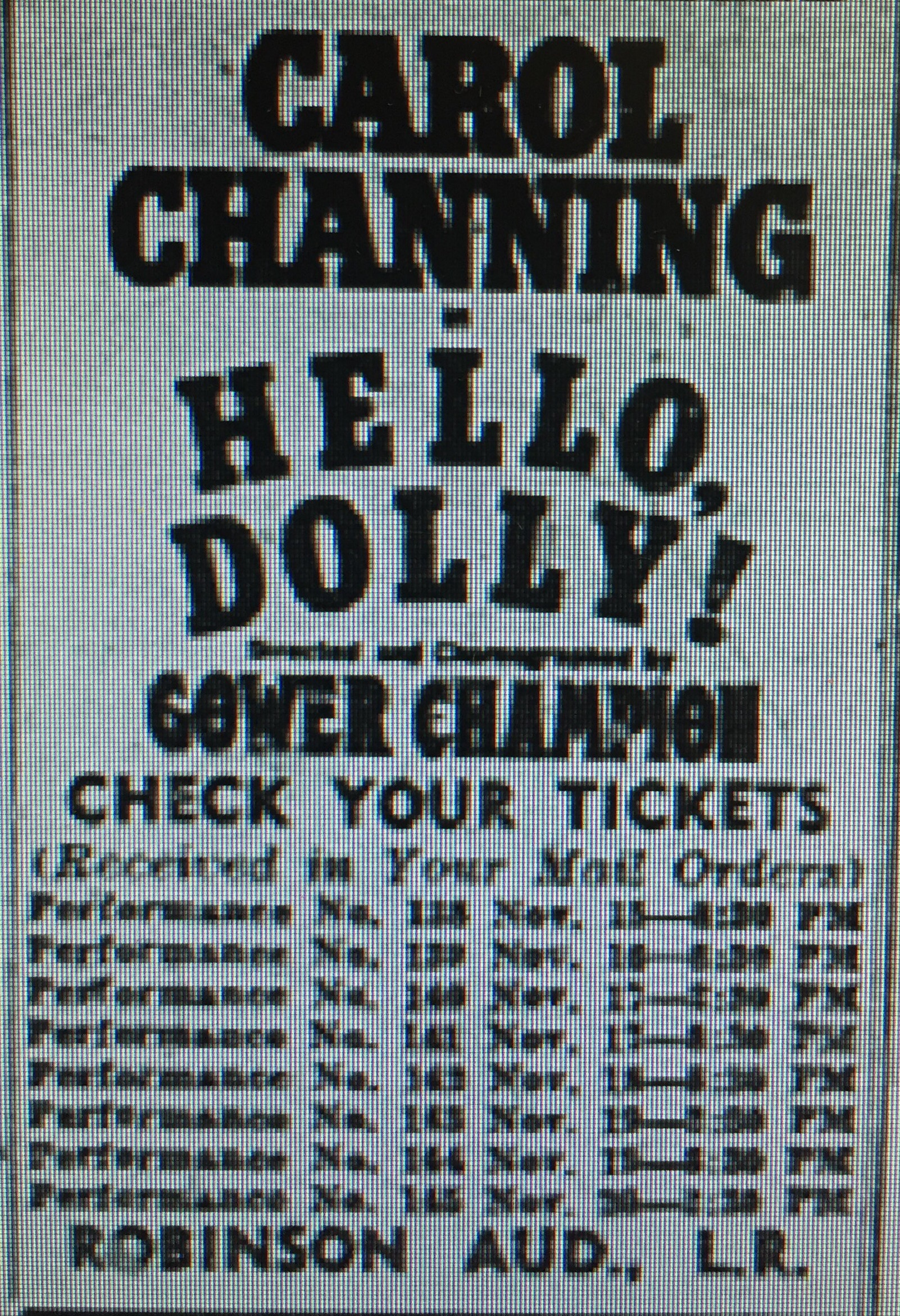
RobinsoNovember: Carol Channing brings HELLO, DOLLY! to Little Rock

50 years ago tonight, on November 15, 1966, Carol Channing opened a six day stint in HELLO, DOLLY! at Robinson Auditorium.  She would play 8 sold out shows over those six days.

Channing, who had won the 1964 Tony Award for Best Actress in a Musical for her role in this show, had recently returned to the national tour.  She had just wrapped filming THOROUGHLY MODERN MILLIE (for which she would receive an Oscar nomination). She had specifically requested that Little Rock be added to the tour.

Her breakout role was in 1949’s GENTLEMEN PREFER BLONDS. In that show she introduced the song “Little Girl from Little Rock.”  Since it had helped make her a star, she had long felt an affinity for the Arkansas capital.  Therefore when she rejoined the tour, she required that LR be one of her stops before she left the tour.

While in Little Rock, Channing was entertained at the Arkansas Governor’s Mansion and feted at parties.  She was made an honorary citizen of Little Rock, as well.

But she was here to perform. And perform she did. She was rarely known to miss a performance and always gave her utmost.  Bill Lewis, in his review in the ARKANSAS GAZETTE, stated “To hear Channing sing ‘Hello, Dolly!’ Is one of the great experiences of all musical theater to date…”

In assessing the show’s run in Little Rock (which would be seen by more than 20,000 people), Lewis summed up what many felt at the time — and to hear the reminiscences from a half century later, it still is a heartfelt sentiment — “A week’s too little.”

Little Rock Look Back: November 8 Presidential Election Arkansas Newspapers

November 8 has been a Presidential Election Day in Arkansas six times.  The first time such a date happened in the US, Arkansas did not participate because it was 1864.  The times it has happened have been 1892, 1904, 1932, 1960, 1988, and today.

A look back at newspaper headlines from the previous years tells a lot about not only the elections, but also the way news was delivered.  For the 1892 and 1904 elections, only the Arkansas Gazette is available.  Though the Arkansas Democrat existed, it did not yet publish every day.  Tuesdays do not appear to have been dates it was published.  (The Gazette itself would not be at seven days until the early 1900s when it finally started publishing a Monday edition.)

elex-ag-1892The 1892 election day Gazette intersperses news stories with advertisements.  One headline states poetically:  “Ballots: Like flakes of snow they will gently fall throughout the Union today.”  Another headline stated “Confident.  Democrats everywhere feel assured of Grover Cleveland’s election today.”  Indeed, Cleveland returned to the White House in 1892 after four years of Benjamin Harrison.

elex-ag-04By 1904, most front page advertising at the Gazette had been banished from the front page, although an small box ad for Blass Department Store is at the top.  Only three of the seven columns on the front page have above-the-fold headlines devoted to election stories, and two of those are about the State of New York.  This reflects new editor J. N. Heiskell’s desire to have the Gazette be national in scope. While early Gazettes often relied on national news to fill space, by the post Reconstruction era, the focus was largely on local news.   The lone local headline was “Arkansas will go Democratic” which was certainly a foregone conclusion at the time.  While Arkansas did go Democratic, Theodore Roosevelt kept the presidency in the hands of the GOP.  Interestingly another headline was about efforts to get Prohibition adopted in the state.  It would become an election issue for years to come.

elex-ag-32By 1932, both the Gazette and Democrat published Election Day editions.  The Gazette’s stories included predictions that FDR would win and a record number of ballots would be cast.  There were also separate stories which highlighted the final day of campaigning for both FDR and Hoover.  One of Mr. Heiskell’s above-the-fold editorials encouraged voting No on a variety of measures which dealt with public school financing, sales tax reduction, bond issuance, and reorganization of county election commissions and state government.

elex-ad-32The afternoon Democrat featured stories on Hoover and FDR in the last hours of the campaigns. Like the Gazette it anticipated a record turnout and showed that Pulaski County was experiencing heavy turnout.  The headline trumpeted that FDR had a lead as early results were starting to trickle in.  The Democrat also offered succinct analysis of key battleground states.  In the end, FDR did carry 42 of the 48 states in an election that saw a record of 38,582, 531 people casting votes for one of the two top candidates.

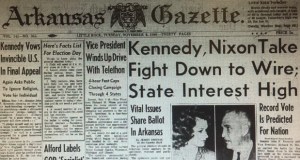
elex-ag-60The 1960 election ended up being one of the closest in popular vote in US history, with only 112,827 votes separating JFK from Nixon.  The Gazette headline was “Kennedy, Nixon take fight down to wire; State interest high.”  The front page also featured stories about Kennedy’s and Nixon’s last full day on the campaign trail.  A box on the front page reminded readers that liquor stores and beer sales could not take place during polling hours. Only persons who had paid their 1960 poll tax were eligible to vote–with an exception made for those who turned 21 after the poll tax deadline and through election day.  The last reminder was that the names of the parties, but not the candidates themselves, would appear on the ballot in the presidential race.

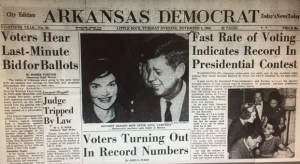
elex-ad-60The afternoon Democrat ran a large photo of Jackie and JFK after they had voted and a slightly smaller one of the Nixon family voting.  Two stories discussed the record turnout that appeared to be taking place — one was on a national scale, and the other was focused on Arkansas.  There was also a story on last minute campaigning.  In the end, over 68,000,000 votes were cast which was a record at the time.

elex-ag-88The most recent presidential election to take place on November 8 was in 1988.  It featured Vice President George H. W. Bush against Massachusetts Governor Michael Dukakis.  The Gazette (covering its final presidential election — though no one knew it at the time) featured a story on Bush and Dukakis in the final day of campaigning.  It also featured a guide to watching the returns and discussed how the networks made their decisions about calling states.  There was also a box highlighting key battleground states which included Massachusetts, Pennsylvania, New York, Illinois and Texas.  Interestingly, two of those were the home states of the candidates.

elex-ad-88By 1988, the Democrat had been a morning paper for several years going head to head with the Gazette.  It carried its own photos of Bush and Dukakis on the final full day of campaigning.  An inside story was highlighted on the cover which featured a Monday rally in Little Rock with Texas Senator Lloyd Bentsen (Dukakis’ running mate).  The 1988 campaign was long, by the standards of the time, but would be considered abbreviated today.  The 1988 election would mark the third consecutive presidential election that the GOP candidate carried Arkansas.

Little Rock Look Back: Airport Commission Created by LR Voters

lr-airport-commission-electionOn November 7, 1950, Little Rock voters approved the creation of the Little Rock Airport Commission.  This was an extremely rare initiated ordinance.

Local business leaders had tried two times prior to get the City Council to create an Airport Commission.  At the time, the Airport was managed by the Council’s Airport Committee, composed of aldermen.  Both times, the Council rejected the measure.  This prompted an organization called the Private Flyers Association to begin the drive to collect the signatures to place the ordinance on the ballot.  Mayor Sam Wassell was in favor of the creation of the separate commission to oversee the airport and was a member of the Private Flyers Association.

At the general election on November 7, 1950, the ordinance was on the ballot.  It passed with an overwhelming majority: 13,025 voters approved of it, and only 3,206 opposed it.  The Arkansas Gazette had been a proponent of the switch, endorsing it with a front page editorial entitled “An Airport for the Air Age.”

In many ways this movement was a precursor to Little Rock’s switch to the City Manager form of government later in the decade.  Where once the business leadership and city council had been one and the same, over the 1940s the two diverged.  Business leaders were less interested in party politics (and at the time the city races were partisan affairs) and more interested in professionally run government.  The main argument for a separate commission was that it would allow the airport to be run more efficiently and removed from party politics.  These would be the same arguments used by the Good Government Committee in 1956.

Also on the ballot in 1950 was a GOP challenger to a Democrat for one of the aldermen positions.  George D. Kelley, Jr., ran against incumbent Lee H. Evans.  Kelley was the first GOP contestant for a city race since Pratt Remmel ran unsuccessfully for City Council in 1938.  Remmel would be back on the ballot in 1951, this time for the position of mayor in a successful effort.

RobinsoNovember: Mayor R. E. Overman

Overman AuditR. E. Overman assumed the office of Little Rock mayor in April 1935. Around that time, a new wave of New Deal programs were filtering down from Washington DC to cities.  It can be said of Mayor Overman that he did not meet a New Deal program he did not like.  From rebuilding the sewer system, to creating a public water utility, to constructing of structures for the Museum of Fine Arts, Little Rock Zoo, and Boyle Park, Mayor Overman signed the City up for program after program.

While the programs were all worthwhile, and in some cases absolute necessities, Mayor Overman did not seem to consider how these massive projects running concurrently would impact the City finances.  In November 1935, he submitted a proposal to the Public Works Administration for the construction of a new municipal auditorium to be located at the northeast corner of the intersection of Scott Street and Capitol Avenue. It would have taken up three/quarters of that block and wrapped around the Women’s City Club building (now the Junior League of Little Rock headquarters).  Because of other projects in the works, he did not pursue any further action on the auditorium project at the time.

In November 1936, Mayor Overman asked the City Council to place three bond issues on a special election ballot for January 1937, one of which was a municipal auditorium. Though a location had previously been identified in 1935, at this point in time supporters made a concerted effort to disclose that no location had been selected.  After the election was called, there was a concerted effort by supporters of the three separate bond issues to collaborate.  Voters overwhelmingly approved all three issues, and Little Rock’s journey to a municipal auditorium at last was underway. Perhaps.

Over the summer, architects and lawyers were selected. In the autumn, a consultant was hired to help with the selection for the site.  The month of October was consumed with City Council battles over the auditorium site.  Mayor Overman favored a location at Markham and Spring Streets (now site of the Cromwell Building and the Bankruptcy Courthouse). Because the Federal Government owned half the site and did not want to sell it, that location was deemed not feasible – though that did not stop Mayor Overman and others from repeatedly citing it as their first choice.  The only person who favored the location at Markham and Broadway did not have a vote: Planning Commission Chair J. N. Heiskell. Though he had no vote, he had the twin bully pulpits of Planning Commission and the Arkansas Gazette. As other sites fell by the wayside, he kept advocating for it.  Finally, the City Council approved of Heiskell’s choice, and the auditorium had a site.

The groundbreaking had to take place by January 1, 1938, or the money would be rescinded. After finalizing a location, planning could get underway.  With a week to spare, the ground was broken on December 24, 1937.  Mrs. Joseph T. Robinson, widow of the recently deceased US Senator from Arkansas, joined Mayor Overman in the groundbreaking. This ceremony was the first mention of the building being named in memory of the fallen senator, who had died in the summer of 1937.

Construction progressed throughout 1938 and into 1939.  Because of the precarious state of the City’s finances, Mayor Overman lost the support of the business community.  In November 1938, he lost his bid for the Democratic nomination for Mayor and was denied a third two-year term.  He left office in April 1939.

Little Rock Look Back: Mrs. Adolphine Fletcher Terry

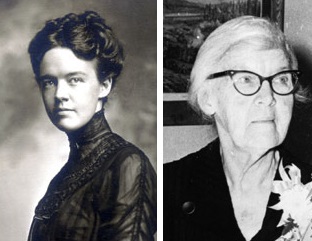
Photos from the collection of the Butler Center

Photos from the collection of the Butler Center

Adolphine Fletcher Terry was born on November 3, 1882 to former Little Rock Mayor John Gould Fletcher and his wife Adolphine Krause Fletcher.

Raised in Little Rock, in 1889 she moved into the Albert Pike House on East 7th Street, when her aunt transferred the title to her father. That house would be her primary residence the rest of her life.  Her sister Mary Fletcher Drennan never lived in Arkansas as an adult after marriage. Her brother John Gould Fletcher spent much of his adulthood in Europe before returning to Little Rock and establishing his own house, Johnswood.

At age 15, Adolphine attended Vassar. She later credited that experience as broadening her views on many issues.  After graduating at age 19, she returned to Little Rock.  Her parents both died prior to her 1910 wedding to David D. Terry, which took place at what was then known as the Pike-Fletcher House (and today is known as the Pike-Fletcher-Terry House).

She is perhaps best known today for establishing the Women’s Emergency Committee in 1958 and for her subsequent deeding of the family house to the City for use by the Arkansas Arts Center.  But her entire life was based on civic engagement.

She was instrumental in establishing the first juvenile court system in Arkansas and helped form the first school improvement association in the state. She was long an advocate for libraries, serving 40 years on the Little Rock public library board.  Through her leadership, the library opened its doors to African Americans in the early 1950s. Today a branch of the Central Arkansas Library System (the successor the Little Rock public library) is named after her.  Another branch is named after her Pulitzer Prize winning brother.

Adolphine formed the Little Rock chapter of the American Association of University Women, the Pulaski County tuberculosis association and the Community Chest.

In 1958, when the Little Rock public high schools were closed instead of allowing them to be desegregated again, she called Harry Ashmore the editor of the Gazette and exclaimed, “the men have failed us…it’s time to call out the women.”  With this, she formed the Women’s Emergency Committee to Open Our Schools. This group played a major role in getting the four high schools open the following year.

From 1933 to 1942, David Terry served in the U.S. Congress. During that time, Adolphine alternated her time between Washington DC and Little Rock. But she spent much time in Little Rock raising her five children.

After her husband’s death in 1963, she continued to remain active in civic affairs. In the 1960’s, she and her sister deeded the Pike-Fletcher-Terry House to the City of Little Rock for use by the Arkansas Arts Center upon both their deaths.  Following Adolphine Fletcher Terry’s death in 1976, Mary turned over the title to the City.

Adolphine Fletcher Terry is buried in Mount Holly Cemetery alongside her husband. Three of her children are also buried in that plot.  Her parents and brother are buried in a nearby plot.

Her son William Terry and his wife Betty continue to reside in Little Rock. Their daughters and their families also carry on Adolphine Fletcher Terry’s commitment to making Little Rock better.

RobinsoNovember: J. N. Heiskell

At the age of 87, J. N. Heiskell in 1960.

John Netherland (J. N.) Heiskell served as editor of the Arkansas Gazette for more than seventy years.  He was usually called “Mr. Heiskell” by all, but a very few confidantes felt confident to call him “Ned.”

Mr. Heiskell is the person most responsible for Robinson Center Music Hall being located at the corner of Markham and Broadway.  As Chair of the Planning Commission and editor of the Arkansas Gazette he had twin bully pulpits to promote this location when those on the City Council (who actually had the final say) were looking at other locations.  He felt the location would help create a cluster of public buildings with its proximity to the county courthouse and to City Hall.  Mr. Heiskell finally succeeded in winning over the mayor and aldermen to his viewpoint.

He was born on November 2, 1872, in Rogersville, Tennessee, to Carrick White Heiskell and Eliza Ayre Netherland Heiskell. He entered the University of Tennessee at Knoxville before his eighteenth birthday and graduated in three years at the head of his class on June 7, 1893.

His early journalism career included jobs with newspapers in Knoxville and Memphis and with the Associated Press in Chicago and Louisville. On June 17, 1902, Heiskell’s family bought controlling interest in the Arkansas Gazette. Heiskell became the editor, and his brother, Fred, became managing editor.

Governor George Donaghey appointed Heiskell to succeed Jeff Davis in the United States Senate after Davis’s death in office. Heiskell served from January 6, 1913, until January 29, 1913, when a successor was chosen by the Arkansas General Assembly.  His tenure is the shortest in the U. S. Senate history.  His first speech on the Senate floor was his farewell.  He was also only the second US Senator to live to be 100.

On June 28, 1910, Heiskell married Wilhelmina Mann, daughter of the nationally prominent architect, George R. Mann. The couple had four children: Elizabeth, Louise, John N. Jr., and Carrick.

In 1907, he joined a successful effort to build the city’s first public library. He served on the library board from that year until his death and was issued the first library card.  He also served on the City’s Planning Commission for decades.  In 1912, he was instrumental in bringing John Nolen to Little Rock to devise a park plan.

In the paper and in his own personal opinions, he crusaded on a variety of progressive causes.  Perhaps the most famous was the Gazette’s stance in the 1957 Central High desegregation crisis.  It was for this effort that the paper received two Pulitzer Prizes.

Although Heiskell stopped going to the office at age ninety-nine, he continued to take an active interest in the newspaper. He began by having a copy of the newspaper delivered to his home by messenger as soon as it came off the press each night. Eventually, he switched to having his secretary call him daily at his home and read the entire newspaper to him. He operated on the premise that “anyone who runs a newspaper needs to know what’s in it, even to the classified ads.”

A few weeks after turning 100, Heiskell died of congestive heart failure brought on by arteriosclerosis on December 28, 1972. He is buried in Little Rock’s Mount Holly Cemetery.  Interestingly, he is buried in the same cemetery as two of his most notable adversaries: Governor Jeff Davis, and segregationist Congressman Dale Alford.

Mr. Heiskell donated his vast papers to UALR. They are part of the Arkansas Studies Institute collection. These papers give insight into not only his career as a journalist, but also his political and civic affairs.  Thankfully he saved much of his paperwork. Without it, much insight into Little Rock in the 20th Century would be lost.