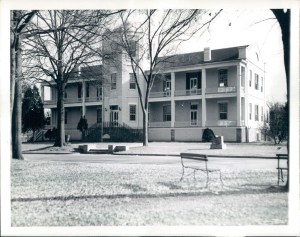
125 years of MacArthur Park

On July 4, 1893, Arsenal Park opened in Little Rock.  This was the City’s first municipal public park.  Though it predated the establishment of a formal Parks and Recreation Department by several decades, it is the oldest part of that department.

The land now known as MacArthur Park had originally served as a horse racetrack in the early days of Little Rock.  By 1836, the federal government purchased the land for construction of a military arsenal.  The flagship building, the Arsenal Tower building, is the only remaining structure from that time period.

The land served as a military outpost until 1892.  On April 23, 1892, a land swap took place where in the City of Little Rock was given the property with the stipulation that it would be “forever exclusively devoted to the uses and purposes of a public park.” (Never mind that the federal government took part of the land back for the construction of the Wilbur Mills Freeway.)  Congressman William L. Terry was active in negotiating the land swap.

In return for giving the City this land, the federal government took possession of land on the north side of the Arkansas River (then part of Little Rock) – that 1,000 acres became Fort Logan H. Roots.

The park officially opened on July 4, 1893, with the name Arsenal Park. Since it was the City’s first and only park at the time, residents started referring to it as City Park. In time, the designation Arsenal Park fell from use.  In fact, it is referred to as City Park exclusively and officially in City documents throughout the first 42 years of the 20th Century.

On March 9, 1942, Little Rock’s first public park was renamed by the Little Rock City Council.  By a vote of fourteen ayes, zero nays and four absent, the alderman approved Ordinance 6,388 which renamed the park in honor of General Douglas MacArthur.

In 1952, General MacArthur (contemplating a run for the GOP nomination for President) visited Little Rock in March.  Later that year, the eventual GOP nominee (and 34th US President) General Dwight Eisenhower visited the park.

Today, MacArthur Park is the anchor of the burgeoning MacPark district as well as the MacArthur Park Historic Distric.

Little Rock Look Back: Museum of Discovery opens in River Market

Museum of Discovery Logo when it opened in 1998

Founded in 1927 as the Arkansas Museum of Natural History and Antiquities in a downtown storefront, by 1997, the museum had been located in at least two other spots and had several different names.  On February 21, 1998, it reopened as the Museum of Discovery in its new location in the recently launched River Market district.  It occupied space on the first floor and basement of the Museum Center building (formerly the Terminal building the erstwhile train station which later was used for printing the Arkansas Democrat.)

The new name and new space reflected a greater emphasis on the science aspect of the museum’s mission.  It featured many hands on and interactive exhibits.

The museum spent one-third of its $10.6 million cost on exhibits.  Of the $10.2 million pledged for the museum, 47 percent — or about $4 million — came from a half-cent city sales tax approved by voters about five years ago. Another 14 percent came from foundations and 2 percent from private organizations and individuals. The remaining 37 percent came from corporations, sometimes in connection with specific exhibits.

Following a February 20, 1998, preview party, the official grand opening was held on February 21, 1998.

The previous museum space (inside the Arsenal building in MacArthur Park) occupied 14,000 square feet, 8,000 of which was display space. After the move, the museum had 35,000 square feet of display space.

Rock the Oscars: Gregory Peck

In August 1977, Oscar winner Gregory Peck appeared in Little Rock for the premiere of the film MacARTHUR.  He played the general who had been born in Little Rock but who spent most of his life downplaying (or even denying) that fact.
MacArthur was brought to the screen by Universal Pictures.  It was their attempt to capitalize on the success of the movie Patton, including sharing some of the same members of the production team.

Told entirely in flashback, it starred Peck as the fabled World War II general who was born in Little Rock. It focuses primarily on events in 1942 during the war, his dismissal by Truman in 1952, and his famous address to West Point in 1962.

Peck initially did not care for the subject or the script, but eventually stated that he grew to admire the challenges MacArthur faced.  Peck later called it one of his favorites roles, if not one of his favorite movies.

Producer Frank McCarthy, who worked on both Patton and MacArthur once said of Patton and MacArthur: “Both were complex men but General MacArthur was complex on a much broader scale. Patton had no ambition except to be a soldier and to command a field army. He was strictly command.”

Most of the film was shot on the backlot at the movie studio, which impacted the quality of the film.  The production budget simply would not allow for overseas location filming.

The premiere was a fundraiser for the Museum of Science and History (now the Museum of Discovery).  At the time it was located in the Arsenal Building, in which MacArthur had been born.  Since 1999, that has been home to the MacArthur Museum of Arkansas Military History.  Since MacArthur only spent a few hours in Little Rock as an adult, it is possible that Peck spent more time in the building than the General did.

The evening of August 5, 1977, started with an exclusive reception for 100 people with Gregory and Veronique Peck.  The movie itself was shown at the Cinema 150, where its general run would start on Saturday, August 6.  Following the film, a reception and silent auction brought people back to the museum.  Tickets ran $250 a person for all events, $100 a person for the film and post-show reception, and $25 for the movie.  It sold out.

Governor and Mrs. David Pryor escorted the Pecks into the theatre.  Former Governor (and World War II hero) Sid McMath introduced Mr. Peck to the crowd.  He extolled the virtues of Peck and MacArthur.  (It is interesting that he should admire MacArthur so much, since the General and President Truman had a well-publicized tiff, and McMath and Truman had enjoyed a warm relationship.)  Little Rock City Director Jim Dailey presented Peck with a Key to the City.

MacArthur did not lead to an Oscar nomination for Peck (though he did earn a Golden Globe nomination for the role).  But the actor had enjoyed four nominations prior to his win for To Kill a Mockingbird.  He also received the Jean Hersholt Humanitarian Award from the Academy.  He served as president of the Academy for several years.


Little Rock Look Back: Groundbreaking for Museum of Fine Arts (forerunner to Arkansas Arts Center)

MFA postcardOn January 3, 1936, the ground was broken for the Museum of Fine Arts building in City Park.  The facility would face Ninth Street and be to the west of the Arsenal Tower Building.   That building was the one remaining structure of more than 30 which had populated the grounds when it was a federal military establishment.

Excavation for the building uncovered the foundation for another structure.  New footings for the Museum would be poured into the old footings.

The cornerstone would be laid in October 1936, and the building would open in October 1937.  The building would serve as the museum’s home until the new construction for the new Arkansas Arts Center began in 1961. That construction would enclose the original Museum of Fine Arts.  By that time, the City had long renamed the park in honor of General Douglas MacArthur, who was born there when it had been a military installation.

Subsequent additions to the Arkansas Arts Center over the decades have further expanded the museum’s footprint.  After the 2000 expansion, the original 1937 facade was featured more prominently than it had been since 1963. With the Arkansas Arts Center again slated for renovation and expansion, the original 1937 facade will be maintained and possibly even further highlighted.

But it all began on January 3, 1936.

War Hero Cinema: Gary Cooper and Gregory Peck as LR natives

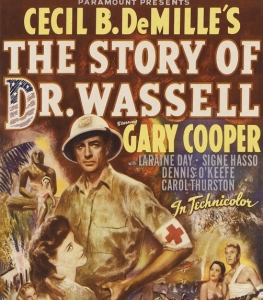
Dr. WassellThe exploits of two Little Rock natives during World War II have both been turned into Hollywood movies.  One was released during World War II and starred Gary Cooper as Dr. Corydon Wassell. The other was released in the 1970s and starred Gregory Peck as General Douglas MacArthur.

Born in Little Rock on July 4, 1884, Corydon McAlmont Wassell (called “Cory”) was born to Albert and Leona Wassell. A grandson of Little Rock Mayor John Wassell, he graduated from what is now UAMS in 1909. In 1911, he married Mary Irene Yarnell, with whom he would have four children.  In 1914, the couple volunteered to be Episcopal missionaries in China.  He served there until 1927. Following Mary’s death and his remarriage, he and new wife Madeline Edith Day Wassell returned to Arkansas in 1927.

Dr. Wassell resumed his medical practice. Given his experience with malaria in China, he proved to be an asset fighting malaria among Civilian Conservation Corps members in Arkansas. He was subsequently called to active duty in the Navy in 1936 and stationed in Key West.

After the outbreak of World War II, he was stationed in Indonesia. In early 1942, he refused to abandon his patients after the Japanese started invading Indonesia. Instead, he was able to evacuate a dozen severely wounded men over 150 miles to get to a ship. It took ten days for the ship to get to Australia, during which time it was attacked numerous times.  His official Navy Cross citation notes that he disregarded personal safety while caring for others.

He became an instant international hero. During the early days of the war, his heroism was one of the few bright spots. James Hilton wrote a biography of him; President Roosevelt praised him in a fireside chat. James Hilton wrote of Dr. Wassell in a book which was then adapted by Cecil B. DeMille into the 1944 movie starring Cooper.  Originally Arkansan Alan Ladd was wanted to play Cooper’s sidekick, but Ladd was pressed into military service and unavailable.

Thirty-three years after The Story of Dr. Wassell was released, MacArthur was brought to the screen by Universal Pictures.  It was their attempt to capitalize on the success of the movie Patton, including sharing some of the same members of the production team.

macarthur-gregory-peck-1977-everettTold entirely in flashback, it stars Gregory Peck as the fabled World War II general who was born in Little Rock. It focuses primarily on events in 1942 during the war, his dismissal by Truman in 1952, and his famous address to West Point in 1962.

Peck initially did not care for the subject or the script, but eventually stated that he grew to admire the challenges MacArthur faced.  Peck later called it one of his favorites roles, if not one of his favorite movies.

Producer Frank McCarthy, who worked on both Patton and MacArthur once said of Patton and MacArthur: “Both were complex men but General MacArthur was complex on a much broader scale. Patton had no ambition except to be a soldier and to command a field army. He was strictly command.”

Most of the film was shot on the backlot at the movie studio, which impacted the quality of the film.  The production budget simply would not allow for overseas location filming.

The film was released in July 1977.  One of the premieres was held in Little Rock. Peck attended a reception in the Arsenal Building where MacArthur was born. Now the home to the MacArthur Museum of Arkansas Military History, in 1977 the building still housed the Museum of Science and Natural History (now the Museum of Discovery).  Since MacArthur only spent a few hours in Little Rock as an adult, it is possible that Peck spent more time in the building than the General did.

Art+History Throwback Thursday: City Park in 1907

On February 9, Little Rock voters will have the chance to say Yes to improving the MacArthur Museum of Arkansas Military History, Arkansas Arts Center, and MacArthur Park.

Leading up to that election is a good time to look back at the development of MacArthur Park.

The land now known as MacArthur Park had originally served as a horse racetrack in the early days of Little Rock.  By 1836, the federal government purchased the land for construction of a military arsenal.  The flagship building, the Arsenal Tower building, is the only remaining structure from that time period.  

The land served as a military outpost until 1892.  On April 23, 1892, a land swap took place where in the City of Little Rock was given the property with the stipulation that it would be “forever exclusively devoted to the uses and purposes of a public park.” (Never mind that the federal government took part of the land back for the construction of the Wilbur Mills Freeway.)  

In return for giving the City this land, the federal government took possession of land on the north side of the Arkansas River (then part of Little Rock) – that 1,000 acres became Fort Logan H. Roots. The park opened on July 4, 1893, with the name Arsenal Park. Since it was the City’s first and only park at the time, residents started referring to it as City Park. In time, the designation Arsenal Park fell from use.  In fact, it is referred to as City Park exclusively and officially in City documents throughout the first 42 years of the 20th Century. 

On March 9, 1942, Little Rock’s first public park was renamed by the Little Rock City Council.  By a vote of fourteen ayes, zero nays and four absent, the alderman approved Ordinance 6,388 which renamed the park in honor of General Douglas MacArthur. 

The text of the ordinance says that “it is fitting and proper that the bravery and glorious deeds of General Douglas MacArthur, a native son of Little Rock, should be commemorated.”  This was passed a few months after the United States’ entry into World War II.   Though he was already a well-established military figure, most of the MacArthur legend during the war would take place after this naming. 

In 1952, General MacArthur (contemplating a run for the GOP nomination for President) visited Little Rock in March.  Later that year, the eventual GOP nominee (and 34th US President) General Dwight Eisenhower visited the park.  The 1952 Democratic nominee Adlai Stevenson also visited MacArthur Park in 1952.

Today, MacArthur Park is the anchor of the burgeoning MacPark district as well as the MacArthur Park Historic Distric.


Arts+History Throwback Thursday: Arsenal Building in 1942

Associated Press photo

Associated Press photo

On February 9, Little Rock voters will have the chance to say Yes to improving the MacArthur Museum of Arkansas Military History, Arkansas Arts Center, and MacArthur Park.

Leading up to that election is a good time to look back at the development of these two MacArthur Park sited museums.

This is a 1942 Associated Press photo of the Arsenal Building.  Completed in 1840, it was decommissioned in 1890 after fifty years as a military arsenal and later officer barracks.  In 1893, the land on which it sits was transferred from the Federal Government to the City of Little Rock. The land became Little Rock’s first public park.  Briefly known as Arsenal Park, it was known as City Park until 1942, when it was renamed MacArthur Park after the five star general who was born there in 1880.

From 1942 until 1996, it was home to the Museum of Science and History (under several different names). The building was restored in preparation for the museum moving in.  After the building was vacated again in 1997 (when the museum moved to the River Market to become the Museum of Discovery), it stood vacant in preparation for a proposed military history museum. In 1999, the building was hit by a tornado which severely damaged part of the roof and caused some interior flooding.  The building was repaired and restored while plans for the new museum were underway.  In May 2001, the MacArthur Museum of Arkansas Military History opened.