
Little Rock Look Back: Pulaski Heights officially becomes part of Little Rock

Ninth Ward

On January 13, 1916, the Little Rock City Council formally accepted Pulaski Heights into the City of Little Rock.

The Council had held a regular meeting on Monday, January 10, 1916, which was the same evening as the final meeting of the Pulaski Heights City Council.

Three days later, on Thursday, January 13, 1916, Mayor Charles Taylor again convened the Little Rock City Council to take the steps to officially annex Pulaski Heights into Little Rock.

By Ordinance 2259, the City’s boundaries were increased to include the land which had been Pulaski Heights.  Resolution 918 directed city staff to replat the land, which was necessary to bring the land in accordance with existing city plats and documents.

Resolution 919 set forth January 20 as a special election date to elect the two new members of the Little Rock City Council who would represent the new Ninth Ward of Little Rock.  Those who won would serve until April 1916.  The election would also serve as the primary for the April election.  Back then, winning the Democratic primary for a City race was tantamount to winning the race.  Since there were two seats being created, one would have a two year term, the other would be for only one year.  The candidate receiving the most votes on January 20 would, after April, take up the two year term and be able to run for re-election in April 1918. The candidate with the second highest total of votes would win the one-year term and be up for re-election in April 1917.  At the time, there were three publicly declared candidates for the two seats.  Another had been interested, but dropped out that morning.

Making Pulaski Heights the Ninth Ward was not the only focus of the City Council meeting.  An ordinance was also approved which allocated $438 for the purchase of beds, mattresses, chairs and other furniture for the City hospital.  (That is the equivalent of nearly $10,000 today.)  The Council then reimbursed a doctor the $438, which presumably had been spent on making the purchases.

Little Rock Look Back: End of City of Pulaski Heights

103 years ago today, the Pulaski Heights City Council held its final meeting.  Following the January 4 annexation election, Mayor L. H. Bradley convened the Pulaski Height City Council for the final time on January 10, 1916.
Five of the eight aldermen were present for the final meeting.  E. T. Reaves, R. G. Trickett, W.A. Turner, J. B. Webster, and H.C. Locklar.  Absent were J. S. Murphy, J.H. Hicks, and W. H. Keeton.

The City Recorder was A. M. Edwards, while O. E. White was Treasurer and Jonathan P. Streepey was City Attorney.

At the meeting, bills were paid and allowances were made for the transfer of assets and responsibilities to the City of Little Rock.  The minutes do not reflect if there were any valedictory addresses by any of the elected officials, which were common at that era.

Once Mayor Bradley and the Council had worked their way through the agenda, Alderman Reaves made the motion to adjourn the council sine die which was seconded by Alderman Webster. The motion passed unanimously.  With that, the Pulaski Heights City Council, which had first met in 1904, finished its business.

Little Rock Look Back: Post-Civil War government resumes for Little Rock

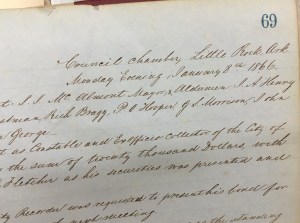
One hundred and fifty three years ago today (on January 8, 1866), Little Rock City Hall resumed functioning after the Civil War.  The City government had disbanded in September 1863 after the Battle of Little Rock.  From September 1863 through the end of the war (on on through part of Reconstruction), Little Rock was under control of Union forces.

Following the April 1865 conclusion of the Civil War, plans were made to restart local government in Little Rock.  Even though Arkansas would not have Congressional representation in Washington until June 1868 (becoming the second Confederate state after Tennessee), the establishment of local government took place in January 1866.  (It was supposed to have started earlier, but the local elections set for November 1865 were cancelled on the day they were originally set to take place.)

The first City Council meeting took place on Monday, January 8, 1866. The council met again on Tuesday, January 9 and Monday, January 15 as they were trying to establish committees and rules for the new government.

The first post-Civil War mayor was Dr. J. J. McAlmont, who was a physician and pharmacist. Following his service as the city’s chief executive, he would later be a co-founder of what is now UAMS.  The initial aldermen were I.A. Henry (who had been on the City Council when it ceased in 1863), Henry Ashley, M. H. Eastman, Rick Bragg, Dr. P. O. Hooper, G. S. Morrison, John Collins and Alexander George.

Their first action was to approve the bond of Thomas C. Scott as Constable and City Collector.  Vouching for him were S. H. Tucker and future LR mayor John Gould Fletcher.  The Recorder was asked to present his bond and the next meeting.

The Mayor then established several committees of the City Council and named his appointments. Among the committees were Finances, Streets, Ordinances, Mount Holly Cemetery, Fire Department and Police.

That meeting and the following two meetings, the City continued to approve motions, resolutions and ordinances to set up the duties and responsibilities of a government.

Ordinance Number 1 established the rates of Licenses for 1866.  Among those were:

  • $100 for the privilege of selling goods at auction
  • $20 for a one-horse wagon, paid quarterly
  • $35 for a two-horse wagon, paid quarterly
  • $50 for a four-horse wagon, paid quarterly
  • $25 to run a cab or bus (which would have been in some horse drawn conveyance), paid quarterly
  • $40 a month to sell liquor, wine, ale, beer, etc., by the glass or bottle to be consumed in a store, tavern, shop or store
  • $25 each quarter for each billiard table
  • $50 each quarter for each ten pin alley

Elvis at 84

Elvis backstage at Robinson–photo by Wayne Cranford

Eighty-four years ago today, Elvis Presley was born in Tupelo, Mississippi. He would, of course, grow up to become a cultural phenomenon.

Elvis performed in Little Rock throughout his career. In April 1972, he played at Barton Coliseum (with tickets on the arena floor going for a whopping $10!). In the 1950s, he played three at Robinson Auditorium. His first appearance was as his career was just starting to take off. The final appearance on that stage, a mere 15 months later, was when he had become a national icon.

His first appearance at Robinson was on February 20, 1955. Billed as the “WSM Grand Ole Opry” show, Elvis Presley was third on the bill behind the Duke of Paducah and Mother Maybelle and the Carter Sisters as he began week long tour of Arkansas and Louisiana. On this date there were a pair of shows, at 3:00 and 8:15 p.m., at Robinson Auditorium. Tickets were 75-cents in advance, $1.00 at the box office and 50-cents for kids. It is believed that Gladys and Vernon Presley attended this performance, invited by Elvis who wanted to introduce them to the Colonel. Gladys was a big fan of the Duke of Paducah. Elvis Presley, Scotty Moore, and Bill Black receive $350 for these two shows instead of their usual $200 per day. In August 1955, he returned and played Robinson as part of the All-Star Jamboree.

His third and final appearance at Robinson Auditorium was on May 16, 1956. This time, the Auditorium was packed. The tickets were $1.50 in advance at Walgreens and $2.00 at the box office. The ads featured 8 great acts in “his” variety show which consisted of the Jordonaires; Rick and Emil Flaim and their orchestra; vocalists Frankie Conners and Jackie Little and comedian-magician Phil Maraquin. A second show was added to accommodate the ticket demand.

About 30 minutes late, due to a missed flight, Elvis appeared on stage in a purple blazer and started singing “Heartbreak Hotel.” The crowd rushed the stage. Little Rock police officers were able to control them eventually and get the teenagers back to their seats. While the crowd was impressed, the police officers were less so. One of the patrolmen told the Arkansas Gazette reporter: “I wouldn’t know him if I saw him. And I wouldn’t be here unless I was being paid.”

Little Rock Look Back: Voters annex Pulaski Heights into Little Rock

On January 4, 1916, voters in Little Rock and Pulaski Heights voted overwhelmingly to annex the latter into the former.

First platted in 1890, Pulaski Heights had been incorporated as a city in August 1905.  By 1915, Pulaski Heights was booming.  It was growing so fast, that its infrastructure and public safety needs were far outpacing the city’s ability to pay for them.  Though there was a ribbon of commercial businesses along Prospect Avenue (now Kavanaugh Boulevard), it did not produce enough sales tax revenue to pay for City services. Then, as now, property taxes were also an important part of city revenue sources but not sufficient without sales taxes.

The City of Little Rock, likewise, was looking for ways to grow physically. At the time, the City was hemmed in by a river to the north and low, marshy land to the east. Current development was to the south, but even that presented limits in the foreseeable future. The best option was to grow to the west, but Pulaski Heights was in the way.  In 1915, Little Rock Mayor Charles Taylor (after failing in a previous attempt to re-annex North Little Rock into Little Rock), approached Pulaski Heights leadership about the possibility of annexation.

010516 PH electionIn November 1915, there were public meetings in Little Rock and Pulaski Heights to discuss the issue.  As a part of the annexation, Little Rock promised to build a fire station in the area and to install traffic lights, sidewalks and pave more streets.
On January 4, 1916, Little Rock voters approved the annexation of Pulaski Heights by a ten-to-one margin. The majority of Pulaski Heights residents also approved the deal.  The suburb became the city’s ninth ward.

This established a couple of precedents for the City of Little Rock which are in effect to this day.  The first is that Little Rock would not be a central city surrounded by a variety of small incorporated towns (in the manner that St. Louis and other cities are).  It was this thought process which has led the City to continue to annex properties.

Little Rock Look Back: David Fulton, LR’s 4th Mayor

On January 2, 1771 in Ireland, future Little Rock Mayor David Fulton was born.
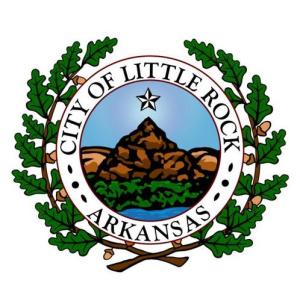
He served as the fourth and final mayor of the Town of Little Rock in 1835. His term was cut short by the transition of Little Rock from town to city status. Once that happened in November 1835, a new election had to be held.

Mayor Fulton was also proprieter of the Tan Yard, a tanning operation in Little Rock.   He later served as a judge and was appointed as  Surveyor General of Public Lands in Arkansas by President Martin Van Buren in 1838.

Mayor Fulton married Elizabeth Savin in June 1795 in Maryland.  She died in November 1829, while they resided in Alabama.  One of their children was William Savin Fulton who served as Territorial Governor of Arkansas in 1835 and 1836 and was one of Arkansas’ first US Senators upon statehood in 1836.  Mayor Fulton was serving as Mayor at the same time his son was Governor.

Mayor Fulton came to Little Rock in 1833.  His daughter Jane Juliet Shall and her four children came to Little Rock as well.  The family made the move to be nearer to the future governor.  The Fultons and Shalls rented the Hinderliter House (now part of Historic Arkansas Museum) in 1834.  One of his descendants, Louise Loughborough was the person who saved the Hinderliter House from destruction and was founder of what is now Historic Arkansas Museum.

In addition to serving as Mayor, he was president of the Anti-Gambling Society and a Pulaski County Justice of the Peace.  From 1836 until 1838, he was County Judge of Pulaski County.

Mayor Fulton died on August 7, 1843 and is buried at Mount Holly Cemetery as are several other members of his family.

Little Rock Look Back: Birth of Eli Colby, Little Rock’s youngest mayor

On Christmas Day in 1814, future Little Rock Mayor Eli Colby was born in Warner, New Hampshire.

At the age of 23, he moved to Little Rock in 1838.  After arriving, he soon became the editor and publisher of the Times and Advocate newspaper.  As a publisher and printer, Colby also had the contract to print official state notifications and documents in the early 1840s.

Politically, Colby served as a Justice of the Peace for several years.  In September 1843, he was elected Mayor of Little Rock in a special election to fill a vacancy. He was 28 years and nine months old, making him the youngest mayor in Little Rock’s history.  He left office in January 1844.  He died March 15, 1844, at the age of 29 after a long illness and was buried with Masonic honors.

No image of him is known to exist.