Clinton School, Central High National Historic Site partner with Little Rock Film Festival on screening of BESA: THE PROMISE as part of Reel Civil Rights Festival

Besa_PosterAs part of the 2014 Reel Civil Rights Festival, the film BESA: The Promise is being shown tonight at 6pm at Riverdale Theater on Cantrell Road.

BESA: The Promise is the never-before-told story of Albania –a small European country which opened its borders to shelter Jewish refugees, even as it endured a brutal Nazi occupation. It’s witnessed through the prism of two men joined together in a remarkable and unexpected quest: Norman H. Gershman, a renowned Jewish-American photographer determined to record the bravery and compassion of the Albanians;and Rexhep Hoxha, a Muslim-Albanian toy shop owner who sets out to return three precious books to the last surviving member of the Jewish family his father sheltered sixty years before. When these two men meet, an extraordinary and utterly unexpected personal drama is set in motion –one that bridges generations and religions…uniting fathers and sons…Muslims and Jews.

The film will be followed by a moderated discussion with Skip Rutherford, Dean of the University of Arkansas Clinton School of Public Service, and film subject Johanna Neumann about her life in Albania during the Holocaust.

The film is being shown by the Clinton School Speaker Series in partnership with the Little Rock Central High School National Historic Site.

Presenting Sponsor –Little Rock Film Festival

Premier Sponsor –Little Rock Central High School National Historic Site

Supporting Sponsors: arfilm|Arkansas Production Alliance, Central High Museum, Inc., City of Little Rock, Conyers Institute of Public Policy, Jefferson National Parks Association, Little Rock Central High School, Little Rock Convention and Visitors Bureau, Little Rock School District, Marriott Little Rock, Mosaic Templars Cultural Center, Moses Tucker Real Estate, Riverdale 10 Movies, National Park Service, Sue Smith Vacations/Vacation Valet, North Point Toyota, University of Arkansas Clinton School of Public Service, Philander Smith College, Whole Hog Cafe –North Little Rock, Arkansas Education Television Network, and Arkansas Motion Picture Institute


Little Rock Look Back: John Elliott Knight, LR’s 18th Mayor

Jno E Knight sigOn September 20, 1816, future Little Rock Mayor John Elliott Knight was born in Newburyport, Massachusetts. In 1843 he married Hannah Donnell in New York, and came to Little Rock that same year.

Knight was editor of the Arkansas Democrat from 1846 to 1850. He was also associated with the Arkansas Gazette and published the short-lived Chronicle. In 1851, Knight served as Mayor of Little Rock. In 1855, he served as a member of the City Council.

In 1858 a song was published entitled “I Am Near to Thee” which featured music by Arkansan Benjamin Scull and lyrics by Knight.  The song was dedicated to Mary Woodruff.

During the Civil War, he served as a Colonel.  During the 1850, 1860 and 1880 census, he was listed as an attorney.

He had one daughter, Elizabeth Knight, who married James S. Pollock, a banker in Little Rock. Knight died in Little Rock, Arkansas, on October 28, 1901, and was buried in Mount Holly Cemetery. Elizabeth Knight Pollock died in 1910.

As an attorney and newspaper editor, John E. Knight collected documents about the settlement of Little Rock. Those papers are now part of a collection at the Arkansas History Commission.  The majority of these papers are from William Russell to Chester Ashley, pertaining to pre-emption claims in and around Little Rock. Other material concerns the 1819-1822 dispute related to the the New Madrid Certificate and pre-emption claims of James Bryant, Stephen F. Austin, and William M. O’Hara.

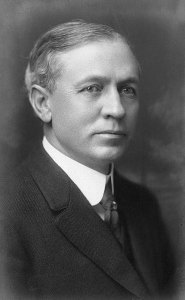
Little Rock Look Back: Charles E. Taylor, LR’s 42nd Mayor

Mayor TaylorOn September 15, 1868, future Little Rock Mayor Charles E. Taylor was born in Austin, Mississippi.  After locating to eastern Arkansas, his family moved to Little Rock around 1880.

Taylor graduated from Scott Street High School in Little Rock and proceeded to work for various hardware stores and other businesses.  In 1895 he married Belle Blackwood, with whom he would have four children.

In 1910, Taylor announced his intention to run for Mayor of Little Rock.  Though he had never held elective office, he had been involved in several civic organizations.  Taylor was the main challenger to Alderman John Tuohey.  Seen as a reformer, Taylor initially lost to Tuohey.  But after an investigation of voter fraud and a subsequent runoff, Taylor was elected Mayor.

Upon taking office in August 1911, Mayor Taylor focused on improving health conditions in the city, upgrading the fire department and enhancing the overall moral tone of the city.

As a progressive of the era, he fought against gambling, drinking and prostitution.  He created a Health Department and enhanced the City Hospital.  His efforts led to a decrease in the death rate in Little Rock.  As Mayor, Taylor introduced motorized vehicles to the Fire Department.  He also led the City Council to establish building and electrical codes.  Mayor Taylor also oversaw the construction of the 1913 Beaux Arts Central Fire Stations (which today serves as the City Hall West Wing).

Under his leadership, the City of Little Rock annexed Pulaski Heights. One of the selling points to Pulaski Heights residents was Mayor Taylor’s ability to provide modern services such as paved streets, water mains, fire hydrants and street lights.

Though neither his 1911 Parks Master Plan nor his dreams for a civic auditorium came to fruition, they paved the way for future successes in both of those areas.

Funding for projects continued to be a problem throughout Mayor Taylor’s four terms in office.  He believed that one obstacle to city funding was the prohibition by the state constitution against cities issuing bonds.  Though that ban has since been lifted, Taylor tried three times unsuccessfully to get it changed while he was Mayor.

In April 1919, Taylor left office after having served eight years.  He was the longest serving Mayor of Little Rock until Jim Dailey served in the 1990s and 2000s.  Following several business ventures, Taylor moved to Pine Bluff and led their chamber of commerce from 1923 through 1930.

Mayor Charles E. Taylor died in Pine Bluff in 1932. He was buried at Oakland Cemetery in Little Rock.

During his time in office, Mayor Taylor was presented with an unofficial flag of Little Rock by a group of citizens.  During Mayor Dailey’s tenure, that flag was restored by some private citizens and presented to the City.  It is framed on the 2nd Floor of Little Rock City Hall.

Little Rock Look Back: Sharon Priest, LR’s 70th Mayor

Photo courtesy of the Downtown Little Rock Partnership

On September 12, 1947, future Little Rock Mayor Sharon Priest was born in Montreal, Canada. After marrying Bill Priest, she came to Little Rock. She began her public service at the grassroots level when she led the effort to bring flood relief to Southwest Little Rock and Pulaski County following the devastating flood of 1978 that killed 13 people in central Arkansas.

She was appointed to the Little Rock City Beautiful Commission.  Following that, she challenged an incumbent City Director and won her first elective office in 1986. In January 1989, she was named Vice Mayor of Little Rock by her colleagues on the City Board.  Two years later, she was selected Mayor becoming only the second female to serve as Mayor of Little Rock.  During her service to the City of Little Rock, she spearheaded the effort to create a Little Rock flag.  At the conclusion of her second four year term on the City Board, she decided to run for Secretary of State.
In November 1994, she elected Secretary of State, becoming the first woman to be elected to that position in Arkansas.  She was reelected in 1998.   In the summer of 2000, she becamePresident of the National Association of Secretaries of State. After the 2000 presidential election, she was thrust into the forefront of the movement towardelection reform. Ms. Priest testified before U.S. House and Senate Committees on election reform. As Secretary of State, restoring the Governor’s Reception Room and the Old Supreme Court Chamber of the State Capitol to their original splendor and restoring the rotunda marble are a few of her proudest achievements.
In January 2003, Ms.Priest was selected to serve as Executive Director of the Downtown Little Rock Partnership. Priest reorganized the Partnership during that first year. The Partnership is spearheading the revitalization of Main Street in collaboration with stakeholders and the City of Little Rock, focusing on the redevelopment of existing structures, streetscape and safety. She has also been a leading champion for the redevelopment of MacArthur Park, the City’s oldest park.

Prior to her work as an elected official, she worked as Director of Membership for Little Rock Chamber of Commerce and was founder and owner of the Delvin Company, a property management firm. She was a Toll Fellow in 1995, and has won numerous distinctions including the Excellence in Leadership Fellowship, Women Executives in State Government, 1997 and TIME/NASBE Award for Outstanding Leadership in Voter Education, 1996.  In 2013, she was the featured honoree at the Big Brothers/Big Sisters Roast and Toast, becoming the first (and to date only) female to be so honored.

Little Rock Look Back: City Councilman Angelo Marre

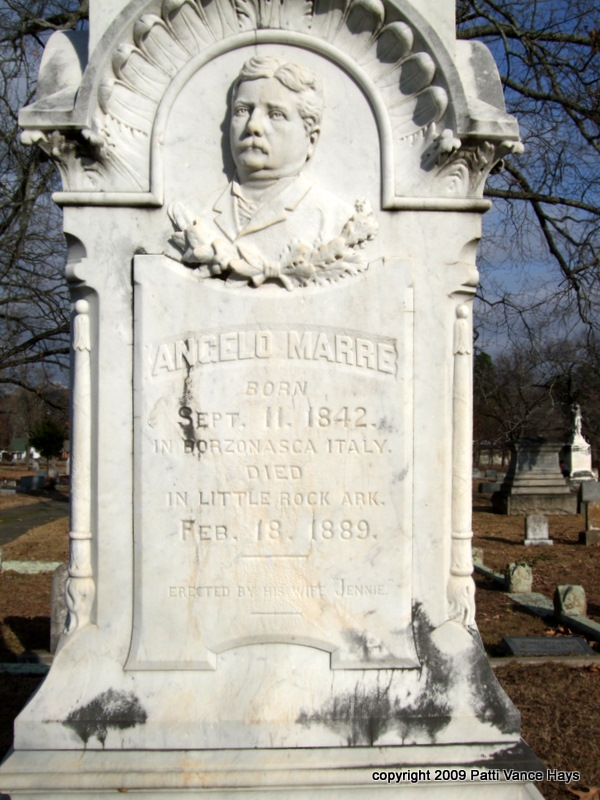
angelomarreOn September 11, 1842, future Little Rock Alderman Angelo Marre was born in Borzonaca, Italy.  He immigrated to Tennessee with his parents in 1854.

During the Civil War, he served in the Confederate Army. From 1865 to 1868, Angelo Marre worked for the Memphis Police Department but was forced to resign after he was accused of killing a man during an argument.  After his acquittal, he returned to the saloon business.  In 1872 Marre was convicted of stealing money and sentenced to three years in prison.

Tennessee Governor John Brown granted Marre a full pardon two years into his sentence, and he regained his citizenship in 1879.

After getting out of prison, he claimed an inheritance and joined his brothers in Little Rock.  He worked as a bartender at the Metropolitan Hotel.  He later opened a saloon and billiard parlor.

By the mid-1880s, Marre owned two saloons, a liquor import business, an office building in downtown LR, 3,000 sharesof stock in mining companies operating in Garland and Montgomery counties, and he was the first president of Edison Electric Company of LR.

In 1883, he was elected as an alderman on the Little Rock City Council.  He lost is bid for reelection in 1885. In 1888, he was an unsuccessful candidate for Pulaski County Sheriff.

villamarreAngelo Marre died February 18, 1889, as a result of his infection.  He is buried at Calvary Cemetery in LR. His custom designed, marble monument was ordered from Florence, Italy, and cost $5,000.

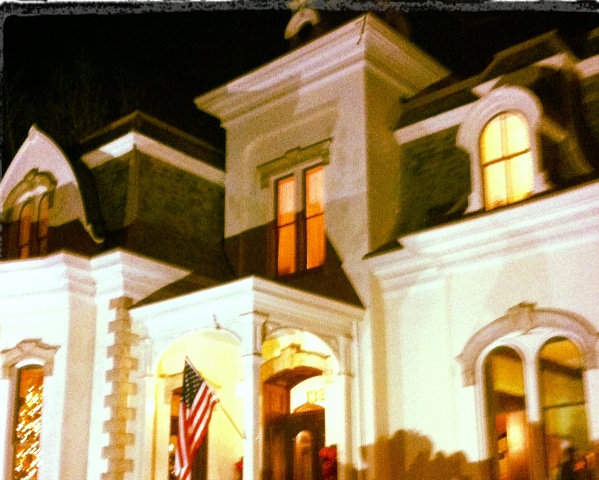
Marre is probably best known today as the builder of the structure now known as the Villa Marre.  Built in 1881, it is designed in the Italianate and Second Empire styles.  It was built in 1881 and 1882 on Block 21, Lots 5 & 6 of the Original City of Little Rock.  The cost was $5,000.

It was originally a red brick structure and has been modified and expanded several times as well as painted white.  It did not bear the name Villa Marre until the 1960s when historic preservation advocate Jimmy Strawn gave it that name.

After serving as the headquarters for the Quapaw Quarter Association for several years, it was returned to a private residence.  It is now available for special events and rentals.

The Villa Marre is probably best known locally and nationally for serving as the facade for the Sugarbaker design firm on the CBS sitcom “Designing Women.”  Though the interior of the house does not match the interior on TV, the building was featured in the opening credits as well as in exterior shots each week.

Little Rock Look Back: William Ashley – LR’s 22nd & 24th Mayor

W E Ashley signature

On August 6, 1823, future Little Rock Mayor William Eliot Ashley was born in Little Rock.  He would go on to become the first Little Rock Mayor to be born in Little Rock.  Ashley was the son of Mary and Chester Ashley; his father would later serve as a U. S. Senator from Arkansas.  He was the second of the couple’s seven children.

Though he was raised in Little Rock, he did receive some schooling out of state. The State History Commission has correspondence between eleven year old William, studying in New York, and his father. Part of the letter is a request for money.

LR sealOn October 26, 1846, he married Frances Eliza Grafton at Christ Episcopal Church.  They were the first Little Rock residents to be married in that church.  The couple had five children, including triplets.  Only one of the children, Frances (who was one of the triplets) survived to adulthood.

Ashley was first elected Mayor of Little Rock in 1857. After completing a two year term, he was succeeded by Gordon N. Peay (another scion of a prominent Little Rock family).  In 1861, Ashley returned to the office of Mayor.  He was reelected to a third term in 1863.  In September 1863, following the defeat of Confederate troops by the Union forces at the Battle of Little Rock, the City of Little Rock ceased operations.  On September 21, 1863, Little Rock municipal government closed its doors, stopped collection of taxes and disbanded.  Thus Ashley’s third term ended.

In addition to his interest in local government, Ashley was a member of St. John’s College Board and a director of the newly-formed Little Rock Gas Company.

William Elliot Ashley died on August 16, 1868 at the age of 45.  He was buried in Mt. Holly Cemetery (which sat partially on land that had once belonged to his family). His parents, wife and children are all buried in Mt. Holly as well.

Interestingly, for someone who grew up in a prominent family, there does not appear to be a surviving likeness of Mayor Ashley – either in painting or photograph.  Several exist of his parents, but none of him.

Little Rock Look Back: William G. Whipple – LR’s 34th Mayor

whippleOn August 4, 1834, future Little Rock Mayor William G. Whipple was born in Connecticut.  He attended school in Massachusetts and graduated from Wesleyan University. After studying law at Albany Law School, he moved to Milwaukee, Wisconsin.

In 1868, Whipple moved to Little Rock following the 1866 death of his first wife in Wisconsin. Long active in Republican politics, he quickly became involved in Little Rock’s political and social life.  Shortly after his arrival he was appointed United States Attorney and served three years.

In 1870, he married Mary S. Dodge, daughter of former mayor Roderick Lathrop Dodge MD.  They had one son Durand, who followed his father into the legal profession. The Whipples were active members of Trinity Episcopal Cathedral.

In 1887, Whipple was elected Mayor of Little Rock and was re-elected two years later.  Whipple’s mayoral administration introduced electric lighting to the city beginning on September 1, 1887, paved many streets with granite and macadam, created sixty miles of new brick and concrete sidewalks, and introduced a steam dummy railway.

In 1892, he ran for Governor of Arkansas as the Republican nominee but was unsuccessful.  In 1895, he sought a third term for Mayor but was defeated by James A. Woodson.

From 1897 to 1900, he served as register of the US Land Office in Arkansas.  Whipple, who had long practiced law, was appointed United States Attorney for the Eastern District of Arkansas in 1900.  He served in that capacity until 1913.

In July 1914, Mayor Whipple died.  He is buried at Oakland Cemetery in Little Rock.