Little Rock Look Back: Donald Mehlburger, LR’s 62nd Mayor

Mayor D L MehlburgerOn October 19, 1937, future Little Rock Mayor Donald Lee Mehlburger was born in Little Rock.  His parents were Max A. Mehlburger and Mary Lou Covey Mehlburger who also had another son Max C. Mehlburger.

Mehlburger’s first run for the City Board of Directors was in November 1968 when there was an open seat.  At the time he was 30, the youngest one could be and be elected to the City Board.  He lost that race, but eight years later ran again.  This time Mehlburger won the race.  At his first meeting on the City Board, Mehlburger was selected as Mayor of Little Rock by his colleagues.

Prior to running for the City Board the second time, Mehlburger had been appointed to the Planning Commission.  Planning and growth were two important emphases for Mayor Mehlburger, in addition to public safety.  He stressed the importance of quality growth in the edges of the city and a push for a revitalized downtown.  Mayor Mehlburger was also an advocate for public mass transit.

Due to business interests taking up too much of his time, he resigned from the City Board a few months before his term was up.  But he remained engaged in civic affairs.  Historic preservation was important to Mehlburger.  In addition to owning historic properties, he was a founding board member of the Historic Preservation Alliance of Arkansas.  He had graduated from the University of Arkansas and was a member of Trinity Episcopal Cathedral.  He had also been active with the Junior Chamber of Commerce (Jaycees) and Rotary Club 99.

Mehlburger died on May 25, 1992 and was buried at Mount Holly Cemetery.  His grave marker features an engraved sextant which pays tribute to his career as an engineer.  It also notes that he was Mayor of Little Rock.  Mayor Mehlburger was survived by his wife Susan and his three children – Donald Lee Jr., Harry and Katherine.

Little Rock Look Back: City Flag Adopted

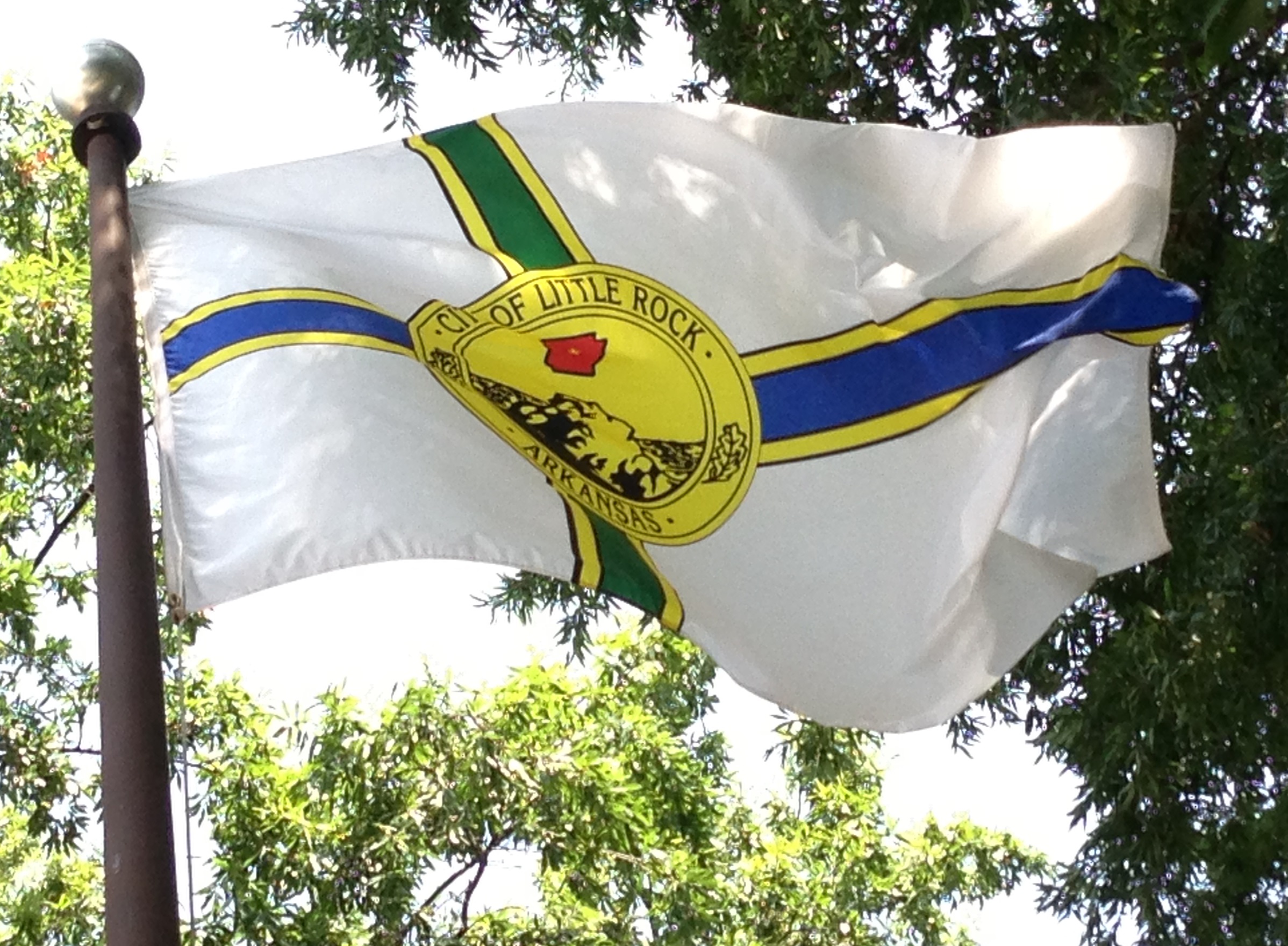
City FlagOn October 18, 1988, the City of Little Rock Board of Directors adopted the first official flag for the City of Little Rock.

The adoption of Ordinance No. 15,566 was the culmination of a design competition which had been spearheaded by Little Rock City Director Sharon Priest (later Little Rock Mayor, Arkansas Secretary of State and now Executive Director of the Downtown Little Rock Partnership).

Prior to the Official Board of Directors meeting that day, a press conference was held in the Little Rock City Board Chambers for presentation of the City’s flag.  The City Beautiful Commission, a commission of the Department of  Parks and Recreation, sponsored a the contest which received a total of fifteen flag designs.

The flags were judged October 12, 1988, by City Directors and City Beautiful Commission Members. Director Sharon Priest presented the winning flag and introduced David Wilson, a law clerk at the Mitchell Law Firm, who designed the flag chosen for the $1,000 first prize. The second-place winner was Craig Rains, who received $500; and the third-place recipient was David Tullis, who received $250.

The flag was adopted by the City Board that night by a 6-0 vote; former mayor and current director Charles Bussey was absent.  Those voting to adopt the flag were Mayor Lottie Shackelford and directors Sharon Priest, Tom Prince, Buddy Villines, Buddy Benafield and Tom Milton.  Priest would be a future mayor while Prince, Villines and Benafield had all served as mayor.

The official description of the flag is as follows:

As the official flag of the City of Little Rock, its symbolism is described as follows: A clean white background of the banner represents the optimism and open potential that the city has to offer. The royal blue horizontal broad stripe symbolizes the Arkansas River which borders Little Rock, and has served as an economical and historical emblem since the city’s beginning. The forest green stripe runs vertical to the royal blue stripe, creating a cross which symbolizes the location and statute of Little Rock—a city serving not only as the crossroads of Arkansas, but a crossroad of the mid-southern United States as well.

The strong forest green color depicts the fields, parks and forests which contribute to the natural beauty of the city. The seal of the flag is a modernized adaptation of the current Little Rock seal. The razorback red silhouette of the great State of Arkansas shows her capitol, the City of Little Rock, represented by the centered star. The star rises directly above “The Little Rock”—the protruding cliff along the Arkansas River, which was discovered in 1722 by French explorer La Harpe, when the city was given the name. The Arkansas River behind the rock and the symmetrical oak leaves in the border of the seal are a stylized illustration of what the flag’s stripes represent—the natural beauty of the city. Finally, the gold color of the seal and bordering stripes symbolize the superior economic history, and the future economic potential that is available in the City of Little Rock, Arkansas.

LR Cultural Touchstone: Ellen Turner Carpenter

Mrs CarpenterEllen Turner Carpenter was born on July 30, 1916 on West Ninth Street.  At the time of her death at the age of 93, her life had come full circle.

As a young girl, she was an active participant in the thriving African American life along west Ninth Street in downtown Little Rock. She attended many events at the Mosaic Templars Hall which sat at Ninth and Broadway.

A longtime Little Rock educator, she became the moving force behind preserving the Mosaic Templars building in the 1980s.   In 1992, she became president of the Mosaic Templars Building Preservation Society, which worked to preserve the Mosaic Templars building in Little Rock to create a museum for black history in Arkansas. Mrs. Carpenter served as president of the society until her death.

In the 1990s, the City of Little Rock purchased the building to keep it stable while the Preservation Society sought to raise the funds.  Due to lobbying efforts led by Mrs. Carpenter, the State of Arkansas purchased the building from the City with the intention of turning it into a museum under the auspices of the Department of Arkansas Heritage.  At a ceremony in 2003, Vice Mayor Willie Hinton handed the keys of the building to Governor Mike Huckabee with Mrs. Carpenter nearby beaming.  Governor Huckabee appointed her to the state advisory committee for this new museum.  She would serve as chair of that committee.

On March 16, 2005, tragedy struck.  The building burned to the ground.  That afternoon at a press conference at the State Capitol, leaders expressed their resolve that the project would move forward with a new building following the original design.  One of the speakers that afternoon was Mrs. Carpenter. She started out in her usual quiet voice. But as she recalled her youth spent at the Mosaic Templar’s building, the years melted away. She demonstrated some of the step dancing she had done as a teenager.

On September 20, 2008, she presided over the grand opening of the new Mosaic Templars Cultural Center. It was the culmination of 15 years of official work and many more years of dreaming.  At the ceremonies, she declared “We made it!” “We made it! We made it!”

Mrs. Carpenter remained an active supporter of the MTCC until her death on July 27, 2010, just three days shy of her 94th birthday.

Throughout her life she wore many hats (including numerous ones to church on Sunday). She was an educator, neighborhood organizer, and public servant. Everyone who met her was positively impacted by her.  Due to her vision and endurance, thousands each year are still positively impacted by her when they visit the Mosaic Templars Cultural Center.  Fittingly, the conference room at MTCC is named in her memory.


Little Rock Look Back: Warren E. Lenon – LR’s 39th Mayor and Father of City Hall

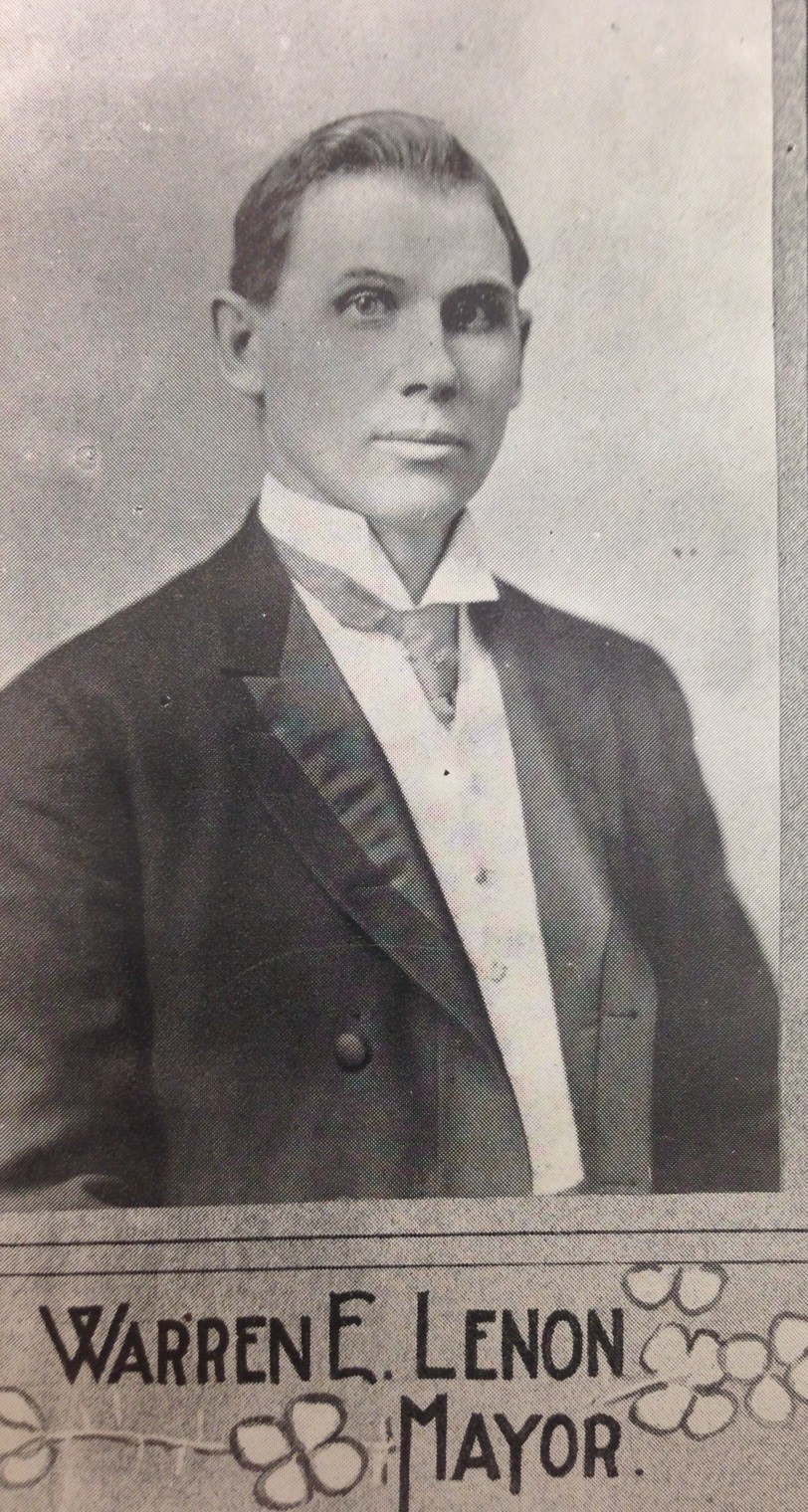
OMayor Lenonn October 8, 1867 in Panora, Iowa, future Little Rock Mayor Warren E. Lenon was born.  He was one of eleven children of John D. and Margaret M. Long Lenon.

Lenon came to LIttle Rock in 1888 after finishing his schooling in Iowa.  He helped set up an abstract company shortly after his arrival.  In 1902 he organized the Peoples Savings Bank.  Among his other business interests were the City Realty Company, the Factory Land Company, the Mountain Park Land Company, and the Pulaski Heights Land Company.

From 1895 to 1903, he was a Little Rock alderman, and in 1903, he was elected Mayor of the city. A progressive Mayor, he championed the construction of a new City Hall which opened in 1908.  At the first meeting of the City Council in that building, Mayor Lenon tendered his resignation.  His duties in his various business interests were taking up too much of his time.

Mayor Lenon had been a champion for the establishment of a municipal auditorium. He had wanted to include one in the new City Hall complex. But a court deemed it not permissible under Arkansas finance laws at the time.  He also worked to help establish the first Carnegie Library in Little Rock which opened in 1912.

Mayor Lenon continued to serve in a variety of public capacities after leaving office.  In the 1920s, he briefly chaired a public facilities board for an auditorium district. It appeared he would see his dream fulfilled of a municipal auditorium.  Unfortunately the Arkansas Supreme Court declared the enabling legislation invalid.

In 1889, he married Clara M. Mercer.  The couple had three children, two of whom survived him.  A son W. E. Lenon Jr., and a daughter Vivian Mercer Lenon Brewer.  She was married to Joseph Brewer, a nephew of Joseph Taylor Robinson, after whom the City’s eventual municipal auditorium would be named.  Mrs. Brewer was also a leader of the Women’s Emergency Committee.

Mayor Lenon died June 25, 1946 and is buried at Roselawn Cemetery.  Lenon Drive just off University Avenue is named after Mayor Lenon.

Little Rock Look Back: First meeting of Pulaski Heights City Council

Pul Heights CC minutesOn September 28, 1905, the first meeting of the Pulaski Heights City Council took place.  The newly elected Mayor was J. H. Joslyn, the Recorder was F. D. Leaming, and new Alderman present were E. E. Moss, Maxwell Coffir and C. C. Thompson.  Pulaski Heights had been incorporated on August 1, 1905.  At that time its population was estimated at between 300 and 400.

The first ordinance, which was offered by E. E. Moss, was to set a tax rate and give the City the ability to levy taxes.  Next was a motion to establish a committee to establish rules and procedures for the council. The final business before the Council was to allow the Recorder to order stationary, a seal and a record book (that record book is now in the vault at Little Rock City Hall).

The next meeting would be October 28.  At that meeting, two other Aldermen are mentioned in the minutes (Fauble and Paul) but were absent from that meeting as well.  Mr. C. M. Fauble was present at the third meeting.  Mr. R. O. Paul did not appear until the fifth meeting (December 13, 1905).

Interestingly the Recorder had a vote in the Council meetings (which was not a practice in the City of Little Rock at the time).

The Council did not have a permanent meeting place until the third meeting.  At that point in time, they used space in the offices of Dr. Hockersmith.  They later met in a building which is now part of the Pulaski Heights Baptist Church campus.

Pulaski Heights was a separate City until January 1916.  On January 4, 1916, Little Rock voters approved the annexation of Pulaski Heights by a ten-to-one margin, and the suburb became the city’s ninth ward. This established a couple of precedents for the City of Little Rock which are in effect to this day.  The first is that Little Rock would not be a central city surrounded by a variety of small incorporated towns (in the manner that St. Louis and other cities are).  It was this thought process which has led the City to continue to annex properties.

In addition, this move to annex Pulaski Heights was the first time that the City grew toward the west.  Previous growth had been to the south.  By emphasizing western expansion, this has allowed Little Rock to continue to grow.

Arts in Park and on Stages with ACANSA today

acansaThe ACANSA Arts Festival moves into the weekend with a full day of activities.

ARTISTS IN THE PARK
12:00pm to 6:00 pm
MacArthur Park
FREE

The Arkansas Arts Center will host a visual artist day at MacArthur Park from noon to 6:00 p.m.   This event is free and open to the public.  The first two hours are dedicated to children with a variety of art activities, and entertainment by Brian Kinder, a singer/ songwriter who performs rollicking goodtime concerts for kids.

Family entertainment by a variety of musical groups will begin at 2 p.m. Bands include the Clark Family Trio, the Greasy Greens, and SOULution.  Local food trucks will offer refreshments for purchase.

Artists will produce and sell art throughout the afternoon and will have the option to participate in a friendly Quick Draw Competition during the event.  Artists will be paired off to draw each other and the winner will receive a $500 prize!

The Quick Draw competition is open to anyone.  Know an artist who would like to participate?   Please have them contact Linda Newbern at lnewbern@ACANSAartsFestival.org.

Sponsored by: Arkansas Children’s Hospital, City of Little Rock & Little Rock Convention and Visitors Bureau
 

Acansa PuppetSUSPENDED ANIMATION
7:00 pm to 9:00 pm
Scottish Rite Masonic Temple
$20 to $50

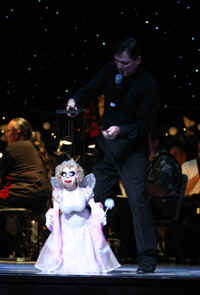
In a cabaret presentation distinctly adult in its sophistication and artistry, internationally acclaimed marionette artist Phillip Huber is in full view of the audience as he controls incredibly compelling characters through a series of variety vignettes revealing humor, pathos, drama and grace.

Phillip Huber is most widely known for his work in the 3-time Academy Award nominated film “Being John Malkovich” and his work in the Disney film “Oz the Great and Powerful,” starring James Franco, Michelle Williams and Mila Kunis. Shimmering with nuance, sophistication and imagination, you won’t want to miss this opportunity to experience a world of sophisticated puppetry designed for entertaining discerning tastes.


Acansa DallasDALLAS BLACK DANCE THEATRE
7:00 pm to 9:00 pm
NLR High School East Campus Auditorium
$10 to $50

Dallas Black Dance Theatre celebrates its 36th season as the oldest, continuously operating professional dance company out of Dallas, Texas. The ensemble, a contemporary modern dance company, consists of 12 professional, full-time dancers performing a mixed repertory of modern jazz, ethnic and spiritual works by nationally and internationally known choreographers.

Sponsored by: Arkansas Black Hall of Fame, City of North Little Rock, North Little Rock Chamber of Commerce, North Little Rock Economic Development Corporation, North Little Rock Visitors Bureau


acansa Mike Disfarmer 3DISFARMER
8:00 pm to 10:00 pm
Argenta Community Theatre
$30

Don’t miss this production of Disfarmer, written by award-winning Arkansas playwright Werner Trieschmann and directed by Bob Hupp of The Rep.  Disfarmer is a comedic portrait which tells the story of Mike Disfarmer, an eccentric photographer from Heber Springs, Arkansas who charged townsfolk and visitors a quarter to have their picture taken in the early forties—and caused a minor speculative mania decades later as New York gallery owners “discovered” his work and descended on the small Arkansas town.

Nothing speaks louder about Mike Disfarmer than his photographs.  Before the play, stop by  Argenta Gallery at 413 Main Street to enjoy an exhibit of Disfarmer photographs. In 1974, Peter Miller purchased the collection of Disfarmer glass negatives from Joe Albright. The Disfarmer prints in this exhibit have been archivally printed from the original Disfarmer glass negatives

Sponsored by: Peter Miller


Acansa St PaulACANSA Late Night II – St. Paul and the Broken Bones
9:00 pm to 11:00 pm
South on Main
SOLD OUT

This Birmingham, Alabama based soul band harkens back to the region’s classic soul roots while extending the form with electrifying potency.  Lead singer, Paul Janeway, takes the soul revival to an equally outrageous place with a voice that hovers between sexy sweet and flat-out dirty.  The horn-fueled Broken Bones re-create one funky groove after another, sounding more like the truth than any band since the Seventies.

Sponsored by:  DOWNSTREAM Casino Resort with staff provided by Oxford American

Little Rock Look Back: City Hall Ceases Operation in 1863

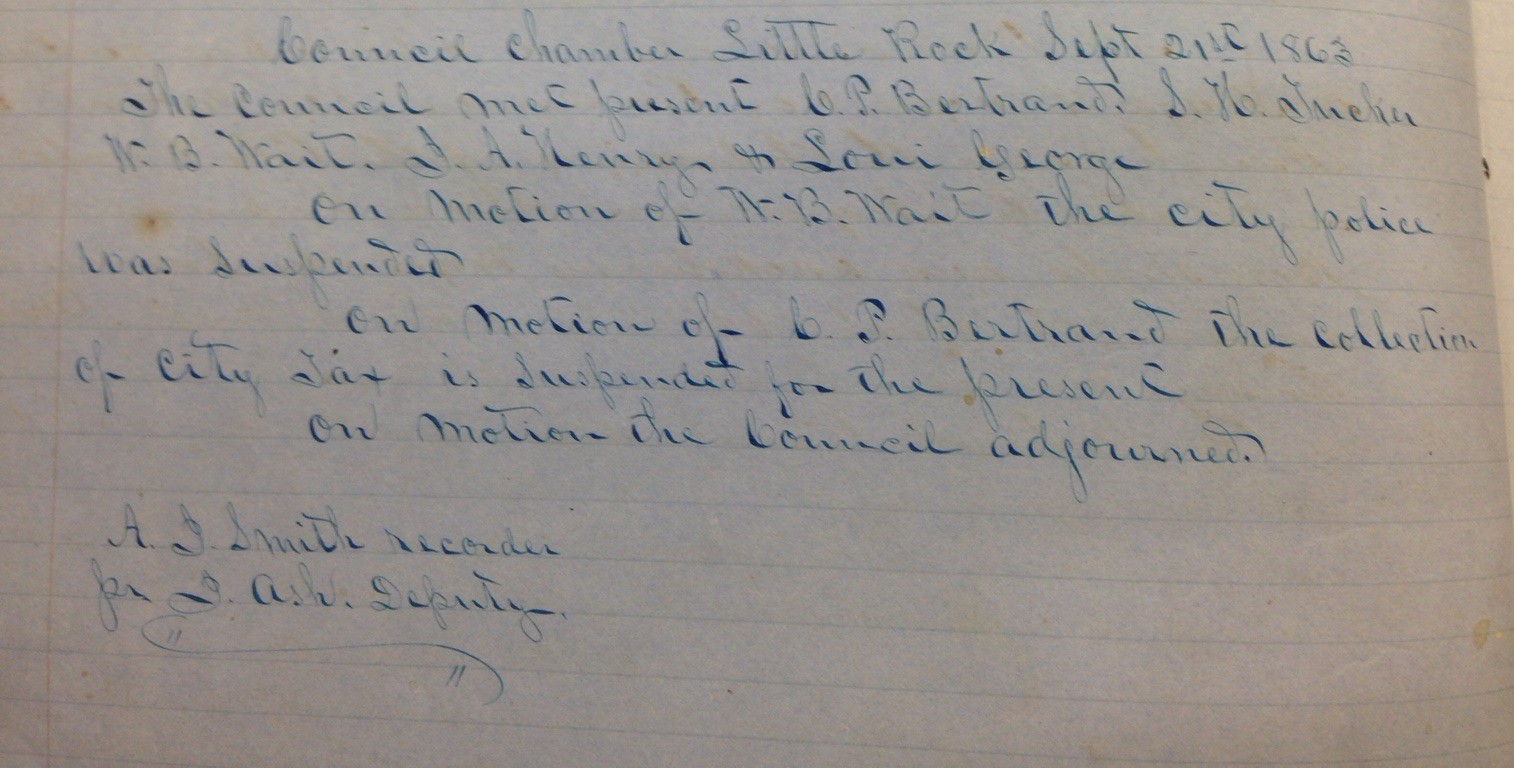
LR1863 minutes of closureFollowing the Battle of Little Rock, the City of Little Rock ceased operations on September 21, 1863.

Planning for this had started in August, which would suggest that civic leaders were none too confident in the ability of Confederate forces to hold on to the city.  At the August 24, 1863, City Council meeting it was reported that the City’s funds (presumably Confederate) had been “placed in the hands of a reliable party who is well known to the Council.”  The identity of this “reliable party” has never been disclosed.

On September 21, the Council met and took three votes.  The first was to suspend the operation of City police (which at the time was not an official police force, it was a constable and some volunteers). The second was to suspend the collection of City taxes.  The final vote was to adjourn.

There is no record of Mayor William Ashley being present at this meeting.  Recorder A. J. Smith (the equivalent of City Clerk today) was not present.  The minutes were signed by “J. Ash, Deputy.” Records do not indicate if that gentleman was officially Deputy Recorder or if he had simply been deputized to take minutes at the meeting.  The five City Council members present were C. P. Bertrand (a former mayor and step-son of Little Rock’s first Mayor, Matthew Cunningham), S. H. Tucker, W. B. Walt, I. A. Henry (would would also serve on the first City Council after the war in 1866), and Lou George.